
Frameworks
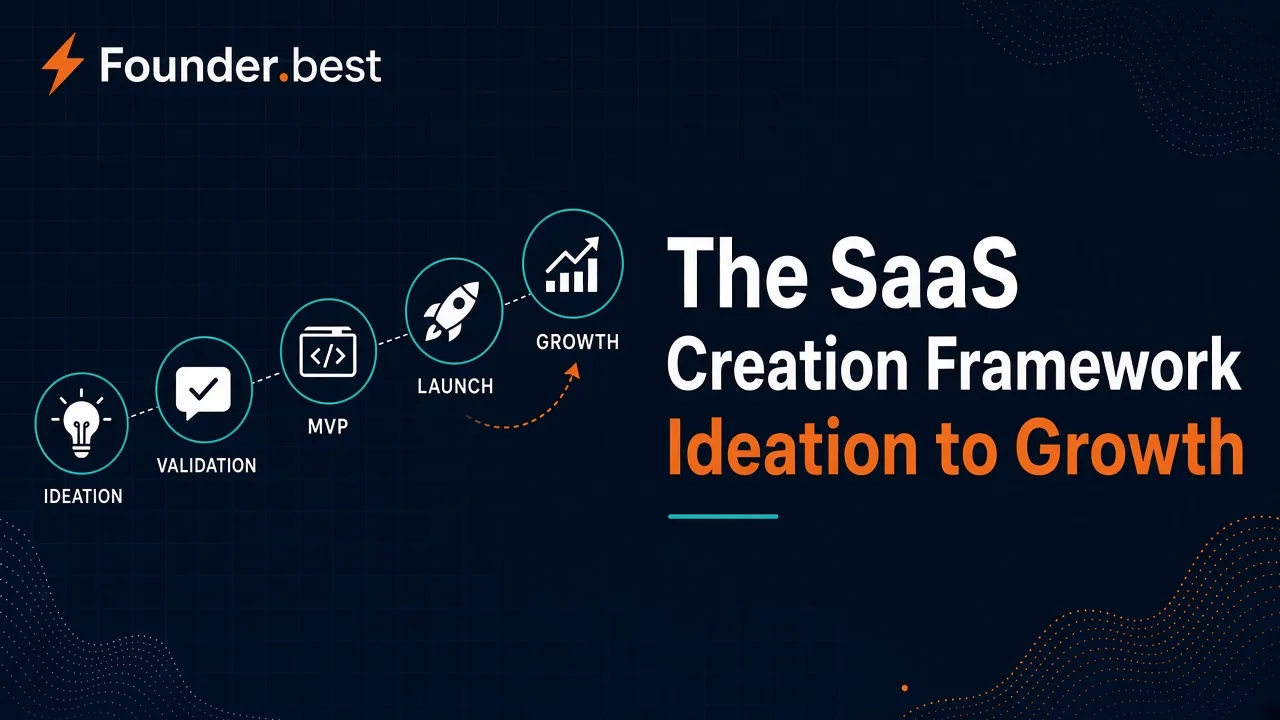
The SaaS creation framework: from ideation to validation, MVP, launch, and growth
Building a SaaS is more than writing code. This framework walks you through the five stages, from ideation and validation to MVP, launch, and growth, plus the feedback loops that send you back when the evidence says so.

Post by Anuj Shashimal
Founder, Founder.best22 min read
You have an idea. You open Cursor. You start building.
Three months later, you have a beautiful SaaS with clean code, a slick dashboard, dark mode, and Stripe wired up. And nobody is using it.
This is the most common story in SaaS, and it is rarely about bad code. AI coding tools have made building faster than ever, which makes it easier than ever to build the wrong thing. The bottleneck is no longer "can I build this?" It is "should I build this, for whom, and how will they find it?"
That is what a SaaS creation framework is for. It gives you a sequence of questions to answer before you spend more time and money, so you only build what someone actually needs.
This guide covers the full framework, stage by stage, with checklists, examples, metrics, and the mistakes that sink most early products. It is written for indie founders, technical founders, and small teams building their first or next SaaS.
Why most SaaS products struggle (and why the order matters)
- 35%
- of failed startups cited 'no market need' as a reason, the problem validation is designed to catch
- 38%
- ran out of cash or failed to raise, often after spending months building before learning
- 19%
- cited a flawed business model, such as pricing that could never cover acquisition costs
- 80%
- of features in the average software product are rarely or never used, according to Pendo's feature adoption research
What is the SaaS creation framework?
The SaaS creation framework is a five-stage process for turning an idea into a working software business:
- Ideation: find a specific problem worth solving
- Validation: prove that people actually want it
- MVP: build the smallest useful product
- Launch: get it in front of real users
- Growth: turn initial traction into a system
Each stage has one main question to answer and a clear exit question. You move forward when you have evidence, not when you feel ready.
There is one important caveat: this is not a strict, one-way sequence. After launch, you might discover your original assumption was wrong and go back to validation. After watching users in your MVP, you might cut half your features. That is normal. Product development is iterative, and the framework works best as a loop.
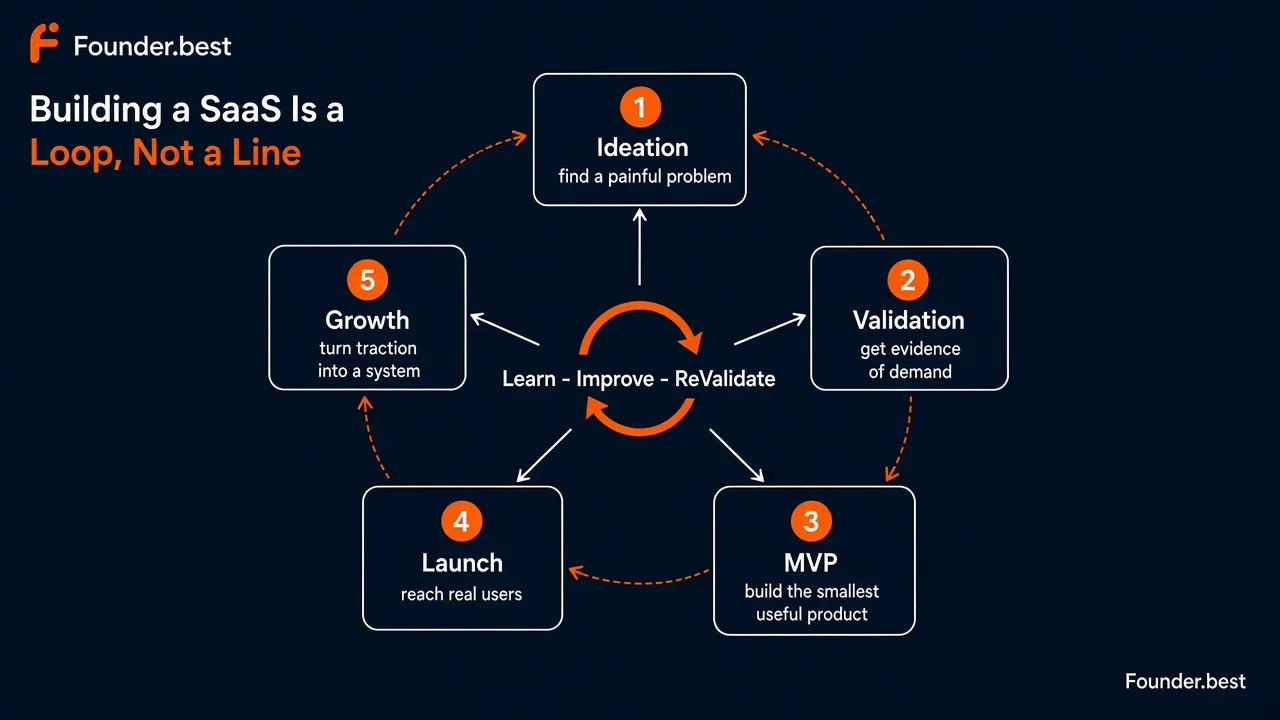 Building a SaaS is a loop, not a line - ideation, validation, MVP, launch, and growth connected by feedback loops
The 5 stages of building a SaaS at a glance
Before going deep on each stage, here is the whole framework on one page:
| Stage | Main question | You are ready to move on when... |
|---|---|---|
| 1. Ideation | Is this a real problem worth solving? | You can say who has the problem, what it is, and why they would pay |
| 2. Validation | Do people actually want this? | You have behavioral evidence such as signups, commitments, or payments |
| 3. MVP | Does the solution work? | Real users reach the core outcome without your help |
| 4. Launch | Can we get users? | A repeatable stream of signups and some users who come back |
| 5. Growth | Can this become a business? | Revenue grows predictably and customers stay |
Now let's go through each stage.
Stage 1: Ideation - find a problem worth solving
Goal: find a specific problem experienced by a specific group of people.
The trap at this stage is starting with a solution or a technology. Don't start with:
"I want to build an AI SaaS."
Start with:
"Freelance designers struggle to collect payments from clients."
The first sentence tells you nothing about who to talk to, what to build, or how to sell it. The second gives you all three: a customer (freelance designers), a pain (late or missing payments), and an obvious starting point for research.
Find problems, not features
Features are what you build. Problems are what people pay to make go away. Train yourself to notice problems:
- Tasks people do repeatedly and complain about
- Workflows held together with spreadsheets, copy-paste, and reminders
- Jobs people pay a freelancer or assistant to do manually
- Tools people use but openly hate
- Problems in your own work or industry that you understand deeply
The best SaaS ideas often come from an unglamorous workflow you know better than most people.
Identify your target customer
"Small businesses" is not a customer. "Marketing agencies with 5 to 20 employees that manage paid ads for local businesses" is. The narrower your first customer, the easier everything gets: finding people to interview, writing your landing page, choosing launch channels, and building the right features.
You can widen your market later. You cannot easily validate a product for "everyone".
Look for painful, repeated problems
Not every problem deserves a SaaS. Look for problems that are:
- Frequent: they happen weekly or daily, not once a year
- Painful: they cost real time, money, stress, or reputation
- Growing: more people face them each year
- Owned: a specific person is responsible for solving them and feels the pain
A problem that is frequent and painful for someone who controls a budget is the best starting point.
Search where people complain
People describe their problems in public every day. Spend a few hours reading:
- Reddit threads in niche subreddits ("how do you handle...", "is there a tool for...")
- Communities like Indie Hackers, Slack groups, Discord servers, and industry forums
- Reviews of existing tools on G2, Capterra, and app marketplaces, especially 2 and 3 star reviews
- X and LinkedIn posts where people vent about their workflow
- Job posts that describe tedious tasks someone is hired to do manually
Copy the exact phrases people use. They will become your interview questions, your landing page copy, and your SEO keywords.
Study existing solutions
Competitors are good news. They prove people spend money on the problem. Look at:
- What they charge and who they target
- What their unhappy customers complain about
- Which customer segments they ignore or serve badly
- How people solve the problem without any tool: spreadsheets, agencies, or doing nothing
"Doing nothing" is your biggest competitor. If people tolerate the problem easily, they won't pay to fix it.
Decide whether it is worth paying to solve
Use this simple framework to pressure-test an idea:
The ideation filter
- 1. Problemwhat specific, repeated task or pain exists?
- 2. Audiencewho exactly has it, and can you reach them?
- 3. Existing alternativeshow do they solve it today, and what do they spend?
- 4. Painhow much time, money, or stress does it cost them?
- 5. Willingness to paywould fixing it be worth real money to them?
Example: narrowing an idea
Instead of:
An AI project management platform.
Narrow it down to:
A project management tool that automatically turns client emails into tasks for small agencies.
The narrow version is far easier to validate. You know who to talk to (small agency owners and project managers), what to test (do client emails really become messy, lost tasks?), and what the first version needs to do.
Exit question
Can you clearly explain who has the problem, what the problem is, and why they would pay to solve it?
If you can't write that in two sentences, stay in ideation a little longer.
Stage 2: Validation - prove people actually want it
Validation is the stage most founders skip, because building feels productive and talking to strangers feels uncomfortable. It is also the stage that saves the most time.
The purpose of validation isn't to prove that everyone wants your product. It is to gather evidence that a specific group has the problem and cares enough to act.
We have a full step-by-step guide on how to validate SaaS ideas before you build. Here is the framework view.
Compliments are not validation
This is the most important idea in this stage:
Compliment ≠ validation
Someone saying "That's a cool idea!" tells you almost nothing. People are polite, and saying nice things costs them nothing.
Someone saying "Can I pay for this?" or "When can I start using it?" is much stronger evidence. So is someone who gives you an hour of their time, introduces you to a colleague, or puts down a deposit.
The rule is simple: the more an action costs someone, the more it tells you.
How strong is your validation evidence?
- Paid pilot or pre-order100/100
- Signed letter of intent or deposit85/100
- Introduced you to their boss or team65/100
- Booked a second call to see a demo55/100
- Joined waitlist and described their use case40/100
- Email signup on a landing page25/100
- Liked or shared your post10/100
- Said 'cool idea'5/100
Validation methods
Pick the methods that fit your product and audience. You don't need all of them.
| Method | What it tests | Good for |
|---|---|---|
| Customer interviews | Is the problem real, frequent, and painful? | Every SaaS. Start here. |
| Landing page test | Does the value proposition make people sign up? | Testing messaging and demand |
| Waitlist | How many people want early access, and why? | Building a launch audience |
| Pre-orders | Will people pay before it exists? | Clear, well-understood problems |
| Paid pilots | Will a business pay to try it with real data? | B2B products with higher prices |
| Concierge MVP | Can you deliver the outcome by hand? | Testing value before building |
| Manual service delivery | Will people pay for the result itself? | Workflows you can do yourself at first |
| Competitor research | Is there proven spending in the category? | Spotting gaps and pricing |
| Search demand | Are people actively looking for a solution? | SEO-led products and positioning |
| Community conversations | How do people talk about the problem? | Language, objections, and channels |
Customer interviews
Talk to 10 to 20 people who have the problem. Don't pitch. Ask about their past behavior:
- "Walk me through the last time this happened."
- "What did you do about it?"
- "What have you tried? What did it cost?"
- "What's the hardest part?"
Past behavior is reliable. Hypothetical answers ("Would you use a tool that...?") are not. If you hear the same pain described in similar words five or more times, you are onto something.
Landing pages and waitlists
A simple landing page with a headline, the problem, how it will work, and an email signup tests whether your message resonates. Add one question to the signup form, such as "What's your biggest challenge with X?", to separate curious visitors from people with real pain.
If you don't have customers yet, our guide on what to put on a SaaS landing page before you have customers walks through every section.
Pre-orders, paid pilots, and concierge MVPs
The strongest validation involves money:
- Pre-orders: offer a discounted founding-member price before launch
- Paid pilots: charge a business to try the product with their real data for 30 to 90 days
- Concierge MVP: deliver the outcome yourself, by hand, behind a simple interface or even email, and charge for it
A concierge MVP is underrated. If you can't get people to pay for the result when you do it by hand, software won't fix that.
Include a validation checklist
Before you move to the MVP stage, check that you can tick most of these:
 Copyable checklist
SaaS validation checklist
☐ Defined a specific target customer
☐ Identified a painful, repeated problem
☐ Talked to at least 10 potential users about the problem
☐ Studied existing alternatives, including "doing nothing"
☐ Created a landing page with one clear value proposition
☐ Collected early interest such as signups or a waitlist
☐ Tested willingness to pay with pre-orders, deposits, or pilots
☐ Identified the single most important use case
Exit question
What evidence do you have that someone actually wants this?
If the honest answer is "people said it sounds great", you are not done. If the answer is "12 people joined the waitlist with detailed use cases and 3 paid for a pilot", you are ready to build.
Stage 3: MVP - build the smallest useful product
This is where technical founders feel at home, and where the biggest mistake happens:
Building the full product before learning what users actually need.
An MVP (minimum viable product) isn't a bad or broken version of your final product. It is the smallest version that delivers the core outcome. It should do one job, and do it well enough that a real user would choose it over their current workaround.
The goal of an MVP is learning. It is a testable version of your product that shows whether your solution works before you commit to building everything else.
Don't build everything at once
Here is what founders often put in version one:
- A dashboard with 12 charts
- A mobile app
- 20 integrations
- An AI assistant
- Advanced analytics
- Team permissions
- Custom reports
- 15 pricing plans
Instead, aim for this:
One user → one important action → one valuable outcome.
For the agency email-to-tasks example, that might be: an agency project manager forwards a client email, and a clean task with the deadline and client name appears in their task list. That's it. If that one workflow saves them time every day, you have something. If it doesn't, no dashboard will save it.
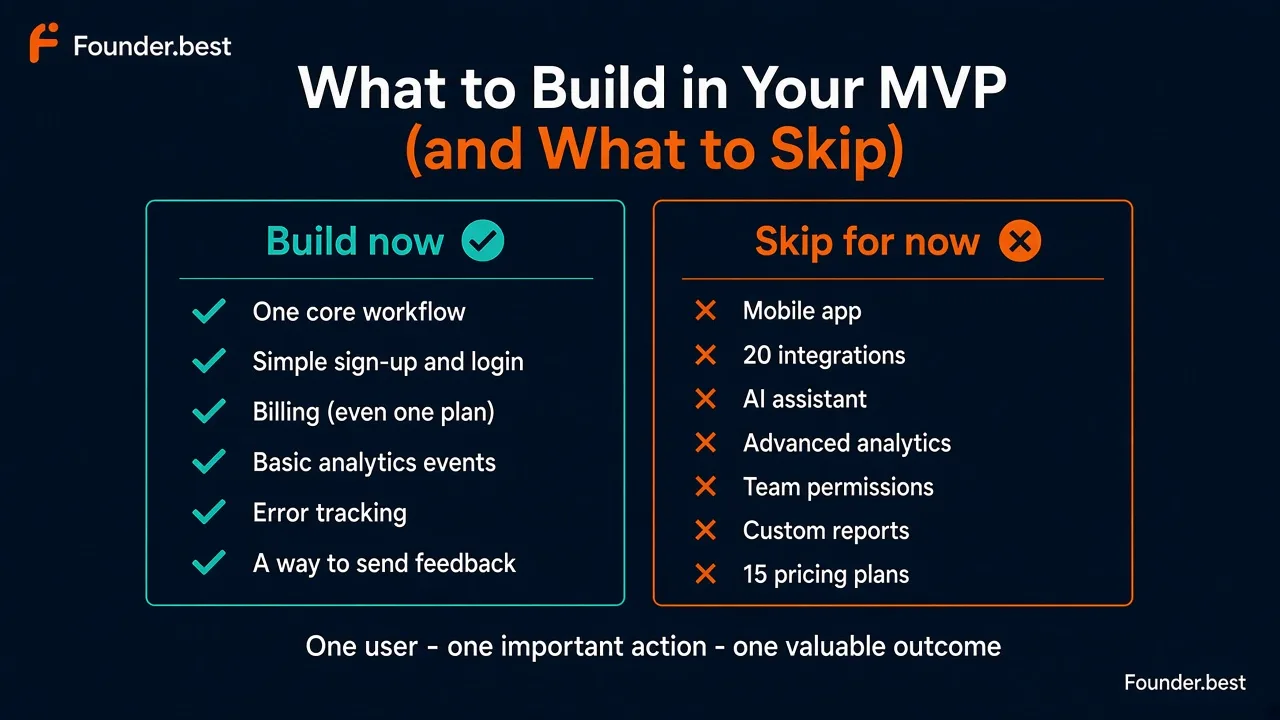 What to build in your MVP and what to skip - core workflow, auth, billing, analytics, error tracking, and feedback versus mobile app, integrations, AI assistant, and complex pricing
Define the core workflow
Write down the shortest path from sign-up to the "aha moment", the first time a user gets real value. For example:
- Sign up with Google
- Connect inbox
- Forward one client email
- See the task created automatically
Every screen and feature in your MVP should either support that path or be cut. If a step isn't on the path, it probably isn't in the MVP.
Prioritize features ruthlessly
A simple way to decide what makes the cut: score each feature on impact on the core outcome and effort to build.
- High impact, low effort: build now
- High impact, high effort: build a simpler version, or do it manually at first
- Low impact, low effort: maybe later
- Low impact, high effort: don't build it
When in doubt, leave it out. You can always add a feature users ask for. Removing a feature people depend on is much harder.
The technical basics an MVP still needs
Small doesn't mean sloppy. A real SaaS MVP still needs a few foundations:
| Area | What the MVP needs | What can wait |
|---|---|---|
| UI/UX | Clean, simple screens for the core workflow | Custom design system, animations, themes |
| Tech stack | Tools you already know and can ship fast with | Microservices, rewrites, "scalable" architecture |
| Database | A managed database with backups | Sharding, multi-region, complex caching |
| Authentication | Email or Google sign-in via a proven provider | SSO, SAML, granular roles |
| Billing | One or two plans through a provider like Stripe | Usage-based pricing, coupons, invoicing |
| Analytics | Events for sign-up, activation, and key actions | Full BI dashboards |
| Error handling | Error tracking and friendly error messages | Advanced observability |
| Basic security | HTTPS, hashed secrets, access checks, dependency updates | Formal audits and certifications, unless buyers require them |
| Deployment | One-click deploys to a managed host | Custom infrastructure |
| Feedback collection | An in-app feedback link, email, or chat | Formal research programs |
Billing deserves a special mention. Many founders delay it "until the product is ready". Charging early is one of the best validation signals you can get, and it forces you to answer pricing questions you would otherwise avoid.
What NOT to build in your MVP
If you remember one list from this section, make it this one:
- A mobile app unless your core workflow only makes sense on a phone
- Many integrations. Start with the one or two your first users actually need.
- An AI assistant bolted on because it's trendy, unless AI is the core outcome
- Advanced analytics and reporting for users who haven't reached the first outcome yet
- Team permissions and roles before you have teams asking for them
- Custom reports and exports that only one prospect requested
- Complex pricing with many tiers, add-ons, and annual discounts
- An admin panel you could replace with direct database access for now
- Settings for everything. Pick sensible defaults instead.
- "Scalable" infrastructure for traffic you don't have yet
Exit question
Do real users reach the core outcome on their own, and do some of them come back?
If people sign up but never reach the aha moment, fix onboarding or the workflow before launching widely.
Stage 4: Launch - get the product in front of real users
Here is an uncomfortable truth: building ≠ launching.
A product sitting on a Vercel URL that only your friends know about isn't launched. Launch means deliberately putting your product in front of the people who have the problem, and making it easy for them to try it.
Launch also isn't a single day. The best launches are a series of pushes across a few channels, followed by steady, ongoing visibility.
Pre-launch checklist
Before you announce anything, make sure the basics are ready:
- Landing page that explains the product in a few seconds
- Clear value proposition: who it's for and what outcome they get
- Pricing, or at least a clear note on how pricing will work
- Demo: a short video or interactive walkthrough
- Product screenshots of the real UI
- Analytics tracking visits, signups, and activation
- Onboarding that gets new users to the aha moment fast
- Email capture for people who aren't ready to sign up yet
- Support channel: email, chat, or a community
- Testimonials, if you have them from beta users
- Launch announcement written for each channel you'll use
Our SaaS launch checklist goes deeper, and the free launch checklist tool lets you tick it off as you go. If you still need a name or a one-liner, try the startup name generator and tagline generator.
Launch channels
There are more launch channels than any founder can use well. The guiding principle:
Go where your target customers already spend time.
You don't need to launch everywhere. Two or three channels done properly beat ten done halfway.
| Channel | Best for | Watch out for |
|---|---|---|
| Product Hunt | Launch-day visibility with a tech-savvy audience | A one-day spike that fades fast, and an audience that may not be your buyers |
| Founder.best | Ongoing discovery, a permanent product page, backlinks, and founder visibility | It works best alongside channels that reach your specific niche |
| Problem-focused discussions in niche communities | Self-promotion rules. Lead with value and follow each subreddit's rules. | |
| X | Building in public and reaching a founder audience | Needs an existing audience or consistent posting over time |
| B2B and professional audiences | Works best with a personal story, not a product announcement | |
| Indie Hackers | Feedback and support from other founders | Founders are often peers, not customers |
| Niche communities | Reaching a specific industry or role | Earn trust before sharing your product |
| Direct outreach | Finding your first 10 to 50 targeted customers | Doesn't scale, which is fine at this stage |
| SEO | Compounding organic discovery over months | Slow to start. Begin early. |
| Newsletters | Reaching an engaged, curated audience | Pick newsletters your buyers actually read |
| Partnerships | Reaching another product's existing users | Needs a clear win for both sides |
For a wider list, see our roundup of the best websites to launch a SaaS, and our guide to Product Hunt launch strategies.
Where Founder.best fits
Many launch platforms give you one day of attention and then bury your product. Founder.best is built for founders who want ongoing visibility rather than a single launch day:
- Launch to founders and early adopters, and collect upvotes, comments, and feedback
- Get a permanent, indexable product page that keeps working for search and AI discovery after launch week
- Earn a backlink to your site, dofollow immediately on paid plans and from launch week on free launches
- Link your product to your founder profile, so people can see who's building it
- Compete for the weekly winners and use the badge as honest social proof
There's a free launch option, and paid plans add instant go-live and more visibility. It works best as one part of a launch plan that also reaches your niche directly.
Traffic is not traction
This is the most important distinction at launch. A launch can bring thousands of visitors and still teach you nothing if they don't sign up, activate, or come back.
Measure the whole path:
From launch traffic to real traction
- 1. Visitorspeople who land on your site
- 2. Signupsvisitors who create an account
- 3. Activated userssignups who reach the aha moment
- 4. Returning usersactivated users who come back on their own
- 5. Paying customersusers who convert to a paid plan
- 6. Retained customerscustomers who keep paying month after month
When you look at your launch results, find the stage with the biggest drop. That is your next priority, whether it's your landing page, your onboarding, or the core product.
If traffic arrived but signups didn't, our post on why you got no signups after launch covers the usual causes.
Exit question
Can you get a steady stream of the right users, and do some of them stick around?
Stage 5: Growth - turn initial traction into a system
Growth isn't "get more users". It is building a repeatable system where you know where customers come from, why they stay, and how revenue grows. Founders who push growth before the product delivers value just fill a leaky bucket faster.
A simple way to structure growth is to work through five areas in order.
Acquisition: where are users coming from?
Find the one or two channels that bring your best customers, then double down:
- SEO: feature, integration, comparison, and use-case pages that rank for buyer searches. See our SEO strategy for startups.
- Content: guides and posts that answer your audience's questions
- Social: consistent posting on the platform your buyers use
- Communities: being genuinely helpful where your audience gathers
- Partnerships: integrations, co-marketing, and affiliates
- Paid acquisition: ads, once you know your numbers can support them
- Referrals: rewarding happy customers for bringing others
- Outbound: targeted emails and messages to well-defined prospects
Track signups and paying customers by channel. A channel that brings 200 visitors and 10 customers is worth more than one that brings 10,000 visitors and none.
Activation: do new users reach the aha moment?
Activation is the share of new signups who reach the first real outcome. It is often the cheapest place to grow, because you've already paid to get those users. Shorten the path to value, remove setup steps, add templates or sample data, and send a helpful email when someone gets stuck.
Retention: do they come back?
Retention is the clearest signal that your product delivers value. Look at cohorts: of the users who signed up in a given week, how many are still active after 1, 4, and 12 weeks? If the curve keeps falling toward zero, more acquisition won't help. Go back to the product.
Revenue: do they pay?
Watch how many active users convert to paid, at what price, and on which plan. Test pricing deliberately. Most early SaaS products undercharge.
Expansion: can customers upgrade or buy more?
The best SaaS businesses grow revenue from existing customers through more seats, higher tiers, add-ons, or usage. Expansion means you can grow even with modest acquisition.
The basic SaaS metrics, explained simply
You don't need a finance degree. You need to understand a handful of numbers:
| Metric | What it means | Simple way to calculate it |
|---|---|---|
| MRR (monthly recurring revenue) | Predictable revenue you earn every month from subscriptions | Sum of all active monthly subscription payments |
| ARR (annual recurring revenue) | The yearly version of MRR | MRR × 12 |
| CAC (customer acquisition cost) | What it costs to win one new customer | Sales and marketing spend ÷ new customers in that period |
| LTV (customer lifetime value) | How much revenue a customer brings over their whole time with you | Average revenue per customer per month ÷ monthly churn rate |
| Churn | The share of customers or revenue you lose each month | Customers lost this month ÷ customers at the start of the month |
| Activation rate | The share of signups who reach the aha moment | Activated users ÷ signups |
| Retention | The share of users or customers still active after a set time | Active users from a cohort after N weeks ÷ cohort size |
| Conversion rate | The share of people who take the next step | For example, paid customers ÷ trial users |
A common rule of thumb is to aim for LTV of at least three times CAC, but treat any benchmark as a rough guide rather than a target. Healthy numbers vary a lot by price point, market, and sales model.
Exit question
Is growth repeatable, and is it profitable enough to keep investing in?
There is no final exit from growth. It is where the loop starts again.
The SaaS feedback loop
Most frameworks present the stages as a straight line:
Ideation → Validation → MVP → Launch → Growth → Done
Real SaaS products don't work like that. Each stage produces evidence, and that evidence often sends you back:
Ideation → Validation → MVP → Launch → Growth → Learn → Improve → Revalidate
Here's what that looks like in practice:
| What you observe | What it usually means | Where to go back to |
|---|---|---|
| Validation fails: no one commits | Wrong problem or wrong audience | Ideation. Change the problem or narrow the audience. |
| MVP users ignore a feature | It isn't part of the core value | MVP. Remove it. |
| Users love one workflow | You found the real product | MVP. Make that workflow better and cut the rest. |
| Launch gets traffic but no signups | Unclear positioning or a weak landing page | Validation. Fix the message and value proposition. |
| Signups are high but retention is poor | The product doesn't deliver enough value | MVP or validation. Investigate why users leave. |
| Customers churn after a few months | Value fades, or the wrong customers signed up | Validation. Re-check who the product is really for. |
| Growth stalls on one channel | The channel is saturated | Growth. Test a new acquisition channel. |
This is why SaaS is a learning loop, not a checklist. Going back a stage isn't failure. It is the framework doing its job, and it is much cheaper than pushing forward on bad assumptions.
What to measure at each stage
Each stage asks a different question, so it needs different metrics. Measuring MRR during ideation makes no sense. Measuring only signups during growth hides churn.
| Stage | Main question | What to measure |
|---|---|---|
| Ideation | Is this a real problem? | Problem frequency, audience size, existing alternatives, current spending |
| Validation | Do people want this? | Interviews completed, repeated pain points, signups, replies, commitments, pre-orders |
| MVP | Does the solution work? | Activation rate, time to value, usage of the core workflow, qualitative feedback |
| Launch | Can we acquire users? | Visitors by channel, signup rate, activation rate, early retention |
| Growth | Can this become a business? | MRR, churn, retention cohorts, CAC, LTV, expansion revenue |
You'll notice there are no magic numbers in this table, like "you need exactly 50 signups". That's deliberate. SaaS businesses vary enormously. A $5 per month consumer tool and a $2,000 per month B2B platform need completely different volumes. Even published frameworks use different thresholds and definitions. Compare yourself against your own earlier results and your specific market, not a universal benchmark.
Common SaaS mistakes (and how to avoid them)
Most failed SaaS products make the same handful of mistakes. Here are the ten we see most often.
Mistake #1: Building before validating
Months of coding go into a product based on an untested assumption. Fix: talk to 10 customers and get at least some behavioral commitment before writing serious code.
Mistake #2: Building too many features
The MVP becomes a "minimum everything product", and the core value gets lost in a crowded interface. Fix: define one core workflow and cut everything that doesn't support it.
Mistake #3: Trying to serve everyone
"It's for any business that..." makes your positioning vague and your marketing expensive. Fix: pick one narrow customer first. You can expand once you win them.
Mistake #4: Treating launch as the finish line
Founders celebrate launch day, then stop marketing when the spike fades. Fix: treat launch as the start of distribution. Plan what you'll do in weeks 2 to 12.
Mistake #5: Measuring traffic instead of retention
A launch with 5,000 visitors feels like success, even if nobody comes back. Fix: track activation and retention cohorts from day one.
Mistake #6: Waiting for the "perfect" product
Polishing in private feels safe, but every week without users is a week without learning. Fix: ship when the core workflow reliably delivers the outcome, even if everything else is rough.
Mistake #7: Ignoring distribution
"If I build it, they will come" is still the most expensive belief in SaaS. Fix: decide how customers will find you during ideation, not after launch. Start SEO and community presence early.
Mistake #8: Adding growth before finding product value
Spending on ads or growth hacks while users churn fills a leaky bucket. Fix: get retention stable for a core group of users before pouring money into acquisition.
Mistake #9: Ignoring customer feedback
Founders build their own roadmap and treat feedback as noise. Fix: talk to users every week, look for patterns, and pay closest attention to your most engaged customers.
Mistake #10: Never going back to an earlier stage
Founders keep pushing forward on a wrong assumption because going back feels like failure. Fix: let the evidence decide. Revisiting validation after a weak launch is the framework working.
The complete SaaS creation checklist
Work through this checklist at each stage. You don't need to tick every box before moving on, but every unchecked box is a risk you're choosing to take.
Copyable checklistThe complete SaaS creation checklist
Ideation
☐ Problem identified, written in one sentence
☐ Target customer defined narrowly
☐ Existing alternatives researched, including "doing nothing"
☐ Problem appears painful and frequent enough to pay to solve
Validation
☐ Talked to at least 10 potential customers
☐ Tested the value proposition on a landing page
☐ Created a landing page with email capture or a waitlist
☐ Tested demand with signups, replies, or community responses
☐ Tested willingness to pay with pre-orders, deposits, or pilots
MVP
☐ Core workflow defined from sign-up to the aha moment
☐ Features prioritized, and non-essential ones cut
☐ MVP built with auth, billing, error tracking, and basic security
☐ Analytics installed for signup, activation, and key actions
☐ First users onboarded and observed
Launch
☐ Landing page ready with value proposition, screenshots, and demo
☐ Pricing ready
☐ Onboarding ready and tested with a new user
☐ Support channel ready
☐ 2 to 3 launch channels selected where customers already spend time
☐ Feedback system ready
Growth
☐ Main acquisition channel identified
☐ Activation rate measured
☐ Retention cohorts measured
☐ Churn measured
☐ Revenue tracked: MRR, conversion, and expansion
☐ Growth experiments running, one at a time
Final thoughts
The SaaS creation framework isn't about slowing you down. It is about making sure the time you spend building goes into something people want, and that they can actually find.
Ideation gives you a problem worth solving. Validation gives you evidence. The MVP gives you a product that delivers one outcome well. Launch gives you real users. Growth turns them into a business. And the feedback loop keeps you honest at every stage.
If you are at the launch stage, or getting close, launch your SaaS on Founder.best. You'll get a permanent product page, feedback from founders and early adopters, and visibility that lasts beyond launch day.
Related guides: How to validate SaaS ideas · SaaS landing page before customers · SaaS launch checklist · Best websites to launch a SaaS · B2B SaaS product marketing · SEO strategy for startups
Key takeaways
- The SaaS creation framework has five stages: ideation, validation, MVP, launch, and growth. Each one answers a different question before you spend more time and money.
- Start with a specific problem for a specific person, not a technology. "AI SaaS" is not an idea. "Freelance designers struggle to collect payments" is.
- A compliment is not validation. Look for behavior that costs people something: time on a call, an email address with a real use case, a deposit, or a paid pilot.
- An MVP is the smallest product that delivers the core outcome, not a bad version of the full product. One user, one important action, one valuable outcome.
- Building is not launching, and traffic is not traction. Measure the full path from visitors to signups, activation, retention, and revenue.
- The framework is a loop. Poor retention, weak signups, or failed validation are signals to go back a stage, not proof that you failed.
Frequently asked questions
What are the stages of creating a SaaS?
Most SaaS products go through five stages. Ideation finds a specific problem worth solving. Validation collects evidence that people want it. The MVP stage builds the smallest useful version. Launch puts it in front of real users. Growth turns early traction into a repeatable business. The stages are iterative, so you will often loop back to validation or the MVP after you learn something new.
How do you validate a SaaS idea?
Talk to 10 to 20 people in your target audience about how they handle the problem today, without pitching. Then test demand with a landing page and waitlist, and test willingness to pay with pre-orders, deposits, or paid pilots. Strong validation is behavioral: people give you time, data, or money. Compliments like "cool idea" are weak evidence.
What should a SaaS MVP include?
A SaaS MVP should include one core workflow that delivers the main outcome, simple authentication, a way to pay if you are testing pricing, basic analytics to see whether people activate, error tracking, basic security, and an easy way for users to send feedback. Mobile apps, many integrations, team permissions, advanced analytics, and complex pricing can usually wait.
How do you launch a SaaS product?
Prepare a landing page with a clear value proposition, screenshots or a demo, pricing, onboarding, analytics, email capture, and a support channel. Then launch where your target customers already spend time, such as niche communities, launch platforms like Founder.best and Product Hunt, X, LinkedIn, newsletters, or direct outreach. Measure signups, activation, and retention, not only visitors.
How long does it take to build a SaaS?
It varies widely. As a rough guide, ideation and validation often take 2 to 8 weeks, and a focused MVP takes a solo technical founder about 4 to 12 weeks with modern tools. Launch prep takes 1 to 3 weeks. Reaching consistent growth usually takes many months to years. The biggest time saver is not coding faster but avoiding building features nobody needs.
What metrics should a SaaS startup track?
Track metrics that fit your stage. Early on, watch activation rate, retention, and qualitative feedback. Once people pay, add conversion rate, MRR, and churn. When you invest in acquisition, add CAC and LTV. Avoid judging an early product only by traffic or signups, because those can look great while retention shows the product is not delivering value.
What is the difference between an MVP and a full SaaS product?
An MVP is the smallest version of your product that delivers the core outcome to a specific user, built to learn whether the solution works. A full SaaS product adds breadth around that core, such as more workflows, integrations, team features, reporting, and polish, once you know which parts customers actually value. An MVP should still be reliable and usable for its one job.
Is the SaaS creation framework a linear process?
No. The stages are a useful order of operations, but in practice you loop back. Failed validation sends you back to ideation. Users ignoring your main feature sends you back to the MVP. Traffic without signups sends you back to positioning. Treat each stage's results as evidence and let them decide your next step.
Where does Founder.best fit in the SaaS creation framework?
Founder.best fits the launch and growth stages. It is a launch platform and directory where you can launch your SaaS to founders and early adopters, collect upvotes and feedback, and get a permanent, indexable product page with a backlink and a linked founder profile. That gives you ongoing visibility instead of a single launch day.

About the author
Anuj Shashimal
Founder, Founder.best
SaaS founder, indie hacker, and software engineer. Anuj built Founder.best to help indie founders launch, get discovered through search and AI answers, and turn launches into customers. He writes from first-hand experience growing Founder.best from zero to 400+ founders and 300+ launched products.
Tagged in
Browse all tagsKeep reading
Free tools and guides for this topic
Hand-picked from the tags on this post.
- Launch SaaS guideHow to launch a SaaS product in 2026: validation, launch platforms, SaaS launch checklist, SEO backlinks,…
- Free startup launch checklist30+ tasks across pre-launch, launch day, and post-launch.
- How Founder.best worksSubmit in 10 minutes, rank on the weekly Launchpad, stay discoverable.
- Indie launch guideLaunch guide for indie founders and bootstrapped makers in 2026. Build in public, pick platforms, earn…
- Free tools for foundersName generator, tagline writer, slug checker, DR checker, launch checklist.
- Startup launch statistics & researchOriginal launch data plus sourced figures on AI search and startup failure.
Ready to launch on Founder.best?
Weekly rankings, dofollow SEO backlinks, founder stories, and a community built for indie makers.
Submit your startup