Post-launch growth
AI tool post-launch strategy: the user onboarding sequence and SaaS product follow-up
Launch day gets your AI tool signups. A deliberate AI tool post-launch strategy - built on a user onboarding sequence and SaaS product follow-up - is what turns those signups into activated, paying users.

Post by Anuj Shashimal
Founder, Founder.best12 min read
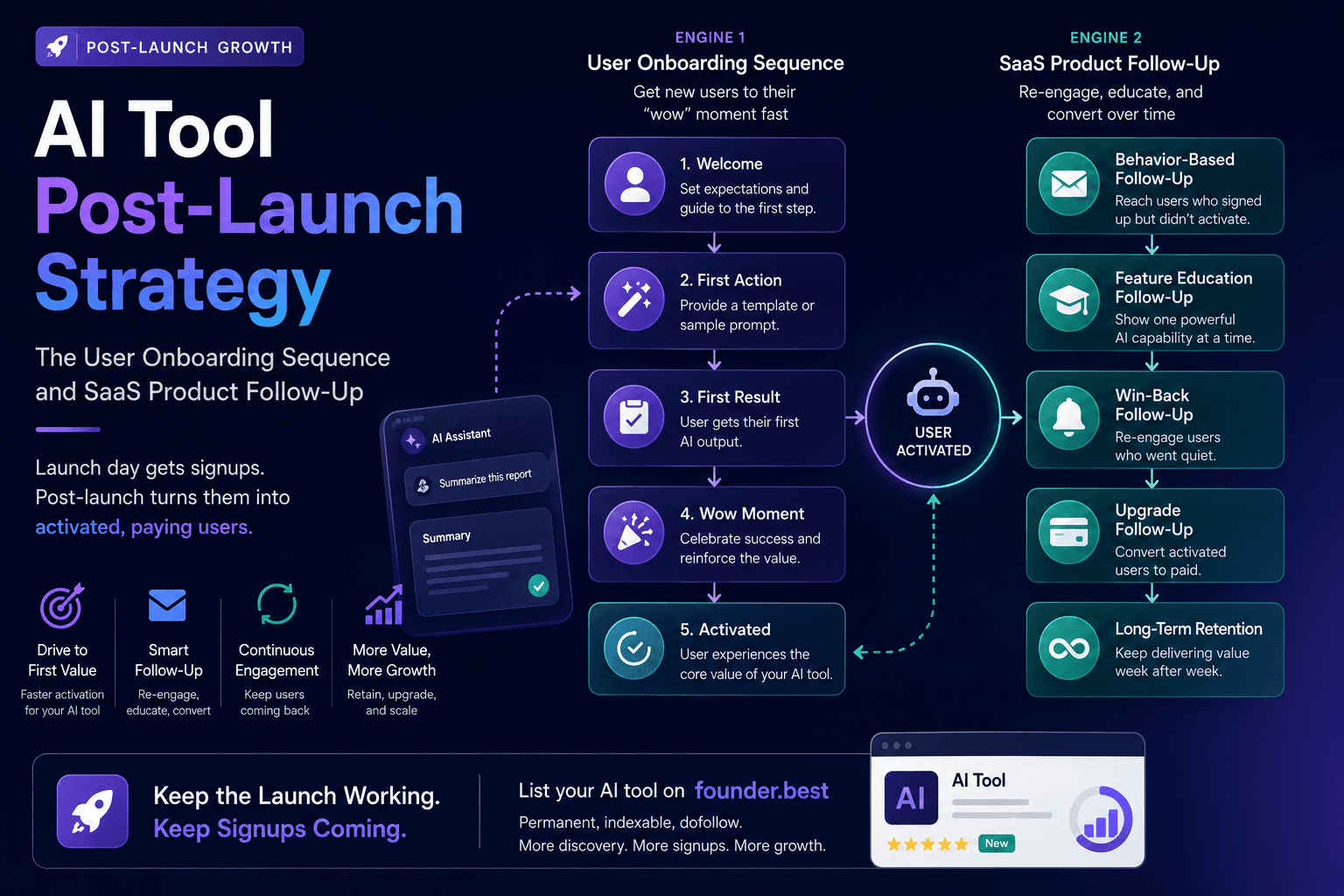
The launch spike for an AI tool is intoxicating - and misleading. A flood of signups feels like success, but without an AI tool post-launch strategy, most of those users never reach value and quietly churn. The real work of an AI launch starts the moment the traffic arrives. This guide lays out an AI tool post-launch strategy built on two connected engines: a user onboarding sequence that gets people to their first meaningful result quickly, and a SaaS product follow-up cadence that keeps re-engaging them until they are activated and retained. AI tools have a specific post-launch challenge: users need to experience the model's value fast, or they assume it does not work. So a great user onboarding sequence and disciplined SaaS product follow-up matter even more for an AI tool than for typical SaaS.
Why an AI tool post-launch strategy decides your outcome
For an AI tool, the post-launch strategy is the whole ballgame. Acquisition got users in the door, but activation and retention decide whether your AI tool becomes a business. Without a post-launch strategy, a launch spike is just an expensive way to inflate a churn chart. AI tools are especially unforgiving here. If a new user does not reach a clear 'the AI just did something useful' moment early, they conclude it is a gimmick and leave. That is why your user onboarding sequence and SaaS product follow-up are the core of any serious AI tool post-launch strategy.
- An AI tool post-launch strategy converts launch signups into activated, retained users.
- Without a post-launch strategy, a launch spike just accelerates churn.
- AI tools must reach a value moment fast, or users assume the tool does not work.
Define the activation moment for your AI tool
Before you build any user onboarding sequence, define the activation moment - the specific point where a new user experiences your AI tool's core value. Every part of your post-launch strategy points at getting users to that moment. For an AI tool, the activation moment is usually the first genuinely useful output: the first accurate summary, the first working generation, the first correct answer. Your entire onboarding sequence and product follow-up should be engineered to reach it fast.
- Name the single activation moment that proves your AI tool's value.
- Measure time-to-value: how long until a new user hits that moment?
- Design the onboarding sequence to shorten that time as much as possible.
Build the user onboarding sequence
The user onboarding sequence is the first engine of your AI tool post-launch strategy. Its job is singular: get the new user to the activation moment with as little friction as possible. A great onboarding sequence blends in-product guidance with a lifecycle email sequence. For an AI tool, the best onboarding sequences remove the blank-canvas problem - they give users a sample prompt, a template, or pre-filled input so the AI produces something impressive on the first try. Every message in the sequence should push toward that first useful result.
- Welcome message: set expectations and point straight at the first AI action.
- Kill the blank canvas: offer a sample prompt, template, or demo input in the onboarding sequence.
- Trigger onboarding emails off behavior - completed setup, first output, or a stall.
- Celebrate the activation moment when it happens - reinforce that the AI tool works.
- Keep the onboarding sequence short: each step should move users closer to value.
Build the SaaS product follow-up cadence
The second engine of your AI tool post-launch strategy is the SaaS product follow-up - the ongoing cadence that re-engages users after onboarding ends. Onboarding gets users to first value; product follow-up brings them back to habitual value. SaaS product follow-up is where most AI tools quit too early. They send a welcome sequence and go silent. A strong product follow-up cadence keeps surfacing new use cases, nudges dormant users, and converts free users to paid well past week one.
- Behavior-based follow-up: re-engage users who signed up but never activated.
- Feature-education follow-up: reveal a new AI capability each week to deepen usage.
- Win-back follow-up: reach out to users who went quiet after the launch.
- Upgrade follow-up: prompt activated free users toward paid at the right moment.
- Keep the SaaS product follow-up running for weeks - post-launch retention is a long game.
Connect onboarding and follow-up into one post-launch loop
The magic of an AI tool post-launch strategy is when the user onboarding sequence and the SaaS product follow-up become one continuous loop instead of two disconnected campaigns. Onboarding hands off cleanly to product follow-up, and both feed off the same activation data. Instrument the loop: track where users drop in the onboarding sequence, which follow-up messages re-activate them, and feed those learnings back into both engines. This closed loop is what makes an AI tool's post-launch strategy compound over time.
- Hand off from onboarding sequence to product follow-up at the activation moment.
- Use one source of truth for user state so onboarding and follow-up stay in sync.
- Continuously test and refine both the onboarding sequence and the follow-up cadence.
Keep the launch working with a permanent discovery surface
A post-launch strategy is not only about existing users - it is also about keeping new users flowing in after the launch spike. Your onboarding sequence and product follow-up only matter if signups keep arriving. That is where a permanent discovery surface fits your AI tool post-launch strategy. Founder.best gives your AI tool a permanent, indexable product page with a dofollow backlink and AI category pages, so people keep discovering your tool long after launch day - continuously feeding fresh signups into your onboarding sequence and SaaS product follow-up loop.
- List your AI tool on Founder.best for a permanent, dofollow, indexable page that keeps driving signups.
- Ship visible product updates so your listing stays fresh and re-enters discovery.
- Feed each new signup straight into your onboarding sequence and product follow-up loop.
Key takeaways
- An AI tool post-launch strategy runs on two engines: a user onboarding sequence and a SaaS product follow-up cadence.
- Define the activation moment first - the point where a user experiences your AI tool's core value.
- The onboarding sequence kills the blank canvas and drives users to first value fast.
- The SaaS product follow-up re-engages, educates, and converts users well past week one.
- A permanent surface like Founder.best keeps feeding new signups into your post-launch loop.
Frequently asked questions
What is an AI tool post-launch strategy?
An AI tool post-launch strategy is the plan for converting launch signups into activated, retained users. It centers on two engines: a user onboarding sequence that drives new users to first value, and a SaaS product follow-up cadence that re-engages and converts them over time.
What should a user onboarding sequence for an AI tool include?
A user onboarding sequence for an AI tool should include a welcome that points at the first AI action, sample prompts or templates to kill the blank-canvas problem, behavior-triggered emails, and a celebration of the activation moment. Every step should shorten time-to-value.
How is SaaS product follow-up different from onboarding?
Onboarding gets a user to first value; SaaS product follow-up brings them back to habitual value. Product follow-up is the ongoing cadence - behavior-based re-engagement, feature education, win-backs, and upgrade prompts - that runs for weeks after the onboarding sequence ends.
How does Founder.best support an AI tool's post-launch strategy?
Founder.best gives your AI tool a permanent, indexable product page with a dofollow backlink and AI category pages, so new users keep discovering it after launch day. That steady stream of signups continuously feeds your user onboarding sequence and SaaS product follow-up loop.

About the author
Anuj Shashimal
Founder, Founder.best
SaaS founder, indie hacker, and software engineer. Anuj built Founder.best to help indie founders launch, get discovered through search and AI answers, and turn launches into customers. He writes from first-hand experience growing Founder.best from zero to 400+ founders and 300+ launched products.
Tagged in
Browse all tagsKeep reading
Free tools and guides for this topic
Hand-picked from the tags on this post.
- How Founder.best worksSubmit in 10 minutes, rank on the weekly Launchpad, stay discoverable.
- Browse products by categorySaaS, AI, developer tools, marketing, and more.
- Free startup launch checklist30+ tasks across pre-launch, launch day, and post-launch.
- Docs: public API, MCP server & AI discoveryHow AI assistants and agents search and cite Founder.best listings.
- Free SaaS directories for backlinksList of free SaaS and startup directories with dofollow filters, Ahrefs DR scores, and a submission checklist.
- Free tools for foundersName generator, tagline writer, slug checker, DR checker, launch checklist.
Ready to launch on Founder.best?
Weekly rankings, dofollow SEO backlinks, founder stories, and a community built for indie makers.
Submit your startup