SEO for founders
How to get more reach for your startup: the 2026 playbook for indie founders
Reach is not one spike on Product Hunt. It is launch-week traffic, search rankings that compound, and brand mentions that make the next launch easier. Here is how bootstrapped founders stack all three in 2026.

Post by Anuj Shashimal
Founder, Founder.best14 min read
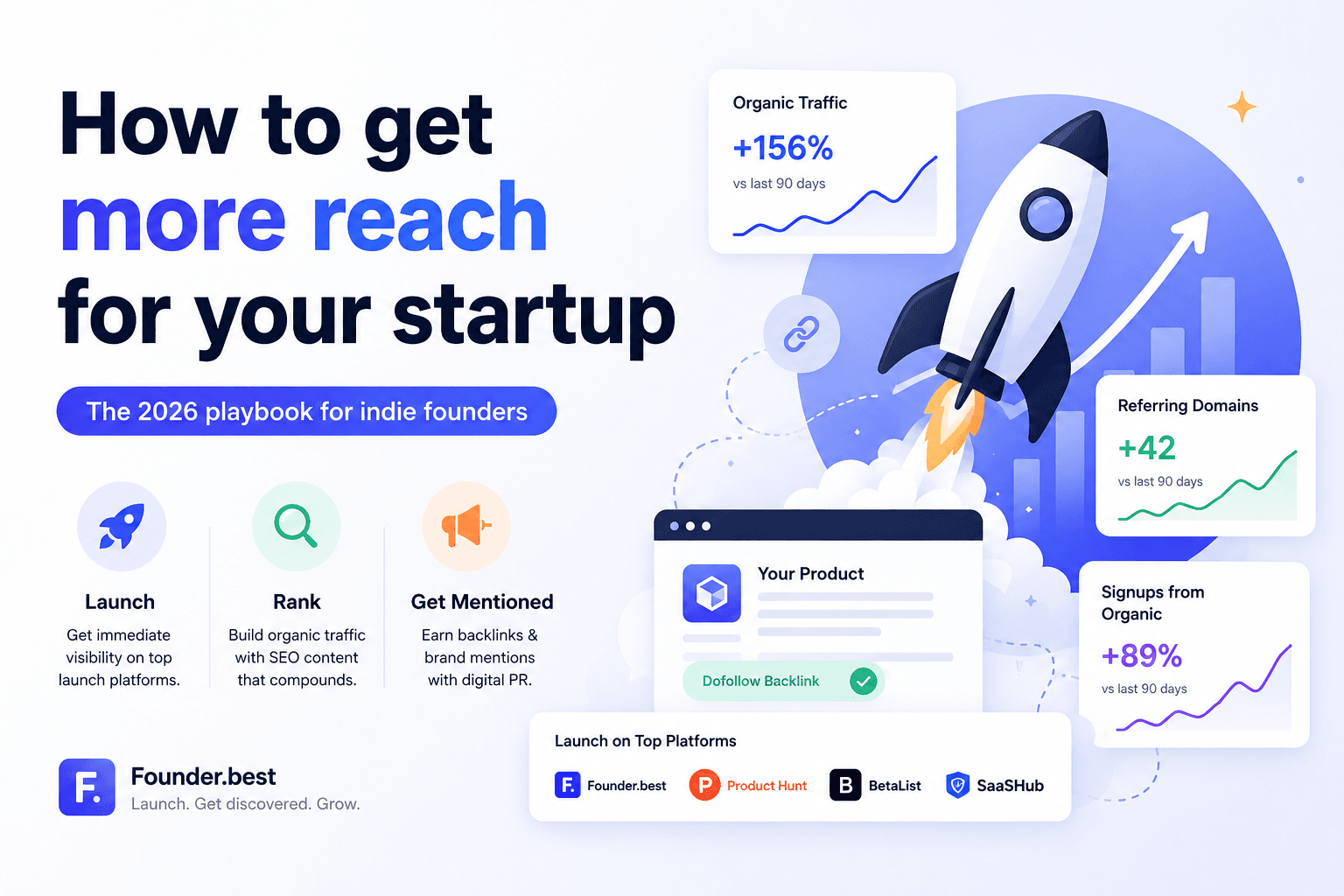
Most founders who search how to get more reach already tried posting on social once and watching impressions flatline. Reach is not a single post going viral. It is the sum of launch traffic, search rankings, referral links, and brand mentions that make the next launch easier than the last.
This playbook is for indie SaaS and bootstrapped teams who want more reach without a six-figure ad budget or a PR agency on retainer. It combines what works in 2026 across launch platforms, SEO, backlinks, and digital PR - the same levers covered in depth on resources like RankInPublic's ranking guides and digital PR for startups - adapted for founders who ship products, not content farms.
The honest version: you cannot buy durable reach safely at scale. You earn it by showing up in places your buyers already look, publishing proof worth citing, and stacking channels so one bad week does not zero out your pipeline.
What reach actually means in 2026
Reach for a startup is qualified discovery - people who could become users finding your product through channels you control or influence. Split it into three layers:
- Launch reach - traffic and visibility from product directories, launch platforms, and community posts during launch week
- Search reach - organic impressions and clicks from Google when buyers search problems you solve
- Brand reach - mentions, press coverage, and word-of-mouth that build familiarity before someone clicks
Launch reach spikes fast and fades unless you follow up. Search reach starts slow and compounds. Brand reach makes every other channel convert better. Founders who get more reach long-term invest in all three - not just one Product Hunt day.
Layer 1: Stack launch platforms for immediate reach
Launch platforms are the fastest legitimate path to more reach when your product is live. The mistake is treating every directory the same or betting everything on a single 24-hour homepage slot.
What to look for in a launch platform
Before you submit anywhere, check four things:
- Does the listing stay live at a permanent URL after launch week?
- Is the backlink to your site dofollow? (Inspect the page source - many popular launch sites use nofollow.)
- Does the platform have real traffic and editorial standards, or is it a link farm?
- Can you post product updates after launch so the page stays fresh for crawlers?
Curated platforms with weekly rankings - like Founder.best - give indie founders recurring homepage exposure plus a dofollow backlink from $9. That is launch reach and SEO reach in one listing. Product Hunt and Show HN can add a large single-day spike; treat them as amplifiers, not your only channel.
A realistic 7–10 day launch stack
Spread launches across a week instead of firing everything on Monday:
- Day 1–2: Soft launch to your email list and one community (Indie Hackers, niche Slack, subreddit where self-promotion is allowed)
- Day 3–5: Primary structured launch on Founder.best or a similar dofollow-friendly platform
- Day 6–8: Secondary spike channel (Product Hunt, Show HN, or a niche directory in your vertical)
- Day 9–10: Launch retro post with real numbers - signups, conversion rate, one lesson - and link back to your product page
This sequence gets more reach than a single-day blast because each channel sees social proof from the previous one. Journalists and community members notice products that already have comments and upvotes elsewhere.
Layer 2: Earn search reach with content and topical authority
Launch traffic fades. Search traffic compounds. To get more reach from Google, you need pages that match search intent and enough authority for Google to trust them.
Start with keywords you can win
Do not target "CRM software" on day one. Focus 70% of early content on low-competition, long-tail keywords where forums or thin pages currently rank. Add modifiers like "for startups," "2026," "free," or "bootstrapped" to find winnable terms.
Before you write, search the keyword and study the top five results. Match the format: guides for informational queries, comparisons for commercial queries, product pages for transactional queries. Writing a sales page for an informational keyword is how reach strategies fail silently.
Build topical clusters, not one-off posts
Sites that publish five to ten interlinked articles around one theme rank faster than sites with scattered posts on random topics. This is topical authority - Google evaluates whether you are a go-to source on a subject, not just whether one page mentions a keyword.
Example cluster for a project management SaaS:
- "Project management for remote startups (2026)"
- "Best free project management tools for teams under 10"
- "How we built async standups without meetings"
- "Project management vs task management: what solo founders need"
Link each article to your product page and to each other. One strong cluster beats twelve unrelated blog posts when your goal is more reach from organic search.
Publish one cite-worthy asset per quarter
Generic listicles rarely earn links. Content with information gain - unique data, screenshots, named frameworks, honest launch numbers - gets cited by newsletters, roundups, and community threads without cold outreach.
Formats that earn reach:
- Transparent launch retros with real metrics
- Honest comparison guides (not pay-to-play "best tools" lists)
- Original benchmarks from your product data (anonymized)
- Step-by-step playbooks someone can follow today
Make citing easy: clear headings, a canonical URL, and a TL;DR at the top. When other sites link to your article, you get more reach through both referral traffic and dofollow backlinks.
Layer 3: Backlinks that multiply reach (quality over volume)
Backlinks remain a top-three ranking signal in 2026 - roughly 45% of off-page SEO weight, with brand mentions and entity signals making up the rest. For founders, that means more reach from search requires verified dofollow links from relevant domains - not hundreds of spam directory submissions.
The backlink quality checklist
Before you count a link toward your reach goals, verify:
- Is the linking page indexed in Google?
- Is the link dofollow (no
rel="nofollow"on the anchor)? - Does the site publish original content in your niche?
- Would you be proud to show this link to a customer?
One editorial link from a DR 50 niche blog beats fifty links from DR 5 scraper sites. RankInPublic's backlink guide puts it plainly: relevance, context, and editorial intent matter more than raw volume.
Free methods that still work
You do not need a link-building agency to get more reach. Proven free channels include:
- Curated directory and launch listings with dofollow product pages
- Guest posts on niche blogs (confirm bio links are dofollow)
- Integration pages on complementary SaaS tools
- Journalist query platforms - respond to 2–3 relevant pitches per week with expert quotes
- Free tools or calculators that solve one painful problem in your niche
Avoid sudden link spikes. A steady pace - a few quality links per month - is safer and more durable than blasting 200 directories in a weekend.
Layer 4: Digital PR for reach that compounds
Digital PR is where SEO meets press coverage. The goal is earned media that links back to your site - driving referral traffic today and link equity for years. Unlike ads, a backlink from a respected publication does not expire when your budget runs out.
High-impact digital PR tactics for startups
Start with tactics that match a solo founder's time budget:
- Data-driven PR: Publish a small industry report from anonymized product data or a 200-response survey. Journalists need sources; become the source.
- Expert commentary: Pitch one specific insight to writers covering your niche - not a generic "we launched" email.
- Launch as news: A well-timed product launch on a curated platform gives journalists something concrete to link to.
- Contrarian takes: Respectful disagreement with conventional wisdom in your space earns shares and quotes.
Press coverage also creates trust signals. "As featured in…" on your landing page reduces friction for buyers who Google you before signing up. That is more reach that converts - not just traffic.
What digital PR is not
Skip these if you want sustainable reach:
- Paying for sponsored posts disguised as editorial
- Wire-service press releases with no journalist relationship
- Buying backlinks from link farms
- Treating social posting as a substitute for earned media
Digital PR compounds: journalists who covered you once are more likely to respond again. Each piece of coverage makes the next pitch easier.
Layer 5: Community and distribution (where your buyers already are)
SEO and PR take months. Community channels get more reach this week - if you show up with value instead of dropping links.
Communities that work for indie SaaS
- Indie Hackers - build-in-public posts, milestone updates, honest metrics
- Niche subreddits - answer questions first; share your product only when it genuinely helps
- Slack and Discord groups in your vertical - become a helpful member before promoting
- Newsletter swaps with complementary founders - cross-promote to aligned audiences
The pattern that works: teach something useful, mention your product as the tool you used, link to a resource page or launch listing - not a hard pitch on every post.
Repurpose once, distribute many times
When you publish a launch retro or SEO article, extract:
- Three short posts for X/LinkedIn with one insight each
- One thread for Indie Hackers with the full story
- One comment-ready summary for relevant Reddit threads
- One email to your list with the headline number
One piece of cite-worthy content should fuel a week of distribution. That is how bootstrapped teams get more reach without hiring a content team.
What to track (and what to ignore)
Reach without measurement is guesswork. Keep the dashboard simple:
Track monthly
- Dofollow referring domains (Ahrefs or Search Console Links report)
- Organic impressions and clicks in Google Search Console
- Organic signups or trials from search - the lagging indicator that matters
- Referral traffic from launch listings and press coverage
Ignore daily
- Domain Rating swings of 1–2 points
- Total backlink count including nofollow and spam
- Vanity impression counts on social with no clicks
- Rankings for keywords you are not actively targeting
More reach should eventually show up in signups and revenue - not just dashboards. If dofollow referring domains grow but organic signups stay flat, your content may be ranking for the wrong intent or your landing page may not convert.
A 90-day reach plan for bootstrapped founders
If you want a concrete sequence, run this over the next quarter:
Month 1 - Launch foundation
- Ship on a dofollow-friendly launch platform with a permanent product page
- Verify every outbound link from launch week (dofollow vs nofollow)
- Publish one honest launch retro with real numbers
- Set up Search Console and Ahrefs (or free alternatives) for baseline metrics
Month 2 - Search foundation
- Identify one topical cluster (5 keyword targets around one theme)
- Publish two interlinked articles that match search intent
- Respond to 2–3 journalist queries per week with expert quotes
- Post weekly product updates on your launch listing
Month 3 - Compounding
- Publish one cite-worthy asset (data report, comparison guide, or playbook)
- Pitch one guest post or integration page link in your niche
- Add a second launch platform or directory with verified dofollow links
- Review organic signups and double down on the channel that converted
This plan gets more reach without pretending one viral moment will carry your startup. Launch platforms buy immediate visibility. SEO and backlinks buy compounding discovery. Digital PR and community buy trust. Stack all three and reach stops being a lottery.
When Founder.best fits your reach strategy
Founder.best is built for founders who want more reach from both launch-week traffic and long-term SEO. Every approved product gets a permanent page with a dofollow backlink, weekly homepage rotation, community upvotes, and product updates that keep the listing fresh.
It is not a replacement for content marketing or digital PR - it is the launch layer that gives search and press something durable to link to. Many founders pair Founder.best with Product Hunt for spike reach, then invest launch-retro content and topical clusters for search reach over the following quarters.
If your product is live and you are ready to stack visibility instead of chasing one-day spikes, launch on Founder.best and treat the listing as the anchor for everything else in this playbook.
Key takeaways
- Reach = launch traffic + search visibility + brand mentions. One channel alone rarely sustains growth.
- Stack 2–3 launch platforms over 7–10 days; prioritize permanent dofollow product pages over one-day homepage spikes.
- Publish one cite-worthy article per quarter and build a 5–10 page topical cluster around your core keyword theme.
- Digital PR (data reports, expert quotes, product launches) earns backlinks and trust signals without a PR agency retainer.
- Track dofollow referring domains and organic signups monthly - not daily DR swings or total impression counts.
Frequently asked questions
What does reach mean for a startup?
Reach is how many qualified people discover your product through launch platforms, organic search, referrals, press coverage, and community channels. Sustainable reach compounds over months - not just launch-day spikes.
How do I get more reach without paid ads?
Stack curated launch platforms with dofollow backlinks, publish SEO content that matches search intent, pitch journalists with original data or expert commentary, and stay active in communities where your buyers already hang out. Consistency beats one viral moment.
Do launch platforms help with SEO reach?
Yes - if the platform gives you a permanent, indexable product page with a dofollow backlink. That listing keeps sending referral traffic and link equity after homepage rotation. Nofollow-only launch sites help awareness but pass little SEO value.
How long until SEO reach shows up?
Low-competition long-tail keywords can rank in 2–4 months with good content and a few quality backlinks. Medium-competition terms often take 4–8 months. Plan for quarters, not weeks, and pair content with verified dofollow links.
Is Product Hunt enough to get more reach?
Product Hunt can drive a strong launch-day spike, but most outbound links are nofollow and homepage visibility is brief. Treat it as one channel in a stack - not your entire reach strategy.
What is the fastest way to get more reach this month?
Launch on a curated platform with weekly visibility and a dofollow backlink, share the listing with your email list and communities, and publish a short launch retro with real numbers. That combination drives immediate traffic and starts compounding SEO.

About the author
Anuj Shashimal
Founder, Founder.best
SaaS founder, indie hacker, and software engineer. Anuj built Founder.best to help indie founders launch, get discovered through search and AI answers, and turn launches into customers. He writes from first-hand experience growing Founder.best from zero to 400+ founders and 300+ launched products.
Tagged in
Browse all tagsKeep reading
Free tools and guides for this topic
Hand-picked from the tags on this post.
- How Founder.best worksSubmit in 10 minutes, rank on the weekly Launchpad, stay discoverable.
- Free SaaS directories for backlinksList of free SaaS and startup directories with dofollow filters, Ahrefs DR scores, and a submission checklist.
- Startup tagline generator12 tight one-liners for your landing page and launch post.
- Free Ahrefs Domain Rating checkerLive DR (0–100) for any domain before you chase a backlink.
- Free startup launch checklist30+ tasks across pre-launch, launch day, and post-launch.
- Launch platform alternatives & guidesProduct Hunt alternatives, where to launch, and SEO launch guides.
Ready to launch on Founder.best?
Weekly rankings, dofollow SEO backlinks, founder stories, and a community built for indie makers.
Submit your startup