
Launch & growth
What is TrustMRR? The verified startup revenue database founders actually trust
What is trustmrr? If you searched the name after seeing a verified MRR badge or a trustmrr.com link on a launch page, here is the full picture - how trustmrr verifies revenue through payment providers, who uses it, and how to connect it to your Founder.best product page.

Post by Anuj Shashimal
Founder, Founder.best11 min read
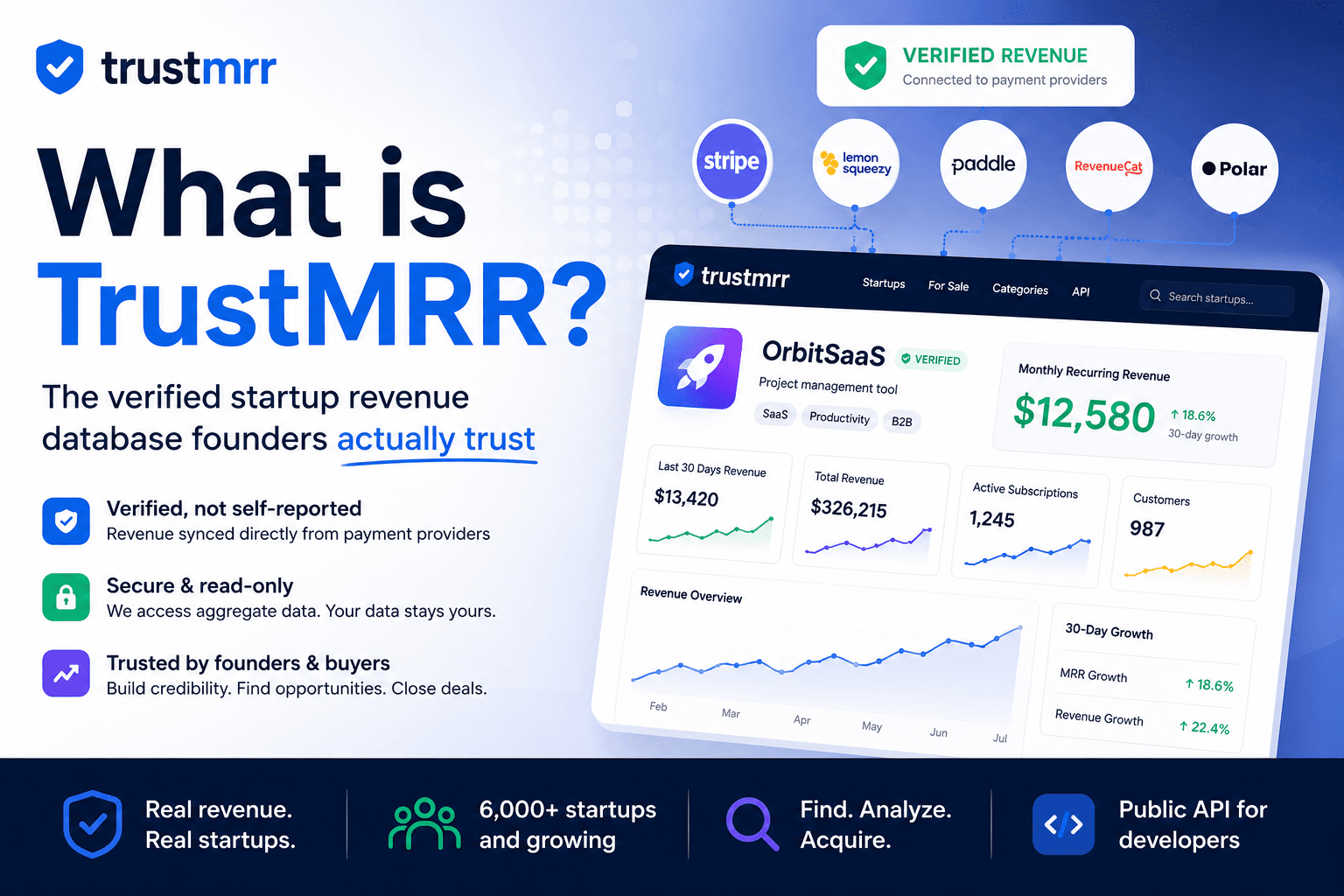
What is trustmrr? It is the question founders, buyers, and investors ask when they first see a verified MRR badge or land on trustmrr.com from a Product Hunt launch or build-in-public thread. Trustmrr is a platform where startup revenue is synced directly from payment processors - so the numbers you browse are tied to real transactions, not founder optimism or edited screenshots. This what is trustmrr guide is written for indie founders, micro-SaaS buyers, and investors who need to understand what trustmrr verifies, what it does not, and how to use verified revenue as a trust signal on launch pages and in acquisition research. The short version of what is trustmrr: trustmrr replaces self-reported MRR with payment-provider-backed metrics in a public verified startup revenue database. Founders get credibility. Buyers get a first-pass screening tool. Neither side should treat trustmrr as a substitute for full due diligence - but it is a massive upgrade over unverified claims.
What is TrustMRR?
What is trustmrr in one sentence: a verified startup revenue database and acquisition marketplace at trustmrr.com where founders connect payment providers and trustmrr publishes aggregate revenue metrics publicly - MRR, last-30-day revenue, total revenue, customer counts, and growth rates. Trustmrr has grown beyond a simple MRR directory. In 2026 the platform also includes for-sale startup listings, deal multiples, category browsing, founder profiles, and a public REST API for developers. The core promise of trustmrr has not changed: revenue data comes from payment systems, not manual entry. Trustmrr is popular in the indie maker and micro-SaaS community - the same audience that launches on Product Hunt, posts build-in-public updates on X, and sells small profitable tools rather than chasing unicorn valuations. That is why trustmrr product hunt searches often overlap: founders want verified proof right after launch week.
- Website: trustmrr.com
- Core function: payment-provider-backed revenue verification
- Also offers: startup marketplace, acquisition listings, public API
- Audience: indie founders, micro-SaaS buyers, investors, analysts
How trustmrr verifies startup revenue
What is trustmrr without understanding verification? Just another directory. Trustmrr requires founders to connect a payment provider via read-only API access. There is no manual override on trustmrr - you cannot type in a revenue number and call it verified. When a founder connects Stripe, LemonSqueezy, Paddle, RevenueCat, Polar, DodoPayments, Superwall, or Creem, trustmrr pulls aggregate metrics only: MRR, total revenue, last-30-day revenue, active subscriptions, and customer counts. Personal customer data is not collected. The trustmrr verification is structural - faking the number would require faking the payment account itself. That is what makes trustmrr different from a spreadsheet or a landing-page claim. Data on trustmrr refreshes from the provider on a schedule, so a verified badge reflects current payment reality - not a screenshot from three months ago when MRR was higher.
- Verification on trustmrr: mandatory payment-provider API connection
- Data accessed: aggregate revenue metrics only (read-only)
- Providers: Stripe, LemonSqueezy, Paddle, RevenueCat, and more
- No self-reported revenue entry on trustmrr - API connection is required
What metrics does trustmrr show?
Browsing trustmrr.com, you will see a consistent set of metrics across startup profiles in the verified startup revenue database. These are the numbers buyers and investors use for first-pass screening before deeper diligence.
- MRR (monthly recurring revenue) - the headline metric for subscription SaaS on trustmrr
- Last 30 days revenue - recent traction signal on trustmrr profiles
- Total revenue - lifetime aggregate from the connected provider
- Active subscriptions and customer counts - scale indicators
- 30-day growth rates - MRR and revenue momentum
- Category, tech stack, country, and rank - context for benchmarking on trustmrr
- For-sale listings: asking price, profit margin, revenue multiple - for acquisition research
Who uses trustmrr?
What is trustmrr used for depends on who is asking. Trustmrr serves three overlapping audiences - each with a different goal but the same need for verified numbers. Founders use trustmrr to prove traction. A verified MRR badge on your trustmrr profile is stronger than tweeting revenue screenshots that skeptics assume are edited. When you launch on platforms like Product Hunt or list on startup directories, linking to trustmrr.com gives visitors a third-party trust signal. Buyers and investors use trustmrr for acquisition screening and market research. Filtering 6,000+ startups by MRR range, growth rate, category, and asking price on trustmrr is faster than cold-emailing founders and hoping they share honest numbers. Trustmrr is a first-pass filter - not a replacement for legal, financial, and customer diligence. Developers and analysts use the trustmrr public API to pull startup revenue data into research tools, dashboards, and datasets. If you are building a SaaS benchmarking product or an acquisition scout, trustmrr turns verified revenue into programmatic data.
Trustmrr vs screenshots and self-reported revenue
Why does trustmrr matter when every founder can post a Stripe dashboard screenshot on X? Because screenshots are trivially fakeable and impossible to verify without direct access to the payment account. Self-reported revenue in pitch decks, directory listings, and Indie Hackers posts has no verification layer. Founders round up, exclude refunds, or cherry-pick peak months. Buyers learn to discount every claim by default - which is exactly why what is trustmrr searches are rising. Trustmrr removes that friction. Profiles on trustmrr.com show numbers synced from the same systems that actually collect payments. A visitor can click through, see the trustmrr verified badge, and know the MRR is tied to a live payment provider - not a Canva mockup. The limitation is scope: trustmrr shows what the connected provider reports. It does not verify profit margins, churn, customer concentration, traffic quality, or legal ownership. Treat trustmrr as screening data, then run normal acquisition diligence before any purchase.
- Screenshots: easy to fake, no third-party verification
- Self-reported MRR: common in pitch decks, unverifiable
- Trustmrr: payment-provider API sync, structural verification
- Still not enough alone for acquisitions - use trustmrr as a first-pass filter
How to show trustmrr verified revenue on your Founder.best launch page
Founder.best integrates directly with trustmrr so founders can display verified MRR badges on product pages - without visitors leaving your launch page to check trustmrr.com separately. From your product dashboard, connect your trustmrr slug or profile URL. Founder.best syncs revenue data read-only via the trustmrr API and renders a verified revenue badge on your product page. Visitors see MRR or revenue backed by payment-provider data - a trust signal that passive directories and screenshot-based launches cannot match. This is included free for product owners on any launch plan. Whether you are on the Free Launch tier or Standard, connecting trustmrr to your Founder.best listing turns a standalone trustmrr profile into an on-page conversion asset. The badge links back to your trustmrr profile for visitors who want the full revenue breakdown. You get credibility on your launch page and a path to deeper verification for serious buyers.
- Connect trustmrr from your Founder.best product dashboard
- Read-only sync - we never access your payment keys directly
- Verified badge displays on your permanent product page
- Free for product owners on all launch plans
- Badge links to your full trustmrr profile for deeper diligence
Trustmrr API: programmatic access to verified revenue data
Developers building on top of trustmrr can use the public REST API at trustmrr.com/api/v1. Generate an API key from the trustmrr developer dashboard (keys start with tmrr_) and query startup profiles, search filters, and acquisition listings. Common trustmrr endpoints include listing startups with filters for MRR, revenue, growth rate, and category; fetching a single startup by slug; and browsing acquisition listings with asking prices and multiples. Rate limits apply (approximately 20 requests per minute), so batch jobs should respect reset headers. Founder.best uses this same trustmrr API for read-only revenue sync on connected product pages. If you are a founder, you do not need to touch the API - connect your slug in the dashboard and the badge updates automatically on a schedule.
- Base URL: trustmrr.com/api/v1
- Auth: Bearer token (tmrr_ API key)
- Use cases: benchmarking tools, acquisition scouts, research dashboards
- Founder.best sync: automatic read-only refresh from trustmrr
Trustmrr alternatives and when to use something else
Trustmrr is the most recognized name in verified startup revenue, but it is not the only option. Depending on your goal, alternatives may fit better than trustmrr.com.
- ShowMRR, ProvenMRR, StartMRR - newer verified MRR directories with similar payment-provider sync models
- Acquire.com, Flippa - full acquisition marketplaces with broader listing types (not all revenue-verified like trustmrr)
- Baremetrics, ChartMogul - private analytics for your own SaaS metrics (not a public directory like trustmrr)
- Open startup spreadsheets - transparent but unverified, easy to cherry-pick
Common mistakes when using trustmrr
Even with trustmrr verified revenue, founders and buyers make predictable errors. Avoid these if you want trustmrr to actually build trust.
- Treating trustmrr as full due diligence for acquisitions - it is screening data, not a legal or financial audit
- Connecting only one provider when revenue is split across Stripe and LemonSqueezy - trustmrr shows what is connected
- Ignoring churn and profit - high MRR on trustmrr with 15% monthly churn is a different business than the headline suggests
- Not linking trustmrr from your launch page - a verified trustmrr profile nobody sees does not convert visitors
- Assuming every trustmrr company listing is for sale - many trustmrr profiles are discovery-only, not acquisition listings
Key takeaways
- What is trustmrr: a verified startup revenue database and acquisition marketplace at trustmrr.com.
- Trustmrr syncs revenue from payment providers - Stripe, LemonSqueezy, Paddle, RevenueCat, and others - not self-reported claims or screenshots.
- Buyers and investors use trustmrr for first-pass acquisition screening; founders use it to prove MRR with a third-party badge.
- Trustmrr verified startup revenue database contains 6,000+ profiles across 23+ categories - filterable by MRR, growth, and asking price.
- Connect trustmrr to your Founder.best product page to display a verified revenue badge - free for product owners on all launch plans.
Frequently asked questions
What is trustmrr?
Trustmrr (trustmrr.com) is a verified startup revenue database and acquisition marketplace. Founders connect payment providers to prove MRR and revenue publicly. Buyers browse for-sale listings with verified metrics. Developers can access trustmrr data via a public REST API.
What is trustmrr.com?
trustmrr.com is the home of TrustMRR - a verified startup revenue database where 6,000+ startups display payment-provider-backed MRR, revenue, and growth metrics. Founders list products, buyers screen acquisitions, and researchers pull data from the trustmrr API.
How does trustmrr verify startup revenue?
Trustmrr requires founders to connect a payment provider through read-only API keys. Trustmrr pulls aggregate metrics - MRR, total revenue, last-30-day revenue, subscriptions, and customer counts - directly from the provider. There is no manual revenue entry option on trustmrr.
Is trustmrr only for Stripe?
No. Trustmrr supports multiple providers including Stripe, LemonSqueezy, Paddle, RevenueCat, Polar, DodoPayments, Superwall, and Creem. Older reviews sometimes describe trustmrr as Stripe-only, but the provider list has expanded.
Can I show trustmrr verified revenue on my Founder.best launch page?
Yes. Founder.best integrates with trustmrr read-only. Connect your trustmrr slug from your product dashboard and a verified revenue badge appears on your product page. This is free for product owners on all launch plans.
Is trustmrr data enough to buy a startup?
No. Trustmrr is excellent for first-pass screening - MRR, growth, category, and asking price. Before any acquisition you still need diligence on profit, churn, customer concentration, traffic quality, legal ownership, and contracts. Treat trustmrr as a filter, not a final answer.
What is the trustmrr verified startup revenue database?
The trustmrr verified startup revenue database is the public directory at trustmrr.com where startup revenue metrics are synced directly from payment providers via read-only API access. Founders cannot manually enter revenue on trustmrr - verification is mandatory and structural.
What are trustmrr alternatives?
Similar verified MRR directories include ShowMRR, ProvenMRR, and StartMRR. For full acquisition marketplaces, Acquire.com and Flippa offer broader listing types. For private analytics on your own SaaS, Baremetrics and ChartMogul are common choices. Trustmrr remains the most recognized verified startup revenue database for public discovery.

About the author
Anuj Shashimal
Founder, Founder.best
SaaS founder, indie hacker, and software engineer. Anuj built Founder.best to help indie founders launch, get discovered through search and AI answers, and turn launches into customers. He writes from first-hand experience growing Founder.best from zero to 400+ founders and 300+ launched products.
Tagged in
Browse all tagsKeep reading
Free tools and guides for this topic
Hand-picked from the tags on this post.
- Founder leaderboardTop indie founders ranked by community upvotes.
- About Founder.bestWhat we do, who launches here, and the founder behind the platform.
- Founder storiesReal startup journeys, lessons, and wins from indie builders.
- How Founder.best worksSubmit in 10 minutes, rank on the weekly Launchpad, stay discoverable.
- What is Founder.bestWhat is Founder.best in 2026? Weekly rankings, dofollow SEO, founder profiles, TrustMRR revenue, free and…
- Community feedFounder posts, product updates, and launch announcements.
Ready to launch on Founder.best?
Weekly rankings, dofollow SEO backlinks, founder stories, and a community built for indie makers.
Submit your startup