Product listing ad guide (2026): how indie founders buy visibility without wasting budget
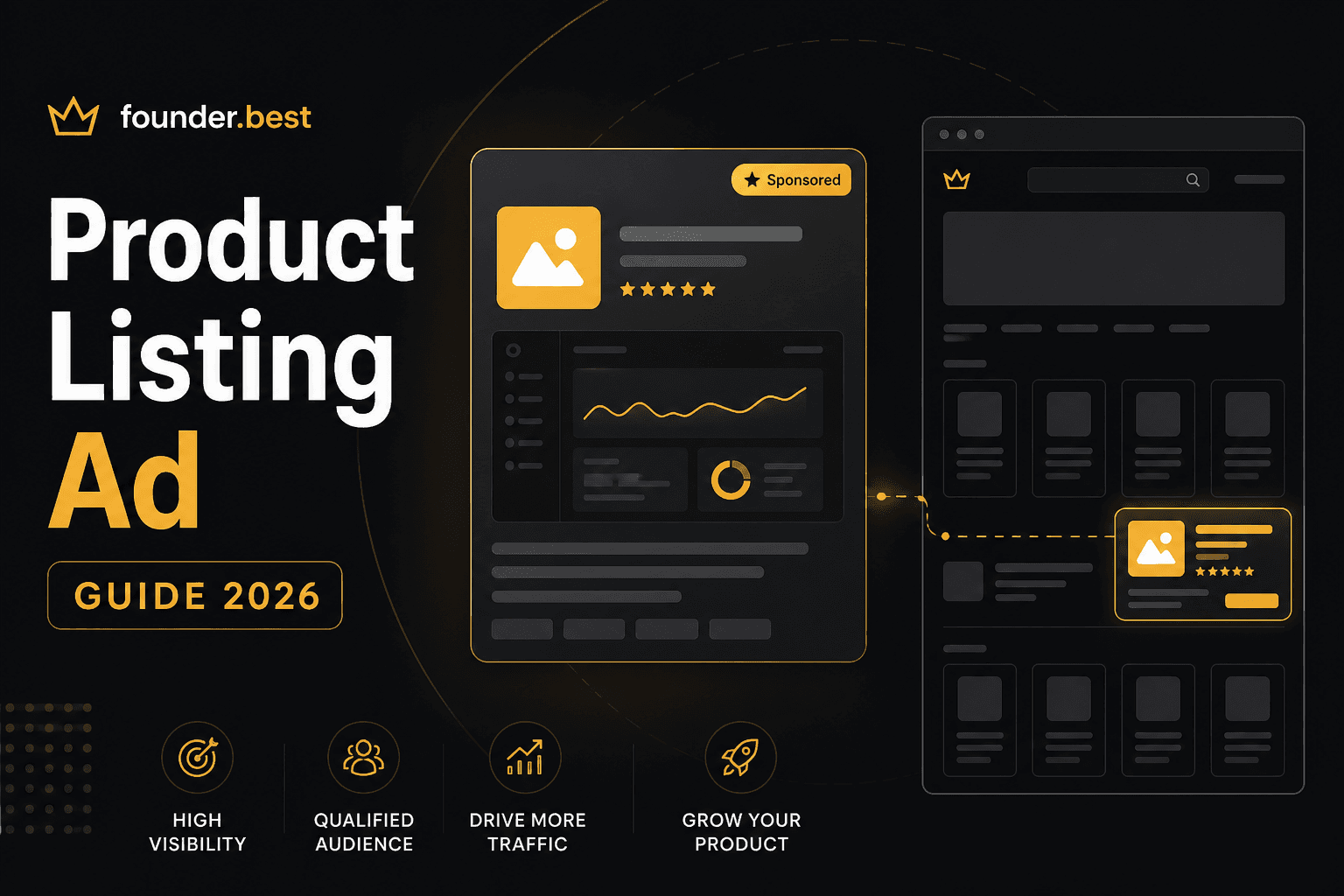
A product listing ad is not the same as a Google banner. It is paid placement inside a directory, marketplace, or launch platform where buyers already browse new tools. Here is how to pick one that drives signups - not just impressions.

Post by Anuj Shashimal
Founder, Founder.best10 min readLast updated
On this page
- TL;DR
- What is a product listing ad?
- Types of product listing ads in 2026
- How to evaluate a product listing ad before you pay
- Listing ads vs other paid channels
- A lean listing stack for indie SaaS
- What to put in your listing creative
- Mistakes that waste listing budget
- Founder.best: paid listings built for indie founders
- FAQ recap
- Bottom line
- Key takeaways
- FAQ
- About the author
- Keep reading
- Tools & guides
When founders ask me about a product listing ad, they're almost never asking about Google Shopping or Display Network tutorials. They want to know where to pay for visibility inside a product directory, SaaS marketplace, or launch platform - and whether that spend actually turns into signups.
This guide breaks down what that kind of ad is in 2026, which formats exist, how to evaluate them before you pay, and how indie SaaS teams stack listings without burning budget on link farms. It's part of our SaaS launch checklist, so if you haven't planned launch week yet, start there.
What is a product listing ad?
A product listing ad is paid placement that promotes your product inside a channel where buyers already discover tools. Think:
- A homepage slot on a launch platform during launch week
- A sponsored sidebar that stays visible while you subscribe
- A featured row in a SaaS directory or comparison category
- A premium tier on a marketplace that bumps your listing above free submissions
The common thread: your logo, name, tagline, and CTA appear in context - next to other products your buyer is comparing. That is different from a banner on a news site where nobody is in "evaluate new SaaS tools" mode.
A strong listing does two jobs:
- Immediate reach - clicks and signups while the placement is live
- Long-term discovery - a permanent product page that keeps ranking and sending referral traffic
If a platform only gives you a temporary badge with no indexable page, you are renting impressions. If you get a permanent listing with a dofollow backlink, you are buying reach and SEO compounding.
Types of product listing ads in 2026
Not every paid listing works the same way. Match the format to your goal before you checkout.
1. Launch-week homepage listings
These are the most common paid listings for indie founders. You pay (or apply free) for a slot on a launch platform homepage - usually for one to four weeks - with community upvotes, comments, and a permanent product page.
Best for: New launches, relaunches, and products that need social proof fast.
Watch for: Whether free tiers use nofollow links, how long homepage visibility lasts, and if you can post updates after launch week.
Founder.best fits here: free launches on open weekly slots ($0 after badge verification), Standard Launch from $9 with instant go-live and a dofollow backlink, or Launch Pro ($19) for a full month of homepage visibility plus premium placement.
2. Always-on sponsored spots
A sidebar or feed placement stays visible as long as you pay. These are subscription placements - not one-time launch slots.
Best for: Products past launch week that still want homepage traffic without re-launching every month.
Watch for: Slot limits (scarcity can be good), whether the spot pauses on failed payment, and click-through to your actual product URL.
On Founder.best, Sponsored Spots are $19/month for premium sidebar placement - only 20 spots total. Your ad stays active while the subscription is paid, with logo, description, and CTA. Launch Pro+ bundle subscribers can also claim a spot as part of their plan.
3. Directory and comparison-site listings
G2, Capterra, SaaSHub, and niche directories sell paid placement as featured categories, sponsored comparisons, or premium profiles.
Best for: Buyers who search "[your category] software" and land on comparison pages.
Watch for: High CPC on lead-gen models, pay-to-rank dynamics, and whether organic traffic justifies the fee for early-stage products.
4. Marketplace and app-store style listings
Product Hunt, Chrome Web Store, Shopify App Store, and vertical marketplaces offer promoted placements inside their own ecosystems.
Best for: Products whose buyers live entirely inside that marketplace.
Watch for: Platform lock-in, nofollow outbound links, and whether promotion helps after the featured day ends.
How to evaluate a product listing ad before you pay
Before you pay for any listing, run this five-point check:
Traffic quality, not traffic size
A directory with 500,000 monthly visits means nothing if those visitors are bots, SEO scrapers, or founders submitting their own tools. Look for comment threads, upvote patterns, newsletter mentions, and whether real products you recognize launched there.
Permanent URL after the ad ends
The best paid listing leaves behind a page at platform.com/products/your-slug that stays indexed. Open three random listings from six months ago - if they 404, you are renting visibility.
Dofollow vs nofollow
Inspect the HTML on your live listing. A dofollow link to your domain passes SEO value; nofollow helps awareness only. For bootstrapped SaaS, dofollow product pages are a major reason to pay for a listing ad instead of only running social ads.
Editorial standards
Platforms that approve every submission become noise. Curated listings on editorially filtered sites signal trust to buyers and to Google.
Clear CTA and attribution
You should know which listing drove signups. Use UTM parameters on every listing link: ?utm_source=founderbest&utm_medium=listing&utm_campaign=launch.
Listing ads vs other paid channels
| Channel | Buyer intent | SEO value | Best stage |
|---|---|---|---|
| Product listing ad (launch platform) | High - browsing tools | Strong if dofollow page | Launch + post-launch |
| Google Search ads | High - searching problem | None on ad itself | When you know converting keywords |
| Social ads | Mixed | None | Retargeting, creative tests |
| Sponsored newsletter | Medium | Usually nofollow | Single-day spikes |
| Podcast sponsorship | Medium | None | Brand awareness |
A listing ad wins when your buyer is in evaluation mode on a trusted platform. Search ads win when you already know the exact keyword that converts. Most indie founders should start with one launch listing, then add search or retargeting once attribution is clear.
A lean listing stack for indie SaaS
You do not need ten directory subscriptions. A realistic stack:
Week 1: Primary launch listing
Pick one curated platform with weekly homepage visibility and a dofollow product page. Submit your positioning, screenshots, and founder story. Engage with every comment on launch day.
Launch on Founder.best - free on open slots or Standard from $9 for instant go-live.
Week 2–4: Community amplification
Share your listing URL in Indie Hackers, niche subreddits, and your email list. The listing is the anchor; community posts are the amplifier.
Month 2+: Optional always-on sponsored spot
If homepage traffic converted, add a Sponsored Spot for sidebar visibility while you publish SEO content and ship product updates.
Quarter 2: Comparison SEO
Add one comparison-site or alternatives page listing (SaaSHub, G2 category) for long-tail "[competitor] alternative" traffic.
This sequence treats every paid listing as part of a system, not a one-off gamble. If you're weighing a pay-to-rank leaderboard instead, Outbid.lol auctions explained covers how that model differs.
What to put in your listing creative
Whether you are buying a sidebar slot or a launch-week feature, the same creative rules apply:
- Name - clear, not clever. Buyers scan fast.
- Tagline - one outcome in under 12 words. "Get a push when your app crashes" beats "Next-gen observability reimagined."
- Logo - high contrast, readable at 48px.
- Screenshot or demo - show the product, not a gradient hero.
- CTA - "Start free trial" or "Book a demo" - match your funnel.
- Social proof - ship count, MRR milestone, or one real testimonial if you have it.
Update your listing when you ship major features. Fresh product pages signal activity to crawlers and to buyers revisiting your listing weeks later.
Mistakes that waste listing budget
Buying ten cheap directories at once. Spread spend across two quality platforms instead of ten sites with no traffic.
Ignoring nofollow. If SEO matters to you, verify the link before you pay.
Launching without a landing page. A listing sends traffic to your site. If the landing page is slow, vague, or broken on mobile, the ad did its job and your funnel failed.
No follow-up content. Pair every listing with one blog post, launch retro, or comparison page that links back to your product. That turns a one-week ad into a compounding asset.
Tracking impressions only. Measure signups, trials, and referring domains from each placement monthly.
Founder.best: paid listings built for indie founders
On Founder.best, paid visibility takes three practical forms:
Free Launch ($0)
Apply on an open weekly slot, verify the Founder.best badge on your site, and submit for admin review. Approved products get one week on the homepage with community upvotes and a permanent product page.
Standard / Launch Pro (one-time)
Instant go-live, homepage visibility for two weeks (Standard) or one month (Pro), dofollow backlink, newsletter inclusion, and weekly winner eligibility. This is the listing most bootstrapped founders start with.
Sponsored Spot ($19/month)
Always-on sidebar placement on the homepage - logo, description, and CTA. The link is marked rel="sponsored", as Google requires for paid placements, so treat it as a traffic channel rather than an SEO backlink. Only 20 spots. Active while subscribed.
Browse live launches to see how other founders structure their listings, or read our how to get more reach playbook for stacking listings with SEO. For a broader map of free and paid launch sites, see the best websites to launch a SaaS.
FAQ recap
Should bootstrapped founders pay for listing ads?
Yes - one quality listing on a curated platform usually outperforms the same budget split across unknown directories.
Free or paid listing?
Free works when the platform has real traffic and you can wait for approval. Paid wins when you need instant go-live, dofollow SEO, and guaranteed homepage time.
How long should you run a paid listing?
Launch-week listings: 1–4 weeks of homepage visibility plus a permanent page. Sponsored spots: keep them while CAC from the placement beats your other channels.
Bottom line
A product listing ad is not a vague "marketing spend" line item. It is paid visibility inside a product discovery channel - with or without long-term SEO upside depending on the platform.
Pick listings that combine buyer intent, editorial quality, permanent URLs, and dofollow links. Stack one launch platform first, measure signups, then add an always-on sponsored spot or comparison listing when the numbers justify it.
Submit your product on Founder.best - free launch slots or paid plans from $9 - and turn your next paid listing into traffic that compounds, not just a line on a receipt.
Key takeaways
- A product listing ad is paid visibility inside a product directory or launch platform - not a generic display banner on random websites.
- The best product listing ads give you homepage or category placement plus a permanent product page that keeps sending traffic and SEO value.
- Check dofollow vs nofollow, traffic quality, and whether the listing stays live after your ad period ends before you pay.
- Indie founders should stack one structured launch listing with an optional always-on sponsored slot instead of buying ten low-quality directory ads.
- Track signups and referring domains from each product listing ad - not impression counts alone.
Frequently asked questions
What is a product listing ad?
A product listing ad is paid placement that promotes your product inside a directory, launch platform, comparison site, or SaaS marketplace. Unlike social ads or Google display banners, a product listing ad appears where buyers are already browsing tools - often with your logo, tagline, CTA, and a link to your site. Strong listings also create a permanent product page that can rank in search and pass backlink equity.
Are product listing ads worth it for SaaS startups?
Yes - when the platform has real buyer traffic and your listing stays live after the ad window. A product listing ad on a curated launch platform can drive immediate signups during launch week and a dofollow backlink that compounds for months. Low-quality directories that accept any submission with no editorial standards rarely justify the spend.
What is the difference between a product listing ad and a launch listing?
A launch listing is usually a time-boxed homepage feature during launch week - often bundled with community upvotes, comments, and a permanent product page. A product listing ad can mean the same thing on some platforms, or a separate sponsored sidebar/category slot that stays visible while you pay. Founder.best combines both: Standard and Pro launches for weekly homepage visibility, plus Sponsored Spots ($19/mo) for always-on sidebar placement.
How much does a product listing ad cost?
Prices vary widely. Free directories exist but often have long queues or nofollow links. Paid product listing ads on reputable launch platforms start around $9–$19 for one-time launches on Founder.best, $19/month for a Sponsored Spot with sidebar placement, and higher on comparison sites or niche marketplaces. Budget for one quality listing before spreading spend across ten unknown directories.
Do product listing ads help SEO?
Only if the platform gives you a dofollow backlink on an indexable product page. A product listing ad on a nofollow-only directory helps awareness but passes little link equity. Verify the rel attribute on your live listing after payment - that is what moves Ahrefs Domain Rating, not the ad badge alone.
Where should I run my first product listing ad?
Start where your buyers already compare tools: a curated launch platform with weekly visibility, real community engagement, and a permanent dofollow product page. Founder.best is built for this - free launches on open weekly slots or Standard Launch from $9 with instant go-live. Add a Sponsored Spot if you want always-on homepage visibility after launch week ends.
Ready to launch on Founder.best?
Weekly rankings, dofollow SEO backlinks, founder stories, and a community built for indie makers.
Submit your startup
About the author
Anuj Shashimal
Founder, Founder.best
SaaS founder, indie hacker, and software engineer. Anuj built Founder.best to help indie founders launch, get discovered through search and AI answers, and turn launches into customers. He writes from first-hand experience growing Founder.best from zero to 400+ founders and 300+ launched products.
Keep reading
- The SaaS launch checklist every indie founder needs (2026)A SaaS launch checklist for indie founders: validation, launch assets, a 7 to 10 day launch week across the right platforms, and the first 30 days after.
- Outbid.lol auctions: what the pay-to-rank hype means for indie foundersHow Outbid.lol pay-to-rank auctions work, why they're trending with indie founders, and how they compare with launch platforms for lasting discovery.
- The best websites to launch a SaaS in 2026 (by channel and stage)The 15 best websites to launch a SaaS in 2026: launch platforms, SaaS directories, marketplaces, and communities, with cost and SEO value.
- AppSumo alternatives: 10 best sites to discover SaaS deals in 2026Compare 10 AppSumo alternatives for 2026: lifetime deal marketplaces, SaaS deal sites, and startup discovery platforms, plus how to pick one before you buy.
- Best SaaS directories in 2026: where to list your software so buyers find itThe best SaaS directories for 2026: review sites like G2 and Capterra, comparison sites like SaaSHub, and SaaS launch platforms, compared.
- How to get your first 100 users: a founder's launch playbookHow to get your first 100 users for a startup: founder outreach, communities, launch platforms, directories, SEO, and referrals, in the order that works.
Weekly launch recap
One email with the week's winners, breakout launches, and what founders shipped.
Free tools and guides for this topic
Hand-picked from the tags on this post.
- Launch plans & pricingFree, Standard, Pro, and Pro+ launches compared side by side.
- Free SaaS directories for backlinksList of free SaaS and startup directories with dofollow filters, Ahrefs DR scores, and a submission checklist.
- Launch platform alternatives & guidesProduct Hunt alternatives, where to launch, and SEO launch guides.
- How Founder.best worksSubmit in 10 minutes, rank on the weekly Launchpad, stay discoverable.
- Where to launchWhere to launch your SaaS or startup in 2026: 15 platforms ranked by SEO, cost, and fit. Product Hunt,…
- Product Hunt alternatives16 Product Hunt alternatives: launch boards, communities, directories, and review sites for indie founders.…