
Launch playbook
How to get your first 100 users: a founder's launch playbook
Your first 100 users usually won't show up from one perfect launch day. They show up when you talk to the right people, stay narrow on who you serve, and keep doing a few channels after launch week is over. Here's that plan, week by week.

Post by Anuj Shashimal
Founder, Founder.best18 min read
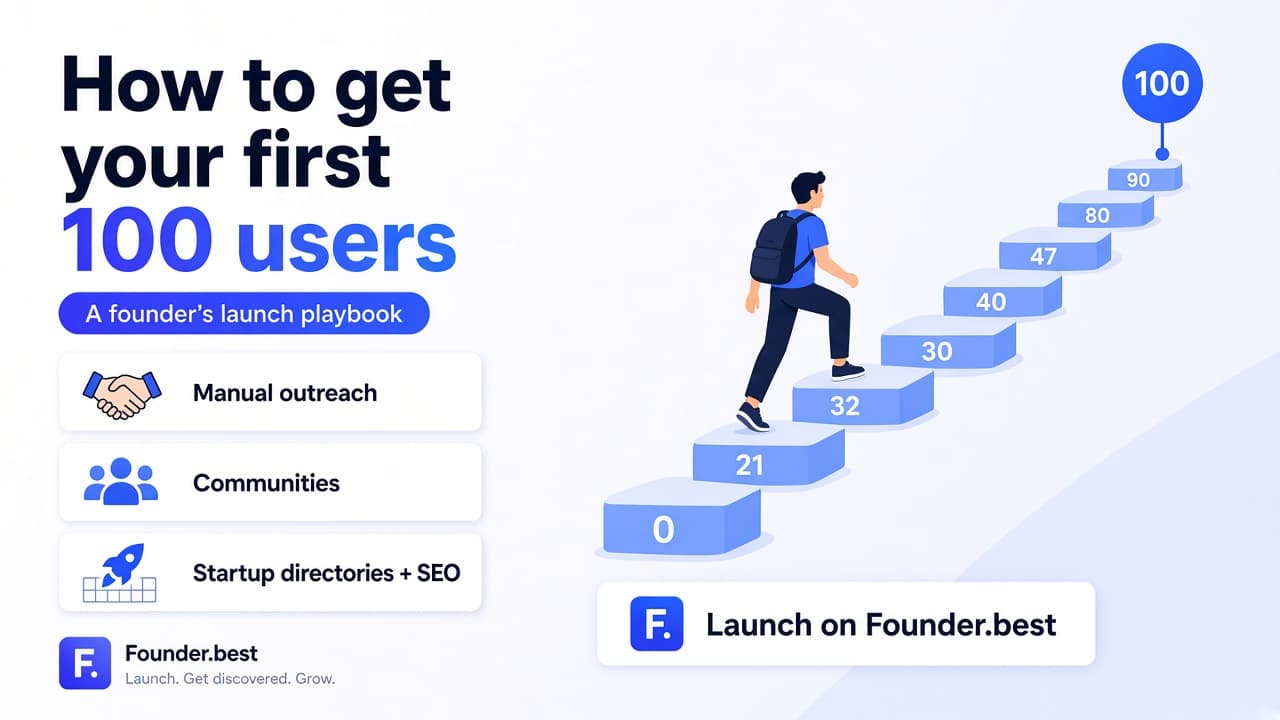
Shipping features feels like progress. How to get your first 100 users usually feels messier: cold emails that go nowhere, posts with a dozen likes, demos where someone says "interesting" and you never hear from them again.
That's normal. You can ship code alone at 2am. Trust only builds when you keep showing up for the same kind of customer.
Your first users won't sign up because the landing page won a design award. They sign up because the problem is real for them and they believe you'll fix it faster than the spreadsheet, the workaround, or the tool they're already paying for.
Those first 100 people teach you what to fix in onboarding, pricing, and positioning. They become testimonials, referrals, and the proof you need when someone asks "who's actually using this?"
This playbook is for founders who want startup user acquisition you can do without a big budget: pick who you serve, ship a small MVP, find users by hand, show up in communities and directories, add content when you're ready, and follow a 30-day plan at the bottom you can start this week.
Still not sure the idea is worth building? Read how to validate SaaS ideas first. If you already have a live product, keep going.
Startup user acquisition: conversations before scale
- 1. Define ICP and value propKnow exactly who hurts and what you promise
- 2. Ship a one-problem MVPStrangers complete the core workflow without a sales call
- 3. Find users 1–10 manuallyPersonalized outreach and demos
- 4. Grow 11–50 via communitiesHelp first, mention product second
- 5. Stack directories and contentLaunch listings plus SEO for ongoing discovery
- 6. Convert and retain to 100Fix onboarding, referrals, and landing page conversion
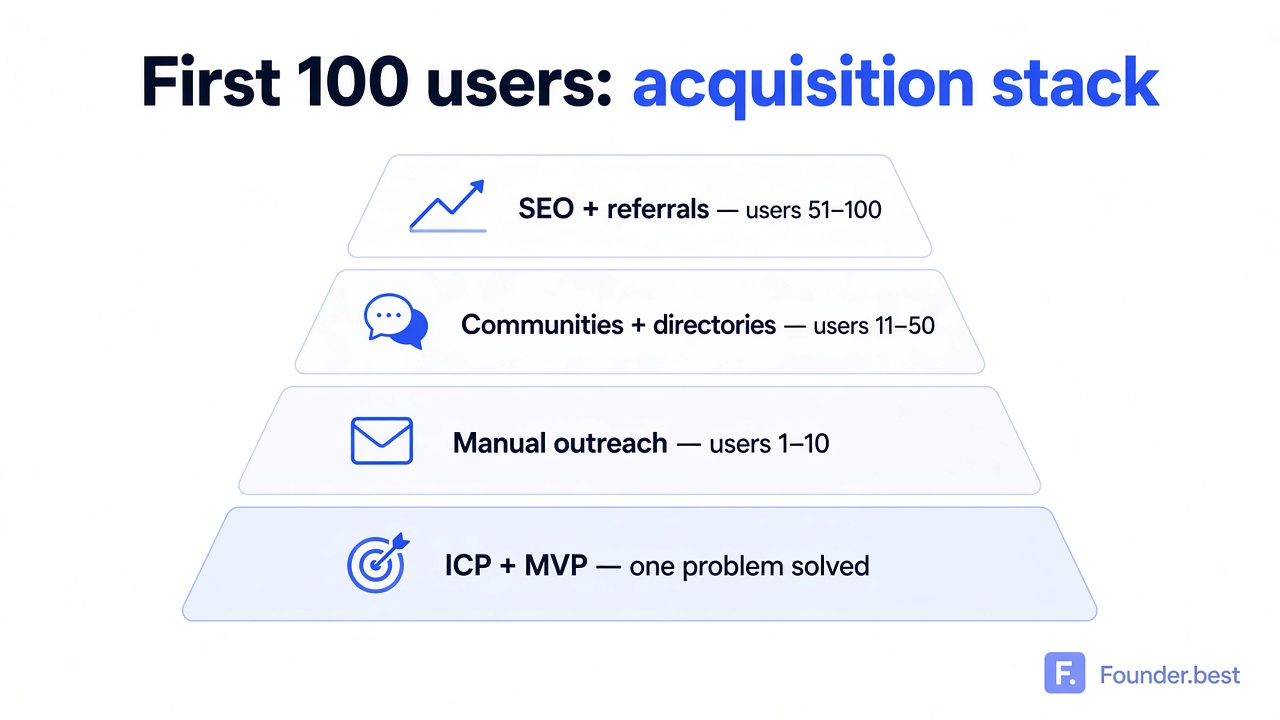 First 100 users acquisition stack: ICP, outreach, communities, directories, SEO, and referrals
What to optimize before you chase user 101
- 10
- activated users worth more than 1,000 impressions
- 3
- 1: helpful community replies per product mention (rule of thumb)
- 7–10
- days to stack directory launches instead of one spike
- 40+
- activated users is a strong 30-day outcome alongside 100 signups
- 2–4
- months before SEO becomes a meaningful signup channel for most niches
Define your target audience
You won't get your first customers by marketing to everyone. When you have no ad budget, narrow wins.
Identify your ideal customer profile (ICP)
Write one paragraph: job title or role, company size, industry, and the workflow they run weekly. Example: "Ops lead at a 20–80 person B2B SaaS who manually reconciles Stripe and the CRM every Monday."
Your ICP should be specific enough that you can name 50 people on LinkedIn without guessing.
Understand your audience's biggest pain points
Pain shows up in what people do, not what they say sounds annoying. Ask what they did the last time the problem hit: which tools they opened, how long it took, what they paid. If they shrug, startup user acquisition is going to be an uphill fight.
Validate your startup idea before launching
Validation means proof, not hype. You want interviews, waitlist signups, or preorders from people in your ICP, not "cool idea" from other founders. Be honest about competitors. "No competition" often means no market, or nobody cares yet.
Create a clear value proposition
One sentence: who + pain + outcome + why you. Not a feature list. Example: "Founders list their SaaS on Founder.best to reach early adopters and keep a product page that keeps sending traffic, without betting the company on one launch day."
Test that sentence in DMs before you redesign the homepage.
Build an MVP that solves one problem
Your MVP is the smallest thing that delivers the outcome you promised. It is not a mini version of your five-year roadmap.
Focus on essential features
List every feature you want. Circle one workflow that completes the value proposition. Everything else goes on a "after 100 users" backlog. How to launch a startup successfully almost always looks embarrassingly small at v1.
Avoid overbuilding before launch
Polish is often procrastination in disguise. Ship when someone you don't know can sign up, do the main job in the product, and get value without a call with you. (If you're selling to enterprise, high-touch is fine.)
Get feedback from early adopters
Early adopters tolerate rough edges if the pain is sharp. Give them a direct line (Slack connect, shared doc, or calendar link) and ask: what almost made you quit? Fix those friction points before you chase new traffic.
Make onboarding simple
Measure time-to-first-value in minutes, not days. Cut optional setup. Pre-fill what you can. When they finish the core action, show one clear "you're done" moment. Confused users don't refer friends.
Find your first 10 users manually
Your first 10 users should have names and email threads, not anonymous signup IDs in your analytics.
Reach out to your personal and professional network
Message people who fit your ICP, not your entire contact list. Lead with the problem: "I'm building X for [role] who struggle with Y. Does that match what you see?" Ask for 20 minutes, not a signup.
Contact potential customers directly
LinkedIn, email, or Twitter DMs work when you personalize. Reference their company, a public post, or a workflow they mentioned. One thoughtful message beats fifty mail-merge blasts.
Join niche communities and online forums
Find where your ICP already asks questions: subreddits, Facebook groups, industry forums. Lurk first. Answer helpfully without linking your product until you have context.
Offer personalized demos
For B2B or complex tools, "book a 15-minute walkthrough" converts better than "start free trial" for users 1–10. You learn objections live and fix copy the same week.
Goal for this stage: 10 people who used the product twice without you reminding them.
Use communities to find early adopters
Communities supply users 11–30 when you contribute before you promote.
Share useful insights on Reddit
Post breakdowns, templates, or lessons. Not "we're live!" on day one. Follow subreddit rules. When someone asks for tool recommendations, mention your product only if it genuinely fits and disclose that you built it.
Participate in relevant Slack and Discord groups
Introduce yourself in #introductions if the group allows it. Answer questions in public channels. DM only when invited or when you are solving a specific thread.
Engage in Indie Hackers and startup communities
Share build-in-public updates with numbers: signups, churn, what you shipped. Founders respect honesty. A post titled "Week 2: 7 users, onboarding drop-off at step 3" earns more help than "We're excited to announce…"
Build relationships before promoting your product
A simple rule: three helpful replies for every time you mention your product. Startup marketing strategies that feel like spam get you banned. Ones that feel like real help get you customers.
Launch on startup directories
Directories can turn launch week into ongoing discovery, but only if you pick platforms that keep your listing live and indexable.
Submit your product to startup directories
Not every directory is worth your time. Score platforms on referral traffic, dofollow links on product pages, category fit, and whether listings stay updated. A dead directory from 2022 sends neither users nor SEO value. Use a framework like startup directories in 2026 before you submit anywhere.
Prepare a compelling product description
Lead with the outcome, not jargon. Line one: who it's for and what changes after signup. Line two: one proof point (a beta quote, time saved, number of integrations). Match how that directory's audience talks (founders vs enterprise buyers).
Use screenshots, demos, and clear benefits
Upload crisp screenshots of the core workflow, not empty dashboards. A 30–60 second demo video lifts conversion on almost every listing. Benefits ("cut reporting from 4 hours to 20 minutes") beat feature bullets ("CSV export, API, webhooks").
Leverage platforms like Product Hunt and Founder.best
Product Hunt can bring a big spike for one day if you show up for comments and have a clear offer. It's reach, not your whole startup user acquisition plan. Many links are nofollow and homepage visibility is short. See Product Hunt launch strategies for the full playbook.
Founder.best is for founders who want early adopters and something that still works after launch week: a curated directory, a permanent indexable product page, category browse, and a dofollow backlink, plus weekly homepage rotation so you're not invisible after day one. A lot of indie teams get signups from people who never saw their tweet but found the listing while comparing tools in their niche.
Stack 2–3 directory launches across 7–10 days instead of firing everything on one Tuesday. Align assets with the SaaS launch checklist so billing, analytics, and support are ready when traffic lands.
Turn your launch into a source of ongoing discovery
After you submit, link the listing from your footer, launch email, and any comparison pages. Update it when you ship something big. Fresh listings help humans and search engines. Think of it as a shelf that stays up, not a checkbox you tick once.
Build an audience on social media
Social alone rarely gets you to 100 users. It does help every other channel when you post consistently.
Share your startup journey on X and LinkedIn
Document decisions: pricing change, onboarding fix, a customer quote with permission. Founders and buyers follow narratives. One post per weekday beats a viral thread once a quarter.
Publish build-in-public updates
Share real numbers when you can: signups, activation, MRR if you're comfortable. At this stage, honesty beats polished brand voice.
Share lessons, milestones, and product improvements
Teach something your ICP can use without your product: a checklist, a teardown, "what broke when we integrated X." Then a soft CTA: "If you want this automated, we built [product]."
Engage with potential customers consistently
Reply to people in your space. Quote-post with added insight. Social startup user acquisition is a daily habit, not a launch-week burst.
Use content marketing and SEO
Content can bring users while you sleep, but only after you know what your ICP actually searches for.
Write blog posts that solve your audience's problems
Each post should match a job-to-be-done: "how to reconcile SaaS metrics," not "our Q3 roadmap." Tie naturally to your product without forcing a pitch every paragraph. Broader guidance lives in content marketing for startups.
Target long-tail keywords
Your site will not rank for "project management" on day one. It can rank for "project management for remote design agencies under 10 people." Build a cluster of 5–10 interlinked pages around one theme.
Create comparison and alternative pages
High-intent searches look like "[competitor] alternative" or "[tool A] vs [tool B]." If you serve a niche, honest comparison pages convert and rank. See product page SEO for structure.
Optimize landing pages for search engines
Unique title tags, meta descriptions, H1 that matches intent, fast mobile load, and internal links from blog posts to signup. Technical basics still matter for how to get first users for a startup via organic search.
Publish content that attracts users over time
SEO pays off over quarters, not days. Publish one problem-solving post during launch month, then roughly one page per month. Link from directories and share in communities so pages don't sit alone.
Full stack overview: SEO for startups in 2026.
Turn early users into advocates
User 50 who refers two friends beats user 200 who churns in a week.
Deliver an excellent first-user experience
Reply fast. Fix bugs they hit. Thank them by name when you can. Early users forgive ugly UI. They don't forgive feeling ignored.
Ask for feedback and testimonials
After they get a win (export done, first report generated), ask: "What almost stopped you?" and "Can I quote you in one sentence?" Put testimonials on your landing page and directory listings.
Encourage referrals and word-of-mouth
Simple referral mechanics work early: extended trial, credit, or founder swag. Ask happy users: "Who else on your team feels this pain?" Get your first customers through trust chains, not coupon spam.
Build relationships with your earliest customers
Schedule monthly check-ins with your first 10–20 accounts. They shape roadmap and often become case studies when you scale startup marketing strategies later.
Convert visitors into signups
Traffic without conversion teaches you nothing except that your headline is vague.
Create a clear landing page headline
State outcome in plain language. Subhead explains how. If a stranger cannot paraphrase what you do in five seconds, rewrite it. More on pre-traffic pages: SaaS landing page before customers.
Highlight benefits instead of just features
Every feature bullet gets a "so that…" clause. "Stripe integration" → "so revenue numbers match your dashboard without manual exports."
Add a strong call to action
One main CTA above the fold: "Start free," "Book demo," or "Join waitlist." Extra links compete for attention when you're still learning what converts.
Reduce signup friction
Social login, minimal form fields, no credit card if it kills trial starts. Remove navigation clutter on landing pages focused on signup.
Track landing page conversion rates
Measure visitor → signup → activation. If traffic rises but signups flatline, fix the page before you buy more reach. How to get more reach only helps when the page converts.
Where to spend a 10-hour landing page sprint (pre-100 users)
- Headline and outcome-focused copy2.5 hrs
- Real product screenshots or demo2 hrs
- Social proof you honestly have1.5 hrs
- Single primary CTA and signup flow2 hrs
- FAQ and objection handling1 hrs
- Visual polish and animations1 hrs
Measure your growth and improve
If you don't measure it, you can't repeat what worked.
Track visitors, signups, and activation rates
Use UTM parameters on directory links, community posts, and emails. Know which channel drove each signup. Activation = completed core workflow, not account created.
Identify your best user acquisition channels
After 30 days, rank channels by activated users, not clicks. Manual outreach plus one good directory often beats a month of Twitter impressions.
Where bootstrapped founders often find activated users 1–100 (illustrative mix)
- Manual outreach and demos28%
- Niche communities and build-in-public22%
- Startup directories (e.g. Founder.best)18%
- Referrals from early customers15%
- Organic search and content10%
- Social posts and DMs7%
Monitor retention and churn
Week-one and week-four retention tell you if you earned 100 users or 100 trials. Fix product and onboarding before scaling spend.
Experiment with different marketing strategies
Change one variable per week: new headline, demo offer, subreddit channel, directory listing copy. Document results in a simple spreadsheet.
Double down on what works
When a channel delivers retained users, allocate your next 20 hours there before opening a new tactic. How to get your first 100 users is mostly focus, not novelty.
A practical 30-day plan to get your first 100 users
Use this calendar as a default; adjust if your sales cycle is longer.
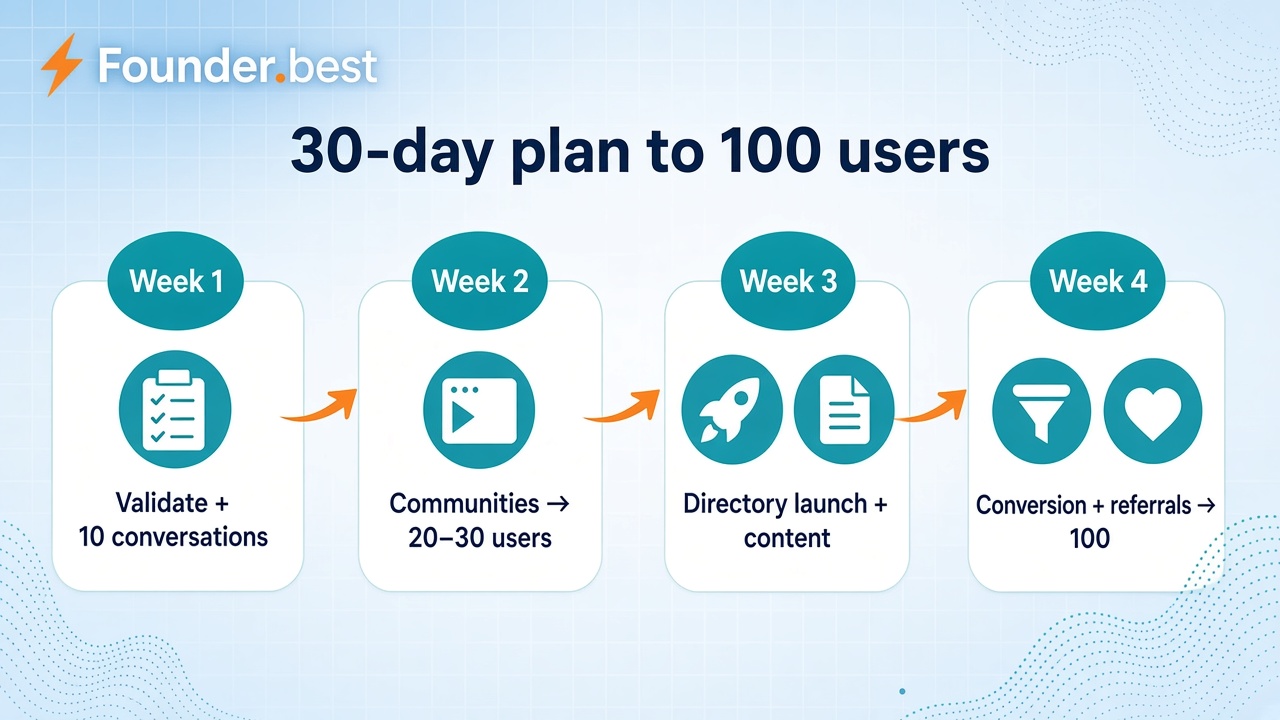 30-day plan to get your first 100 startup users: four-week founder calendar
30-day user target by week (example ramp to 100 signups)
- Week 1: validate and activate10 users
- Week 2: communities and demos30 users
- Week 3: directories and content65 users
- Week 4: conversion and referrals100 users
Week 1: Validate the idea and contact 10 potential users
- Finalize ICP and one-sentence value prop
- Ship or tighten MVP around one workflow
- Send 30 personalized outreach messages; goal 10 conversations and 5 activations
- Fix top three onboarding drop-offs
Week 2: Reach out to communities and acquire the first 20–30 users
- Join 2–3 communities; post 2 helpful replies daily
- Share one build-in-public update with real metrics
- Run 5–10 demos or walk people through setup live
- Ask every active user for one referral intro
Week 3: Launch on directories and publish content
- Submit to Founder.best and one complementary directory or launch platform
- Prepare Product Hunt or Show HN if it fits your audience
- Publish one SEO post or comparison page targeting a long-tail query
- Email your list (even small) with the new listing and ask for feedback
Week 4: Improve conversions, encourage referrals, and aim for 100 users
- A/B test headline and primary CTA
- Collect 3–5 testimonials; add to landing page and listings
- Re-engage churned signups with "what blocked you?" emails
- Sum channel totals; push hardest on the top two retention-positive sources
By day 30, 100 signups with 40+ activated users is a solid result. If you're enterprise sales-led, 10 activated accounts might matter more than 100 free signups.
Common mistakes founders should avoid
Knowing what not to do saves weeks.
Waiting for a perfect product
Perfection is procrastination. Ship when the core workflow works for your ICP; polish in public with real users.
Relying on a single launch day
One spike without follow-up looks like a flatline on your analytics. Stack directories, content, and community across weeks.
Promoting without understanding the audience
Generic launch tweets reach other founders, not buyers. Speak to one ICP in their language.
Ignoring user feedback
If the same objection shows up five times, that's your roadmap, not background noise.
Focusing on vanity metrics instead of active users
Impressions don't pay bills. People who keep using the product do.
Conclusion: Focus on conversations before scale
How to get your first 100 users isn't one growth hack. It's a lot of small moves: clearer positioning, manual outreach, showing up in communities, directory listings that stay live, content that matches what people search, and a landing page that doesn't confuse strangers.
Start with conversations. Double down on what keeps people around. When you want launch week to turn into steady discovery, list on Founder.best next to the channels that already sent you your best users, and keep the listing updated as you ship.
Your first 100 users are proof the problem is real. After that, you're mostly tuning what already works.
Key takeaways
- Your first 100 users are mostly a distribution problem. Talk to people before you spend on ads.
- One ICP, one core workflow, and onboarding that works beat a bloated MVP nobody can explain.
- Outreach and communities get you to roughly user 30. Directories and SEO help strangers find you after launch week.
- Listing on Founder.best (and similar directories) puts you in front of early adopters and gives you a product page that stays indexable.
- A hundred people who actually use the product beats a thousand who signed up once and left.
Frequently asked questions
How long does it take to get your first 100 users?
Most bootstrapped founders reach 100 users in 30–90 days with consistent outreach, community participation, and at least one launch on a startup directory. Speed depends on how narrow your ICP is and how painful the problem feels today.
What is the fastest way to get first users for a startup?
Message people who already have the problem: folks in your network, LinkedIn connections, niche Slack or Discord groups. Offer a quick demo or walk them through setup yourself instead of waiting for inbound.
Do I need Product Hunt to get my first 100 users?
No. Product Hunt can spike awareness for a day, but many teams get their first 100 users from manual sales, communities, and curated directories without a top-five launch. Treat launch platforms as one layer in a stack, not the whole plan.
How do startup directories help with early user acquisition?
Quality directories send qualified referral traffic, give you a dofollow backlink on an indexable product page, and act as third-party proof when buyers compare tools. Platforms like Founder.best are built for ongoing discovery, not just a one-day homepage slot.
When should I start SEO for user acquisition?
Once you have a live product and a landing page that converts, publish content that matches how your ICP searches: comparison pages, alternatives, and how-to posts. SEO compounds; it rarely replaces week-one conversations.
What metrics matter before 100 users?
Track visitors and signups by channel, activation (did they complete the core action?), and week-one retention. Ignore raw social impressions until you know which posts drive signups.

About the author
Anuj Shashimal
Founder, Founder.best
SaaS founder, indie hacker, and software engineer. Anuj built Founder.best to help indie founders launch, get discovered through search and AI answers, and turn launches into customers. He writes from first-hand experience growing Founder.best from zero to 400+ founders and 300+ launched products.
Tagged in
Browse all tagsKeep reading
Free tools and guides for this topic
Hand-picked from the tags on this post.
- How Founder.best worksSubmit in 10 minutes, rank on the weekly Launchpad, stay discoverable.
- Startup tagline generator12 tight one-liners for your landing page and launch post.
- Free SaaS directories for backlinksList of free SaaS and startup directories with dofollow filters, Ahrefs DR scores, and a submission checklist.
- Indie launch guideLaunch guide for indie founders and bootstrapped makers in 2026. Build in public, pick platforms, earn…
- Free startup launch checklist30+ tasks across pre-launch, launch day, and post-launch.
- Launch platform alternatives & guidesProduct Hunt alternatives, where to launch, and SEO launch guides.
Ready to launch on Founder.best?
Weekly rankings, dofollow SEO backlinks, founder stories, and a community built for indie makers.
Submit your startup