
SEO for founders
Startup directories in 2026: score traffic, dofollow links, and AI citations before you submit
Every founder hears "submit to startup directories" in week one. Few get a framework for telling live platforms from dead pages—or why category match now affects AI citations as much as Domain Rating.
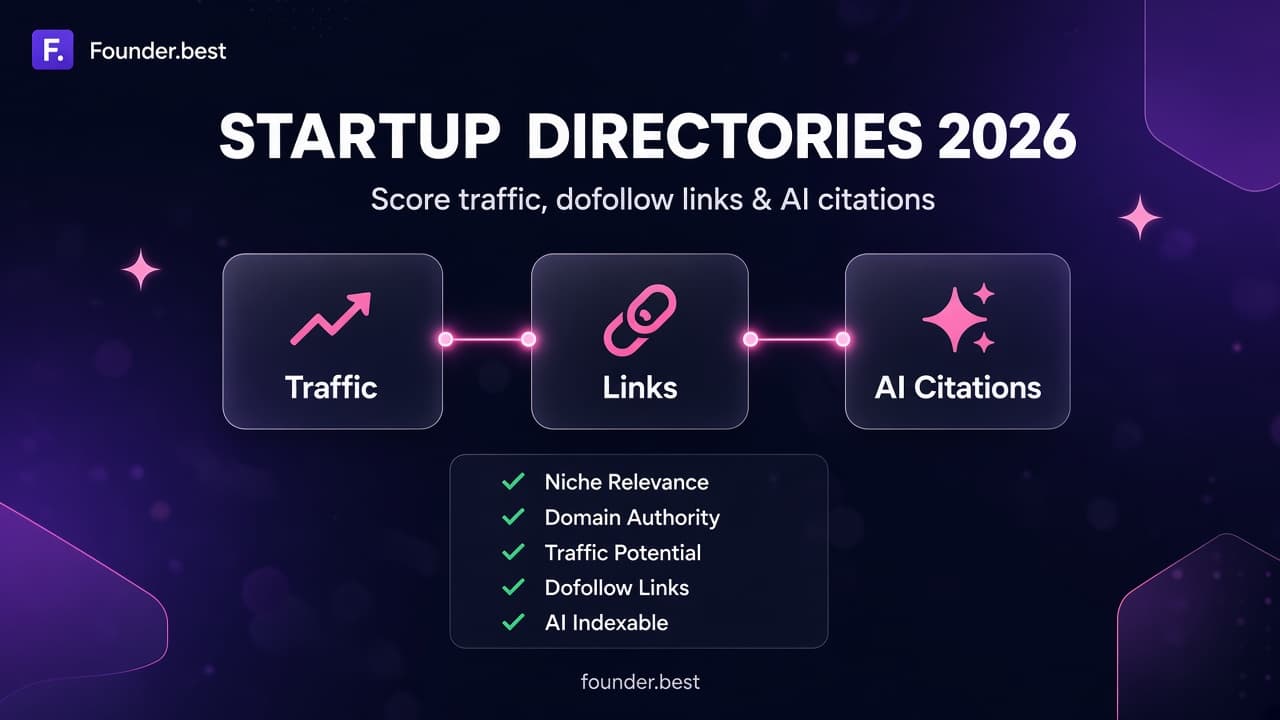
Every founder gets the same advice in week one: submit to startup directories. Almost nobody gets a filter for which directories still move the needle in 2026—and which ones are zombie pages that humans and crawlers stopped visiting years ago.
That gap is expensive. Ten minutes per form adds up fast when you are working through a 90-name list where half the domains have not published a new listing this quarter.
Startup directories in 2026 are judged on three outputs at once:
| Output | What it gives you | Why it still matters |
|---|---|---|
| Referral traffic | Visitors who click through from the listing | Early validation and signup volume |
| Dofollow authority | Link equity that compounds with your domain | Rankings, trust, crawl discovery |
| AI corroboration | A third-party page models can cite or match to your entity | Visibility in ChatGPT, Perplexity, and AI Overviews |
A directory that only delivers the first column was always weaker than founders assumed. In 2026, with generative search retrieval layered on top of classic SEO, a nofollow listing on a dead category page is close to worthless.
This guide gives you a scoring rubric—not another padded mega-list—so you can decide where the next hour of submission time actually pays back.
What counts as a startup directory in 2026
The label covers more surface area than most roundups admit. Group them before you score them:
| Type | Examples (verify policies yourself) | Primary strength |
|---|---|---|
| Weekly launch boards | Founder.best, Uneed, TinyLaunch | Freshness + community signal |
| Pre-launch waitlists | BetaList | Email signups before ship |
| Community launches | Indie Hackers, Show HN | Qualified founder/buyer traffic |
| Comparison indexes | SaaSHub, AlternativeTo, G2 | Long-tail "X alternative" SEO |
| Entity databases | Crunchbase | Brand corroboration, not always dofollow |
| Niche vertical indexes | AI tool dirs, dev tool galleries, design showcases | Category match for AI + SEO |
The type tells you which column of the three-output table to weight highest. BetaList optimizes pre-launch email. Crunchbase helps entity consistency. A weekly launch board with dofollow product pages hits all three—if the listing stays indexable after homepage rotation.
For a deeper submission workflow and copy template, pair this piece with the directory submission sites guide.
Why category match now beats "biggest audience"
Founders still optimize for the directory with the loudest brand name. That made sense when the only KPI was launch-day clicks.
It is incomplete in 2026 for two reasons:
Referral quality. A productivity app listed in a developer-tools grid sends the wrong audience. Bounce rates spike, signups flatline, and you misread the launch as a product failure.
Semantic retrieval. AI systems weight sources that match the query context. A listing on a niche directory in your exact category—a CRM on a sales-tools index, an AI writer on an AI-tools hub—carries more corroboration value per page than the same listing buried on a generic "submit anything" grid.
Rule of thumb: match category first, authority second. A modest niche directory in your lane often beats a mismatched general platform with a bigger logo.
The backlink question (and why nofollow-only lists decay)
Dofollow outbound links still pass authority the same way they did five years ago. What changed is what happens after the crawl on a young domain.
New sites have thin ranking history. Search engines and AI retrieval both lean on third-party validation—consistent product facts on pages they already trust. Each verified dofollow listing on an indexed directory is one more validation point.
Nofollow is not evil. Some high-traffic platforms nofollow by policy and still send buyers. But count them honestly:
| Link type | Traffic potential | SEO authority | AI corroboration weight |
|---|---|---|---|
| Dofollow, indexable product page | Yes | Yes | Strong |
| Nofollow, active community | Often yes | Minimal | Moderate (entity mention) |
| Nofollow on dead page | Rarely | None | Weak |
| Sitewide footer / link farm | No | Risk | None |
Always inspect a live listing—not the marketing submit page. Policies drift. Paid tiers change rel attributes. A directory that promised dofollow in 2024 may nofollow every outbound link today.
The problem with "submit to 100 directories" lists
Most articles ranking for startup directories 2026 are padded inventory: 50 to 900 URLs, minimal QA, no freshness check. A meaningful share are abandoned—last listing months ago, broken forms, zero organic keywords.
Submitting there costs the same ten minutes as a good directory and returns nothing across all three outputs.
What separates directories that still work is not count—it is editorial or community activity:
- Humans (or a real community queue) review submissions
- New listings appear weekly, not yearly
- Product pages stay at stable URLs
- Categories are enforced, not catch-all spam buckets
Product Hunt, BetaList, Indie Hackers, and focused niche boards share that property even when their business models differ. Dead "SEO directory" sites do not.
The 5-point scoring rubric (run this before every submit)
Score each directory 0, 1, or 2 per row. Submit if the total is 7+. Reconsider at 5–6. Skip at 4 or below.
| Criterion | 0 points | 1 point | 2 points | | --- | --- | --- | | Link attribute | All live listings nofollow/sponsored | Mixed or unclear | Dofollow on your tier's product page | | Freshness | No new listings in 90+ days | Sporadic updates | New listings weekly or per launch cycle | | Indexability | Blocked, thin, or duplicate URLs | Indexable but weak template | Permanent product URL in sitemap | | Category fit | Wrong audience / catch-all spam | Adjacent category | Exact match to your product type | | Traffic or rank proof | Zero visible engagement | Some long-tail keywords | Real referrals or ranking category terms |
Quick verification steps
| Step | How to check | Time |
|---|---|---|
| 1 | Open a live listing in your category → View Source → search rel= on your outbound link | 2 min |
| 2 | Sort by newest submissions—when was the last one? | 1 min |
| 3 | Paste the product URL into Google: site:directory.com/your-category | 1 min |
| 4 | Compare your ICP to the last 10 listed products | 3 min |
| 5 | Check Similarweb/Ahrefs/GA referral if you have access—or ask in founder communities | 5 min |
If a directory fails link attribute and freshness, stop. Nothing downstream fixes a nofollow page nobody updates.
Where to spend your first hour (priority order)
This is a sequence, not a ranked "top 47" dump. Adjust for your stage and category.
| Priority | When | Where to focus | Goal |
|---|---|---|---|
| 1 | Launch week | One primary launch platform with dofollow + weekly visibility | Traffic + link + fresh signal |
| 2 | Days 3–10 | 2–3 niche directories in your exact category | Category match for SEO + AI |
| 3 | Weeks 2–4 | Comparison indexes (SaaSHub, AlternativeTo) if B2B SaaS | Long-tail discovery queries |
| 4 | Month 1 | Entity corroboration (Crunchbase, consistent founder profiles) | Brand disambiguation |
| 5 | Ongoing | Product updates on listings that support them | Recrawl + freshness |
Founder.best fits priority 1 for shipped products: permanent /products/your-slug URL, weekly launch cycle, dofollow on paid plans, founder feed updates, and structured listing data readable by search engines and AI agents. Submit here when your core landing page is ready—not before.
For launch-platform comparisons beyond directories, see how to get more reach for your startup.
How startup directories feed AI citations
Generative engines do not cite brands they cannot verify. They look for consistent entity facts repeated on trusted pages: product name, canonical URL, category, pricing band, and what problem the tool solves.
A startup directory helps when:
- The listing page is indexable and topically relevant
- Your copy matches your site and other listings (no tagline drift)
- The directory itself is cited or crawled in your niche
- Listings stay fresh—stale grids look abandoned to retrieval systems too
This is not a guarantee ChatGPT will recommend you. It is table stakes for increasing SaaS visibility in AI answers: corroboration layers models can fetch when a buyer asks "what is the best X for Y?"
Practical GEO hygiene on every directory form:
- Same product name spelling everywhere
- One canonical URL (no tracking-parameter variants as the "official" link)
- Category that matches how buyers describe the problem
- Two sentences in buyer language, not internal roadmap jargon
Submission timing and follow-through
Cluster submissions around launch week. Several new third-party mentions in the same fortnight read as a current product signal. One listing in January, one in June, and one in September look like noise.
Follow up on pending reviews. A submission stuck in "under review" for six weeks delivers none of the three outputs. Check status, nudge politely, or move on.
Track what worked. Simple spreadsheet columns:
| Directory | Submit date | Live URL | Dofollow? | Indexed? | Referral sessions (30d) |
|---|---|---|---|---|---|
| Example | 2026-09-14 | /products/you | Yes | Yes | 42 |
Review monthly. Double down on directories that send traffic and stay indexed—not vanity DR screenshots.
What this guide deliberately does not do
No stale DR table. Domain Rating and Domain Authority differ by tool, update constantly, and tempt bad decisions ("this one is DR 62 so it must be good") when freshness and category fit matter more. Pull current metrics yourself in Ahrefs or Moz if DR helps you break ties—do not trust numbers frozen in a blog post.
No 200-link blast list. Quantity is how padded SEO articles rank. Quality is how founders actually get traffic, links, and citations.
No promise of AI placement. Directories increase corroboration surface area. They do not replace a clear product page, schema markup, llms.txt, or cite-worthy content on your own domain.
Red flags: skip these directories
| Red flag | Why it fails |
|---|---|
| "Instant DR boost" upsell | Link-farm pattern |
| Auto-approve every URL in 60 seconds | No editorial trust |
| Categories full of unrelated niches | Spam index |
| Submit form works but no listings page | Data harvest |
| Paid-only dofollow buried in fine print | Misleading SEO promise |
| Newest listing is 8+ months old | Dead platform |
If two or more apply, spend the ten minutes on your product page instead.
Stack directories inside a real SEO plan
Startup directories in 2026 are infrastructure—not the whole strategy. Layer them like this:
| Layer | Tactic | Timeline |
|---|---|---|
| Foundation | Product page SEO + schema | Pre-launch |
| Week 1 | 8–12 scored directory submissions | Launch fortnight |
| Month 1 | One cite-worthy article or comparison | Weeks 3–6 |
| Quarter 1 | Editorial backlinks + AI mention monitoring | Ongoing |
The SEO for startups playbook covers the full stack. Directories kickstart the backlink and corroboration layer while you publish content that earns links on its own.
Bottom line
Before you submit anywhere, ask three questions:
- Will this send qualified traffic—not just bot sessions?
- Does the live listing pass dofollow authority I can verify in HTML?
- Would an AI retrieval layer treat this page as credible corroboration in my category?
If you cannot answer yes to at least two, the directory is not worth the form.
Score first. Submit second. Track indexed URLs and referrals third. That is how startup directories in 2026 earn their place in a modern launch stack—without copying a decade-old submission blast and calling it SEO.
Browse live platforms on Founder.best, filter the startup directories hub, or launch your product when your listing copy is ready to match across every surface.
Key takeaways
- A startup directory must earn traffic, dofollow authority, and corroboration for AI answers—not just one of the three.
- Verify rel attributes on a live listing in your category; submit-page promises often disagree with published HTML.
- Category match beats raw audience size: a niche AI or dev directory in your lane outperforms a generic grid for both referrals and GEO.
- Fresh listings cluster around launch week read as a current signal; stale directories with months-old submissions usually pass none of the three tests.
- Score directories before submitting; skip any platform that fails two or more rows on the 5-point rubric below.
Frequently asked questions
Do startup directories still work in 2026?
Yes—selectively. Curated launch platforms and niche SaaS indexes with indexable product pages, editorial review, and dofollow outbound links still send traffic and compound SEO. Bulk lists of 200+ auto-approve directories mostly waste time and can pollute your backlink profile.
How do startup directories help AI citations?
AI answer engines corroborate brands across trusted third-party pages. A startup directory listing with consistent product name, URL, category, and description adds an entity signal models can retrieve when someone asks for tools in your space—especially when the directory itself is topical and recently updated.
How do I check if a startup directory gives dofollow links?
Open an existing product listing in the category you would submit to, inspect the outbound link HTML, and look for rel="nofollow" or rel="sponsored". If every live listing is nofollow, count the directory as traffic-only—not an SEO or AI-authority play.
How many startup directories should I submit to?
Most bootstrapped teams see better results from 8–12 verified directories submitted over 2–3 weeks than from mass blasts. Match category, verify dofollow, and track referral traffic plus indexed listing URLs in Search Console.
What is the difference between a startup directory and a launch platform?
Directories publish categorized listings and wait for search traffic. Launch platforms add community mechanics—upvotes, comments, homepage rotation, product updates—that keep pages fresh. Founder.best combines both: a permanent directory-style product page plus weekly launch visibility.
Tagged in
Browse all tagsKeep reading
Ready to launch on Founder.best?
Weekly rankings, dofollow SEO backlinks, founder stories, and a community built for indie makers.
Submit your startup