SEO for founders
SEO for startups: the complete 2026 playbook (Google + AI search)
SEO for startups is not enterprise SEO on a smaller budget. It is a compounding system: fix your product page, earn a few dofollow links, publish content you can win, and make your brand easy for Google and AI answers to cite. Here is the full 2026 playbook - including the AI layer most guides skip.
If you searched seo for startups, you probably already know organic traffic is cheaper than ads - and that most SEO advice online was written for teams with content departments, not two founders and a Stripe account.
SEO for startups in 2026 is different. You are not trying to outrank HubSpot on "CRM software." You are building a compounding discovery engine: one canonical product page, a handful of dofollow backlinks, a topical content cluster you can actually win, and - increasingly - entity signals that make AI answers name your product when buyers ask for recommendations.
This guide is the full playbook we use at Founder.best - launch platform, founder profiles, and free SEO tools for indie makers - adapted for bootstrapped SaaS, AI tools, and side projects that need SEO results without an agency retainer.
The honest version: startup SEO is slow at first, then unfairly durable. Launch-day spikes fade. A dofollow product listing and a comparison page that ranks for three years do not.
What SEO for startups actually means in 2026
SEO for startups is not one tactic. It is four layers that reinforce each other:
- Technical SEO - fast pages, clean URLs, schema markup, indexable structure
- On-page SEO - product pages and content that match search intent
- Off-page SEO - dofollow backlinks and brand mentions that build authority
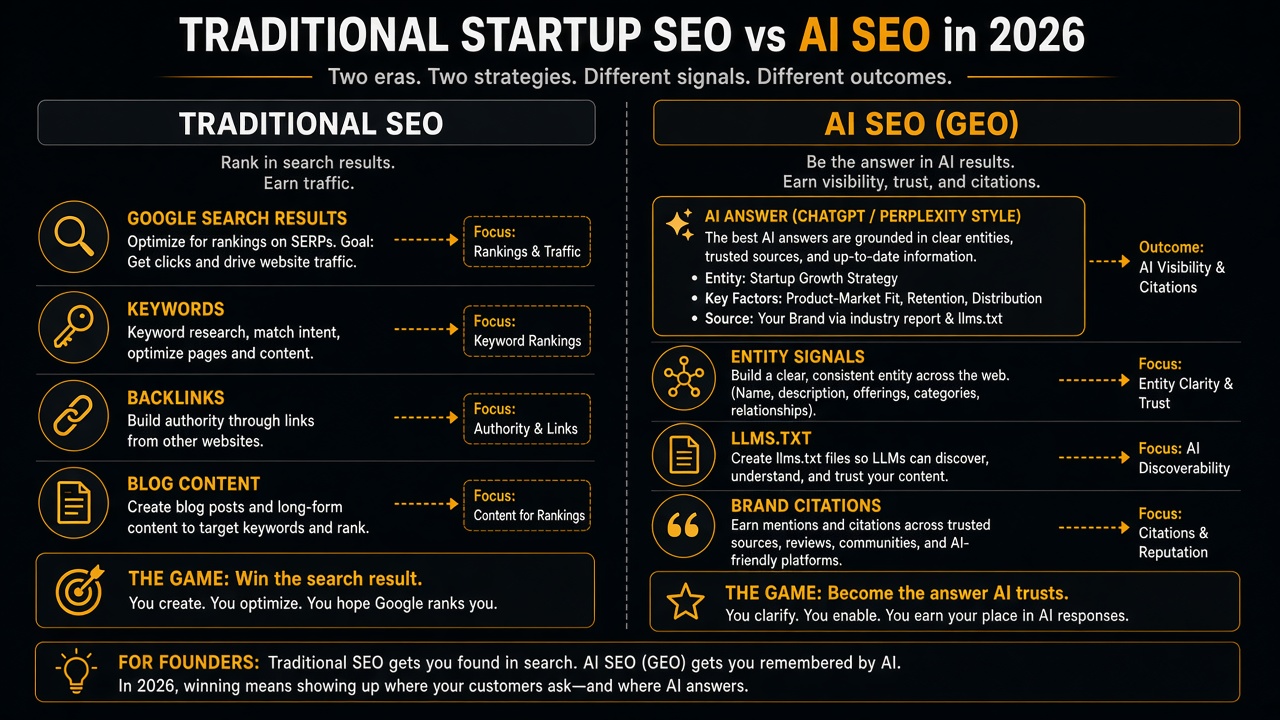
- AI SEO (GEO) - making your brand cite-worthy in ChatGPT, Perplexity, Claude, and Google AI Overviews
Enterprise teams optimize thousands of URLs. Startups win by making one product URL extremely clear, then earning 5–15 verified dofollow links and 5–10 interlinked articles around a theme buyers search.
Skip the fantasy of ranking #1 for head terms in month one. Win long-tail queries like "seo for startups," "best [category] for bootstrapped founders," and "[competitor] alternative for [use case]" first. That is how early-stage startup SEO builds momentum without burning six months on unwinnable keywords.
Why startup SEO is not enterprise SEO
Large companies buy DR 80 links, run programmatic SEO at scale, and rank on brand searches alone. Startups do not have that luxury - and that is fine.
| Enterprise SEO | Startup SEO |
|---|---|
| Thousands of landing pages | One canonical product page + small cluster |
| Dedicated content team | Founder-written guides with real proof |
| Brand queries dominate | Long-tail + comparison keywords first |
| PR agency retainer | Launch platforms + one cite-worthy asset per quarter |
| SEO as a department | SEO as launch infrastructure |
Startup SEO rewards specificity. A page titled "SEO for startups" with honest pricing, screenshots, and third-party mentions on Founder.best will outrank a generic "digital marketing tips" post from a DR 40 blog - because it matches intent and earns corroboration.
If you are pre-product, SEO can wait. If you have a live URL and checkout, seo for startups should start the same week you launch.
The startup SEO stack (2026)
Think of startup SEO as five stacked layers. Skip a lower layer and the upper ones wobble.
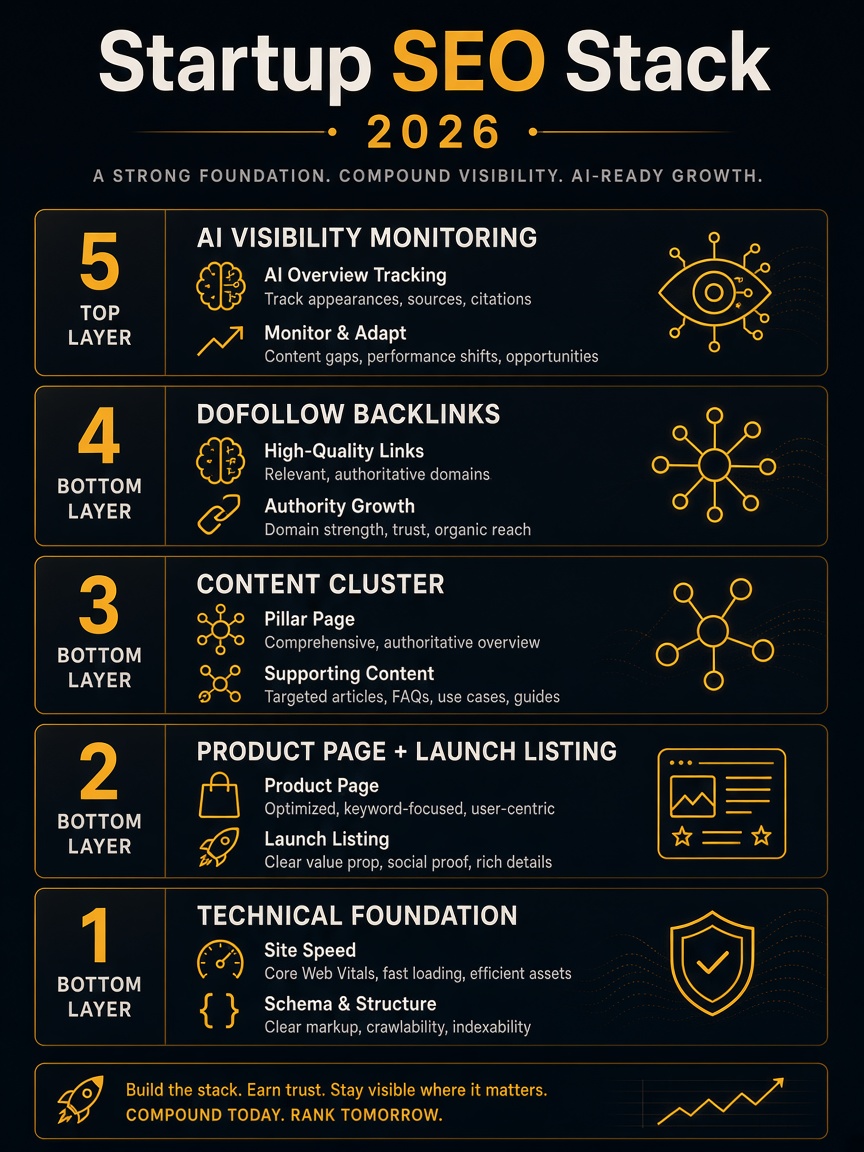
Layer 1: Technical foundation
You do not need a perfect Lighthouse score. You need a site Google and AI crawlers can parse without friction:
- Indexable product page at a stable URL (homepage or
/product) - Title tag + meta description with your primary category keyword
- Core Web Vitals in the green on mobile (PageSpeed Insights is free)
- SoftwareApplication or Product JSON-LD with name, description, url, offers/pricing
- Sitemap + robots.txt that do not accidentally block key pages
- Canonical tags so www/non-www and trailing-slash duplicates do not split equity
Run Google Search Console from day one. It is the only tool that shows which queries already send impressions - free buyer-intent data most startups ignore for months.
Layer 2: Product page + launch listing
Your site is the source of truth. A third-party product listing is the corroboration layer - critical for both Google entity understanding and AI answer visibility.
Launch on Founder.best because it gives you:
- Permanent product page at
founder.best/products/your-slug(stays indexable after homepage rotation) - Dofollow backlink on paid plans instantly; free launches from launch week onward
- Founder profile at
founder.best/yournamelinking back to your launches - Weekly homepage visibility and community upvotes during launch cycle
- Category discovery in SEO-relevant verticals (marketing, AI, analytics, etc.)
Plans from $0 Free Launch (limited weekly slots, admin review) to $2.99 Standard (instant go-live, 2 weeks homepage, dofollow backlink, newsletter) to $9 Pro (1 month visibility, premium badge, starter upvotes). For most bootstrapped teams, Standard is the fastest startup SEO win: you get launch traffic and a verified dofollow link in one step.
Before you submit, use Founder.best free tools at /tools:
- Domain Rating checker - benchmark your site and competitors
- Tagline generator - sharpen your listing hook
- Slug checker - pick a clean product URL
- Launch checklist - do not skip pre-launch SEO steps
Layer 3: Topical content cluster
Startup SEO content is not "blog more." It is 5–10 interlinked pages around one buyer theme - the same approach enterprise sites call topical authority, sized for a solo founder.
Example cluster if you sell SEO software (like SEOFarmer):
- "SEO for startups (2026)" ← you are reading this
- "Best keyword research tools for bootstrapped SaaS"
- "How to connect Google Search Console to your product"
- "AI content briefs vs AI-generated posts: what ranks"
- "[Your product] vs Ahrefs for indie founders"
Rules for startup SEO content:
- Match intent - study top 5 Google results before writing; match format (guide vs comparison vs list)
- Add information gain - screenshots, pricing tables, launch numbers, workflow diagrams
- Internal link aggressively - every article links to product page + 2 sibling articles
- Update quarterly - refresh dates, pricing, and stats; stale pages lose clicks and AI citations
One strong cluster beats twenty unrelated posts. Google and AI systems both reward sites that look like the go-to source on a topic - not a random blog.
Layer 4: Dofollow backlinks (quality over volume)
Backlinks remain a top ranking signal for startup SEO. The mistake is counting total referring domains in Ahrefs without checking rel attributes.
Before you count a link:
- Is the page indexed in Google?
- Is the link dofollow?
- Is the site relevant to your category?
- Would you show this link to a customer?
Proven free backlink channels for startups:
- Curated launch platforms with permanent dofollow product pages (Founder.best, niche directories in your vertical)
- Integration pages on complementary tools ("Works with [your product]")
- Guest posts on niche blogs (confirm bio links are dofollow)
- Original data or benchmarks journalists cite without a pitch deck
- Open-source or free tools that earn natural links (calculators, checkers, templates)
Avoid: 200-directory blasts, PBN packages, paid DR boosters. They pollute your profile and rarely move rankings for startup SEO.
Read the deep dive: High authority backlinks for founders.
Layer 5: AI SEO and GEO for startups
This is the layer most "seo for startups" guides still ignore - and it is why buyers discover competitors in ChatGPT before they ever hit Google.
AI SEO (often called GEO - Generative Engine Optimization) means making your brand easy for large language models to find, verify, and cite:
- Entity consistency - same product name, pricing, and one-line description on your site, Founder.best listing, and social profiles
- Structured data - JSON-LD so facts are machine-readable
- llms.txt - a text file at
yourdomain.com/llms.txtlisting your canonical URLs (product, pricing, docs, top guides) - Cite-worthy pages - comparisons, pricing explainers, category definitions with honest tradeoffs
- Third-party corroboration - launch listings, founder stories, press mentions on trusted domains
Monthly, prompt 10–15 buyer questions across ChatGPT, Perplexity, and Claude:
- "Best [category] for bootstrapped founders?"
- "Alternatives to [competitor]?"
- "How much does [your product] cost?"
Log whether you are named, whether facts are accurate, and which competitors appear instead. Fix drift on your product page and listing first - not with keyword stuffing.
Full playbook: Increase SaaS brand visibility in AI answers and AI search visibility tools for SaaS.
How to use AI for startup SEO (without publishing fluff)
AI belongs in your startup SEO workflow - not as a replacement for proof.
Use AI for (safe, high-leverage tasks)
- Keyword clustering - group 50 long-tail terms into 3–5 cluster themes
- Content briefs - outline H2s, questions to answer, internal links to include
- Schema drafts - generate JSON-LD skeletons you validate manually
- Meta title/description variants - pick the best after human edit
- Competitor page summaries - speed up comparison research, then add your own screenshots
- FAQ expansion - turn support tickets into FAQ schema candidates
- AI mention monitoring prompts - templated buyer questions for monthly GEO logs
Do not use AI for (ranking killers)
- Publishing 30 generic listicles with no original data
- Auto-generating "best tools" pages you have not used
- Copying competitor content structure without information gain
- Hiding AI content without human review on YMYL-adjacent topics (finance, health, legal)
Google and AI systems both reward verifiable facts. A Founder.best founder story with real MRR milestones, or a launch retro with conversion numbers, outperforms polished AI prose every time.
Publish on /stories for long-form build-in-public narratives that compound startup SEO and entity signals from a trusted domain.
90-day SEO plan for startups
A realistic seo for startups timeline for a bootstrapped team (5–8 hours/week):
Days 1–14: Foundation + launch
- Fix product page: title, meta, schema, pricing clarity, mobile speed
- Create
llms.txtpointing to product, pricing, and top 3 guides - Submit sitemap in Search Console
- Launch on Founder.best - Free Launch ($0) or Standard ($2.99) for instant dofollow backlink
- Embed Founder.best badge on your site (extra dofollow link back to your listing)
- Publish one launch retro with real numbers
Days 15–45: Content cluster (phase 1)
- Pick one keyword theme (3–5 winnable terms)
- Publish pillar page (2,000+ words, screenshots, FAQ schema)
- Publish 2 supporting articles interlinked to pillar + product page
- Respond to 2 journalist queries/week if relevant (free digital PR)
Days 46–90: Authority + AI layer
- Publish 2 more cluster articles
- Secure 1 additional dofollow link (guest post, integration, or second quality launch listing)
- Run first AI mention audit (15 prompts, log results)
- Refresh pillar page with updated stats and internal links
- Check Domain Rating monthly - track dofollow referring domains, not daily DR swings
Most founders see first organic signups from long-tail terms between weeks 8 and 16 if the product page and backlink layer are solid.
Common startup SEO mistakes
These kill startup SEO more often than "not enough content":
- Chasing head terms - "project management software" on day 30 instead of "project management for remote startups under 10 people"
- Nofollow-only launch stack - Product Hunt traffic without a single dofollow product page elsewhere
- Thin AI content farms - 40 posts, zero screenshots, zero backlinks, zero rankings
- Ignoring Search Console - missing impressions you could win with one hour of on-page edits
- Inconsistent entity data - different pricing on site vs Founder.best vs AI directories (models trust consistent facts)
- No product updates after launch - stale listing pages signal abandonment to crawlers; post updates on Founder.best product page
- Tracking vanity metrics - total impressions without organic signup attribution
Fix the backlink and entity layer before you write article #25.
Where Founder.best fits in your startup SEO stack
Founder.best is not a replacement for Google Search Console or Ahrefs. It is the launch + corroboration layer purpose-built for indie founders who need startup SEO infrastructure without enterprise pricing:
| Need | Founder.best answer |
|---|---|
| Dofollow backlink | Permanent product page; paid plans instant, free from launch week |
| Entity signal for AI | Indexable third-party listing + founder profile + stories |
| Launch-week traffic | Weekly homepage rankings, upvotes, newsletter (paid tiers) |
| Free SEO utilities | Domain Rating checker, tagline/slug tools, launch checklist at /tools |
| Post-launch freshness | Product updates and relaunch scheduling from dashboard |
Stack Founder.best with one primary content cluster, Search Console, and (when budget allows) Ahrefs or Semrush for keyword and backlink research. Add an AI mention monitor once MRR supports $50–200/month - not before your product page and listing are airtight.
Compare launch SEO options: How to get more reach for your startup and the SaaS launch checklist.
Metrics that matter for startup SEO
Track monthly - not daily:
- Dofollow referring domains (Ahrefs or manual spot checks)
- Organic sessions + signups from Search Console + your analytics
- Top 10 keyword count for long-tail cluster terms
- Indexed pages vs submitted pages
- AI mention rate - % of buyer prompts where you are named (GEO log)
- Listing freshness - last product update on Founder.best and your site
Domain Rating is a lagging summary, not a daily KPI. Read Ahrefs Domain Rating explained before obsessing over the number.
Start this week
SEO for startups is not a someday project. If your product is live, the compounding clock already started - with or without you.
Minimum viable startup SEO stack for this week:
- Ship schema on your product page
- Add
llms.txt - Launch on Founder.best for a dofollow listing and founder profile
- Outline one content cluster around a keyword you can win in 90 days
- Log 15 AI buyer prompts and see who gets cited today
Launch once. Stay discoverable. Let search and AI answers compound while you build the product.
Key takeaways
- SEO for startups means compounding discovery - not chasing DR 70 links on day one. Focus on product-page clarity, topical content, and verified dofollow backlinks.
- In 2026, startup SEO includes AI answer visibility (GEO): models cite brands they can verify across trusted third-party pages.
- Launch on Founder.best for a permanent product page, dofollow backlink, founder profile, and weekly homepage visibility from $0 (free launch) or $2.99 (Standard).
- Use AI for keyword clustering, briefs, and schema drafts - publish only pages with original proof, screenshots, or data.
- Track dofollow referring domains and organic signups monthly; add AI mention monitoring once you have product-market fit.
Frequently asked questions
What is SEO for startups?
SEO for startups is the practice of earning qualified traffic from organic search without a large paid budget. It combines technical site health, indexable product pages, topical content, dofollow backlinks, and - in 2026 - AI answer visibility so ChatGPT, Perplexity, and Google AI Overviews can cite your brand accurately.
How long does SEO take for a startup?
Low-competition long-tail keywords often move in 8–16 weeks with a solid product page and a few quality backlinks. Medium-competition terms typically take 4–8 months. Plan in quarters: launch month for backlinks and entity signals, months 2–4 for content clusters, months 4–12 for compounding rankings and AI citations.
Is SEO worth it for early-stage startups?
Yes - if you treat it as compounding infrastructure, not a launch-day trick. A permanent dofollow product listing, one topical content cluster, and a canonical product page cost far less than ads and keep sending traffic after launch week ends. Skip SEO only if you have no live product page yet.
What is the difference between startup SEO and enterprise SEO?
Enterprise SEO optimizes thousands of pages with dedicated teams and brand budgets. Startup SEO prioritizes one product URL, 5–15 quality backlinks, a winnable keyword cluster, and entity consistency across launch platforms. Speed and focus beat volume.
How does AI change SEO for startups?
Buyers now ask AI tools the same questions they used to Google. Startup SEO must include GEO (Generative Engine Optimization): structured data, llms.txt, cite-worthy comparisons, and third-party mentions on trusted directories and launch platforms so models can verify your product name, category, and pricing.
Can I use AI to write SEO content for my startup?
Use AI for outlines, keyword clustering, meta drafts, and schema snippets - not for publishing generic 800-word posts with no proof. AI-written fluff rarely ranks or gets cited. Pages with screenshots, pricing tables, launch numbers, or original data outperform pure AI output.
Does Founder.best help with startup SEO?
Yes. Every approved launch on Founder.best gets a permanent, indexable product page with a dofollow backlink (paid plans immediately; free launches from launch week). You also get founder profile linkage, category discovery, community upvotes, and optional founder stories - all entity signals that help Google and AI systems corroborate your brand.
What are the best free SEO tools for startups?
Google Search Console, Google PageSpeed Insights, and manual AI prompt testing are free essentials. Founder.best offers free launch tools at /tools including a Domain Rating checker, tagline generator, slug checker, and launch checklist. Add one paid SEO suite (Ahrefs or Semrush) when MRR justifies it.
How many backlinks does a startup need for SEO?
Quality beats quantity. Many bootstrapped SaaS sites see meaningful early movement with 5–15 verified dofollow links from relevant domains - launch pages, one editorial mention, an integration listing, and a few cite-worthy articles. One strong editorial link outweighs dozens of spam directory links.
Should startups do SEO or paid ads first?
Run both if you can measure conversion, but prioritize SEO infrastructure early: product page, schema, one launch listing with dofollow backlink, and a content cluster. Paid ads stop when budget stops; SEO and directory listings compound. Most indie founders under-invest in the backlink and entity layer.
Keep reading
Ready to launch on Founder.best?
Weekly rankings, dofollow SEO backlinks, founder stories, and a community built for indie makers.
Submit your startup