SEO for founders
How to increase your SaaS brand's visibility in AI answers: the 2026 GEO playbook
When buyers ask ChatGPT, Perplexity, or Claude which tool to use, your SaaS either shows up as a cited source - or it does not. Here is how to increase your SaaS brand's visibility in AI answers without guessing what the models want.

Post by Anuj Shashimal
Founder, Founder.best15 min read
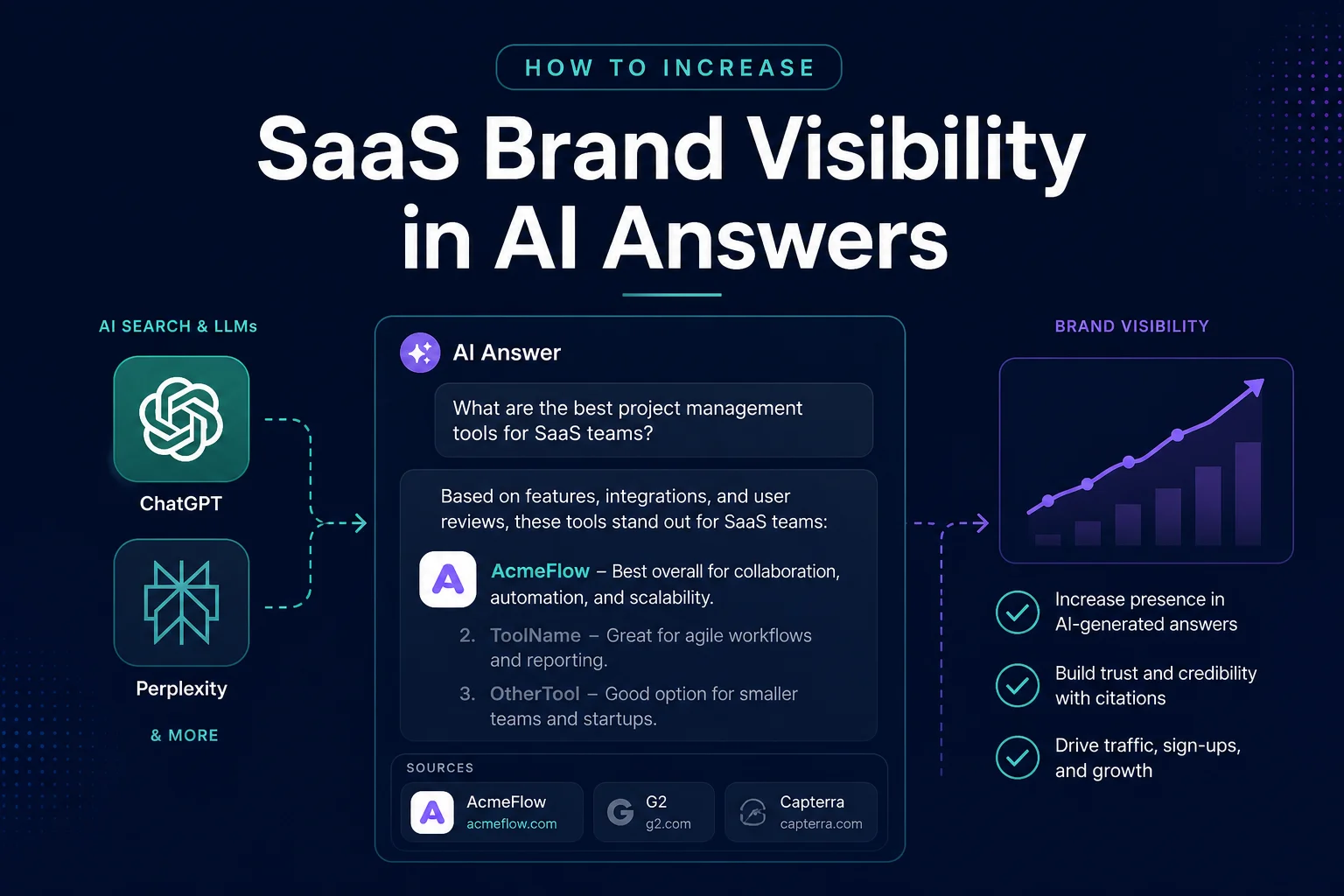
If you searched how to increase my SaaS brand's visibility in AI answers, you already noticed the shift: buyers are not only Googling "best CRM for startups" - they are asking ChatGPT, Perplexity, Claude, and Gemini the same question and trusting the summarized answer. That changes what "SEO" means for SaaS founders. Ranking in AI answers is not about tricking a model. It is about becoming the brand models can find, verify, and cite when someone asks for a recommendation in your category. This guide is the practical playbook we use at Founder.best - launch platform, founder stories, and weekly discovery for indie SaaS - to help founders increase visibility in AI-generated answers without a six-figure marketing budget.
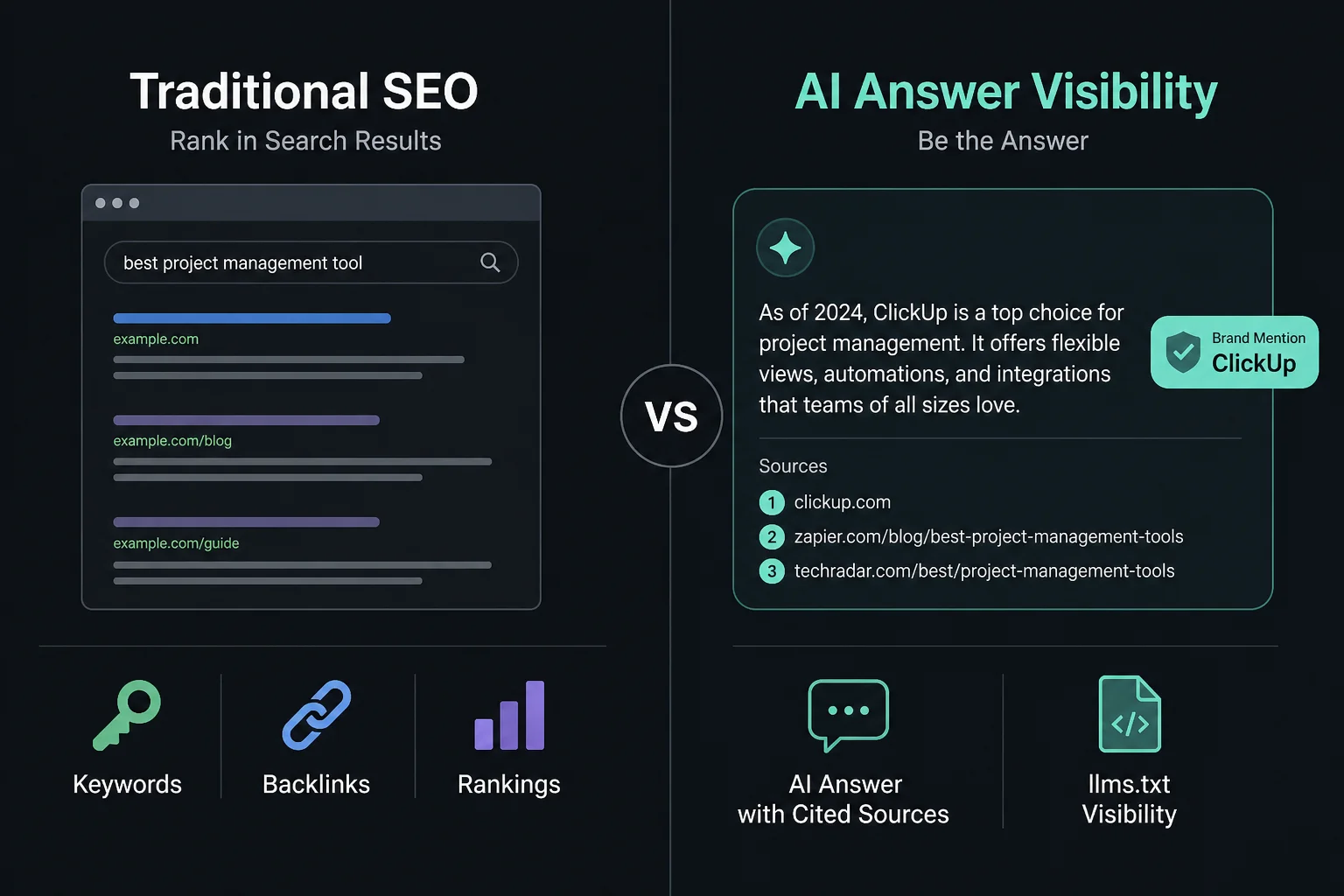 Traditional SEO vs AI answer visibility for SaaS brands
Why SaaS brands need AI answer visibility in 2026
Traditional SEO still matters. But the discovery funnel split: some users click ten blue links; others read one AI answer and shortlist two products. For SaaS, AI answer visibility means your brand name appears when prospects ask:
- "What is the best [category] tool for bootstrapped founders?"
- "Alternatives to [competitor] for [use case]?"
- "How much does [your product] cost?"
If your SaaS is absent from those answers, you are invisible to a growing slice of high-intent buyers - even if your Google rankings are fine. The founders winning in 2026 treat AI visibility as entity building: making sure every trusted page on the internet agrees on who you are, what you do, and who you are for.
What AI systems actually cite
Large language models do not browse randomly. They synthesize from sources they already associate with authority: indexed web pages, retrieval-augmented search results, and training-era patterns reinforced by fresh crawls. When you increase your SaaS brand's visibility in AI answers, you are optimizing for citation eligibility:
- Named entities - product name, company name, founder name used consistently
- Corroboration - the same facts on your site, launch pages, directories, and press
- Extractable facts - pricing, features, category, integrations in plain language
- Trust signals - backlinks from sites models already weight (directories, launch platforms, reputable blogs)
Models rarely cite pages they cannot verify. A landing page that says "best AI tool ever" with no third-party mention is noise. A product page on Founder.best that says "weekly launch platform for indie founders, from $9" - linked from your site, your founder profile, and a founder story - is a signal.
The GEO stack for SaaS founders
GEO (Generative Engine Optimization) is the layer on top of classic SEO focused on AI retrieval and citation. Think of it as five stacked layers:
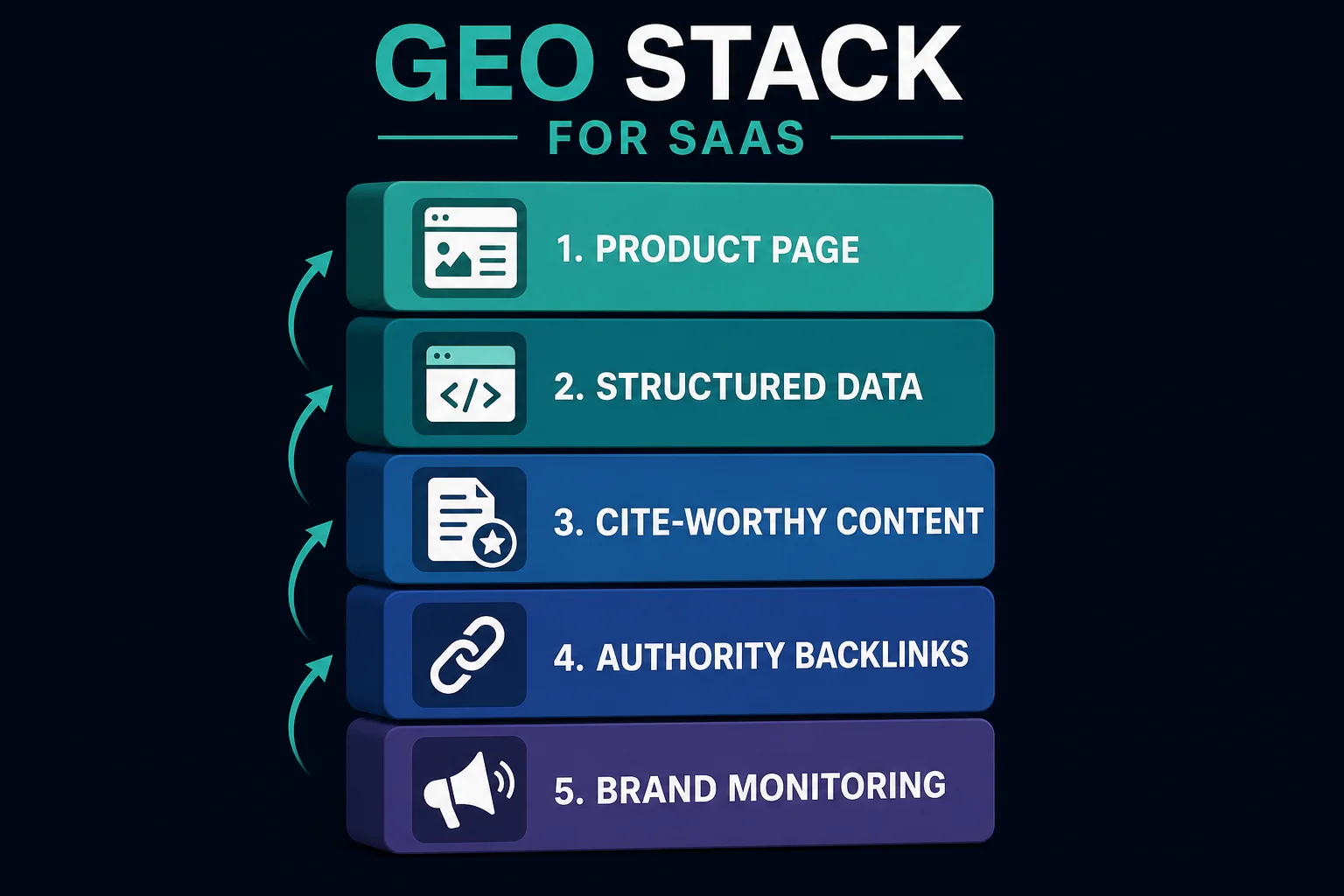 GEO stack for SaaS - product page, schema, content, backlinks, monitoring
Layer 1: One canonical product page
Pick one URL as the source of truth: your homepage or a dedicated /product page. Every other mention should align with it - same product name spelling, same pricing, same one-line description.
On Founder.best, that is your permanent listing at founder.best/products/your-slug. It stays indexable after launch week ends, carries a dofollow backlink to your site, and gives AI systems a third-party product record.
Layer 2: Structured data (schema.org)
Add SoftwareApplication or Product JSON-LD on your site: name, description, url, applicationCategory, offers (pricing), aggregateRating if you have reviews.
Structured data does not guarantee AI citations, but it makes facts machine-readable. Models and search crawlers extract the same fields you want cited in answers.
Layer 3: Cite-worthy content
Publish pages AI systems want to reference:
- Category definers - "What is [category]?" with a clear, neutral explanation
- Comparison pages - "[You] vs [Competitor]" with honest tradeoffs
- Pricing explainers - transparent tiers, who each plan is for
- Original data - benchmarks, surveys, usage stats only you have
Founder.best blog posts and founder stories serve this layer from a trusted domain - especially when they mention your product in context (category, pricing, use case) without sounding like ad copy.
Layer 4: Authority backlinks and directory presence
AI systems trust brands mentioned on sites they already know. High-authority backlinks and curated directory listings are corroboration signals. Launch on Founder.best for:
- Permanent product page with dofollow SEO
- Weekly homepage visibility and community upvotes
- Founder profile linkage (
founder.best/yourname) - Founder stories for long-form build-in-public narratives
Stack 2–3 quality launch listings over 10–14 days rather than spraying fifty low-trust directories. One strong entity mention beats twenty spam listings.
Layer 5: Monitor and iterate
Monthly, prompt 10–15 buyer-intent questions in ChatGPT, Perplexity, and Claude:
- Are you mentioned by name?
- Are your competitors cited instead?
- Is the pricing or feature description accurate?
Log results in a spreadsheet. Double down on pages that already get cited; fix factual drift on pages that describe you wrong.
llms.txt: point models at your best URLs
llms.txt is a simple convention: a text file at yourdomain.com/llms.txt listing the pages you want AI systems to prioritize.
Example structure:
- Product overview URL
- Pricing page
- Documentation / API reference
- Top 3 guides or comparisons
llms.txt does not replace SEO. It reduces ambiguity - especially for young SaaS brands with blog clutter and duplicate landing pages. Founder.best publishes llms.txt for the platform itself; your SaaS should do the same for your product facts.
Founder stories: the underrated AI visibility channel
Blog SEO playbooks rarely mention founder essays. They should. A founder story on Founder.best does three things for AI visibility:
- Entity reinforcement - links your name, product name, and category in natural language
- Long-tail coverage - "how I increased visibility," "why we built X," "lessons from launch week"
- Fresh crawl signals - new indexed content on a domain models already associate with startups
Write honestly about your stack, your launch, and your category. Do not keyword-stuff. Models cite narratives that read human because they are human. Pair every launch with one founder story within 14 days. Link the story from your product page and your Founder.best listing.
A 30-day action plan to increase AI answer visibility
Week 1 - Foundation
- Audit product name consistency across site, social, and directories
- Add SoftwareApplication schema to your homepage
- Create
llms.txtwith 5–8 canonical URLs - Submit or update your Founder.best product page
Week 2 - Corroboration
- Launch or relaunch on Founder.best (Free or Standard from $9)
- Publish one comparison or "what is [category]" article on your blog
- Ensure pricing on your site matches your Founder.best listing exactly
Week 3 - Cite-worthy asset
- Ship one original asset: benchmark, checklist, pricing breakdown, or data snippet
- Publish a founder story about why you built the product
- Pitch the asset to 3 communities where your buyers hang out (with link, not spam)
Week 4 - Measure and fix
- Run 15 buyer-intent prompts across AI tools; log mentions
- Fix any wrong pricing or feature descriptions you find
- Update your top-cited page with fresher data and a "Last updated" date
Repeat quarterly. AI visibility compounds like SEO - it is not a one-week stunt.
Founder.best vs DIY AI visibility hacks
Founders ask whether they need a launch platform at all. You can DIY everything - but most bootstrapped teams skip the corroboration layer because it is tedious. Founder.best is built to supply that layer affordably:
| Tactic | DIY | With Founder.best |
|---|---|---|
| Indexable product page | Your site only | Your site + permanent /products/[slug] |
| Dofollow backlink | Hope for press | Included on every approved launch |
| Third-party product record | Manual outreach | Auto-generated listing with categories |
| Founder entity page | LinkedIn only | Public founder profile + leaderboard |
| Long-form brand narrative | Your blog | Founder stories indexed on platform |
| Weekly discovery spike | Paid ads | Community upvotes + newsletter features |
AI answer visibility is a trust problem. Founder.best gives models another trusted place to verify you exist, what you charge, and who you serve.
Common mistakes that kill AI citations
- Inconsistent product names - "AcmeAI" on site, "Acme AI" on directories, "acme" in press
- No pricing on page - models skip brands they cannot quote accurately
- Thin AI-generated blog spam - 50 posts, zero original data; nothing cite-worthy
- Orphan product pages - no internal links, no external mentions, no schema
- Ignoring factual drift - AI answers describe old pricing for months because you never checked
- One-day launch only - spike traffic with no permanent listing; entity signal fades
Avoid these and you are already ahead of most SaaS brands asking about AI visibility.
What to track (metrics that matter)
Skip vanity "AI traffic" dashboards that cannot attribute reliably yet. Track:
- Brand mention rate - % of target prompts where you appear by name
- Citation URL rate - % of answers linking to your domain
- Dofollow referring domains - monthly growth (Ahrefs, Semrush, or free alternatives)
- Indexed pages - product, pricing, top guides in Google Search Console
- Launch listing completeness - Founder.best page filled: logo, tags, description, TrustMRR if applicable
If brand mention rate climbs while referring domains grow, AI answer visibility usually follows.
The long game: entity + launch + content
There is no hack to force ChatGPT to recommend your SaaS tomorrow. There is a system:
- Entity - one clear product identity everywhere
- Launch - third-party verification on Founder.best and 1–2 peer platforms
- Content - cite-worthy pages only you can publish
- Monitor - fix drift before competitors define you
That is how to increase your SaaS brand's visibility in AI answers in 2026 - not by gaming prompts, but by becoming the obvious, verifiable answer when models go looking for sources.
Ready to build the corroboration layer? Launch on Founder.best - free and paid plans available - and publish your first founder story within two weeks of going live.
Key takeaways
- AI visibility is entity visibility: models cite brands they can verify across multiple trusted pages.
- Your product page must be the canonical source of truth - tagline, pricing, features, and founder identity in one indexable URL.
- GEO (Generative Engine Optimization) rewards original data, clear definitions, and pages other sites link to.
- Launch on Founder.best for a permanent dofollow product page, weekly discovery, and founder stories that compound entity signals.
- Track AI brand mentions quarterly; optimize pages that already get cited, not vanity prompt spam.
Frequently asked questions
How do I increase my SaaS brand's visibility in AI answers?
Publish a definitive product page, add structured data (SoftwareApplication schema), create cite-worthy comparison and how-to content, earn backlinks from authoritative directories and launch platforms, publish founder stories that explain your category, and maintain an llms.txt file pointing models to your best URLs. Consistency across sources matters more than keyword stuffing.
What is GEO for SaaS?
GEO (Generative Engine Optimization) is the practice of making your brand easy for large language models to find, verify, and cite. For SaaS, that means clear product metadata, third-party mentions, original research, and pages structured so AI systems can extract accurate facts about your tool.
Does Founder.best help with AI answer visibility?
Yes. Every approved launch gets a permanent, indexable product page with a dofollow backlink, founder profile linkage, and optional founder stories. Those pages give AI systems a verified third-party mention of your product name, category, pricing, and URL - entity signals that help models recommend you in answers.
Should I create an llms.txt file for my SaaS?
Yes, if you want models to discover your canonical pages faster. llms.txt is a simple text file at yourdomain.com/llms.txt listing your product page, docs, pricing, and key guides. It does not guarantee citations, but it reduces ambiguity about which URLs represent your brand.
How long until my SaaS shows up in AI answers?
There is no fixed timeline. Brands with clear product pages, existing backlinks, and category-relevant content often see mention growth within 8–12 weeks of publishing cite-worthy assets and earning directory listings. New domains should expect longer - focus on entity consistency first.
Is AI visibility different from Google SEO?
Overlapping but not identical. Google SEO optimizes for blue-link rankings; AI answer visibility optimizes for being named and cited inside generated responses. Both reward authoritative pages, but AI systems weight brand consistency, definitional clarity, and cross-site corroboration heavily.
What content gets cited in AI answers?
Original benchmarks, comparison tables, pricing breakdowns, category definitions, implementation guides, and data-backed reports. Thin listicles and generic AI-generated fluff rarely earn citations because models cannot verify the claims.
Can I pay to appear in ChatGPT answers?
There is no official paid placement for organic AI answers today. Tactics that work are the same as durable SEO: be the best source on a topic, earn mentions on trusted sites, and keep your product facts accurate everywhere they appear.

About the author
Anuj Shashimal
Founder, Founder.best
SaaS founder, indie hacker, and software engineer. Anuj built Founder.best to help indie founders launch, get discovered through search and AI answers, and turn launches into customers. He writes from first-hand experience growing Founder.best from zero to 400+ founders and 300+ launched products.
Tagged in
Browse all tagsKeep reading
Free tools and guides for this topic
Hand-picked from the tags on this post.
- Free Ahrefs Domain Rating checkerLive DR (0–100) for any domain before you chase a backlink.
- Get your product discovered by AI assistantsWhich listing fields make your product rank for the right questions.
- Browse blog posts by topicSEO, backlinks, launch platforms, AI search, startup tools, and more.
- Free SaaS directories for backlinksList of free SaaS and startup directories with dofollow filters, Ahrefs DR scores, and a submission checklist.
- Startup launch statistics & researchOriginal launch data plus sourced figures on AI search and startup failure.
- Directories & SEOWhich startup directories give dofollow backlinks in 2026? Launch platforms, SaaSHub, AI directories, and…
Ready to launch on Founder.best?
Weekly rankings, dofollow SEO backlinks, founder stories, and a community built for indie makers.
Submit your startup