SEO for founders
AI search visibility tools for SaaS: what to use, what to skip, and how to stack them in 2026
AI search visibility tools for SaaS fall into four buckets: mention monitors, SEO suites with AI modules, technical/schema helpers, and launch platforms that create third-party citations. Here is how to pick the right stack without buying six overlapping subscriptions.

Post by Anuj Shashimal
Founder, Founder.best14 min read
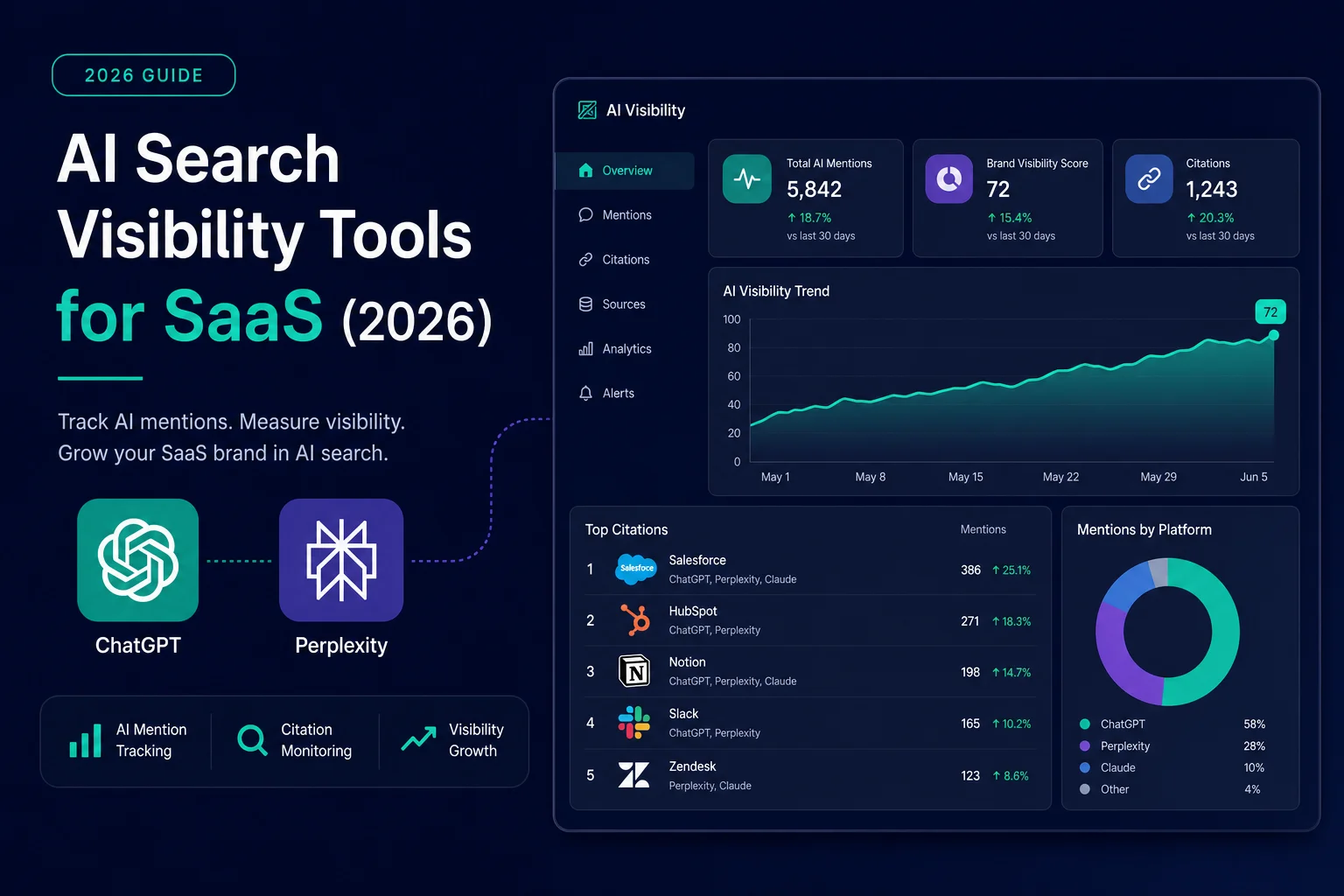
SaaS founders searching ai search visibility tools saas are usually past the "is this real?" phase. They asked ChatGPT for a recommendation in their category - and their product was not on the list. Now they want software to fix it. Here is the honest framing: ai search visibility tools help you measure and improve how often LLMs name, describe, and link to your brand. None of them can force a citation. What they can do is show gaps, track competitors, flag wrong pricing in AI answers, and nudge you toward the pages and mentions models already trust. This guide ranks the tool categories SaaS teams actually use in 2026, what each layer costs, and where Founder.best fits as the launch-and-corroboration layer most GEO checklists forget.
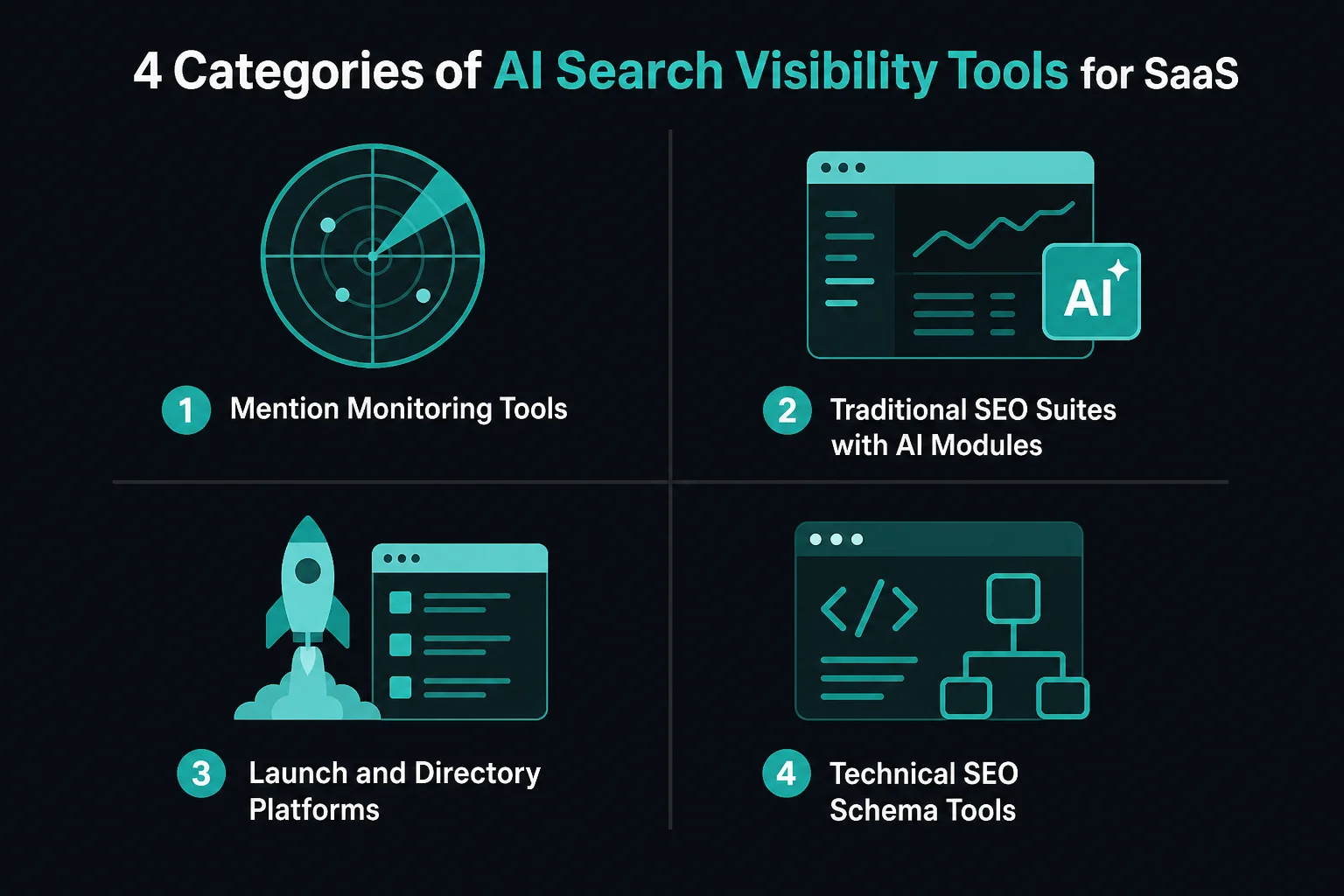 Four categories of AI search visibility tools for SaaS
What ai search visibility tools for SaaS actually do
Before you buy anything, separate monitoring from optimization:
- Monitoring tools - run prompts across AI surfaces and log whether your brand appears, which URLs get cited, and how answers describe you
- SEO suites with AI modules - extend Ahrefs, Semrush, or similar with AI overview / citation tracking on top of classic keyword and backlink data
- Technical helpers - schema validators, site auditors, llms.txt generators that make your facts machine-readable
- Launch and directory platforms - create third-party product records models use to verify you exist (Founder.best, category directories, comparison sites)
AI search visibility tools saas buyers often overlook the fourth bucket. Models rarely cite a brand that only exists on its own homepage. They want corroboration - the same product name, category, and pricing on a trusted external page.
Category 1: AI mention monitoring tools
These are the purest ai search visibility tools - built specifically for GEO-era tracking.
What they typically track:
- Brand mentions in ChatGPT, Perplexity, Claude, Gemini, and sometimes Google AI Overviews
- Citation URLs (which page the model linked or implied)
- Competitor mention share for the same prompt set
- Sentiment and factual accuracy flags
Examples in this category (landscape shifts fast - verify features before buying):
- Otterly.ai - AI search monitoring and brand mention tracking
- Peec AI - prompt-based visibility analytics for brands
- Profound - enterprise-oriented AI answer intelligence
- Emerging GEO dashboards - new tools launch monthly; evaluate on prompt coverage and export quality
Best for: SaaS teams with $2k+ MRR who need automated weekly reports instead of a manual spreadsheet.
Skip if: You have no product page worth citing yet. Monitors will show zero mentions until you fix the foundation.
Bootstrapped alternative (free): Create a Google Sheet with 15 buyer-intent prompts. Run them manually in ChatGPT and Perplexity on the 1st of each month. Columns: prompt, mentioned (Y/N), competitors named, URL cited, pricing accurate (Y/N).
Category 2: Traditional SEO tools with AI visibility modules
If you already pay for Ahrefs or Semrush, check their AI visibility or brand radar add-ons before buying a standalone GEO tool.
What they add on top of classic SEO:
- AI overview appearance tracking in Google
- Brand mention trends tied to your existing keyword projects
- Overlap between ranking URLs and AI-cited URLs
Best for: SaaS marketing teams already living in an SEO suite who want one dashboard.
Limitation: Coverage of non-Google AI chat interfaces varies. Pair with manual Perplexity/ChatGPT checks or a dedicated monitor for full picture.
Still essential for SaaS: Backlink analysis, referring domain growth, and content gap research - AI visibility does not replace these. Models cite pages that already look authoritative; DR and dofollow links still matter.
Category 3: Technical and schema tools
These are not glamorous ai search visibility tools saas founders talk about on Twitter - but they fix the reasons models skip you.
Schema and structured data:
- Google Rich Results Test (free) - validate SoftwareApplication JSON-LD
- Schema markup plugins or custom JSON-LD on your site
- Clear
offerspricing blocks models can extract
Site health:
- Screaming Frog, Sitebulb, or your SEO suite's crawler - fix broken pages, duplicate titles, thin content
- Page speed and mobile usability - still baseline for crawlability
llms.txt:
- Simple text file at
/llms.txtlisting product, pricing, docs, and top guides - Not a monitoring tool - a discovery hint for retrieval systems
Best for: Every SaaS, especially pre-launch. Free tools cover 80% of what you need.
Rule: If ChatGPT describes your pricing wrong, fix the source page first - not the monitor dashboard.
Category 4: Launch platforms (the corroboration layer)
This is where most ai search visibility tools saas roundups fail. They list software dashboards but ignore the entity signals that make citations possible.
Founder.best is a launch platform - not a GEO monitor - but it belongs in your AI visibility stack because it creates durable, indexable third-party records of your product:
- Permanent product page at
founder.best/products/your-slug - Dofollow backlink to your site on every approved listing
- Founder profile linking person → product → category
- Founder stories for long-form narratives models can index
- Weekly discovery and community upvotes for referral traffic
When an LLM evaluates whether to name your SaaS, it weighs whether your brand appears on trusted startup surfaces - not only your own marketing site. A Founder.best listing is structured product metadata on a domain models already associate with indie SaaS.
Best for: Bootstrapped founders who need corroboration without a PR budget. Launch from $0 (free tier) or Standard at $9 for faster go-live.
Stack it with: One mention monitor + your own cite-worthy blog content. Founder.best handles the "verified elsewhere" layer.
How to pick your ai search visibility tool stack
Do not buy four tools in the same category. Use this decision tree:
Stage 1: Pre-revenue or just launched
- Manual prompt log (free)
- Google Search Console (free)
- Schema on product page (free)
- llms.txt (free)
- Founder.best launch for third-party listing
Monthly cost: $0–$3
Stage 2: $1k–$5k MRR
- Everything in Stage 1
- Ahrefs or Semrush Lite (if not already)
- One dedicated AI mention monitor
- One cite-worthy article per quarter (comparison, pricing guide, category explainer)
Monthly cost: ~$50–$150
Stage 3: $5k+ MRR, competitive category
- Automated monitoring with competitor benchmarks
- Digital PR or data studies for link-worthy assets
- Relaunch on Founder.best for updates + fresh crawl signals
- Founder story after each major launch
Monthly cost: $150–$500+ depending on suite tier
Tool comparison: what each layer solves
| Layer | Job | Example tools | Founder.best role |
|---|---|---|---|
| Monitor | Track AI mentions & citations | Otterly, Peec, manual log | - |
| SEO suite | Rankings, backlinks, gaps | Ahrefs, Semrush | Complements with dofollow listing |
| Technical | Schema, crawl health, llms.txt | GSC, Rich Results Test | Listing mirrors your product facts |
| Launch / GEO entity | Third-party corroboration | Founder.best, niche directories | Primary fit - permanent product page |
The best ai search visibility tools saas strategy treats Founder.best as the corroboration layer - the place models verify your product exists outside your own domain.
Metrics your tools should report (and what to ignore)
Track these:
- Brand mention rate - % of your 15 standard prompts where you appear by name
- Citation URL rate - answers that link to your domain
- Factual accuracy score - pricing and feature description correct vs wrong
- Competitor share - who else gets named for the same prompts
- Dofollow referring domains - monthly trend from your SEO tool
Ignore or deprioritize:
- Unattributed "AI traffic" spikes with no conversion data
- Daily mention noise in non-buyer prompts ("write me a poem about SaaS")
- Tool-generated "visibility scores" with opaque methodology
AI search visibility tools saas teams trust are the ones that export raw prompt results you can audit yourself.
30-day implementation plan
Week 1 - Baseline
- Run 15 buyer-intent prompts manually; save results
- Audit product page: name, pricing, category, schema
- Publish
llms.txt
Week 2 - Corroboration
- Submit or update your Founder.best listing
- Ensure pricing matches your site exactly
- Add 2–3 internal links to your best guide from the homepage
Week 3 - Content
- Publish one comparison or "best [category] tools" page with honest tradeoffs
- Write a short founder story about your category
Week 4 - Tooling
- Pick one monitor OR enable AI module in existing SEO suite
- Re-run the same 15 prompts; compare to Week 1
- Fix any factual errors found in AI answers
Repeat monthly. Mention rate should climb as referring domains and corroboration pages accumulate.
Common mistakes when buying ai search visibility tools
- Buying monitors before fixing the product page - tools report zero; you blame the tool
- Ignoring launch platforms - no third-party listing means weak entity signals
- Overlapping subscriptions - two GEO monitors, no content budget
- Chasing vanity prompts - tracking branded queries you already own
- No competitor benchmark - mention rate means nothing without context
- Set and forget - AI answers drift; pricing goes stale for months
Where Founder.best fits in your GEO stack
We built Founder.best for indie founders who need launch visibility and SEO that compounds - which turns out to be exactly what AI citation systems reward.
You get:
- Indexable product metadata models can crawl
- Dofollow link equity from a startup-trusted domain
- Founder identity tied to product (person + company entity)
- Long-form stories indexed on the same platform
- Weekly rankings for ongoing discovery - not a one-day spike
ai search visibility tools saas guides often end with "buy a dashboard." The founders winning in 2026 stack a dashboard plus corroboration plus cite-worthy content. Founder.best is the corroboration piece - affordable, permanent, and built for bootstrapped teams.
Launch your SaaS on Founder.best → add one mention monitor when ready → publish content worth citing. That is the stack.
Key takeaways
- AI search visibility tools for SaaS split into monitors, SEO suites, technical helpers, and launch/corroboration platforms - you need at least one from each layer, not four monitors.
- No tool guarantees ChatGPT citations; they track mentions, find gaps, and surface factual drift in AI answers.
- Founder.best is a launch-layer tool: permanent product pages, dofollow backlinks, and founder stories that give models a verified third-party record.
- Bootstrapped stacks: manual prompt log + Google Search Console + Founder.best launch + one paid monitor when MRR justifies it.
- Measure brand mention rate monthly across 15 buyer-intent prompts - not vanity "AI traffic" dashboards alone.
Frequently asked questions
What are AI search visibility tools for SaaS?
AI search visibility tools for SaaS help you track whether your product appears in AI-generated answers (ChatGPT, Perplexity, Claude, Gemini), monitor citation accuracy, audit schema and llms.txt, and build the third-party mentions models use to verify your brand. They complement - not replace - traditional SEO software.
Do I need a paid AI visibility tool as an early-stage SaaS?
Not on day one. Start with a free manual prompt log: ask 15 buyer questions monthly across 2–3 AI tools and record whether you are named. Add a paid monitor once you have product-market fit and budget ($50–200/mo category). Fix your product page and earn one directory listing first - tools surface problems you cannot fix without content and corroboration.
What is the best AI search visibility tool for SaaS in 2026?
There is no single winner. Mention monitors (Otterly, Peec, Profound, and similar) excel at tracking AI citations. Ahrefs and Semrush added AI visibility modules for teams already on those suites. Founder.best covers the launch/corroboration layer with permanent product pages and dofollow SEO. Most SaaS teams stack one monitor + one SEO tool + one launch platform.
Can Founder.best improve AI search visibility for my SaaS?
Yes - indirectly but structurally. Founder.best gives you an indexable product listing, dofollow backlink, founder profile, and optional founder stories. AI systems cite brands they can corroborate across trusted pages; a Founder.best listing is exactly that kind of third-party entity signal.
How is GEO different from traditional SEO tools?
Traditional SEO tools optimize for Google rankings: keywords, backlinks, technical audits. GEO (Generative Engine Optimization) tools focus on whether LLMs name and cite your brand in synthesized answers. Overlap exists - both care about authority and accurate pages - but GEO adds prompt-based mention tracking and citation URL monitoring.
What metrics should SaaS founders track for AI visibility?
Brand mention rate (% of target prompts where you appear), citation URL rate (answers linking to your domain), factual accuracy (pricing/features correct), competitor mention share, and dofollow referring domain growth. Skip unverifiable "AI traffic" claims until attribution matures.
Is llms.txt an AI search visibility tool?
llms.txt is a lightweight convention, not SaaS software. It is a text file listing your canonical URLs so crawlers and retrieval systems find your best pages faster. Pair it with schema markup and accurate product pages - it helps discovery, not monitoring.
How often should I run AI visibility checks?
Monthly for early-stage SaaS; bi-weekly if you are in a competitive category or just launched. Run the same 15 prompts each time so trends are comparable. Update product pages within 48 hours when you find wrong pricing or features in AI answers.

About the author
Anuj Shashimal
Founder, Founder.best
SaaS founder, indie hacker, and software engineer. Anuj built Founder.best to help indie founders launch, get discovered through search and AI answers, and turn launches into customers. He writes from first-hand experience growing Founder.best from zero to 400+ founders and 300+ launched products.
Tagged in
Browse all tagsKeep reading
Free tools and guides for this topic
Hand-picked from the tags on this post.
- Free Ahrefs Domain Rating checkerLive DR (0–100) for any domain before you chase a backlink.
- Get your product discovered by AI assistantsWhich listing fields make your product rank for the right questions.
- Free tools for foundersName generator, tagline writer, slug checker, DR checker, launch checklist.
- Free SaaS directories for backlinksList of free SaaS and startup directories with dofollow filters, Ahrefs DR scores, and a submission checklist.
- Startup launch statistics & researchOriginal launch data plus sourced figures on AI search and startup failure.
- Free founder toolsFree tools for startup founders in 2026: launch checklist, name generator, tagline writer, slug checker, and…
Ready to launch on Founder.best?
Weekly rankings, dofollow SEO backlinks, founder stories, and a community built for indie makers.
Submit your startup