Startup tools
10 Best Product-Led Growth Platforms for SaaS Conversion in 2026
Signups are easy to buy. Paying customers aren't. These ten product-led growth platforms help you find where free users get stuck and fix it, from the first session to the upgrade screen. Pricing checked on vendor sites on October 20, 2026.

Post by Anuj Shashimal
Founder, Founder.best19 min read
You launched. Signups came in. A month later, almost none of them are paying. Sound familiar?
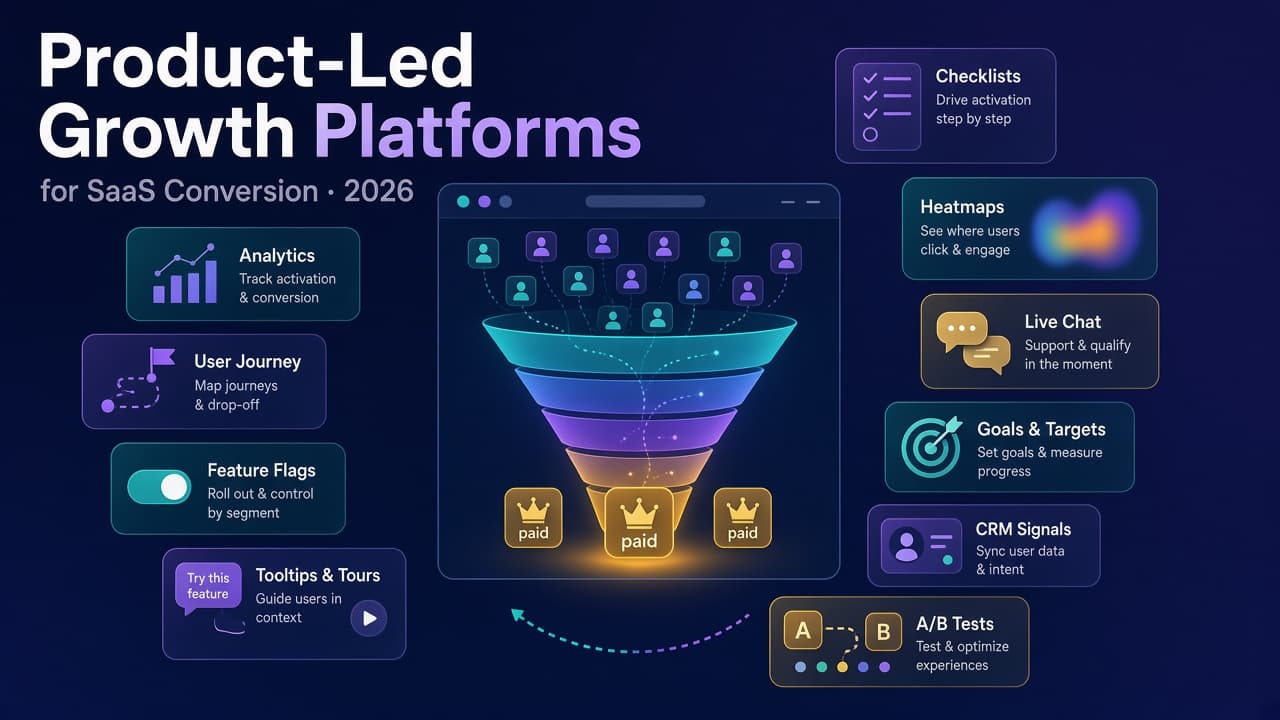
That gap between signup and paid is where most SaaS revenue is won or lost. This guide compares the 10 best product-led growth platforms for SaaS conversion in 2026, grouped by the job each one does, so you can fix the step that's actually leaking instead of buying a stack of tools you don't need.
Quick note on sources: we checked every price and free plan on the vendor's own pricing page on October 20, 2026. Where a vendor doesn't publish prices, we say so.
1. Why SaaS Conversion Needs a Product-Led Growth Strategy
Getting signups is not enough
A signup is a promise, not a customer. Someone typed in an email address because your landing page caught their attention. That's it.
If they log in once, get confused and never return, that signup cost you money and taught you nothing. Plenty of founders hit 1,000 signups and still have fewer than 20 paying customers.
The hard part is free-to-paid conversion
Converting free users into paying customers is hard because each free user has to do three things on their own:
- Understand what your product does for them
- Reach a real result, like a first report, a first invoice sent or a first teammate invited
- Decide that result is worth paying for
In a sales-led company, a salesperson walks the buyer through all three. In a product-led company, the product has to do it.
Benchmarks: what "good" free-to-paid conversion looks like
Before you try to fix conversion, know what normal looks like. In a 2023 survey of over 1,000 software products, Lenny Rachitsky and Kyle Poyar measured the share of new accounts that start paying within six months.
Good free-to-paid conversion rate by pricing model (midpoint of the 'good' range, %)
- Self-serve freemium4%
- Sales-assisted freemium6%
- Reverse trial9%
- Free trial10%
ChartMogul's 2026 SaaS Conversion Report found a similar picture. The median free-to-paid rate across 200 products was 8%, and free trials that ask for a credit card upfront converted at about 30%.
So if your freemium product converts 1% of signups, you have real room to grow, and the fix is almost always inside the product.
Where product-led growth platforms fit
Product-led growth (PLG) platforms are the tools that help the product do the selling. They show you where users drop off, guide them to their first win, nudge them to adopt key features and prompt an upgrade when it makes sense.
What you'll learn in this guide
- What PLG platforms are and how they differ from sales-led tools
- The seven features that matter most for conversion
- The 10 best product-led growth platforms for SaaS conversion, with verified 2026 pricing
- How to choose based on your stage and business model
- A seven-step workflow to raise free-to-paid conversion
- The most common PLG mistakes to avoid
2. What Are Product-Led Growth Platforms?
Definition of product-led growth software
Product-led growth software is any tool that helps your product acquire, activate, convert and keep customers on its own. It usually does two things:
- Measures behavior: what users do, where they stop and what separates users who pay from users who leave
- Changes behavior: onboarding tours, checklists, in-app messages, experiments and upgrade prompts
The best product-led growth platforms for SaaS conversion connect both sides. You see a drop-off, you ship a fix, and you measure whether it worked.
How PLG differs from sales-led growth
| Sales-led growth | Product-led growth | |
|---|---|---|
| First touch | Demo request or sales call | Free plan, trial or self-serve signup |
| Who explains the value | A salesperson | The product itself |
| Main conversion metric | Meetings booked, deals closed | Activation rate, free-to-paid conversion |
| Typical buyer | Executive or committee | The person who'll use the product |
| Core tools | CRM, sales engagement, call recording | Product analytics, onboarding, in-app messaging |
Most SaaS companies end up doing both. PLG brings users in and gets them to value, and sales helps larger accounts upgrade. That's often called product-led sales.
How product experience drives acquisition, retention and revenue
In a product-led company, the product touches every revenue number:
- Acquisition: happy users invite teammates and share what they made, so the product markets itself
- Retention: users who hit their first win early tend to keep coming back
- Revenue: usage limits and premium features turn engaged free users into paying ones
Examples of self-service onboarding and free-to-paid conversion
You already use products built this way:
- Slack lets a team chat for free, then asks for payment once message history and integrations matter
- Canva gives you free designs and charges for premium templates, brand kits and background removal
- Notion is free for individuals, then charges when teams need more collaboration and admin controls
- Calendly books meetings for free, then upgrades users who want multiple event types and integrations
Each one lets you get value first and pay later. The upgrade feels like a natural next step, not a sales pitch.
3. What Features Should You Look for in a PLG Platform?
No tool does all of this well. Use this list to decide which capabilities you need first.
Product analytics and conversion funnels
This is the foundation. You need to see each step from signup to activation to payment, and the share of users who make it through each one.
Look for funnels, retention charts, cohort analysis and the ability to break results down by plan, signup source or company size.
User onboarding and interactive product tours
Once you know where users get stuck, onboarding tools let you guide them past it. That means checklists, tooltips, modals and step-by-step product tours, usually built without code.
In-app messaging and engagement
In-app messages reach users while they're using the product, which is when they're paying attention. Use them for feature announcements, tips, surveys and support.
Customer behavior tracking and session replay
Funnels tell you where users drop off. Session replay shows you why. Watching five recordings of users abandoning the same step often explains more than a week of chart analysis.
A/B testing and experimentation
Every change to onboarding or pricing is a guess until you test it. Experimentation tools let you show different versions to different users and measure which one converts better.
User segmentation and product-qualified leads
A product-qualified lead (PQL) is a free user whose behavior shows they're likely to buy. For example, a workspace that invited three teammates and hit its usage limit twice this week.
Segmentation lets you find those users and treat them differently, whether that means a targeted upgrade prompt or a call from sales.
Subscription upgrades and paywall optimization
The upgrade moment matters. Look for tools that can trigger an upgrade prompt when a user hits a usage limit or tries a premium feature, and let you test different paywall designs and messages.
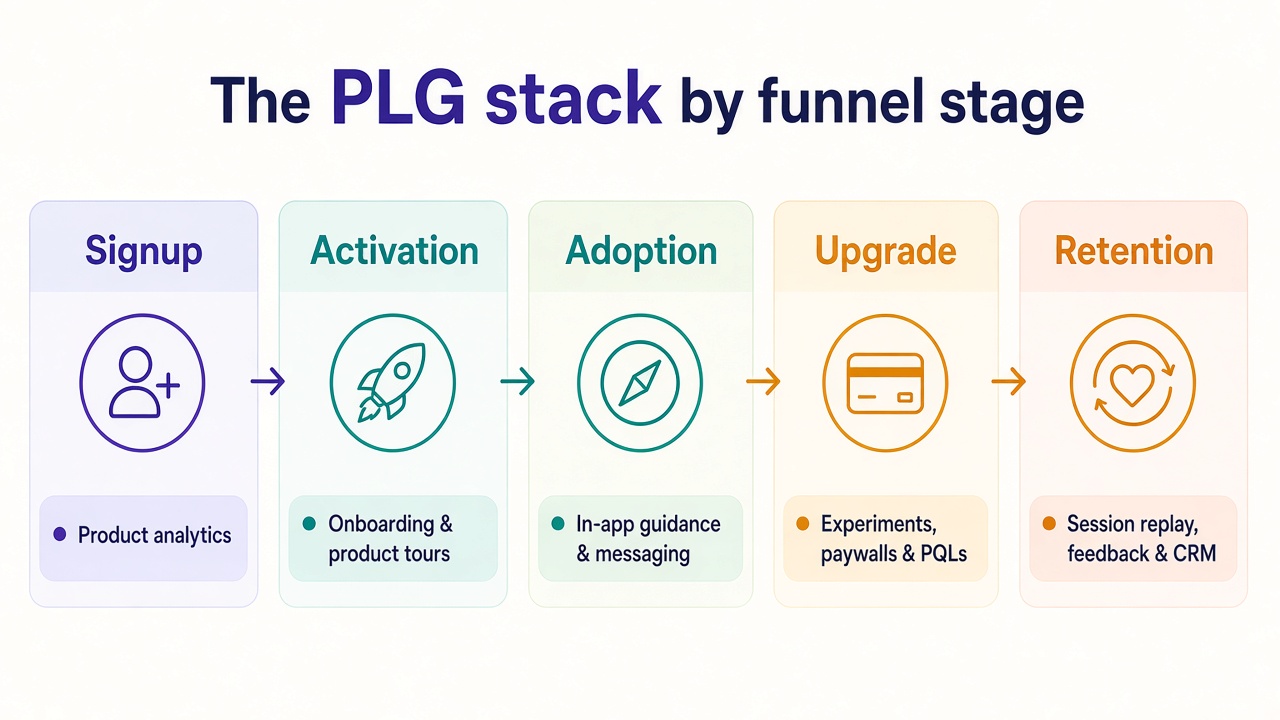 The PLG stack by funnel stage: product analytics for signup, onboarding and product tours for activation, in-app guidance and messaging for adoption, experiments, paywalls and PQLs for upgrade, and session replay, feedback and CRM for retention
4. The 10 Best Product-Led Growth Platforms for SaaS Conversion
We grouped these tools by their main job. Analytics tools come first because they tell you where to focus. Onboarding and engagement tools come next because they act on what you find.
These are strong candidates for different use cases, not a definitive ranking. The right pick depends on your bottleneck, budget and team.
#
Mixpanel
Best for product analytics
Mixpanel is an event-based product analytics tool. You send it events like "Signed up," "Created project" and "Upgraded," and it shows you how users move between them.
How teams use it for conversion:
- Conversion funnels: build a funnel from signup to first key action to payment, and see the exact step where most users quit
- Drop-off analysis: click into any step to see who dropped off, then compare them with users who converted
- Retention reports: check whether users who hit a certain action in week one stick around longer
- Session replay and experiments: watch recordings and run A/B tests from the same tool
Pricing (checked October 2026): The free plan includes up to 1 million events a month, 10,000 session replays and unlimited seats. The Growth plan starts at $0, includes the first 1 million events, then scales with volume. For example, 2 million events a month costs $185 a month billed annually. Startups founded less than five years ago with up to $8 million in funding can apply for a free first year.
- Strengths: fast, easy-to-read funnel and retention reports; generous free plan; unlimited seats
- Limitations: you need a clear event-tracking plan, or reports get messy fast; no built-in onboarding tours
- Best for: SaaS teams that want to find and fix funnel drop-offs
#
Amplitude
Best for behavioral analytics
Amplitude is a behavioral analytics platform that has grown into a broader suite. It now includes session replay, experimentation, in-app guides and surveys alongside its analytics.
How teams use it for conversion:
- User journeys: see the paths users take after signup, including the ones that lead to paying and the ones that lead to churn
- Retention analysis: compare how different cohorts retain over weeks and months
- Conversion drivers: find which actions are most associated with users upgrading (available on the Growth plan)
- Guides and surveys: act on what you find with in-app guides, without adding a separate tool
Pricing (checked October 2026): The free plan includes 2 million events a month, 10,000 session replays, unlimited seats and limited experiments, guides and surveys. The Plus plan starts at $0 and scales with event volume up to 70 million events. Growth and Enterprise are custom-priced. Startups with fewer than 20 employees and under $10 million in funding can get a free year of Growth.
- Strengths: deep behavioral analysis; full platform on every plan; the most generous free event allowance here
- Limitations: advanced features like conversion drivers and full A/B testing sit on paid plans; the depth takes time to learn
- Best for: teams that want to understand which behaviors lead to retention and revenue
#
PostHog
Best for developer-led SaaS teams
PostHog is an all-in-one product platform built for engineers. It bundles product analytics, session replay, feature flags, experiments, surveys and error tracking, and it has an open-source version under the MIT license.
How teams use it for conversion:
- Product analytics: funnels, retention, paths and SQL queries on your own event data
- Feature flags: roll out a new onboarding flow to 10% of users, then expand it if it works
- Experiments: run A/B tests on onboarding, pricing pages and upgrade prompts, with results tied to the same event data
- Session replay: jump from a funnel drop-off straight to recordings of the users who dropped
Pricing (checked October 2026): The free tier resets every month and includes 1 million analytics events, 5,000 session recordings, 1 million feature flag requests and 1,500 survey responses. PostHog says 97% of companies use it for free. Above that, you pay as you go, and you can set a billing limit on each product so there are no surprises.
- Strengths: one SDK for many tools; transparent usage-based pricing; very generous free tier
- Limitations: built for technical users, so non-technical teammates may find it harder to use; no visual no-code tour builder like dedicated onboarding tools
- Best for: developer-led startups that want analytics, flags and experiments in one place
#
Pendo
Best for product adoption and insights
Pendo combines product analytics with in-app guides, feedback and session replay. It's popular with B2B product teams that need to see which features each customer account uses.
How teams use it for conversion:
- Feature usage: see which features get used, by which accounts, and which ones are ignored
- In-app guides: walk new users through setup and point existing users to features they haven't found
- Retroactive analytics: analyze past behavior from the day you installed Pendo, without tagging events in advance
- Feedback and NPS: collect feature requests and satisfaction scores inside the product
Pricing (checked October 2026): Pendo Free is free forever for up to 500 monthly active users and includes analytics, in-app guides, and Pendo-branded NPS and roadmaps. Paid plans (Base, Core and Ultimate) are custom-priced based on monthly active users. A 30-day trial of the full platform is available through sales. Pendo integrates with more than 85 tools.
- Strengths: analytics and guidance in one tool; strong account-level insights for B2B
- Limitations: paid pricing isn't published and usually suits mid-market budgets; the free plan's 500-user cap is outgrown quickly
- Best for: growing B2B product teams focused on feature adoption
#
Userpilot
Best for onboarding and activation
Userpilot is a no-code product growth platform for onboarding, feature adoption and in-app feedback. It's built for product and growth teams that want to ship onboarding changes without waiting on engineers.
How teams use it for conversion:
- Onboarding flows: build multi-step walkthroughs that guide new users to their first meaningful result
- Checklists: give new users a short list of setup tasks, which works well for products with several activation steps
- Contextual guidance: show tooltips, banners and spotlights when a user reaches a specific page or takes a specific action
- Feature adoption: track how many users try a feature after you announce it
Pricing (checked October 2026): Starter is $299 a month for up to 2,000 monthly active users and includes in-app engagement, segmentation and NPS surveys. Growth starts at $849 a month and adds product analytics with funnels and retention, A/B testing, session replay and email. There's a 14-day free trial with no credit card required.
- Strengths: easy no-code builder; onboarding, surveys and analytics in one tool
- Limitations: funnels, retention reports and A/B testing are only on Growth and above; HubSpot and Salesforce integrations are paid add-ons
- Best for: SaaS teams whose biggest problem is getting new users activated
#
Appcues
Best for no-code onboarding experiences
Appcues is one of the longest-running no-code onboarding tools. Product and marketing teams use it to build tours, checklists and announcements on web and mobile without writing code.
How teams use it for conversion:
- Product tours: walk new users through the first few steps of your product
- Announcements: tell users about new features with modals, slideouts and banners
- In-app experiences: build checklists, tooltips and surveys, and target them by user properties or behavior
- Goals: measure whether users who saw a flow went on to complete the target action
Pricing (checked October 2026): Appcues no longer publishes prices. The Start plan covers up to 3,000 monthly active users and 10 published experiences, and Grow covers 25 published experiences. Until March 2026, Appcues listed Start from $300 a month at 1,000 users, billed annually. Every plan includes all experience types and integrations. Teams with fewer than 25 people can apply for the Spark program, and a free trial is available after a call.
- Strengths: mature, polished builder; mobile support; every feature on every plan
- Limitations: no public pricing; you need a sales call to start; limits on published experiences
- Best for: non-technical teams that want polished onboarding without engineering help
#
Hotjar
Best for understanding user friction
Hotjar (now part of Contentsquare) shows you how people actually use your site and app. It's the fastest way to see friction that funnels can't explain.
How teams use it for conversion:
- Heatmaps: see where users click, move and scroll on your pricing page, signup form and key screens
- Session recordings: watch real users struggle with a form, miss a button or rage-click a broken element
- Feedback tools: ask quick in-page questions like "What's stopping you from upgrading today?"
- Funnels: spot the page where most visitors leave, then jump to recordings of that step
Pricing (checked October 2026): The free plan includes up to 200,000 monthly sessions, heatmaps, funnels, basic surveys and replays for a sample of sessions (5%, up to 10,000), with one month of data access. Growth starts at $39 a month billed annually ($49 monthly) and adds 13 months of data, journey analysis and AI summaries. Voice of Customer surveys start at $79 a month. New accounts get a 15-day trial of the Growth plans.
- Strengths: easy to set up; visual and convincing for the whole team; useful free plan
- Limitations: not a full product analytics tool; the free plan only records a sample of sessions
- Best for: finding UX problems on your website, signup flow and in-app screens
#
Intercom
Best for customer engagement
Intercom is a customer service platform with an AI agent, Fin, plus in-app messaging and product tours. For PLG teams, it covers support and the messages that move users through the lifecycle.
How teams use it for conversion:
- Contextual messaging: show in-app messages, banners and tooltips to users based on what they've done
- Customer support: answer questions in a chat widget, so confused trial users get help before they leave
- Fin AI agent: resolve common questions automatically, around the clock
- Automated communication: with the Proactive Support Plus add-on, send product tours, checklists, surveys and multi-step campaigns
Pricing (checked October 2026): Essential costs $29 per seat a month billed annually, Advanced costs $85 and Expert costs $132. Fin costs $0.99 per resolved outcome. Proactive Support Plus, which adds product tours, checklists and surveys, is $99 a month with 500 messages included. Eligible startups can get up to 93% off. There's a 14-day free trial with no credit card.
- Strengths: support and engagement in one tool; strong AI agent; widely used chat widget
- Limitations: costs grow with seats, AI outcomes and message volume; product tours need a paid add-on
- Best for: SaaS teams that want support and lifecycle messaging in one place
#
Chameleon
Best for targeted in-product experiences
Chameleon builds in-product experiences that match your product's design closely. It's known for fine-grained targeting and custom styling.
How teams use it for conversion:
- Personalized onboarding: show different tours to different user segments, such as admins and regular users
- Feature announcements: use tooltips, modals and banners to introduce new features
- Contextual guidance: trigger help based on URLs, clicks, typing and user behavior
- A/B testing: compare versions of an experience with control groups and goals
Pricing (checked October 2026): The Startup plan starts at $279 a month for 2,000 monthly tracked users and 10 live experiences. Pro starts at $750 a month with up to 20 live experiences, A/B testing and custom CSS. Growth starts at $1,250 a month for 5,000 tracked users, billed annually. A free trial with full access is available, and Chameleon connects to more than 30 tools including HubSpot and Mixpanel.
- Strengths: detailed targeting; experiences that look native to your product; built-in A/B testing on Pro and above
- Limitations: higher entry price than most analytics tools; caps on live experiences on lower plans
- Best for: teams that want targeted, on-brand feature adoption campaigns
#
HubSpot
Best for connecting product-led growth with CRM
HubSpot is a CRM and marketing platform. It's not a product analytics tool, but it's where many PLG companies connect product usage to email follow-ups and sales.
How teams use it for conversion:
- Customer data: store every signup, account and deal in one CRM, enriched with product usage from tools like Amplitude or Mixpanel
- Lifecycle automation: send emails based on what users do or don't do, such as a nudge when someone stalls on day three
- Sales follow-up: route product-qualified leads to a salesperson when an account hits a usage threshold
- Reporting: see which marketing channels bring users who actually pay
Pricing (checked October 2026): The free CRM is free forever for up to 2 users and 1,000 contacts. The Starter Customer Platform lists at $20 per seat a month, and new customers often get discounts that bring it lower. Professional CRM starts at $50 per seat a month. HubSpot's marketplace has more than 2,000 integrations.
- Strengths: free CRM; huge integration marketplace; strong email and automation
- Limitations: needs a product analytics tool to feed it usage data; costs climb with contacts and higher tiers
- Best for: teams combining self-serve signups with sales follow-up
For a wider comparison of CRMs, see our guide to the best CRM for startups.
5. Comparison Table: Which PLG Platform Is Best for Your SaaS?
Prices below were checked on each vendor's pricing page on October 20, 2026. Plans and promotions change often, so confirm before you buy.
| Platform | Primary use case | Best for | Free plan | Starting paid price | Main limitation |
|---|---|---|---|---|---|
| Mixpanel | Product analytics | Funnel optimization | Yes, 1M events/mo | Growth from $0, pay above 1M events | Needs a clean tracking plan |
| Amplitude | Behavioral analytics | Retention and conversion insights | Yes, 2M events/mo | Plus from $0, scales with events | Advanced features on Growth |
| PostHog | Analytics and experiments | Developer-led startups | Yes, 1M events + 5K replays/mo | Pay as you go | Less friendly for non-technical users |
| Pendo | Product adoption | Growing product teams | Yes, up to 500 MAU | Custom quote | No public paid pricing |
| Userpilot | User onboarding | Activation improvements | 14-day trial | $299/mo | Funnels and A/B tests on Growth |
| Appcues | In-app guidance | No-code onboarding | Trial via sales | Custom quote (was from $300/mo) | No public pricing |
| Hotjar | Behavior insights | Finding UX friction | Yes, sampled replays | $39/mo billed yearly | Not full product analytics |
| Intercom | Customer engagement | Support and messaging | 14-day trial | $29/seat/mo + $0.99/Fin outcome | Tours need $99/mo add-on |
| Chameleon | In-product experiences | Targeted feature adoption | Free trial | $279/mo (Startup plan) | Caps on live experiences |
| HubSpot | CRM and automation | Customer lifecycle management | Yes, 2 users, 1,000 contacts | Starter $20/seat/mo list | Needs product data from another tool |
Lowest published paid entry price (USD per month)
- HubSpot Starter (per seat, list)$20
- Intercom Essential (per seat)$29
- Hotjar Growth$39
- Chameleon Startup$279
- Userpilot Starter$299
- Appcues Start (last published)$300
How the free plans compare
If you're early, free plans matter more than feature lists. Here's what each analytics-first tool gives you every month at $0.
Free monthly allowances on analytics-first PLG platforms
- 2M events
- Amplitude free plan, plus 10K session replays
- 1M events
- Mixpanel free plan, plus 10K session replays
- 1M events
- PostHog free tier, plus 5K replays and 1M flag requests
- 500 MAU
- Pendo Free, with analytics and in-app guides
6. How to Choose the Right Platform for Your SaaS
The right product-led growth platform for SaaS conversion depends on your stage and model more than on any feature list.
Early-stage startups: prioritize affordable analytics and onboarding
If you have fewer than a few thousand signups a month, you don't need an enterprise stack.
- Start with PostHog, Mixpanel or Amplitude on their free plans
- Add Hotjar's free plan to watch real sessions
- Build your first onboarding checklist in your own code before paying for a tool
- Apply for startup programs: Mixpanel, Amplitude and Intercom all offer discounts or free years for qualifying startups
Freemium SaaS: focus on activation events, usage limits and upgrade prompts
Freemium lives or dies on two moments: the first win and the limit. Track both carefully.
- Define one activation event and track it in your analytics tool
- Set usage limits that free users hit only after they've seen real value
- Use Userpilot, Appcues or Chameleon to show an upgrade prompt when users hit a limit or try a premium feature
B2B SaaS: consider account-level insights and product-qualified leads
In B2B, the account pays, not the individual user. You need to see usage by company, not just by person.
- Choose a tool with account-level analytics, such as Pendo or Amplitude
- Define what makes an account a product-qualified lead, such as three active users and one integration connected
- Send those accounts to HubSpot so sales can follow up at the right time
Developer-focused SaaS: look for APIs, SDKs and flexible event tracking
Developers don't want pop-up tours. They want good docs, fast setup and tools that stay out of the way.
- PostHog fits best here, with SDKs for most languages, feature flags and SQL access
- Track technical activation events, like "first API call succeeded" or "first deploy"
- Use feature flags to test changes to onboarding docs and setup flows
Growing SaaS companies: evaluate experimentation, segmentation and integrations
Once you have steady traffic, small conversion gains add up to real revenue.
- Run regular A/B tests on onboarding and pricing pages
- Segment users by plan, role, company size and signup source
- Check that your analytics, onboarding and CRM tools share data cleanly, either directly or through a tool like Segment
7. How to Improve SaaS Conversion With PLG Tools
Tools only help if you use them in a loop. Here's a seven-step workflow you can start this week.
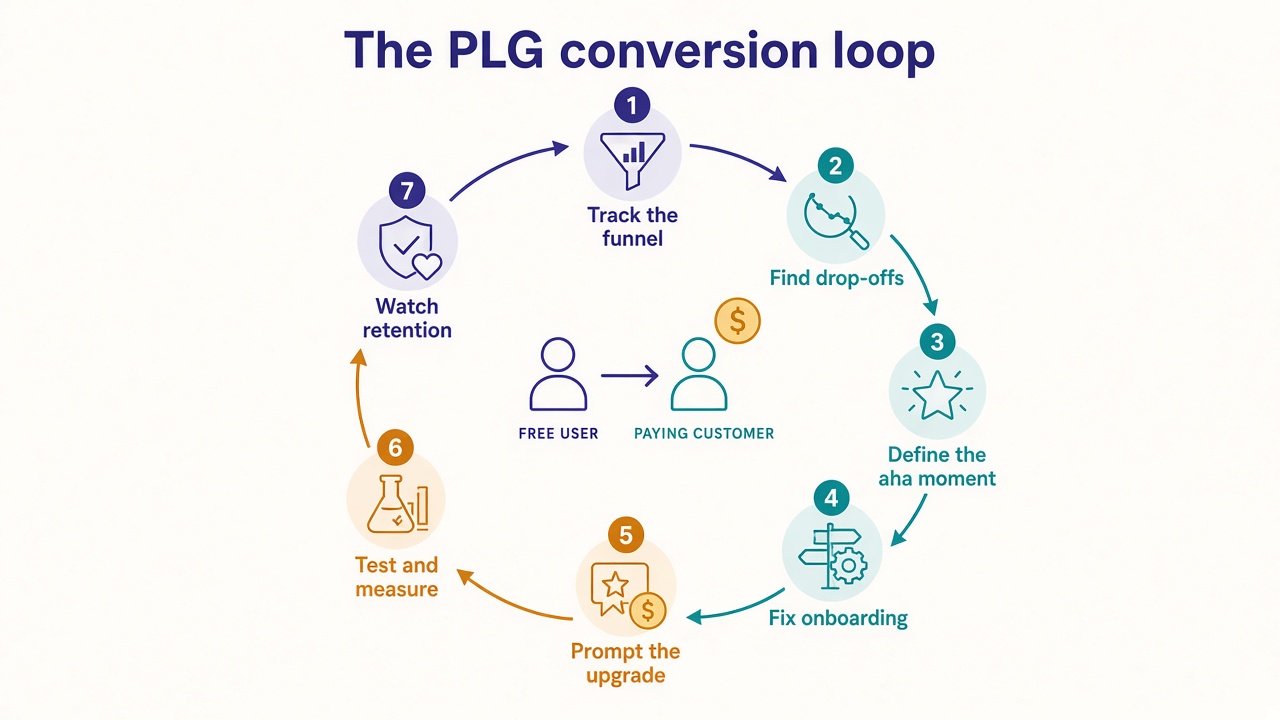 The PLG conversion loop: track the funnel, find drop-offs, define the aha moment, fix onboarding, prompt the upgrade, test and measure, and watch retention
- Track the signup-to-activation funnel. Instrument each step from signup to first key action to payment. Keep it to five to seven events at first.
- Identify where new users abandon the product. Find the step with the biggest drop. Then watch 10 session recordings of users who left at that step.
- Define the first meaningful value milestone. This is the "aha moment," the action that best predicts that a user will stick around. For a scheduling tool, it might be the first meeting booked through a shared link.
- Improve onboarding around that milestone. Cut every step that doesn't lead to it. Use a checklist or tour to point users straight at it.
- Introduce relevant upgrade prompts when users experience value. Show the upgrade when a user hits a limit or reaches for a premium feature, not on day one.
- Test changes and measure paid conversion. A/B test one change at a time. Measure paid conversion by signup cohort, not just clicks on the upgrade button.
- Monitor retention and churn to ensure upgrades last. An upgrade that cancels after one month isn't a win. Check that converted users stay for at least three months.
Here's what that funnel can look like for a typical self-serve SaaS product:
Illustrative signup-to-paid funnel for a freemium SaaS
- 1. Signups1,000 new accounts in a month
- 2. Activated400 reach their first meaningful result
- 3. Engaged180 return in week two and use a key feature
- 4. Hit a limit90 reach a free-plan usage limit
- 5. Paid45 upgrade within six months (4.5%)
Notice where the leverage is. Most teams obsess over the upgrade screen, but the biggest drop usually happens between signup and activation.
If you need traffic at the top of the funnel, our guide on how to get your first 100 users covers the channels that work early. For a ready-made activation email plan, see this AI tool post-launch onboarding sequence.
8. Common Product-Led Growth Mistakes to Avoid
Tracking signups instead of meaningful activation
Signups make a nice chart. Activation pays the bills. Report activated signups as your main growth number, and judge marketing channels by how many activated users they bring in.
Adding too many onboarding steps
Every extra form field and tour step loses users. If a question doesn't change what you show the user next, remove it. Ask for details later, once they've seen value.
Pushing upgrades before users experience value
An upgrade modal on day one feels like a toll booth. Wait until users hit a limit, reach for a premium feature or finish a meaningful task. Then the upgrade feels like the next step.
Buying multiple overlapping tools
Mixpanel, Amplitude and PostHog do many of the same things. So do Userpilot, Appcues, Pendo and Chameleon. Running two from the same group splits your data, doubles your tracking work and confuses your team. Pick one per job.
Ignoring customer feedback
Analytics tell you what users did. They don't tell you what users wanted. Pair your charts with short in-app surveys and five customer calls a month. Ask churned users why they left.
Failing to measure retention after conversion
A conversion campaign that brings in customers who cancel in 30 days just moves churn around. Track paid retention at 3, 6 and 12 months for every cohort, and keep an eye on refunds.
9. Frequently Asked Questions
What is the best product-led growth platform for SaaS?
There isn't one best platform, because each tool fixes a different part of the funnel. For most SaaS teams, start with a product analytics tool like Mixpanel, Amplitude or PostHog. You can't fix a drop-off you can't see. Add an onboarding tool like Userpilot or Appcues once you know where users get stuck.
How do PLG platforms improve free-to-paid conversion?
They show you where free users drop off, help you guide them to their first meaningful result faster, and let you show upgrade prompts when users feel the product's value. They also let you test those changes, so you know which ones raise paid conversion.
What is the difference between product analytics and product-led growth software?
Product analytics measures what users do: funnels, retention and feature usage. Product-led growth software is the wider category. It includes analytics plus tools that act on the data, such as onboarding tours, in-app messages, experiments, paywalls and product-qualified lead scoring.
Are there free product-led growth tools for startups?
Yes. PostHog gives you 1 million events, 5,000 session recordings and 1 million feature flag requests free every month. Amplitude's free plan includes 2 million events a month, and Mixpanel's includes 1 million. Hotjar has a free plan, Pendo Free covers up to 500 monthly active users, and HubSpot's CRM is free for up to 2 users.
Which PLG tools are best for early-stage SaaS companies?
Start with one free analytics tool. PostHog suits technical teams that also want feature flags and experiments. Mixpanel or Amplitude suit teams that want polished funnel and retention reports. Add Hotjar's free plan to watch session recordings. Hold off on paid onboarding tools until you have steady signup volume.
How do you measure product-led growth success?
Track activation rate (the share of signups who reach their first meaningful result), time to value, free-to-paid conversion within six months, net revenue retention and churn. Measure free-to-paid by signup cohort, not as a blended monthly number.
10. Conclusion: Build a PLG Stack That Converts Users Into Customers
The best product-led growth platforms for SaaS conversion don't add more signups. They turn the signups you already have into customers.
Here's the short version by use case:
- Find drop-offs: Mixpanel for funnels, Amplitude for behavioral analysis, PostHog if your team is technical
- Get users to their first win: Userpilot for activation, Appcues for no-code tours, Chameleon for targeted experiences, Pendo for B2B adoption
- See the friction: Hotjar for heatmaps and recordings
- Talk to users at the right moment: Intercom for support and messaging
- Hand hot accounts to sales: HubSpot for CRM and lifecycle automation
Start with the bottleneck, not the tool. If you don't know where users drop off, get analytics first. If you know where but not why, add session replay. If you know why, add onboarding. Every tool you add should fix a specific problem you can name.
Looking for more tools to grow your SaaS? Browse new launches on Founder.best, explore tools by category, or read founder stories about how other builders turned their first users into paying customers. Building a PLG tool yourself? Launch it on Founder.best to get in front of founders who are choosing their stack right now.
Key takeaways
- Product-led growth platforms improve SaaS conversion by fixing activation, adoption and upgrade moments inside the product, not by adding more signups.
- Start with analytics. Mixpanel, Amplitude and PostHog all have free plans with at least 1 million events a month, which covers most early-stage products.
- Add an onboarding tool like Userpilot, Appcues, Pendo or Chameleon only after you know which step loses the most users.
- A good free-to-paid rate is 3% to 5% for self-serve freemium and 8% to 12% for free trials, measured within six months of signup.
- Buy one tool per bottleneck. Overlapping tools split your data and slow your team down.

About the author
Anuj Shashimal
Founder, Founder.best
SaaS founder, indie hacker, and software engineer. Anuj built Founder.best to help indie founders launch, get discovered through search and AI answers, and turn launches into customers. He writes from first-hand experience growing Founder.best from zero to 400+ founders and 300+ launched products.
Tagged in
Browse all tagsKeep reading
Free tools and guides for this topic
Hand-picked from the tags on this post.
- Free tools for foundersName generator, tagline writer, slug checker, DR checker, launch checklist.
- Free founder toolsFree tools for startup founders in 2026: launch checklist, name generator, tagline writer, slug checker, and…
- Launch toolsBest startup launch tools in 2026: pre-launch prep, launch platforms, post-launch SEO. Free tools,…
- Free startup launch checklist30+ tasks across pre-launch, launch day, and post-launch.
- Free SaaS directories for backlinksList of free SaaS and startup directories with dofollow filters, Ahrefs DR scores, and a submission checklist.
- How Founder.best worksSubmit in 10 minutes, rank on the weekly Launchpad, stay discoverable.
Ready to launch on Founder.best?
Weekly rankings, dofollow SEO backlinks, founder stories, and a community built for indie makers.
Submit your startup