
Startup ideas
10 Success Factors for AI Agent Startups in 2026
Demos are cheap in 2026. Paying customers, reliable outcomes, and unit economics that survive inference costs are not. Here are ten success factors AI agent founders use to turn impressive agents into businesses people renew.

Post by Anuj Shashimal
Founder, Founder.best14 min read
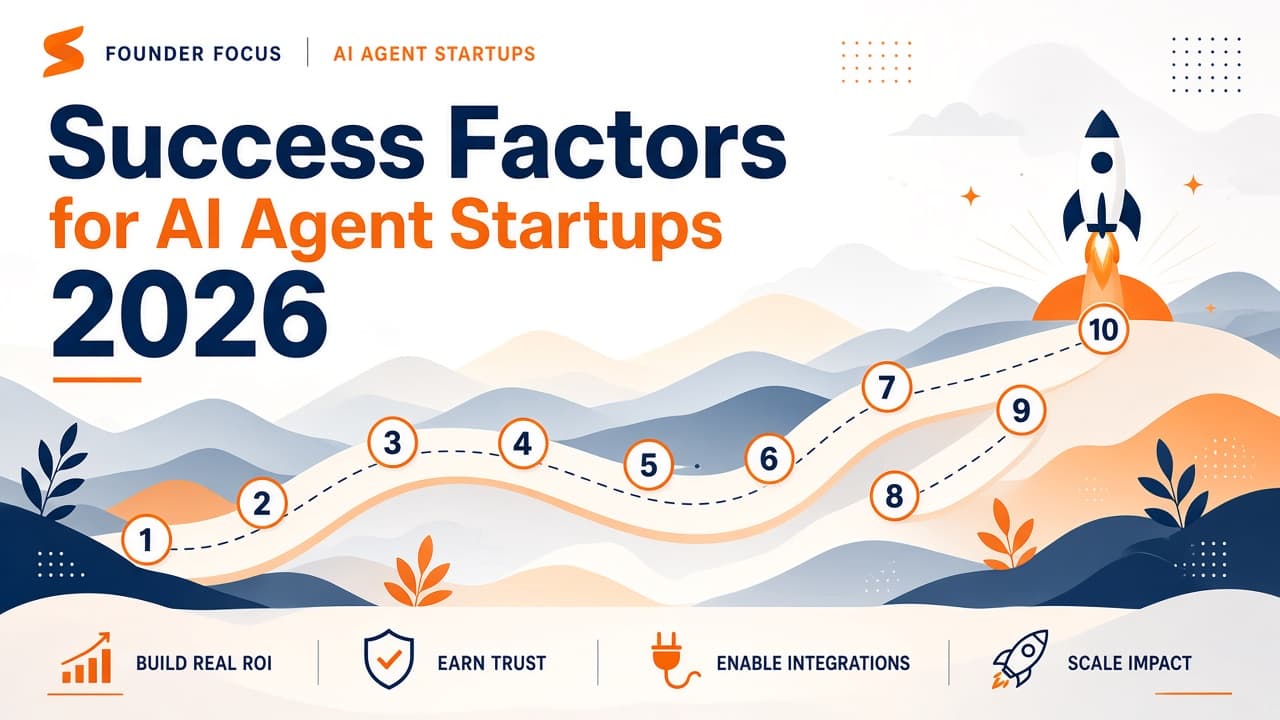
You can ship an AI agent demo in a weekend. That's the easy part in 2026.
What's hard is getting someone to pay next month when the demo novelty wears off. Buyers have seen agents that draft emails, agents that "research anything," and agents that break on the third step of a real workflow. They're tired of magic. They want fewer late nights on repetitive work and fewer expensive mistakes.
If you're building an AI agent startup, the success factors for AI agent startups in 2026 look less like model benchmarks and more like boring business fundamentals: a sharp problem, proof in the customer's language, and a product that fails safely.
This guide walks through ten factors we see separate agents that become companies from agents that become GitHub repos.
Why AI agent startups need more than good technology
Model quality keeps improving. So does the pile of undifferentiated "autonomous AI for X" landing pages.
In 2026, AI agent startups compete on trust and outcomes, not on being the first team to wire an LLM to a browser. Salesforce's 2026 agent research stresses clean data, clearly bounded tasks, and human escalation when the agent is unsure. Gartner keeps pushing reliability, accountability, and governance over raw autonomy.
That matches what buyers tell us in support tickets and sales calls. They don't ask which foundation model you use first. They ask what happens when the agent is wrong, who can see what it did, and whether finance will sign off.
Good technology is table stakes. Distribution, workflow fit, and economics decide who survives.
What buyers expect from AI agents in 2026
- 62%
- organizations experimenting with AI agents
- 23%
- scaling agentic AI somewhere in the business
- Top blockers
- data quality, unclear ROI, and lack of trust in autonomous action
What makes an AI agent startup successful in 2026?
Let's define success without hype.
A successful AI agent startup in 2026 has paying customers who renew because the agent reliably moves a metric they already track: hours saved, cost per ticket, qualified meetings booked, claims processed, or errors caught before production.
Success is not:
- A viral launch post with no retained usage
- A demo that works on three curated examples
- "Full autonomy" that hides failure until the customer notices
Success is recurring revenue, retention on a workflow, gross margin that survives inference, and a support burden you can actually staff.
The ten factors below are the pattern we see on Founder.best among AI products that keep getting upvotes and inbound after launch week. They're also the gaps that sink teams who over-index on the model.
From demo to durable AI agent business
- 1. Pick one costly workflownarrow industry and repetitive work
- 2. Prove ROI on a pilottime, money, or risk
- 3. Harden reliabilitytests, escalation, logs
- 4. Integrate where work livesAPIs and permissions
- 5. Price for marginsubscription, usage, or outcomes
- 6. Scale distributionSEO, community, launch platforms
1. Solve a specific and expensive customer problem
Generic agents are easy to build and hard to sell.
Pick a lane. Insurance intake for small brokers. Quote follow-up for regional manufacturers. Tier-one support for a Shopify app category. Compliance evidence collection for a single regulation.
The workflow should be repetitive, measurable, and painful enough that someone already pays humans or legacy software to cope with it.
How to validate before you overbuild:
- Run 15 to 20 interviews with people who own the workflow, not just "AI curious" friends
- Ask what broke last quarter and what it cost
- Offer a paid pilot that delivers one slice of the outcome, even if you semi-automate behind the scenes
- Say no to "we'll figure out the customer later"
If you need a structured process, use our SaaS idea validation guide. The same interview logic applies to agents.
Avoid the trap of building "an AI employee" for everyone. You're not competing with ChatGPT. You're competing with a spreadsheet, an intern, or an offshore team.
2. Build a product that delivers measurable ROI
Buyers fund agents when the ROI story fits their existing reports.
Translate output into outcomes:
- Time: "Average handling time down 28% on tier-one tickets"
- Money: "Three fewer hours of paralegal review per contract batch"
- Revenue: "12 qualified meetings booked from inbound leads last month"
- Risk: "Zero payments released without dual approval"
Show the difference between AI-generated text and a completed business step. A draft email is weak proof. A CRM updated, a calendar held, a ticket closed with the right category, that's proof.
In pilots, co-write the success metrics with the customer. Put them in the SOW. Review them weekly. When the pilot ends, you want a one-page case study with numbers, not adjectives.
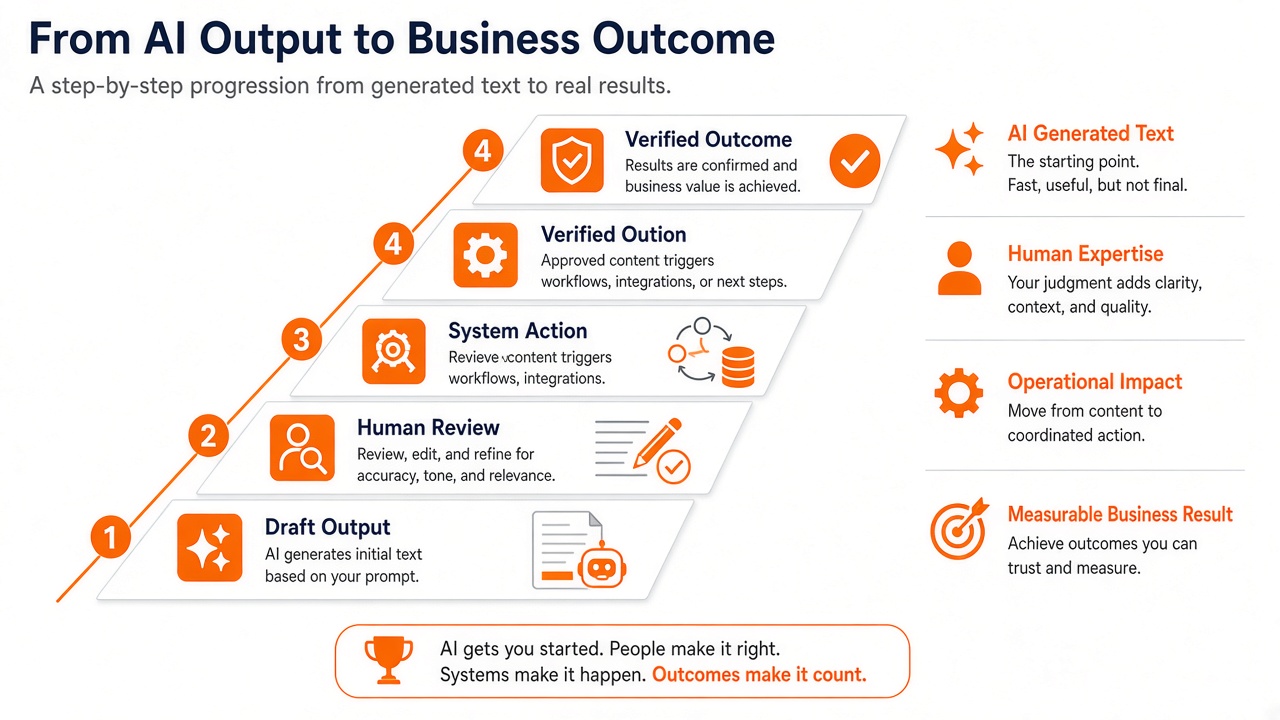 AI agent ROI - from model output to completed business outcome
3. Prioritize reliability, accuracy, and human oversight
Agents that only chat are forgiving. Agents that click buttons are not.
Your product needs:
- Test suites on real customer-shaped inputs, including messy PDFs and incomplete forms
- Explicit edge cases: missing permissions, changed UI, ambiguous instructions
- Error recovery that stops instead of guessing
- Human approval for irreversible or high-value actions
- Escalation when confidence is low or policy says so
Salesforce's agent guidance and similar enterprise research converge here: bounded tasks, clean handoffs, and humans who can see what the agent tried to do.
Founders sometimes treat oversight as a v1 embarrassment. Customers treat it as a requirement. You're selling to people who will be blamed if the agent sends the wrong email to a client.
Ship approval queues, diff views, and rollback where you can. Reliability is a success factor for AI agent startups in 2026 because it's the difference between "cool pilot" and "production system."
4. Make integrations and data quality a competitive advantage
Another chat window is rarely the moat. Access to the right data at the right time is.
Winning AI agent startups meet customers inside tools they already use: CRM, ERP, ticketing, email, internal wikis, data warehouses. They respect OAuth scopes, least privilege, and audit requirements.
Data quality beats model upgrades more often than founders admit:
- Duplicate CRM records confuse retrieval
- Stale knowledge bases produce confident wrong answers
- Missing API fields force the agent to improvise
Invest in connectors, field mapping, and validation before you invest in a twelfth prompt tweak. Document which systems you support and which you don't. Saying "we integrate with Salesforce" is less credible than showing the exact objects and events you read and write.
Privacy matters in the pitch too. Explain retention, subprocessors, and what you log when the agent acts. Trust starts in the integration dialog.
5. Choose the right AI agent business model
AI agent business models in 2026 usually fall into four buckets:
| Model | Fits when | Watch out for |
|---|---|---|
| Subscription per seat | Copilot-style assist, predictable usage | Heavy users destroy margin |
| Usage-based | Variable task volume, API-first buyers | Bill shock if not forecasted |
| Outcome-based | Clear unit of value (lead, ticket, shipment) | Disputes over attribution |
| Hybrid | Platform fee + metered actions | Needs transparent dashboards |
Inference isn't free. Track cost per successful task, not cost per demo click. If gross margin can't clear 60 to 70% at scale for a SaaS-shaped business, fix scope, caching, model routing, or pricing before you pour money into ads.
Compare positioning honestly in our AI SaaS classification guide. Agents priced like seat-based CRM while burning tokens like a research lab rarely end well.
Where AI agent startups feel pricing pressure first
- Inference per successful task85
- Customer support load62
- Integration maintenance48
- Model upgrade churn35
6. Find product-market fit before scaling
You don't need ten industries. You need ten customers who would be upset if you shut down.
Product-market fit for an agent sounds like:
- Users run the same workflow weekly without you nagging them
- Expansion happens inside the account (more seats, more tasks, more departments)
- Support tickets shift from "how do I trust this?" to "can you add this field?"
Start with one segment. Improve onboarding until a new user reaches first successful task in one session. Watch retention at week four, not day one.
Follow the stage gates in our SaaS creation framework. Agents skip steps too; they launch on Product Hunt before a single pilot completes.
Hold marketing spend until retention and unit economics on that segment look boringly stable. Boring is good.
7. Build distribution and AI search visibility early
Technical excellence without discovery is a tree falling in an empty forest.
AI agent startups need the same compounding channels as other SaaS products, plus clarity for AI answers:
- SEO around the workflow you own, not "AI agent platform"
- Useful content with screenshots, pricing, and real constraints
- Communities where practitioners complain about the problem you solve
- Founder-led posts that show the before/after metric
- Launch platforms and directories that give you a permanent, indexable product page
- Partnerships with tools you integrate
Read our SEO for startups playbook and AI answer visibility guide when you're ready to layer search and GEO on top of launch week.
For launch specifically, compare channels in best websites to launch SaaS in 2026. One channel we bias toward, because we run it: submit your AI product on Founder.best. You get a lasting product page, founder profile, category discovery, and an audience of makers who actually try new tools. Launch week traffic fades. A solid listing and founder story keep sending qualified visitors.
Pair the launch with our free launch checklist so post-launch SEO and onboarding don't slip.
8. Treat security, privacy, and trust as core features
Autonomy increases blast radius.
Core features in 2026 include:
- Role-based access and scoped credentials per integration
- Audit logs: who approved, what changed, which model version ran
- Secrets handling and rotation, not long-lived tokens in prompts
- Policies for PII, retention, and customer data isolation
- Kill switches when an integration behaves unexpectedly
Buyers ask these questions in the first call now. If your answers live only in a Notion doc, you lose to a slower team with a security page and a clear data flow diagram.
Trust is also positioning. "We never train on your data" only helps if your architecture backs it. Show diagrams. Offer a DPA early for B2B.
9. Track the metrics that predict long-term growth
Vanity metrics lie about agents. Task completion lies less.
Track weekly:
- MRR and net revenue retention
- Logo retention and churn with exit reasons
- CAC by channel once you spend on ads
- Gross margin per customer after inference and support
- Task completion rate and error rate by workflow step
- Human interventions per task (should fall as you harden, but never pretend it's zero)
When human touches spike, that's a product signal, not only a support signal. Fix the workflow or narrow scope.
Share a simple internal dashboard with design partners during pilots. Transparency builds trust and saves you from scaling a broken funnel.
10. Common mistakes AI agent founders should avoid
You can hit all nine factors above and still stall if you step on these rakes:
- Overbuilding a platform before one workflow pays
- Chasing trends (multi-agent swarms!) instead of customer calendars
- Promising full autonomy before approval and logging exist
- Ignoring inference costs until margins are gone
- Single-model dependency with no fallback or evaluation harness
- Scaling ads before retention and support playbooks work
- Generic positioning that sounds like every other agent launch
If you're hunting ideas without repeating those mistakes, skim YC startup ideas for 2026 for problem shapes YC partners keep highlighting, then narrow harder than the list suggests.
For first customers after launch, our first 100 users guide still applies. Agents don't get a pass on manual outreach.
Where to go from here
The success factors for AI agent startups in 2026 boil down to problems worth paying for, proof customers can repeat, reliability people can stake their job on, and economics that survive real usage.
Models will keep getting cheaper. Your moat is workflow depth, integrations, trust, and distribution that compounds.
When your agent does one thing measurably well, put it where founders and early adopters look for new tools. Launch on Founder.best, ship the case study numbers in your product page, and keep tightening the workflow until renewal feels obvious.
Key takeaways
- Success factors for AI agent startups in 2026 start with a narrow, costly workflow and paid validation, not a general-purpose assistant demo.
- Customers pay for completed business outcomes and reliable action, not for fluent text. ROI, escalation paths, and auditability beat autonomy hype.
- Integrations and clean data often beat another model upgrade. Workflow fit is the moat when models commoditize.
- Sustainable AI agent business models tie price to usage or outcomes once you know inference cost per successful task.
- Distribution and trust compound early. Launch on Founder.best for a permanent product page, founder audience, and discovery beyond launch week.
Frequently asked questions
What makes an AI agent startup successful in 2026?
The strongest AI agent startups solve one expensive workflow for a defined buyer, prove ROI with metrics the customer already reports, keep humans in the loop for high-risk steps, and integrate with tools where work lives. They reach product-market fit on a small segment before scaling spend, and they earn trust with access controls and clear logs when agents act on behalf of users.
Are AI agent startups profitable?
Some are, and many are not yet. Profitability depends on gross margin after inference and support, retention on recurring workflows, and pricing that matches cost per completed task. Agents that replace billable hours or prevent revenue loss can support healthy margins. Agents sold as cheap chat subscriptions with heavy token use often struggle unless usage is capped or priced explicitly.
How do AI agent startups make money?
Common models are seat-based SaaS with included agent runs, usage-based pricing per task or token bundle, outcome-based fees per qualified lead or resolved ticket, and hybrid plans with a platform fee plus metered actions. B2B teams often start with subscription plus pilot pricing, then move toward usage or outcomes as they learn cost per success.
What are the biggest challenges facing AI agent startups?
Reliability on long workflows, integration and data quality, inference costs, customer trust when agents take actions, and standing out in a crowded market. Founders also underestimate support load when the agent fails silently or needs frequent human rescue.
How can a founder validate an AI agent startup idea?
Interview buyers in one industry, map the workflow step by step, and run paid pilots that deliver a partial outcome manually or with a narrow agent. Use our guide on how to validate SaaS ideas for interview scripts and signal thresholds. If nobody will prepay or co-design a pilot, the problem or buyer is wrong.
How can AI agent startups attract their first customers?
Founder-led outreach in communities where the workflow is discussed, case studies with measured ROI, partnerships with tools you integrate, and launch on discovery platforms. List on Founder.best for a permanent product page, founder profile, and exposure to early adopters browsing new AI tools.

About the author
Anuj Shashimal
Founder, Founder.best
SaaS founder, indie hacker, and software engineer. Anuj built Founder.best to help indie founders launch, get discovered through search and AI answers, and turn launches into customers. He writes from first-hand experience growing Founder.best from zero to 400+ founders and 300+ launched products.
Tagged in
Browse all tagsKeep reading
Free tools and guides for this topic
Hand-picked from the tags on this post.
- Browse products by categorySaaS, AI, developer tools, marketing, and more.
- Indie launch guideLaunch guide for indie founders and bootstrapped makers in 2026. Build in public, pick platforms, earn…
- Launch platform alternatives & guidesProduct Hunt alternatives, where to launch, and SEO launch guides.
- Get your product discovered by AI assistantsWhich listing fields make your product rank for the right questions.
- Browse blog posts by topicSEO, backlinks, launch platforms, AI search, startup tools, and more.
- Docs: public API, MCP server & AI discoveryHow AI assistants and agents search and cite Founder.best listings.
Ready to launch on Founder.best?
Weekly rankings, dofollow SEO backlinks, founder stories, and a community built for indie makers.
Submit your startup