
SEO for founders
No signups after launch? Run these 4 SEO checks before you blame the idea
A quiet launch feels like rejection, but most flat launches never reached enough qualified people to test the idea. These four SEO checks tell you whether to fix distribution, copy, keywords, or the concept itself.
You launched. The board shows a handful of upvotes. Analytics says 90 visitors. Signups: one friend and one person who already followed you on X.
No signups after launch feels like the market rejected you. Usually it means the market never saw a fair test.
Shipping got cheap. Getting found did not. Most founders who search no signups after launch are deciding between two expensive mistakes: grinding distribution on something nobody wants, or killing a decent idea because they posted once and checked analytics the next morning.
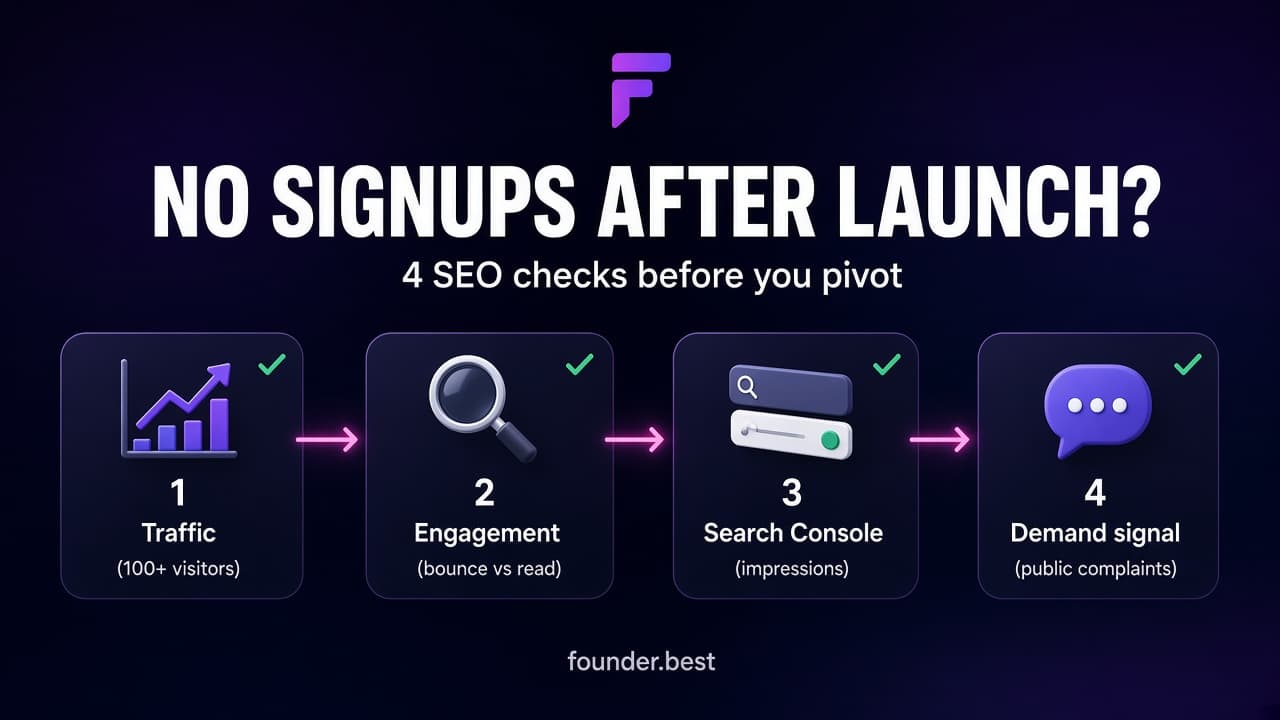
This guide is the SEO-first version of that decision. Four checks, in order, because each one only tells you something if the previous one passed. The goal is not a motivational pep talk—it is to stop you from pivoting when you need backlinks, or from posting in thirty more directories when the problem itself is silent.
Why SEO belongs in this conversation first
Launch day traffic is messy. Social spikes, homepage rotations, and generic "new products" feeds mix curious scrollers with zero intent alongside the handful of people who actually have your problem.
SEO forces clarity in a way raw signup counts do not:
- Search traffic arrives with declared intent in the query
- Search Console shows whether Google thinks your page matches real problems
- Product page engagement (time on page, scroll depth) separates "wrong headline" from "understood but declined"
- Indexable launch listings keep sending referral traffic and link equity after launch week ends
If you only measure total sessions, you will misread a distribution failure as a product failure almost every time.
Check 1: Did qualified traffic actually arrive?
Start with one number: targeted visitors—people from a source where the audience plausibly has your problem.
Not total sessions. Not launch-day vanity traffic. Not your own retweets.
Use this split before you trust your conversion rate:
| Source type | Usually targeted? |
|---|---|
| Thread about the exact problem you solve | Yes |
| Niche directory in your category | Mostly yes |
| General "products launched this week" feed | Mixed |
| Your personal social following | Often no |
Pass threshold: about 100 targeted visitors before you treat conversion rate as signal.
Below 100, moving one or two signups swings your rate by multiple percentage points. You would be making a build-or-kill call on a coin flip—and feeling confident doing it.
If you failed Check 1: the idea is not dead. You have not run the test. Go get distribution:
- List on 2–3 indexable launch platforms with permanent product URLs, not one-day homepage slots. See how to get more reach for your startup for how to stack them across 7–10 days.
- Submit to startup directories that still pass dofollow links and stay indexed. The directory submission guide separates dead listings from ones that earn traffic.
- Tag every outbound link with UTMs so next time you can separate targeted from generic traffic. If you cannot split sources in analytics, fix tagging before you fix the product.
This is the unsatisfying answer—and the correct one most of the time.
Check 2: Did they bounce or did they read?
Assuming you cleared 100 targeted visitors, open analytics for your landing page or product page.
Look at median time on page and scroll depth (or a simple "scrolled past hero" event if you track it).
| Pattern | What you see | What it usually means |
|---|---|---|
| A — Fast bounce | Under ~10 seconds, high bounce | Headline or audience mismatch |
| B — Read but left | 30–90 seconds, scrolled past fold, no signup | Offer, price, or trust gap |
| C — Idle tab | Long session, no scroll | Tab left open — ignore |
Pattern A: under ~10 seconds, high bounce
They read the headline and left. Common causes:
- Traffic source promised something your page did not deliver
- H1 speaks builder language; visitor expected buyer language
- Page loads slowly or hero section hides the value prop
SEO fix this week: rewrite title tag, H1, and first paragraph to match the query or community thread that sent the click. Run your copy through the product page SEO checklist—especially meta title, description, and above-the-fold clarity.
This is a positioning and on-page SEO problem, not proof the idea failed.
Pattern B: 30–90 seconds, scrolled past the fold, still no signup
They understood the offer and passed. Now you are learning something real—though not necessarily that the idea is wrong. Could be pricing, missing product behind the page, weak social proof, or no clear next step.
SEO fix this month: add FAQ schema, comparison section, pricing clarity, and one proof element (screenshot, testimonial, or metric). Publish a product update on your launch listing so the URL gets recrawled.
Pattern C: long session, no scroll
Often a tab left open. Do not overweight it.
Why this check matters: Pattern A and Pattern B produce the same signup count and mean opposite things. Founders who read no signups after launch as "nobody wants this" are usually staring at Pattern A.
Check 3: Is Google matching you to problem-shaped queries?
Wait 30 days after indexing, then open Google Search Console for your product URL.
Look at impressions first. Clicks can wait.
| Search Console signal | What it usually means | Next step |
|---|---|---|
| Any impressions at all | Google connects your page to real queries | Improve title and meta for clicks |
| Impressions but zero clicks | Demand may exist; snippet is weak | Rewrite title tag and description |
| Zero impressions after 30 days | Vocabulary mismatch or page not indexable | Rewrite in buyer language; check indexing |
Zero impressions does not automatically mean no demand. It often means nobody describes the problem the way you wrote it.
Builders say "workflow automation for agencies." Buyers search "how do I stop forgetting to send client invoices." Same pain, different words—and Google has no reason to bridge them.
SEO fix:
| Step | Action |
|---|---|
| 1 | Read actual queries in Search Console, including rows with 3–5 impressions. The phrasing is the data. |
| 2 | Rewrite H1, subheads, and meta around complaint language, not feature language. |
| 3 | Add one supporting paragraph or FAQ entry per query cluster. |
| 4 | Wait another 30 days. Change copy—not positioning, pricing, and product at the same time. |
If you skipped technical basics, run the indexing checks in SEO for startups: canonical tags, sitemap inclusion, and whether your launch listing actually links to an indexable product page.
Check 4: Are strangers complaining about this problem in public?
This is the only check that tests the idea, not your execution—which is why it goes last. The first three explain most flat launches and cost little to fix.
The question: in the last 90 days, have strangers complained about this specific problem in public, unprompted, without knowing you exist?
Rough bar: five complaints from five different people, not friends, not "sounds cool" replies, not upvotes on your launch post.
Where to look manually:
| Channel | What to search for |
|---|---|
| Problem phrasing from Check 3, sorted by past year | |
| Hacker News | Same phrasing via Algolia search |
| Competitor launch threads | Comments where evaluators say what's missing |
Save a permalink every time. Two real complaints and three maybes is not five.
If you failed Check 4 after passing Checks 1–3: you may be looking at a real product-market fit gap. People find you, read you, and decline—and nobody else is venting about the problem unprompted. Rewriting the headline again is procrastination.
If you passed Check 4 but still have no signups: the problem is real and reachable. Your offer is off—price, scope, credibility gap, or a landing page with nothing working behind it. The next test should cost them money: preorder, deposit, paid pilot. Email signups are free to hand over; the distance between an email and a card is where many "validated" ideas quietly die.
How to read the four checks together
Use this summary table after you run all four checks:
| Your result | Likely diagnosis | What to do next |
|---|---|---|
| Failed Check 1 | Distribution never ran | Stack launch listings + directories; retest in 2–4 weeks |
| Passed 1, failed 2 (fast bounce) | Headline / audience mismatch | Rewrite product page SEO; fix UTMs |
| Passed 1–2, failed 3 | Keyword vocabulary gap | Rewrite in buyer language; wait 30 days |
| Passed 1–3, failed 4 | Idea or problem selection | Stop directory grinding; revisit problem |
| Passed all four, zero signups | Offer, price, or trust | Paid pilot, narrower scope, ship working product |
Most founders stop at Check 1, realize they never ran the test, and go get traffic. Less romantic than "my idea was ahead of its time." Considerably more useful.
The SEO stack to rerun the test properly
Once you know which check failed, this sequence fixes the distribution layer without guessing:
| Week | Focus | Actions |
|---|---|---|
| Week 1 | Make the page measurable | UTM every launch link; confirm indexability; track one conversion event |
| Week 2 | Earn indexable discovery | List on Founder.best; submit to 5–10 live directories; post in one relevant community |
| Week 3 | Fix on-page intent match | Align H1 and title with top query; add FAQ section; publish one product update |
| Week 4 | Re-read the checks | Did traffic cross 100? Did bounce improve? Any new Search Console impressions? |
Only then decide whether no signups after launch means pivot—or publish.
What this diagnostic will not tell you
Be honest about the limits:
- Whether anyone will pay. Recognition and interest are not revenue.
- Whether the market is large enough. Five public complaints prove the problem exists—not that it exists ten thousand times at a viable price.
- Whether you can reach these people repeatedly. Launch-week discovery and monthly SEO traffic are different skills. The second one decides if this becomes a business.
After a flat launch, run the checks—not your mood
You will reach for whichever explanation matches how you feel that day. Flat launches hurt. The checks exist so you do not pay for that feeling with a premature pivot or six months of directory spam on the wrong problem.
Usually you stop at Check 1, realize you never got enough qualified traffic, and go fix distribution with an SEO plan that compounds. That is the boring, high-leverage move—and the one most no signups after launch searches are actually looking for.
Browse the full SaaS launch checklist before your next attempt, or list your product on Founder.best when you are ready to rerun the test with indexable discovery built in.
Key takeaways
- Most no-signup launches fail Check 1: fewer than 100 targeted visitors means you never ran the experiment.
- Fast bounces with zero scroll mean a headline or audience mismatch—not a dead idea.
- Zero Search Console impressions after 30 days usually means keyword vocabulary mismatch, not zero demand.
- Only after traffic, engagement, and search signals pass should you treat flat conversion as a product-market fit problem.
- Stack indexable launch listings, fix product page SEO, then re-test before pivoting.
Frequently asked questions
Why did my launch get views but no signups?
Views from generic launch feeds often are not qualified buyers. Split traffic by source in analytics. High bounce under 10 seconds usually means the headline promised something the page did not deliver. Longer sessions with no signup mean the offer, price, or trust gap—not just distribution.
How many visitors do I need before judging a flat launch?
Aim for at least 100 visitors from sources where the audience plausibly has your problem—community threads, niche directories, or search—not total sessions including your own social followers. Below that, conversion rate is mostly noise.
How long should I wait before checking Search Console?
Give Google 30 days after your product page and launch listing are indexed. Impressions matter more than clicks early on. Even 40 impressions with zero clicks suggests demand exists and your title or meta needs work.
Is no signups after launch always a distribution problem?
No—but it is a distribution problem most of the time. Run the four checks in order. If targeted traffic engaged, search showed impressions, and strangers complain about the problem publicly, then revisit pricing, scope, or whether the product exists behind the landing page.
What is the fastest SEO fix after a flat launch?
Submit to indexable startup directories with permanent product pages, rewrite your H1 and meta description in the words buyers actually search, add UTM tags so you can see which sources send qualified traffic, and post one product update so crawlers revisit the page.
Tagged in
Browse all tagsKeep reading
Ready to launch on Founder.best?
Weekly rankings, dofollow SEO backlinks, founder stories, and a community built for indie makers.
Submit your startup