
Product discovery
Free Active Directory tools: the best utilities for managing AD without a budget
You do not need a six-figure identity platform to run a healthy domain. The right free Active Directory tools cover daily admin, security audits, and cleanup - if you know which ones to install and when to use each.
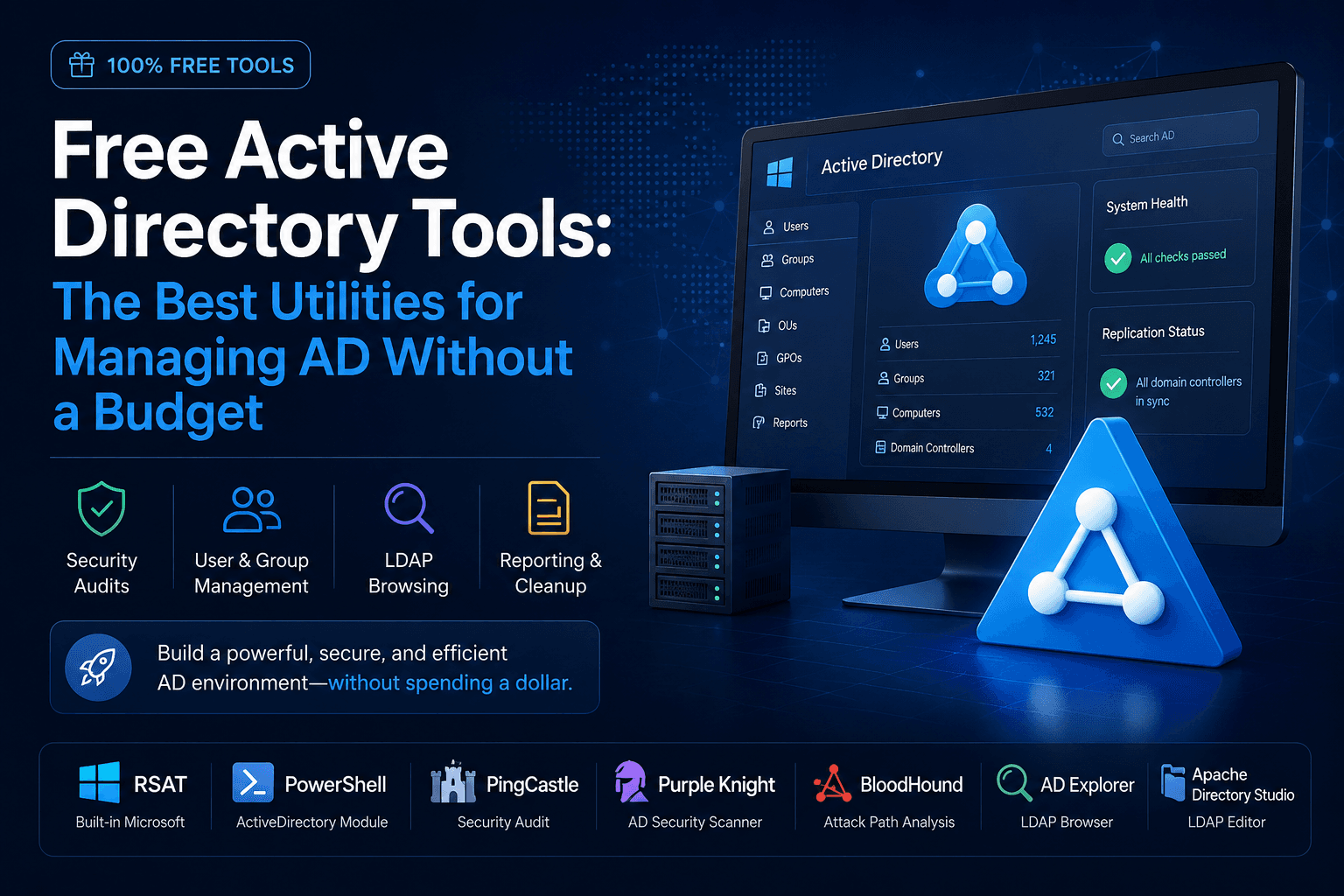
If you searched free active directory tools, you probably manage a Windows domain on a tight budget - or you inherited one without an identity team behind it. Active Directory is not optional infrastructure for most businesses: it holds user accounts, group memberships, Group Policy, and the permission boundaries your entire org runs on. Enterprise IAM platforms price that reality accordingly.
The good news: Microsoft and the security community ship a deep set of free Active Directory tools that cover daily admin, troubleshooting, security audits, and cleanup. You do not need to pay for a full AD management suite on day one. You need the right free utilities installed, a repeatable audit habit, and clear rules about who can run destructive scripts.
This guide organizes free active directory tools by job - administration, auditing, browsing, reporting, and cleanup - so you can build a zero-cost toolkit that scales from a 20-person startup to a mid-size domain.
Why free Active Directory tools matter for small IT teams
Enterprise AD platforms bundle reporting, workflow, and delegated admin into one license. That makes sense at 5,000 seats. At 50 seats, the same problems exist - stale accounts, weak service principals, replication drift, over-privileged groups - but the budget does not.
Free active directory tools fill that gap:
- Built-in Microsoft utilities handle user creation, GPO edits, and replication diagnostics without extra licenses.
- Community security scanners surface misconfigurations that lead to Kerberoasting, pass-the-hash, and privilege escalation - for free.
- LDAP browsers let you inspect object attributes when the GUI management console is overkill or broken.
- PowerShell scripts automate bulk changes that would take hours in ADUC.
The pattern successful small IT teams follow: RSAT plus PowerShell for daily work, a quarterly run of PingCastle or Purple Knight, and AD Explorer in your troubleshooting kit. Paid tools come later - when delegation workflows, change approval, or compliance reporting become daily requirements.
Built-in Microsoft free Active Directory tools (start here)
Before you download anything third-party, install the free Active Directory tools Microsoft already provides. These are production utilities, not trials.
RSAT: Active Directory Users and Computers (ADUC)
Remote Server Administration Tools (RSAT) is the standard Windows client package for AD management. After installation, you get:
- Active Directory Users and Computers - create users, reset passwords, manage groups, move OUs
- Active Directory Sites and Services - replication topology and site links
- ADSI Edit - low-level LDAP editing (use carefully)
- Group Policy Management Console (GPMC) - create and link GPOs
RSAT is the baseline for any list of free active directory tools. Every IT admin on a Windows domain should have it installed.
Best for: Daily user and group management, OU structure changes, GPO administration.
Active Directory PowerShell module
The ActiveDirectory PowerShell module ships with RSAT and on Windows Server. It is one of the most powerful free Active Directory tools because it scales from one-liners to full automation:
Get-ADUser -Filter * -Properties LastLogonDate |
  Where-Object { $_.LastLogonDate -lt (Get-Date).AddDays(-90) }
Common tasks: bulk user creation from CSV, group membership reports, fine-grained password policy checks, disabled account audits, and delegated admin verification.
Best for: Reporting, bulk changes, scheduled tasks, and anything repetitive in ADUC.
repadmin and dcdiag
These command-line free active directory tools diagnose replication - the subsystem that breaks silently until login failures spike:
- repadmin /showrepl - replication status between domain controllers
- repadmin /syncall - force replication (use with care in production)
- dcdiag /v - comprehensive domain controller health check
- dcdiag /test:dns - DNS registration issues that break AD
Run dcdiag after every DC patch cycle and whenever users report random authentication failures across sites.
Best for: Multi-site domains, post-maintenance verification, replication troubleshooting.
nltest and netdom
Additional built-in free Active Directory tools for trust and secure channel validation:
- nltest /dsgetdc:domain.com - locate a domain controller
- nltest /sc_query:domain.com - secure channel status for a workstation
- netdom resetpwd - reset machine account password trust (classic fix for "trust relationship failed")
Best for: Workstation join issues, trust relationship errors, DC locator problems.
AD Explorer (Microsoft Sysinternals)
AD Explorer is a free Active Directory browser from Sysinternals. It shows the live AD database as a navigable tree, lets you search by attribute, bookmark common queries, and compare snapshots over time to see what changed.
Unlike ADUC, AD Explorer exposes raw attributes - useful when an application expects a specific extensionAttribute or when you need to verify memberOf without opening multiple dialogs.
Best for: Attribute troubleshooting, LDAP path discovery, before/after change comparison.
Free Active Directory security and audit tools
Daily admin keeps the lights on. Security audits keep attackers out. These free active directory tools focus on misconfigurations that lead to breaches.
PingCastle
PingCastle is the most widely recommended free AD security scanner. It produces a scored report covering:
- Kerberos and NTLM configuration weaknesses
- Stale admin accounts and inactive privileged users
- Excessive Domain Admins membership
- Trust relationships and SID filtering gaps
- GPO security baseline deviations
Download the ZIP, run it against your domain from a management workstation, and review the HTML report. No agent install on domain controllers required for a standard scan.
Best for: Quarterly AD health reviews, pre-audit baselines, post-acquisition domain assessments.
Purple Knight (Semperis)
Purple Knight is Semperis's free Active Directory security assessment tool. It runs hundreds of indicators of exposure (IOEs) and indicators of compromise (IOCs) - stale KRBTGT keys, unconstrained delegation, vulnerable certificate templates, and more.
Purple Knight complements PingCastle; many teams run both free active directory tools and compare results. The Semperis community edition is free for unlimited scans.
Best for: Security-focused AD reviews, identifying attack paths, compliance prep.
BloodHound Community Edition
BloodHound CE maps attack paths in AD using graph analysis. It answers: "If an attacker compromises this standard user, what domain admin paths exist?" Collectors ingest AD data; the UI visualizes GenericAll, WriteDACL, MemberOf chains, and other edges attackers abuse.
BloodHound has a learning curve, but it is the deepest free tool for understanding privilege escalation in complex domains.
Best for: Red-team style assessments, identifying hidden admin paths, cleaning excessive ACLs.
ADRecon
ADRecon generates HTML and CSV reports on users, groups, computers, GPOs, trusts, and ACLs. It is lighter than BloodHound and faster than manual PowerShell reporting - a solid free Active Directory tool for documentation and handoff when you inherit an unknown domain.
Best for: Domain documentation, M&A due diligence, baseline inventory before cleanup.
Free LDAP and directory browsing tools
When you need to see LDAP structure without full ADUC - or you manage a mixed environment - these free active directory tools help.
Apache Directory Studio
Apache Directory Studio is a free, cross-platform LDAP browser and editor. Connect to AD with bind credentials and browse the directory tree, run LDAP filters, and edit attributes. Works on macOS and Linux when RSAT is not available.
Best for: Non-Windows admins, LDAP filter development, multi-directory environments.
ldapsearch (OpenLDAP tools)
On Linux or WSL, ldapsearch queries AD directly:
ldapsearch -H ldap://dc01.domain.com -D "user@domain.com" -W \
  -b "DC=domain,DC=com" "(objectClass=user)" sAMAccountName mail
Pair with scripts for automated reporting. Essential when your automation pipeline runs on Linux CI runners.
Best for: Scripting, CI/CD identity checks, Linux-first ops teams.
Softerra LDAP Administrator (free edition)
Softerra offers a limited free edition of LDAP Administrator with basic browse and search. Less common than Apache Directory Studio but worth knowing if your team already uses it.
Best for: Lightweight LDAP browsing when Apache Directory Studio feels heavy.
Free Active Directory reporting and cleanup tools
Stale objects bloat AD, slow logons, and create audit noise. These free active directory tools help you find and remove what should not be there.
PowerShell cleanup scripts (community and Microsoft)
Before buying cleanup software, standard free Active Directory tools built from PowerShell cover most needs:
- Disabled users inactive 90+ days
- Computer accounts that have not authenticated in 60+ days
- Empty security groups
- Users with passwordNeverExpires set
- Orphaned adminCount flags on de-privileged accounts
Microsoft's own documentation and GitHub community scripts (search "AD cleanup PowerShell") provide vetted starting points. Always run with -WhatIf first.
Best for: Scheduled maintenance, pre-audit cleanup, reducing object count.
OldCmpObj.ps1 and similar community tools
Community-maintained free active directory tools like stale computer account finders and LastLogonTimestamp reporters circulate on GitHub and SpiceWorks. Vet any script before production: read the code, test in a lab OU, and restrict who can execute it.
Best for: One-off cleanup projects when you inherit a neglected domain.
CSVDE and LDIFDE (built-in)
CSVDE and LDIFDE are command-line free Active Directory tools for bulk export and import:
- csvde -f users.csv - export users to CSV
- ldifde -f backup.ldf -d "DC=domain,DC=com" - full subtree export
Useful for migration prep, backup documentation, and bulk user provisioning templates.
Best for: Bulk export/import, migration projects, offline documentation.
Free Active Directory tools for Group Policy
GPO mistakes cause widespread login and software deployment failures. These utilities extend the built-in free Active Directory tools for GPO work.
Group Policy Management Console (GPMC)
Included with RSAT, GPMC is the primary free Active Directory tool for GPO creation, linking, backup, and restore. Use Group Policy Results and Group Policy Modeling wizards to troubleshoot why a setting does not apply.
Best for: All GPO administration - no paid alternative needed for basic work.
PolicyAnalyzer (Microsoft)
PolicyAnalyzer compares GPO settings across domains or over time. Export policy definitions, diff them, and find drift. Essential when you manage multiple domains or need to prove baseline compliance.
Best for: GPO baseline comparison, multi-domain consistency checks.
LGPO.exe (Local Group Policy Object utility)
LGPO applies local GPO backups and exports local policy - useful for member servers and workstations when domain GPO is not the right scope.
Best for: Standalone servers, air-gapped systems, local policy troubleshooting.
Hybrid and cloud: free tools alongside on-prem AD
Many startups run hybrid identity - on-prem AD synced to Microsoft Entra ID (Azure AD). Extend your free active directory tools list with cloud-side utilities:
Microsoft Entra admin center (free tier)
The Entra ID free tier includes user management, basic security defaults, and sign-in logs (limited retention). Azure AD Connect syncs on-prem AD to the cloud - the sync tool itself is free.
Best for: Cloud SSO, MFA rollout, hybrid identity foundations.
IdFix
IdFix is Microsoft's free tool for finding and fixing object attribute issues that block Azure AD Connect sync - duplicate proxyAddresses, invalid characters, and malformed UPNs.
Best for: Pre-migration sync remediation, Azure AD Connect error resolution.
DSRegCmd and AADInternals (advanced)
dsregcmd /status verifies hybrid join state on workstations. Security teams use AADInternals (free PowerShell module) for Entra ID and hybrid assessment - treat it as a powerful audit tool with strict access controls.
Best for: Hybrid join troubleshooting, cloud identity security reviews.
How to build your free Active Directory tools stack
You do not need every tool on this list. Build in layers:
| Layer | Free Active Directory tools | When to use |
|---|---|---|
| Daily admin | RSAT, PowerShell AD module, GPMC | User/group changes, GPO edits |
| Troubleshooting | AD Explorer, dcdiag, repadmin, nltest | Auth failures, replication issues |
| Security audit | PingCastle, Purple Knight | Quarterly reviews |
| Deep attack path analysis | BloodHound CE | Annual or post-incident |
| LDAP access | Apache Directory Studio, ldapsearch | Cross-platform queries |
| Cleanup | PowerShell scripts, CSVDE/LDIFDE | Monthly maintenance |
Install order for a new IT admin:
- RSAT plus PowerShell ActiveDirectory module
- AD Explorer (Sysinternals)
- PingCastle or Purple Knight
- Apache Directory Studio (if you work from Mac/Linux)
- BloodHound CE when you are ready for graph-based analysis
Document which free active directory tools are approved in your environment and who may run write operations or cleanup scripts.
Common mistakes when using free Active Directory tools
Even the best free active directory tools cause outages when used without guardrails:
- Running cleanup scripts without -WhatIf - test in a lab OU first; stale account logic varies by org policy
- Editing with ADSI Edit - bypasses the safety rails in ADUC; one wrong DN delete is painful to recover
- Ignoring replication before bulk changes - run repadmin /showrepl before mass imports on multi-DC domains
- Scanning production without change control - PingCastle and BloodHound are read-heavy; schedule scans off-peak and notify stakeholders
- Equating free with unsupported - RSAT, dcdiag, and AD Explorer are Microsoft-supported; community scripts are not - vet accordingly
- Skipping documentation - free tools change hands; maintain a runbook listing which free Active Directory tools you use and what each output means
Free vs paid Active Directory tools: when to upgrade
Free active directory tools cover most startup and SMB AD needs. Consider paid platforms when:
- Multiple non-admin teams need delegated workflows with approval chains
- Compliance requires immutable audit logs beyond Windows event forwarding
- You manage 10+ domains or frequent M&A integrations
- Self-service password reset and identity lifecycle must be fully automated
- Real-time threat detection for AD attacks (Tier 0 monitoring) is mandatory
Until then, the combination of RSAT, PowerShell, PingCastle, and AD Explorer delivers more value than an unused enterprise license sitting on shelfware.
Quick evaluation checklist
Before you add any new entry to your free active directory tools kit, run through this:
- Does the vendor publish source code or a checksum for downloads?
- Is the tool read-only by default, or does it require domain admin?
- Did you test on a non-production OU or lab domain first?
- Can output be exported (HTML, CSV, JSON) for trend tracking quarter over quarter?
- Is there an active community or vendor still maintaining the tool in 2026?
If a "free" tool has not been updated in three years, skip it - AD attack techniques and schema expectations move faster than stale utilities.
Keep your AD toolkit current
The list of free active directory tools evolves as vendors release community editions and Microsoft expands Sysinternals and Entra capabilities. Bookmark this page, but treat it as a starting framework - not a one-time install list.
Practical habits that keep AD healthy without spending:
- Run PingCastle or Purple Knight every quarter and file the report
- Automate one PowerShell report (stale users, privileged group changes) monthly
- Review Domain Admins and Enterprise Admins membership after every hire and departure
- Patch domain controllers on a predictable cycle and run dcdiag after each round
- Train a backup admin on RSAT and your audit tools - bus factor applies to identity too
If you are building identity or security tooling for IT teams, launch on Founder.best to reach founders and operators comparing solutions. The same discovery habits that surface new SaaS products apply when admins search for free active directory tools - show up where they evaluate, document what your tool does honestly, and let the community vote with real feedback.
Key takeaways
- Built-in Microsoft tools (RSAT, PowerShell AD module, repadmin, dcdiag) are the foundation of any free Active Directory tools stack - install these first.
- Security scanners like PingCastle and Purple Knight give you enterprise-grade AD health reports at no cost; run them quarterly.
- AD Explorer and Apache Directory Studio are the best free Active Directory tools for browsing LDAP objects and troubleshooting attribute issues.
- Free does not mean ungoverned - document which tools touch production and restrict who can run cleanup scripts.
- Startups on Azure AD hybrid can extend this list with Entra ID free tier features alongside on-prem AD utilities.
Frequently asked questions
What are the best free Active Directory tools?
For daily administration, RSAT (Active Directory Users and Computers) and the PowerShell ActiveDirectory module are essential. For security audits, PingCastle and Purple Knight are the most widely used free Active Directory tools. For object inspection, Sysinternals AD Explorer is the fastest option. Together they cover 90% of what small IT teams need without a paid license.
Are there free Active Directory tools from Microsoft?
Yes. Microsoft ships many free Active Directory tools with Windows Server and as optional downloads: RSAT for Windows client management, PowerShell AD cmdlets, AD Explorer (Sysinternals), repadmin, dcdiag, nltest, and Group Policy Management Console. These are production-grade utilities - not trials - and form the core of most free AD toolkits.
Can I manage Active Directory for free without Windows Server?
You can browse and query AD from any platform using free LDAP clients like Apache Directory Studio or ldapsearch on Linux. Full user and group management, GPO editing, and domain-controller operations still require Windows and RSAT or remote server access. Hybrid setups can use Entra ID (Azure AD) free tier for cloud identity alongside on-prem tools.
What free Active Directory tools help with security audits?
PingCastle, Purple Knight (Semperis), BloodHound Community Edition, and ADRecon are the top free Active Directory tools for security assessments. They flag weak Kerberos settings, stale admin accounts, excessive privileges, and misconfigured ACLs - the issues attackers exploit first.
How often should I run free AD audit tools?
Run PingCastle or Purple Knight at least quarterly and after any major AD change (new trust, domain upgrade, acquisition). Use dcdiag and repadmin monthly for replication health. Daily admin tasks can stay on RSAT and PowerShell - reserve audit scanners for structured reviews so you can track improvements over time.
Keep reading
Ready to launch on Founder.best?
Weekly rankings, dofollow SEO backlinks, founder stories, and a community built for indie makers.
Submit your startup