
SEO for founders
Product page SEO: the complete checklist for SaaS founders (2026)
Your product page is the highest-leverage SEO asset you own - one URL that converts buyers, earns backlinks, and feeds AI answers. Most founders ship a pretty landing page and miss the technical layer that makes Google and ChatGPT trust it. Here is the full product page SEO checklist for 2026.
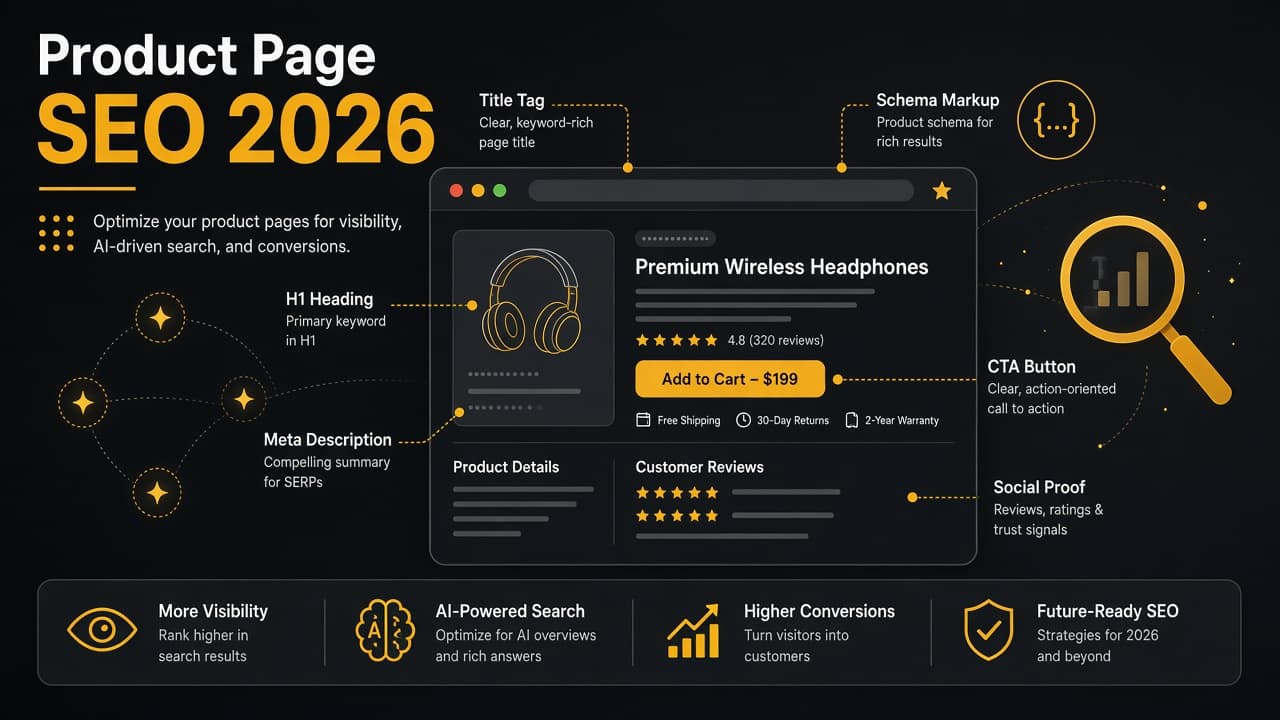
If you searched product page seo, you probably already have a landing page - and it might look great while ranking nowhere.
That is the gap most SaaS founders hit: design ships first, product page SEO ships never. Meanwhile, competitors with uglier pages outrank you because their title tags, schema, and third-party listings tell Google and AI systems exactly what the product is, who it is for, and what it costs.
Product page SEO is the highest-leverage SEO work a startup can do. One URL carries your brand, converts buyers, earns backlinks, and feeds ChatGPT answers. Get it wrong and every blog post you publish sends equity to a page search engines cannot parse.
This guide is the complete product page SEO checklist we recommend at Founder.best - including the AI layer (GEO) and the second product page most founders forget: your permanent launch listing.
What product page SEO means in 2026
Product page SEO is not stuffing "best CRM software" into a hero headline. It is making one canonical product URL:
- Crawlable - fast, mobile-friendly, indexable, no duplicate versions
- Understandable - clear H1, feature blocks, pricing, FAQ that match search intent
- Machine-readable - SoftwareApplication JSON-LD, FAQ schema, OG tags
- Corroborated - the same facts on your site and trusted third-party listings
- Cite-worthy - extractable data AI systems can quote without guessing
In 2026, product page SEO has two audiences: Google searchers clicking blue links, and buyers asking AI tools "what is the best [category] for my use case?" Both need the same thing - a definitive page with verifiable facts.
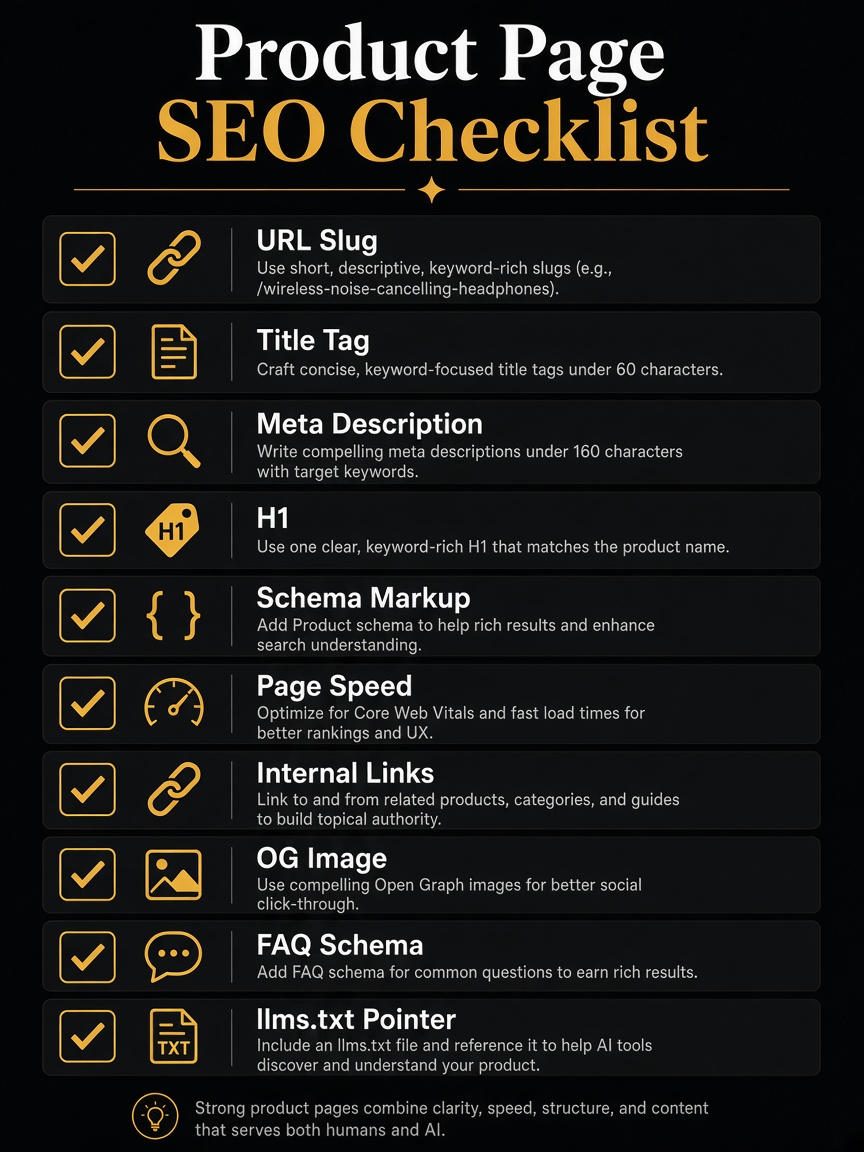
The product page SEO checklist (on-site)
Work through this list on your primary product URL - homepage or /product - before you publish another blog post.
1. Pick one canonical URL
Duplicate product pages split ranking signals. Choose one URL:
- Early-stage single-product SaaS: homepage is fine
- Multi-page site: dedicated
/product,/pricing, or category landing page - Set
rel="canonical"on any alternate URLs (A/B test variants, trailing slashes, www vs non-www)
Every internal link from your blog, footer, and nav should point to this URL - not a random /features page with overlapping copy.
Use the slug checker before you lock a URL on Founder.best so your listing slug matches your brand (founder.best/products/your-slug).
2. Title tag (SERP headline)
The title tag is what appears in Google results. Rules for product page SEO:
- Format:
Product Name - Primary benefit or category - Length: aim for 50–60 characters; Google may rewrite longer titles
- Include: product name (brand query), one category or outcome keyword
- Avoid: repeating the same phrase twice, ALL CAPS, or ten comma-separated keywords
Examples:
SEOFarmer - SEO workspace with Search Console + AIAcme CRM - Simple CRM for bootstrapped startups
Write 2–3 variants and pick the one that reads naturally in a search result - not the one with the most keywords.
3. Meta description (SERP snippet)
Meta descriptions do not directly rank, but they drive click-through rate - which affects rankings indirectly.
- Length: 140–160 characters
- Include: product name, core benefit, pricing signal if relevant ("free trial", "from $9/mo")
- Tone: specific, not hype ("Grow traffic with real SEO data" beats "Revolutionary AI platform")
If Google rewrites your meta, check Search Console for the queries triggering rewrites and align copy with actual search intent.
4. H1 and heading structure
One H1 per page - usually your product name or primary value proposition. Feature sections use H2/H3 in logical order:
H1: Grow traffic with real SEO data + AI intelligence
  H2: Keyword research
  H2: Google Search Console integration
  H2: AI content briefs
  H2: Pricing
  H2: FAQ
Search engines and AI parsers use headings to understand page structure. Do not skip from H1 to H4. Do not put your only keyword mention in an H3 buried below the fold.
5. Body copy that matches intent
Product page SEO copy should answer buyer questions in the first two scrolls:
- What does it do? (one paragraph, plain language)
- Who is it for? (founders, marketers, agencies - be specific)
- How is it different? (honest comparison, not "best in class")
- What does it cost? (tier names, starting price, free trial yes/no)
- How do I start? (clear CTA above the fold)
Aim for 800–2,000 words of substantive copy across hero, features, social proof, and FAQ. Screenshots and short demo GIFs count as content - they increase dwell time and give AI systems visual context when cited in guides.
6. Schema markup (SoftwareApplication JSON-LD)
Schema is non-negotiable for SaaS product page SEO in 2026. Minimum JSON-LD block:
@type:SoftwareApplication(orProductfor non-software)name,description,url(your product website)applicationCategoryoperatingSystem:Webfor SaaSofferswithpriceandpriceCurrencywhen public pricing existsaggregateRatingonly when you have real reviews - never fake stars
Add FAQPage schema for your FAQ section. Google uses it for rich results; AI systems use it for direct answer extraction.
Founder.best product pages emit SoftwareApplication JSON-LD automatically for every approved listing - including Offer data for free/freemium tiers and real AggregateRating only when reviews exist. Mirror the same facts on your site.
7. Page speed and Core Web Vitals
Slow product pages lose rankings and conversions. Priorities:
- Compress hero images (WebP, lazy load below fold)
- Defer non-critical JavaScript
- Use a CDN for assets
- Target LCP under 2.5s on mobile (PageSpeed Insights is free)
Product page SEO fails silently when Lighthouse scores are red and founders blame "competition" instead of a 4MB PNG hero.
8. Open Graph and Twitter cards
Social shares drive referral traffic and brand searches. Every product page needs:
- OG image: 1200×630 PNG or JPG (not SVG - most platforms ignore SVG previews)
- og:title and og:description aligned with title tag and meta
- twitter:card set to
summary_large_image
When someone shares your launch on X or LinkedIn, the preview card is often the first impression - treat it as part of product page SEO.
9. Internal links
Your product page should receive links from:
- Homepage (if product page is separate)
- Blog cluster articles (3–5 contextual links minimum)
- Footer "Product" link
- Documentation and changelog
Link out from the product page to 2–3 supporting guides ("How [product] works with Search Console") to build topical authority. Read the broader strategy in SEO for startups.
10. llms.txt pointer
Add your canonical product URL to yourdomain.com/llms.txt:
# Product
- https://yourdomain.com/ (or /product)
- https://yourdomain.com/pricing
This tells AI crawlers which page is authoritative. It does not guarantee citations, but it reduces ambiguity when models pick sources.
The second product page: launch platform listings
Most product page SEO guides stop at your own site. That is half the picture.
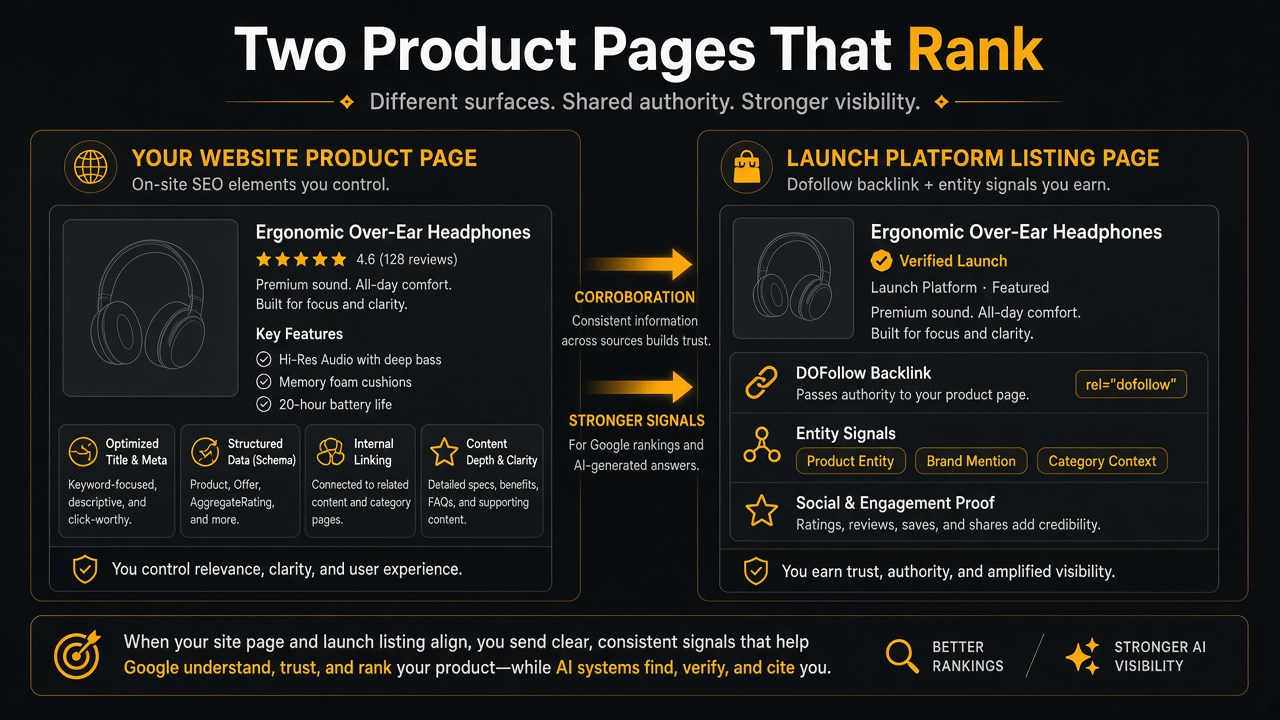
Google and AI systems trust brands mentioned consistently across multiple indexed pages. Your site is the source of truth. A third-party product listing is the corroboration layer.
Launch on Founder.best because every approved product gets:
- Permanent URL:
founder.best/products/your-slug- stays indexable after homepage rotation - Dofollow backlink to your site (paid plans immediately; free launches from launch week)
- Structured listing: tagline, description, categories, pricing type, upvotes, launch date
- SoftwareApplication JSON-LD on the listing page
- Founder profile link at
founder.best/yourname - Product updates that keep the listing fresh for crawlers
Keep these fields aligned with your site product page:
| Field | Must match across site + listing |
|---|---|
| Product name | Exact spelling |
| One-line pitch | Same positioning |
| Pricing type | free / freemium / paid / subscription |
| Category | Same vertical |
| Website URL | Same domain |
Misaligned facts confuse entity understanding. If your site says "$9/mo" and your listing says "free," AI answers may skip you entirely.
Plans: Free Launch ($0) with limited weekly slots, Standard ($2.99) for instant go-live and 2-week homepage visibility, Pro ($9) for 1-month featured placement. All include a permanent product page built for product page SEO.
Product page SEO for AI answers (GEO layer)
Classic product page SEO optimizes for Google clicks. GEO optimizes for AI citations.
Make facts extractable
AI systems quote pages with clear, scannable facts:
- Pricing table with tier names and prices
- "Best for:" line (founders, agencies, enterprise)
- Feature comparison vs 1–2 competitors (honest tradeoffs)
- Integration list with names, not "100+ integrations"
- FAQ with direct question-answer pairs
Avoid AI-invisible patterns
These hurt product page SEO for both Google and AI:
- Critical pricing hidden behind "Contact sales" with no starting price
- Product name only in images, not in HTML text
- JavaScript-rendered content with no server-side fallback for key facts
- Generic marketing fluff with no verifiable claims
- Multiple product names or rebrands on the same page
Monitor AI citations monthly
Prompt 10 buyer questions in ChatGPT and Perplexity:
- "What is [your product]?"
- "How much does [your product] cost?"
- "Best alternative to [competitor]?"
Log accuracy. Fix your product page and Founder.best listing before buying another SEO tool.
Deep dive: Increase SaaS brand visibility in AI answers.
Using AI to speed up product page SEO (safely)
AI accelerates product page SEO when used for drafts, not publishing:
| Task | AI role | Human role |
|---|---|---|
| Meta description variants | Generate 5 options | Pick and edit for accuracy |
| FAQ schema questions | Suggest buyer questions | Write verified answers |
| JSON-LD skeleton | Draft SoftwareApplication block | Validate pricing and URLs |
| Feature copy | Outline H2 sections | Add screenshots and proof |
| Competitor comparison | Research summary | Add honest tradeoffs |
Never ship an AI-only product page with no screenshots, no pricing clarity, and no customer proof. Thin pages fail product page SEO even when schema is perfect.
Product page SEO vs other page types
Founders confuse product page SEO with adjacent work:
| Page type | SEO job | Product page SEO overlap |
|---|---|---|
| Product page | Convert + rank for brand/category terms | Core focus of this guide |
| Blog post | Rank for informational keywords | Links to product page |
| Pricing page | Rank for "[product] pricing" | Canonical pricing source |
| Comparison page | Rank for "[you] vs [competitor]" | Supports product page entity |
| Docs | Rank for "how to [use case]" | Links back to product page |
Your product page is the hub. Blog posts, comparisons, and launch listings are spokes. Build the hub first.
1-day product page SEO sprint
Block one day and ship these in order:
Morning (on-site)
- Audit current URL - pick canonical, fix redirects
- Rewrite title tag + meta description
- Fix H1 and H2 structure
- Add or update SoftwareApplication + FAQ JSON-LD
- Compress images; re-test mobile PageSpeed
Afternoon (off-site + AI)
- Create or update
llms.txt - Launch or refresh Founder.best listing - match all facts
- Embed Founder.best badge on your site (extra dofollow link)
- Add 3 internal links from existing blog posts to product page
- Run 10 AI prompt tests; log citation accuracy
Most teams finish in 6–8 hours. Re-check Search Console in 30 days for impression growth on brand and category queries.
Common product page SEO mistakes
- Three URLs, same pitch -
/,/product,/homeall competing - Title tag is just the brand name - misses category keywords
- No schema - machines guess your pricing and category
- Fake review stars - Google manual actions; AI systems distrust you
- Listing facts do not match site - entity confusion kills AI citations
- Set and forget - no updates after pricing change or rebrand
- Product page is 100% image - crawlers and AI parsers need text
Fix the product page before scaling content or ads. Every dollar spent on traffic to a poorly optimized URL leaks conversion and SEO equity.
Metrics for product page SEO
Track monthly on your canonical product URL:
- Impressions and clicks in Search Console (brand + category queries)
- Average position for "[product name]" and "[product name] pricing"
- Organic signups attributed to product page landing
- Core Web Vitals pass rate on mobile
- Indexed status - URL appears in Google site: search
- AI citation accuracy - % of prompts with correct name and pricing
- Dofollow backlinks pointing at product page (Ahrefs or manual)
Domain Rating is site-wide; product page SEO success shows up in URL-level impressions first.
Start today
Product page SEO is not a quarterly project. It is the foundation every other SEO tactic builds on.
If you do three things this week:
- Fix title tag, meta, and schema on your product page
- Add FAQ schema with five real buyer questions
- Launch on Founder.best so a permanent listing corroborates your facts
You will have stronger product page SEO than most competitors who published thirty blog posts on a broken landing page.
Related guides: SEO for startups · High authority backlinks · SaaS launch checklist · Domain Rating checker
Key takeaways
- Product page SEO starts with one canonical URL - not your homepage, not three competing landing pages with the same pitch.
- Title tag, meta description, H1, and schema must agree on product name, category, and pricing tier - AI systems penalize inconsistent facts.
- SoftwareApplication JSON-LD + FAQ schema + OG image are the minimum structured layer for SaaS product pages in 2026.
- Stack your site product page with a Founder.best listing for dofollow backlinks and third-party entity corroboration.
- Use AI for schema drafts and meta variants - never publish a product page with no screenshots, pricing clarity, or social proof.
Frequently asked questions
What is product page SEO?
Product page SEO is the practice of optimizing your product landing page so search engines and AI systems can crawl, understand, and rank it for buyer-intent queries. It covers URL structure, title tags, meta descriptions, headings, schema markup, page speed, internal links, and social preview images - plus third-party listings that corroborate the same product facts.
What should a product page title tag include for SEO?
Lead with your product name, add your primary category or benefit, and stay under 60 characters when possible. Example: "Acme CRM - Simple CRM for Bootstrapped Startups." Avoid keyword stuffing. Match the H1 closely but not identically - the title tag is for SERP clicks; the H1 is for on-page clarity.
Does schema markup help product page SEO?
Yes. SoftwareApplication or Product JSON-LD makes your name, description, URL, category, and pricing machine-readable. Google uses it for rich results; AI systems use it to extract facts for answers. Include Offer data when you have public pricing, and AggregateRating only when you have real reviews - never fabricate ratings.
How long should a product page be for SEO?
Most SaaS product pages perform well between 800 and 2,000 words of substantive copy - plus feature sections, FAQ, and social proof. Thin pages under 300 words rarely rank for competitive terms. Prioritize scannable structure: H2 feature blocks, comparison table, pricing section, and FAQ over dense paragraphs.
Should my homepage or a dedicated /product page be the SEO target?
Pick one canonical URL and stick with it. Many startups use the homepage as the product page early on - that is fine if it is focused on one product. Once you add a blog, docs, or second product, split to a dedicated /product or root landing page and canonicalize duplicates.
How does AI search change product page SEO?
AI answers cite product pages they can verify. That means extractable facts (pricing, features, category), structured data, llms.txt pointing to your canonical URL, and matching information on trusted third-party listings like Founder.best. Product page SEO in 2026 includes GEO - making your page cite-worthy in ChatGPT and Perplexity, not just Google blue links.
Does a Founder.best listing count as product page SEO?
It complements your site product page. Founder.best gives you a permanent indexable listing at founder.best/products/your-slug with a dofollow backlink, categories, upvotes, and founder profile linkage. AI systems and Google treat it as a third-party corroboration page - keep facts aligned with your own product page for best results.
What is the fastest product page SEO win for a new SaaS?
In one day: fix title tag and meta description, add SoftwareApplication JSON-LD, compress hero images for mobile speed, add 5-question FAQ schema, upload a 1200x630 OG image, and launch on Founder.best for a dofollow listing. That covers on-page, structured data, and off-page corroboration in a single sprint.
Can I use AI to write my product page for SEO?
Use AI for first drafts of meta descriptions, FAQ answers, and schema snippets - then edit heavily. Add screenshots, real pricing, customer quotes, and integration logos only a human can verify. AI-only product pages without proof rarely rank or get cited.
How often should I update product page SEO?
Refresh title and meta when positioning shifts. Update schema and FAQ whenever pricing or major features change. Post product updates on Founder.best so your listing stays fresh. Re-check Search Console quarterly for queries driving impressions to your product URL.
Keep reading
Ready to launch on Founder.best?
Weekly rankings, dofollow SEO backlinks, founder stories, and a community built for indie makers.
Submit your startup