
SEO for founders
SaaS content refresh strategy: how to update old content for better SEO results
New posts get the glory. Your fastest SEO wins often live in URLs that already rank on page two, bleed CTR, or explain your product with 2023 screenshots. This is a repeatable SaaS content refresh strategy—audit, prioritize, update, link, measure—without burning domain equity on unnecessary URL changes.

Post by Anuj Shashimal
Founder, Founder.best16 min read

You do not need another twelve net-new posts this quarter to move organic pipeline. You need a SaaS content refresh strategy that turns aging URLs into pages worth clicking again—without throwing away the history Google already trusts.
This guide walks through what refreshing means, how to find candidates in Search Console and analytics, a seven-step update playbook, URL and internal linking rules, measurement that accounts for seasonality, mistakes that waste founder hours, and a copyable checklist you can run before every republish.
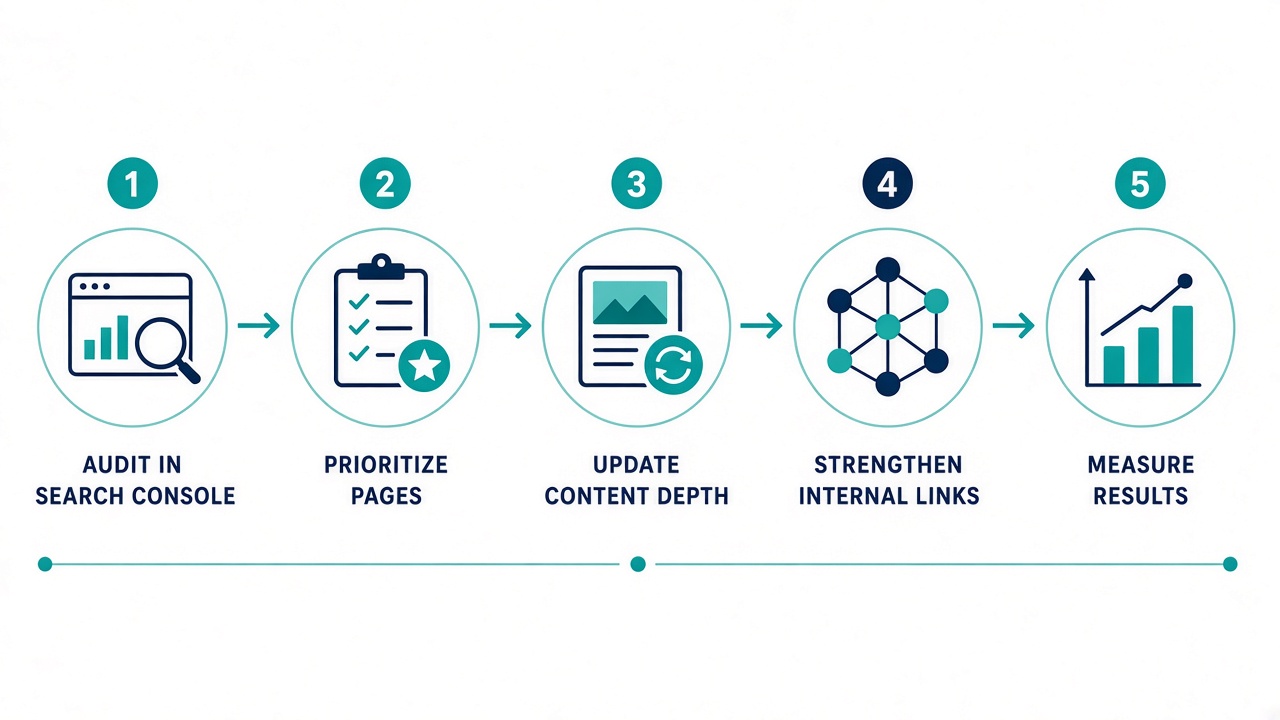 Five-step SaaS content refresh workflow—from audit and prioritize to update, link, and measure
What is a content refresh strategy?
A content refresh strategy is the deliberate practice of improving pages you already published instead of only adding new ones.
Refreshing means updating facts, examples, structure, media, keywords, internal links, and on-page SEO so the page better matches what searchers want today. It is not a light copy edit. It is not swapping the hero image and calling it done.
Creating new content targets queries you do not cover yet—new comparisons, integrations, or pillars in a topic cluster. Refreshing targets URLs that already exist: they may have backlinks, internal links, indexed history, or impressions on page two that a brand-new slug would take months to earn.
For SaaS companies, the library mixes blog guides, landing pages, docs, and comparison pages. All of them decay: pricing changes, competitors ship features, screenshots age, your ICP narrows, and Google’s results page adds AI overviews and new SERP layouts. A refresh program reviews that inventory on a schedule—usually monthly triage plus quarterly deep passes on money pages.
Refresh vs net-new: where each lever wins
- 1. Refresh existing URLPage already has impressions, links, or rank history—upgrade depth and intent match
- 2. Net-new URLGap in topic cluster or zero coverage for a buyer query—publish and interlink
- 3. HybridMerge two thin posts into one strong URL—redirect the loser, refresh the survivor
Why SaaS companies should refresh existing content
SaaS content is unusually perishable. Your product, positioning, and competitive set change faster than a law firm’s practice areas or a local plumber’s service list. If you only publish forward, old posts become silent liabilities.
Declining organic traffic on a URL that still ranks is often fixable. Rankings slip when competitors publish deeper guides, when your page stops answering the query, or when CTR falls because the title promises 2023 and the SERP shows 2026 results.
Outdated information erodes trust and conversions even when traffic holds. Wrong pricing, retired integrations, or screenshots of a UI you redesigned teach buyers that your site is unmaintained—and sales teams pay the tax in objections.
Search intent shifts when categories mature. A post written for “what is X” traffic may need to become a buyer checklist, a comparison, or a workflow guide as the market learns the category.
Stronger competitors update on cadence. You do not need their budget; you need their habit of improving pages that already earn impressions.
Missed conversion opportunities show up when analytics says traffic is fine but trials are not. Refresh is where you add clearer CTAs, better internal links to product page SEO targets, and sections that match bottom-of-funnel intent—topics we cover in finding B2B clients for your SaaS.
Signals that a SaaS URL is ready for refresh (illustrative weights)
- 42%
- Year-over-year organic clicks down on a URL with stable impressions
- 38%
- Average position between 5 and 20 for a money keyword
- 31%
- CTR below peer pages for the same query set
- 27%
- Product facts, pricing, or screenshots out of date
- 22%
- High traffic, low trial or demo conversion from that landing page
How to identify content that needs refreshing
Think in signals, not vibes. Build a simple spreadsheet: URL, primary intent, last meaningful update, 90-day clicks, impressions, CTR, average position (for top queries), and conversions (trial, demo, or signup).
| Signal | What it usually means | Refresh angle |
|---|---|---|
| Declining clicks, stable impressions | CTR or relevance problem | Title, meta, intro, SERP mismatch |
| Declining average position | Competition or thin content | Depth, examples, structure, links |
| High impressions, low CTR | Snippet does not win the click | Title, description, date cues, FAQ schema |
| Traffic up, conversions flat | Intent mismatch or weak CTA | BOFU sections, product ties, proof |
| Outdated facts | Trust and AI citation risk | Pricing, features, screenshots, tools |
| New queries in GSC not on-page | Intent expanded | New H2 sections, FAQ, internal links |
Content decay is normal. A guide that ranked at launch may sit at position 11 eighteen months later—not because SEO “stopped working,” but because the page froze while the SERP moved.
Prioritize money pages first: comparisons, alternatives, integration explainers, pricing-adjacent guides, and pillars that feed your product. Refreshing a viral top-of-funnel post feels good; refreshing a comparison page that feeds trials pays rent.
Where SaaS teams get the most refresh ROI first (typical priority order)
- Comparison and alternative pages94
- Integration and use-case pages86
- Product-adjacent guides and checklists79
- Evergreen pillar posts71
- Top-of-funnel educational posts55
- Company news and launch recaps28
How to audit old content using Google Search Console and analytics
You do not need a enterprise content ops stack. You need Search Console, analytics (GA4 or product analytics), and thirty focused minutes.
Google Search Console
- Open Performance → Search results, set range to last 3 months, compare to previous period (or year-over-year if seasonality matters).
- Filter by Page containing
/blog/or your content path. - Sort by Clicks Δ (biggest drops) and by Impressions (high visibility, underperforming clicks).
- Click a URL, switch to Queries, and note: main keyword, position, CTR vs site average.
- Export pages with impressions > 500 (adjust for your size) and CTR below ~2–3% for positions 1–10—those are title/snippet fixes.
- Check Pages indexing report for “Crawled – currently not indexed” on URLs you care about—refresh plus internal links sometimes helps; sometimes technical fixes come first (see SEO for startups).
Analytics
In GA4 (or equivalent), build a report for Organic landing pages:
- Sessions and engaged sessions (or time on page for long guides)
- Key events: trial signup, demo request, newsletter, pricing view
- Landing page → conversion rate for content URLs
Crosswalk GSC clicks with analytics conversions. A post with 400 clicks and zero trials is a different refresh than a post with 40 clicks and five trials.
Optional rank tracking
Ahrefs, Semrush, or a lightweight rank tracker helps for priority keywords on your refresh list. Use weekly checks, not daily panic. Our how to measure SaaS content marketing guide aligns refresh KPIs with the same metrics you should already review monthly.
7 steps to refresh SaaS content for better SEO
Treat each refresh as a small project with a definition of done—not a vague “make it better.”
1. Update outdated statistics, examples, screenshots, and recommendations
Replace old market sizes, deprecated tools, and UI captures. Add current pricing bands, integration logos you support today, and honest “what changed since we first published this” notes where transparency helps trust.
SaaS buyers compare freshness. A 2026 SERP next to your 2023 title is a CTR leak.
2. Reevaluate keywords and search intent
Pull the top 10–20 queries from GSC for that URL. Ask: Does the page still match the dominant intent?
- Informational → add steps, definitions, and a path toward product
- Commercial → add comparison tables, criteria, and proof
- Transactional → shorten fluff, surface pricing and signup paths
Avoid stuffing secondary keywords into every paragraph. Add an H2 where a query deserves a real section.
3. Improve content depth, clarity, and usefulness
Merge thin sections. Delete boilerplate that repeats the intro. Add decision frameworks, checklists, and “if you are X, do Y” branches—patterns that work in content marketing for startups.
Aim for the page to be the best single URL a busy operator could send to a colleague. That standard beats word count targets.
4. Add relevant examples, original insights, and actionable advice
Generic refreshes fail. Add:
- A worked example (metrics, timeline, or anonymized customer pattern)
- Your product’s point of view on the workflow—without turning the post into an ad
- Links to primary sources, docs, or your own data
Original insight earns links and AI citations over time, especially when paired with founder-led SEO.
5. Improve titles, meta descriptions, and headings where necessary
Rewrite the title tag when intent or year matters. Test a meta description that states who it is for and what they get—not keyword soup.
Fix heading hierarchy: one H1, logical H2s that mirror queries, H3s for substeps. Broken hierarchy confuses readers and parsers.
6. Add relevant internal links to related articles and product pages
Every refresh should add 3–8 contextual internal links: pillar pages, sibling posts, product features, and comparison URLs. Use descriptive anchors (“SaaS content refresh checklist,” not “click here”).
This step is cheap SEO leverage and often skipped—see the dedicated section below.
7. Review technical SEO elements and page experience
Before republish:
- Canonical URL unchanged (unless you merged pages)
- Indexable (no accidental
noindex) - Core Web Vitals acceptable on mobile
- Images compressed with modern formats; alt text accurate
- FAQ or HowTo schema where it reflects visible content
- Last modified reflects real update (some CMSs expose this automatically)
Request indexing in Search Console after meaningful changes. Ping your sitemap if your stack does not update automatically.
How to improve search rankings without unnecessary URL changes
Default: keep the URL. Stable URLs preserve:
- External backlinks pointing at the path
- Internal links across your site
- Historical performance data in GSC
- User bookmarks and sales deck links
Refresh the body, title, and metadata in place when the page still answers the same primary question.
Consider a URL change or merge when:
- You combine two thin posts into one definitive guide (301 the removed URL to the survivor)
- The product or category renamed and the slug misleads (“old-brand-vs-x” → new brand)
- Intent pivots so far that the old slug promises the wrong thing
- You deprecate a feature and the URL should redirect to a replacement guide or product page
Use 301 redirects for permanent moves, update internal links sitewide, and keep the redirect in place for at least a year. Do not chain redirects.
When you must change URLs, treat it as a migration mini-project—not a side effect of editing copy.
How to strengthen internal linking after a content refresh
Internal linking is how you tell Google—and readers—which pages matter in your topic cluster. After a refresh, you have new sections worth wiring into the graph.
From the refreshed page, link out to:
- The pillar for that cluster (for example SEO strategy for startups)
- Two sibling articles that deepen subtopics
- One product or feature page when the section is BOFU
- Measurement or ops posts when you mention KPIs (measure SaaS content marketing)
Into the refreshed page, add links from:
- Older posts that mention the topic in passing
- Navigation or “related reading” modules if your template supports them
- Updated comparison pages that should cite the refreshed criteria
Maintain a simple link log in your refresh ticket: source URL, anchor text, target URL. That prevents orphan refreshes that Google never re-crawls from strong parents.
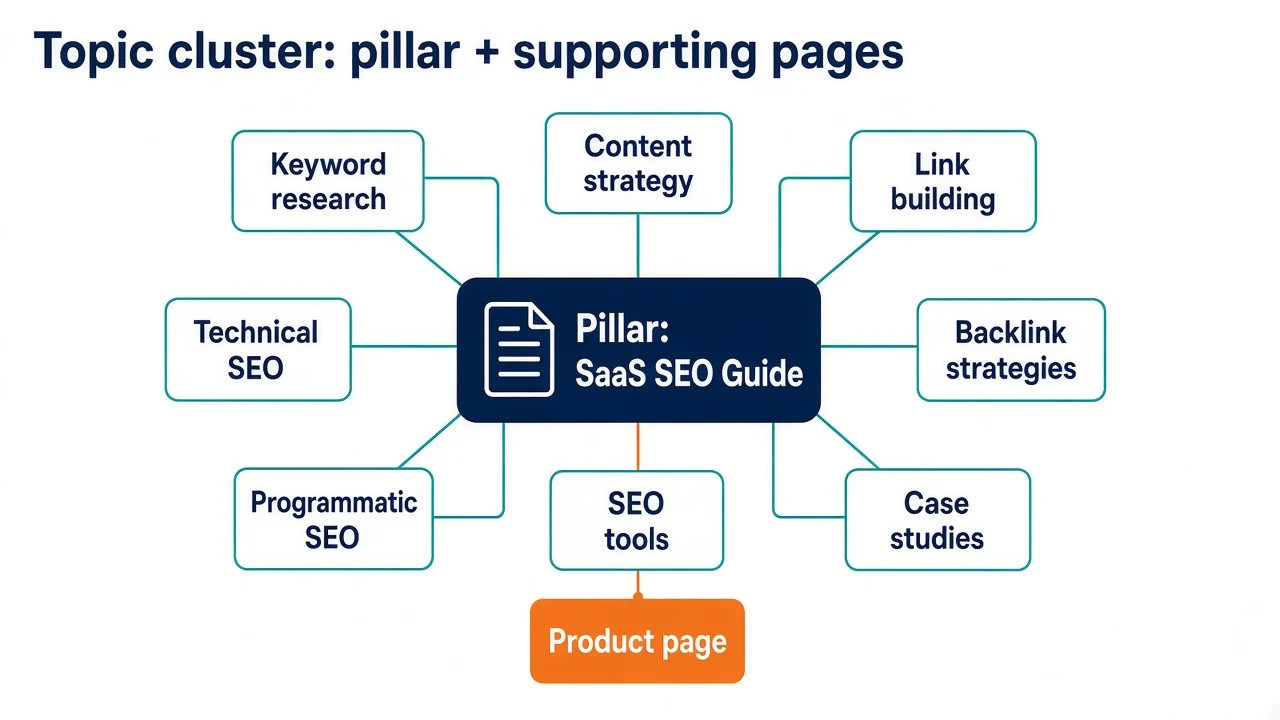 Internal linking after a content refresh—connect refreshed articles to pillars, product pages, and sibling guides
How to measure the results of a content refresh
Measure like a scientist, not a gambler. Capture a baseline the week before publish and compare 8–12 weeks after, using the same day-of-week range when seasonality exists (B2B dips on holidays; edtech spikes in fall).
| Metric | Where to read it | What “good” looks like |
|---|---|---|
| Organic clicks | GSC Performance, page filter | Sustained lift vs baseline, not one spike |
| Impressions | GSC | Often rises when relevance improves |
| CTR | GSC | Up when titles and snippets match intent |
| Average position | GSC queries | Gradual improvement on target queries |
| Engaged sessions | GA4 | Up if content is genuinely more useful |
| Trial / demo conversions | GA4 + CRM | Up on URLs you optimized for BOFU |
Account for seasonality: compare October to October, not October to July, unless your business is flat year-round.
Account for noise: rankings fluctuate daily. Judge trends over weeks. A refresh that moves position 14 → 9 may take two index cycles.
Document what you changed (title, new H2s, merged sections, links added). When results arrive, you learn which levers work on your domain—valuable for B2B SaaS product marketing planning.
Example: clicks before vs 10 weeks after refresh (illustrative single URL)
- Baseline 90-day organic clicks620
- Post-refresh 90-day organic clicks910
- Baseline CTR0
- Post-refresh CTR0
- Trial assists tagged in CRM4
- Post-refresh trial assists11
Common content refresh mistakes to avoid
Changing publication dates without meaningful updates trains your team to perform SEO theater. Readers and reviewers notice. Make edits you would proudly describe in a changelog.
Adding keywords unnaturally makes content worse and can trigger quality demotions. Write for the query, not for density.
Deleting useful content too quickly during “pruning” removes passages that ranked for long-tail queries. Trim fluff; keep unique examples and FAQ answers unless you merge them elsewhere.
Unnecessary URL changes discard equity. If marketing wants a prettier slug, weigh the cost.
Expecting immediate ranking jumps leads to premature rewrites. Allow crawl, index, and user signal accumulation.
Refreshing without internal links leaves the page isolated. Always connect refreshes to pillars and product paths.
Ignoring conversion intent produces pretty traffic graphs and empty pipelines—exactly what strong measurement practices are meant to catch.
SaaS content refresh checklist
Use this before you hit publish on any updated article or landing page.
 Copyable checklist
SaaS content refresh checklist (2026)
Audit and scope
- Baseline exported: 90-day clicks, impressions, CTR, top queries, conversions
- Primary intent confirmed from GSC queries (not guessed from the old title)
- Outdated facts flagged: pricing, features, competitors, screenshots, legal claims
Content and SEO
- Title and meta description rewritten for click and intent (if needed)
- H2/H3 structure matches queries; fluff removed; depth added where thin
- New examples, data, or original insight added (not just synonym swaps)
- 3–8 internal links out; 2+ older posts updated to link in
- CTA appropriate to funnel stage (trial, demo, newsletter, next article)
Technical
- URL unchanged OR 301 plan executed with internal link sweep
- Indexable, canonical correct, images optimized, schema valid
- Request indexing submitted; sitemap includes URL
Measurement
- Refresh log notes what changed and publish date of meaningful update
- Calendar reminder set for 8–12 week post-review against baseline
Build a repeatable SaaS content refresh process
A one-off heroic rewrite does not scale. A repeatable process does:
- Monthly: Scan GSC for click drops and CTR outliers; fix quick wins (titles, broken links, obvious staleness).
- Quarterly: Run the full seven-step refresh on 3–10 priority URLs—comparisons, pillars, integration pages first.
- After product launches: Update any page that names features, pricing, or positioning you changed.
- With measurement: Use the same KPIs as your content program (SaaS content marketing metrics) so refresh competes fairly against new topics in your roadmap.
Over a year, a team that refreshes ten strong URLs often beats a team that publishes thirty disconnected posts—especially when domain authority is still growing. Refresh is how small SaaS sites punch above their weight in SEO strategy for startups terms: winnable keywords on URLs that already exist.
Start with one page that has impressions and shameful CTR. Run the checklist. Link it to your product story. Measure for twelve weeks. Then schedule the next URL.
Related reading: Content marketing for startups · Product page SEO · Founder-led SEO · List on Founder.best when you want launch listings and dofollow product pages in the same authority graph you are strengthening with refreshes.
Key takeaways
- Refresh beats net-new when a URL already has impressions, backlinks, or internal links—updating depth is often cheaper than ranking a blank page.
- Search Console surfaces the queue: falling clicks, position 5–20 keywords, high impressions with weak CTR, and queries you no longer answer on-page.
- Meaningful updates change facts, structure, and usefulness—not the publication date alone. Match search intent before you add keywords.
- Keep the URL when the page serves the same job; redirect only when intent, product name, or slug semantics truly change.
- After publish, wire internal links from refreshed posts to pillars, product pages, and sibling guides—then judge results over 8–12 weeks, not 48 hours.
Frequently asked questions
What is a content refresh strategy for SaaS?
A content refresh strategy is a repeatable process to audit existing blog posts, guides, and landing pages, prioritize underperformers, improve accuracy and depth, fix titles and meta descriptions, strengthen internal links, and measure organic clicks and conversions over time. It complements publishing new content rather than replacing it.
How often should SaaS companies refresh content?
Review Search Console monthly for sharp drops. Run a structured refresh cycle quarterly on buyer-intent and product-adjacent pages, and annually on evergreen pillars. Comparison, pricing, and integration pages may need updates whenever your product, competitors, or screenshots change.
Does updating publish date help SEO?
Changing the date without substantive edits does not reliably improve rankings and can erode trust if readers notice shallow changes. Search engines respond to improved relevance, satisfaction signals, and clearer intent match—not cosmetic timestamps.
Should I change the URL when refreshing content?
Keep the URL when the topic and intent stay the same so you preserve link equity and history. Change the slug and use a 301 redirect only when you merge pages, rename the product, or shift intent so the old URL would mislead searchers.
How long until a content refresh shows SEO results?
Crawl and re-indexing can happen within days. CTR and ranking movement often appear in two to six weeks; conversion lift may take longer. Compare 90-day windows before and after refresh, and ignore single-day rank noise.
What pages should SaaS teams refresh first?
Start with pages that already get impressions: positions roughly 5–20, declining clicks year over year, high impressions with low CTR, outdated pricing or feature claims, and URLs that rank but rarely produce trials or demos.

About the author
Anuj Shashimal
Founder, Founder.best
SaaS founder, indie hacker, and software engineer. Anuj built Founder.best to help indie founders launch, get discovered through search and AI answers, and turn launches into customers. He writes from first-hand experience growing Founder.best from zero to 400+ founders and 300+ launched products.
Tagged in
Browse all tagsKeep reading
Free tools and guides for this topic
Hand-picked from the tags on this post.
- Free Ahrefs Domain Rating checkerLive DR (0–100) for any domain before you chase a backlink.
- Browse blog posts by topicSEO, backlinks, launch platforms, AI search, startup tools, and more.
- Free SaaS directories for backlinksList of free SaaS and startup directories with dofollow filters, Ahrefs DR scores, and a submission checklist.
- Get your product discovered by AI assistantsWhich listing fields make your product rank for the right questions.
- Directories & SEOWhich startup directories give dofollow backlinks in 2026? Launch platforms, SaaSHub, AI directories, and…
- Free tools for foundersName generator, tagline writer, slug checker, DR checker, launch checklist.
Ready to launch on Founder.best?
Weekly rankings, dofollow SEO backlinks, founder stories, and a community built for indie makers.
Submit your startup