SaaS discovery
Small B2B SaaS Companies in the US to Watch in 2026
Discover emerging US SaaS startups building AI-powered business software for sales, marketing, operations, finance, legal and more. Fifteen companies, grouped by what they help a business do, with team sizes and the reasons they're worth watching.

Post by Anuj Shashimal
Founder, Founder.best15 min read
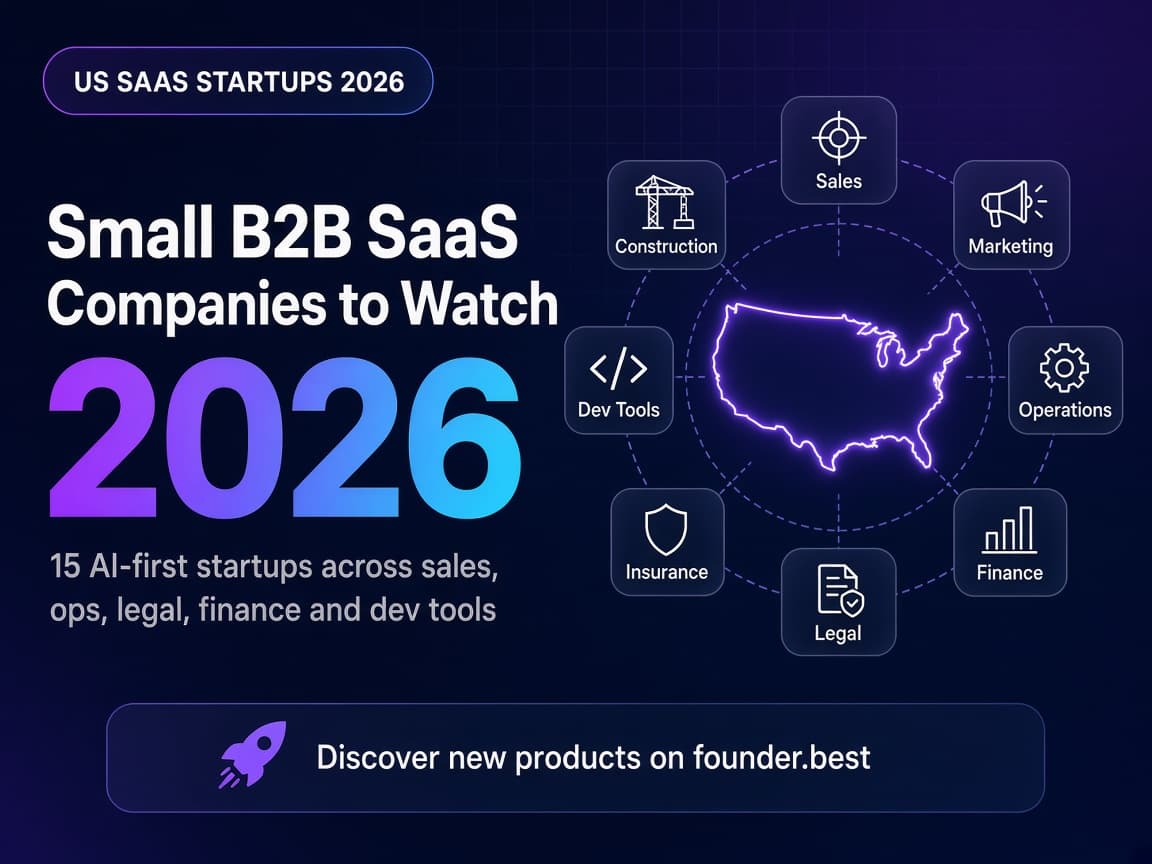
A lot of the most interesting business software in 2026 is coming from teams you could fit around one table. Nine of the 15 startups in this list have exactly two people on their Y Combinator profile.
This guide covers why small B2B SaaS companies matter right now, what counts as one, and 15 US startups worth tracking. You'll also get a checklist for judging a young vendor before you trust it with your data.
A quick note on sources. Company details come from each startup's YC directory profile and its own website, checked on October 26, 2026. Team sizes change fast at this stage, so treat them as a snapshot.
Why Small B2B SaaS Companies Matter in 2026
AI lowered the cost of building SaaS
A few years ago, a credible B2B product needed several engineers, a designer and months of runway before a customer saw it. Now one engineer with a coding agent can ship a working MVP in weeks.
You can see it in this list. Adside.ai said it was live with 30 companies while still a team of two. ByteAsk raised a $1 million pre-seed months after founding.
Cheaper building doesn't make the business easy. It does mean a tiny team can reach paying customers before the money runs out.
Small teams can compete with enterprise software
Big vendors sell broad platforms. That breadth is also their weak spot, because every feature has to work for thousands of different customers.
A small team can build for one buyer. Covera only serves independent property and casualty insurance agencies, and it plugs into the agency software they already run, like Applied Epic, EZLynx and HawkSoft.
When a product speaks the buyer's language from the first screen, the enterprise suite starts to look like a lot of menus.
Businesses increasingly adopt niche SaaS tools
Buyers are comfortable stacking specialized tools now. A construction estimator would rather use software built for takeoffs and bid leveling than bend a generic project tool into shape.
And AI makes niche tools better, not worse. A model tuned to how mechanical contractors price ductwork beats one that knows a little about everything.
Why founders should watch emerging startups
If you're a founder, brand-new companies show you where the market is heading long before analyst reports catch up.
They show which problems investors are funding, how new products get positioned and which categories are already crowded. That's free market research.
If you're a buyer, early vendors often give you founder attention and pricing you won't get from a public company.
What Makes a Company a "Small B2B SaaS Company?"
There's no official definition. But when people say "small B2B SaaS company," they usually mean something close to this.
Typical team size: 1 to 50 employees
Most small B2B SaaS companies have between 1 and 50 people. Very early ones, like almost everyone in this article, have two to five.
Past about 50 people, a company usually has dedicated sales, support and success teams. At that point it starts to look like a mid-market vendor.
Team size of the startups in this list
- Clean5 people
- Nex5 people
- Zomma5 people
- Plyxl4 people
- Marker3 people
- UFO.ai2 people
- Adside.ai2 people
- Lightfield2 people
- Covera2 people
- ByteAsk2 people
- Pomerado2 people
- FlowManual2 people
- LinkLane2 people
- Marble2 people
A SaaS business model
Customers pay a recurring fee, monthly or yearly, for hosted software. Many AI products add usage-based charges on top.
Nex is a good example of the hybrid. Its Pro plan is $49 a month plus usage, with $100 of monthly AI usage included.
Business customers instead of consumers
B2B means the buyer is a company. Sales take longer than with consumer apps, but customers tend to stay longer and pay more.
Adside lists its AI agency plan from $590 per brand per month. That's a very different business from a $9.99 consumer subscription.
AI-first vs traditional SaaS
Traditional SaaS gives you a tool and expects your team to do the work inside it. AI-first SaaS tries to do the work and asks your team to approve it.
| Traditional SaaS | AI-first SaaS | |
|---|---|---|
| Who does the work | Your team, inside the tool | The software, with your team reviewing |
| Typical pricing | Per seat | Per workspace, per outcome or usage-based |
| Setup | Configure the tool yourself | Connect your systems and describe the job |
| Example | A CRM your reps update by hand | Nex agents that clean the CRM for you |
Billow is the far end of that range. It calls itself an AI-native accounting firm with "zero software for customers to use." You connect NetSuite or QuickBooks, and it works through your close.
Most AI-first products sit in the middle. They draft, you approve.
Common funding stages
- Bootstrapped: funded by revenue and the founders' savings. Slower, but nobody else owns a piece.
- Pre-seed: the first outside money, often from an accelerator or angels. ByteAsk's $1 million round, led by YC and Entrepreneur First, is a typical example.
- Seed: a larger round once there's early traction, used to hire the first handful of employees.
Every company below is YC-backed, so they sit at pre-seed or seed. That's on purpose. YC's directory is public and lists team sizes, so we could check the facts.
15 Small B2B SaaS Companies in the US Worth Watching
We grouped these by what they help a business do. Each entry covers what the company builds, its industry, why it's interesting and its team size.
All 15 come from YC's Summer 2026, Fall 2026 and Winter 2027 batches, and most are based in San Francisco.
The 15 startups at a glance
- 15
- Startups featured
- 2
- Most common team size
- 5
- Largest listed team
- 3
- YC batches represented
AI Business Operations
1. UFO.ai
UFO is a chat-first AI teammate for running a company. You ask for something in a conversation, and it uses a browser, a terminal and your connected accounts to get it done.
It can also build small internal apps. One example from its docs is an agent that writes a brief before every customer meeting, pulling from your calendar, CRM and notes.
Why it's interesting: the team comes from GitHub Copilot and Perplexity. Its agent runtime, ufo-core, is open source under Apache 2.0, so a company can run agents on its own servers.
- Industry: business operations and internal tools
- Team size: 2
- YC batch: Fall 2026, San Francisco
- Website: ufo.ai
2. Plyxl
Plyxl calls itself "the workspace that does the work." You connect the tools your business already uses, and its agent works across all of them.
That might mean chasing late invoices, moving a job and telling the customer, or building a small app you're missing. It asks first before anything that leaves your business or can't be undone.
Why it's interesting: it's priced per workspace, not per person, which small businesses love. The four founders say they sold more than $150,000 of custom software to businesses as teenagers. Plyxl is the product version of that service.
- Industry: operations software for small businesses
- Team size: 4
- YC batch: Winter 2027
- Website: plyxl.com
3. Marker
Marker isn't classic self-serve SaaS. It pairs a platform with forward-deployed engineers, who embed with a company, map how the work really happens and ship custom AI agents into production in weeks.
The founders built Drapr (YC S20), which Gap Inc. acquired. Co-founder Richard Berwick went on to found Gap's Office of AI.
Why it's interesting: it shows where enterprise AI buying is heading. Companies don't want another tool. They want someone to make agents work inside the systems they already have. Marker says it cut manual product-ops work by 80% at a Fortune 500 retailer.
- Industry: enterprise AI transformation
- Team size: 3
- YC batch: Summer 2026, San Francisco
- Website: onmarker.com
Marketing & Sales
4. Adside.ai
Adside runs paid ads with a team of AI agents. It researches your market, drafts a strategy, makes static and video ads and runs campaigns on Meta, Google, LinkedIn, Reddit and X.
If you'd rather not touch it, there's a managed service with a human expert from its network, starting at $3,500 a month.
Why it's interesting: the founders bootstrapped and sold a B2B SaaS company where paid ads were the main channel. CEO Robin Choy is a second-time YC founder. They said they were live with 30 companies at launch and getting enough inbound to charge $50 per demo.
- Industry: marketing and paid advertising
- Team size: 2
- YC batch: Fall 2026, San Francisco
- Website: adside.ai
5. Clean
Clean tells B2B sellers when a company is ready to buy. Instead of intent data like ad clicks, it reads public records: loans, building permits, customs shipments, contract awards and fleet records.
A loan for a new building, then a closed permit, then machines clearing customs tell one story. Clean turns that into a ranked prospect, with the evidence attached and the right people to contact.
Why it's interesting: most prospecting tools guess from web behavior. Clean bets that real business activity leaves a paper trail. It currently focuses on companies selling into manufacturing, insurance and legal, and syncs prospects to HubSpot or Attio.
- Industry: sales intelligence
- Team size: 5
- YC batch: Fall 2026, San Francisco
- Website: tryclean.ai
6. Nex
Nex builds AI agents for revenue teams. They handle prospecting, lead qualification, CRM cleanup, pipeline alerts and re-engaging lost deals.
Its trick is cost. Nex has AI write code for the predictable parts of a workflow and saves model reasoning for the hard calls, so high-volume work doesn't burn your AI budget overnight.
Why it's interesting: the founders ran large platforms at HubSpot, and one was a founding engineer on the HubSpot CRM. Nex says that on a single onboarding call, it audited thousands of a customer's HubSpot records and started fixing them before the call ended.
- Industry: sales and revenue operations
- Team size: 5
- YC batch: Summer 2026, San Francisco
- Website: nex.ai
Legal & Insurance
7. Lightfield
Lightfield does legal work before it reaches the legal team. It connects to email, Slack, Teams, Salesforce, Jira and other tools, captures requests and applies company policy and past decisions.
Counsel then gets a prepared matter to approve, instead of a vague "quick question" buried in a Slack thread.
Why it's interesting: in-house legal teams field a steady stream of requests from sales and ops across a dozen channels. A front door that triages them automatically is an easy pitch to a general counsel.
One heads-up. This is the Lightfield at trylightfield.ai. The AI CRM at lightfield.com is a different company with the same name.
- Industry: legal tech
- Team size: 2
- YC batch: Fall 2026, San Francisco
- Website: trylightfield.ai
8. Covera
Covera is an AI operating system for independent property and casualty insurance agencies. It lives inside the agency's management system and inbox.
Its agents turn new requests into submission files, fill in carrier portals for quotes, compare quotes side by side, flag renewals at 90, 60 and 30 days and find cross-sell gaps across the book.
Why it's interesting: agencies lose hours re-typing the same data into different carrier portals. Covera says agencies go from lead to quote in five minutes, and nothing reaches a client or carrier without someone at the agency approving it.
The founders previously sold Simio, a conversational AI company, in 2024. Covera also works with brokerages in France and is using YC to grow in the US.
- Industry: insurance
- Team size: 2
- YC batch: Fall 2026, San Francisco
- Website: covera-agents.com
Finance & Compliance
9. Billow
Billow is an AI-native accounting firm. It connects to NetSuite, QuickBooks, Dynamics 365 and dozens of other systems, then handles reconciliations, accruals, the month-end close and budget-versus-actuals work.
Your finance team reviews and approves. Billow prepares the files.
Why it's interesting: in a published case study, a biotech accountant says Billow took his month-end close from two weeks to two days. The CEO previously built and exited an accounting and ERP platform used by 45,000 businesses.
- Industry: accounting and FP&A
- Team size: not listed
- YC batch: Summer 2026, San Francisco
- Website: thebillow.ai
10. Zomma
Zomma builds computer-use agents for financial services back offices. They work on the same screens human analysts use, so there's no integration project.
It starts with cross-border transaction alerts. The agent pulls the KYC profile and payment history, researches the counterparty, writes a cited assessment and drafts a request for information when documents are missing.
Why it's interesting: compliance work can't skip steps, and examiners want a trail. Zomma logs every step with timestamped screenshots. It's running pilots with a US registered investment adviser and a wealth-tech firm with $10 billion in assets.
- Industry: fintech and compliance
- Team size: 5
- YC batch: Summer 2026, San Francisco
- Website: zommalabs.com
Developer Tools
11. ByteAsk
ByteAsk is an AI coding agent for C and C++, the languages behind trading systems, cars, chips and operating systems.
It doesn't stop at a diff that looks right. It builds the change, runs your sanitizers and tests and joins your open gdb session, so you review code that already compiles and passes.
Why it's interesting: the founders argue that AI coding gains haven't carried over well to C and C++, where a subtle bug can crash a car or a trading system. ByteAsk is going after high-frequency trading, automotive and embedded teams first. It works in the terminal, VS Code, Neovim and Emacs, and can run fully on-prem.
- Industry: developer tools
- Team size: 2
- YC batch: Fall 2026, headquartered in San Francisco with a team in India
- Website: byteask.ai
12. Pomerado
Pomerado turns any website into an API or MCP server your AI agents can call. That includes legacy portals, internal tools and sites that never had an API.
Why it's interesting: browser agents are slow and break often. Pomerado says its integrations run 2 to 4 times faster than browser use, and its APIs repair themselves when a site changes. The core is open source.
- Industry: developer tools and agent infrastructure
- Team size: 2
- YC batch: Fall 2026, San Francisco
- Website: pomerado.ai
Industry-Specific Software
13. FlowManual
FlowManual is preconstruction software for general and MEP contractors. It does AI takeoffs from PDF drawings, estimating workbooks, bid leveling and contract review.
Why it's interesting: the founders say one missed clause in a 400-page project manual can cost a contractor $5,000 to $10,000. FlowManual highlights scope, deadlines and exclusions so estimators miss less. Every feature is on the free plan, within a daily usage limit.
- Industry: construction
- Team size: 2
- YC batch: Summer 2026, San Francisco
- Website: flowmanual.com
14. LinkLane
LinkLane is an AI-powered freight brokerage. Shippers get a quote in under a minute and book online. Then AI agents and human specialists find a carrier, negotiate the rate and track the load.
Why it's interesting: trucking is close to a $1 trillion market still run largely by brokers working the phones. LinkLane is an FMCSA-licensed broker itself, with software at the core, rather than a tool sold to other brokers.
- Industry: supply chain and logistics
- Team size: 2
- YC batch: Winter 2027, San Francisco
- Website: linklane.ai
15. Marble
Marble is an AI-native back-of-house system for restaurants, cafes and bars. It covers inventory counts using computer vision and voice, item-level demand forecasts, purchasing, invoice reconciliation and scheduling.
Why it's interesting: plenty of kitchens still count stock on clipboards. Marble says its counts are 90% faster than manual ones, and it wants to replace the pile of disconnected tools restaurants use today.
- Industry: restaurants
- Team size: 2
- YC batch: Summer 2026, New York City
- Website: Marble on YC
AI SaaS Trends Driving Small Software Companies
AI Agents
The biggest shift is software that acts instead of software you operate. You describe the job, and an agent does it across your tools.
Adside runs a swarm of agents on ad accounts. Nex runs revenue agents. Zomma uses computer-use agents that click through the same screens a compliance analyst would.
Notice the pattern? Nearly all of them keep a human approval step. Nex won't send an email you haven't approved, and Covera fills carrier portals but never submits them. That's what makes buyers comfortable letting agents near real systems.
Workflow Automation
A huge amount of business work is still copy and paste between systems. That's the gap these startups go after.
Billow automates the month-end close. Covera removes re-keying across carrier portals. Pomerado gives agents a way into old web portals that never had an API.
Trelium (YC Fall 2025, 11 people) is another good example. It automates order entry, purchase orders and PO-to-invoice matching for distributors in print, merch and apparel.
The pitch has changed. Older automation tools gave you building blocks. These startups sell the finished process.
Industry-Specific AI
Vertical AI is where small teams have the clearest edge. They learn one industry's jargon, systems and paperwork better than a horizontal tool ever will.
- Legal: Lightfield triages in-house legal requests. MarkIt (YC Fall 2025, Atlanta) checks cosmetics and food products against US regulations before launch.
- Insurance: Covera serves P&C agencies. Vestris (YC Summer 2026) automates title processing, and Rote (YC Winter 2027) fights denied insurance claims for auto repair shops.
- Construction: FlowManual handles preconstruction. Helonic (YC Fall 2025, New York) finds clashes across drawings and drafts RFIs before work starts.
- Restaurants: Marble runs the back of house. Shire Intelligence (YC Fall 2026) uses existing CCTV cameras as an AI floor manager, and Certus AI (YC Summer 2025) answers restaurant phone lines with voice AI.
- Supply chain: LinkLane books freight. Lighthouz AI (YC Summer 2024, Atlanta) automates freight bill audits, invoicing and collections for brokers.
B2B SaaS Categories Growing Fast in 2026
Here's where the activity is concentrated. The "why" column is our read of recent YC batches and launches, not market-sizing data.
| Category | Why it's growing | Startups to watch |
|---|---|---|
| AI sales software | Higher productivity, as agents take over research, CRM cleanup and follow-ups | Nex, Clean |
| Marketing automation | Better ROI on ad spend through faster creative testing and 24/7 monitoring | Adside.ai |
| Developer tools | The AI coding boom is spreading to harder languages and agent integrations | ByteAsk, Pomerado |
| Legal tech | Faster document and intake workflows for small legal teams | Lightfield, MarkIt |
| Cybersecurity | More compliance pressure, plus AI-era threats like deepfake fraud | Zomma (compliance ops) |
| Fintech SaaS | Business finance automation, from the close to KYC reviews | Billow, Zomma |
| HR tech | AI recruiting and onboarding for teams that hire at volume | Firstwork (YC Summer 2024) |
How to Evaluate an Emerging SaaS Company
Buying from a two-person startup can be a great deal. It can also leave you migrating data in a panic a year later. Here's how to tell the difference.
Team
Look for founders who have lived the problem. Covera's founders already sold a conversational AI company. Billow's CEO ran accounting and FP&A before building an accounting product.
Check LinkedIn and the YC profile. A previous exit or deep industry experience is a good sign.
Product
Don't judge from the homepage. Ask for a free trial or a live demo on your own data.
FlowManual, for example, puts every feature on its free plan with a daily usage limit. That's the kind of offer that lets you test without a sales call.
Customer reviews
Young companies won't have 400 reviews on G2. That's fine. Ask for two or three named customers you can actually talk to.
Be wary of a wall of logos with no case studies behind it.
Funding
Money in the bank matters, because you need the vendor to still exist next year. A YC company at least has its standard investment and access to follow-on investors.
Ask directly: "How many months of runway do you have?" Good founders will answer.
Product updates
A public changelog tells you a lot. Weekly or monthly releases mean the team is shipping and listening.
If the last update was six months ago, ask why.
AI capabilities
Ask what the AI does on its own and what needs your approval. The best products in this list draft, prepare and flag, then let a person approve anything risky.
Also ask where your data goes and whether it trains their models. Lightfield and Covera both state on their sites that customer data isn't used to train AI models.
Pricing transparency
Public pricing is a sign of confidence. Nex, Adside and FlowManual all show prices or plans on their sites.
"Contact sales" isn't a dealbreaker for enterprise tools. But for a product aimed at small teams, hidden pricing usually means it changes depending on who asks.
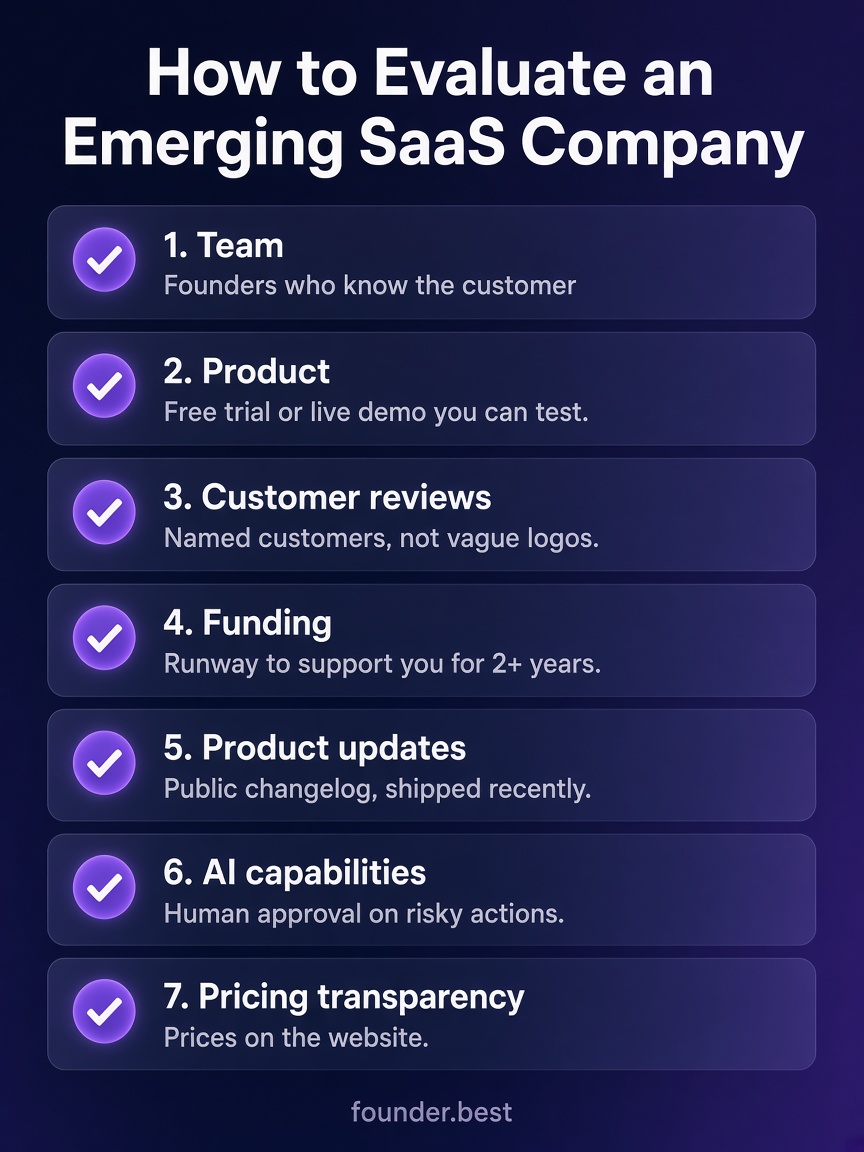 Checklist for how to evaluate an emerging SaaS company: team, product, customer reviews, funding, product updates, AI capabilities and pricing transparency
A practical checklist
Run through this before you sign anything:
- The founders have direct experience with your problem or industry.
- You've tested the product on your own data, not just watched a demo.
- You've spoken to at least one named customer.
- The company can tell you roughly how long its runway lasts.
- There's a changelog or release notes updated in the last month or two.
- Risky AI actions, like sending emails or changing records, need your approval.
- Pricing is public, or at least written down in your contract with a cap on increases.
- You can export all your data in a standard format if you leave.
Where to Discover New US SaaS Startups Before Everyone Else
Y Combinator
The YC company directory is the best free source for brand-new startups. Filter by batch, industry and location, and every profile lists team size and founders.
Its Launch YC posts are worth reading too. Founders explain the problem, the product and what they're asking for, usually in plain language.
Product Hunt
Product Hunt shows what's launching every day. Read the comments, not just the rankings. That's where you find real questions about pricing and limits.
Seedtable
Seedtable publishes ranked lists of startups by sector and country. It's handy when you want a broader scan of a category rather than this week's launches.
Founder.best
Founder.best helps founders publish products that stay discoverable after launch day. Each product gets a permanent page, and each maker gets a founder profile, so you can see who's building what.
Pages are also built to be easy for search engines and AI assistants to read, so a product doesn't vanish once launch week ends. Browse categories, recent launches and weekly winners to spot new tools early.
If you're the founder hoping to be discovered, the same principles apply to your own site. Our guides on AI search visibility tools for SaaS and SEO strategy for startups are good places to start, and you can submit your product on Founder.best when you're ready.
Why Small SaaS Companies Often Beat Bigger Competitors
Faster shipping
A two-person team doesn't need a roadmap committee. If a customer asks for a feature on Monday, it can ship by Friday.
That speed compounds. Small vendors often go from "missing feature" to "best in class" for one niche within a year.
Founder-led support
When you email a small SaaS company, you often reach a founder. Plyxl even lists a free 30-minute call with all four founders, where they build the first piece of your setup with you.
You won't get that from a vendor with 5,000 employees.
AI-first architecture
Older products bolt AI onto software designed for humans clicking buttons. New products start with the assumption that an agent will do much of the work.
That changes everything from the data model to the pricing. It's also why products like Nex can run high-volume workflows cheaply.
Lower pricing
Small teams have lower costs, so they can charge less. Many also price per workspace or per outcome instead of per seat.
If you're comparing how young products convert free users into paying ones, our guide to product-led growth platforms for SaaS conversion breaks down the common models.
Niche focus
A product built for "independent insurance agencies on EZLynx" will beat a generic tool for that buyer almost every time.
Niche focus also shapes how a startup presents itself. Clear positioning and a recognizable brand help a tiny company look trustworthy, which is why our branding tips for startups start with picking one audience.
The honest trade-off
Small vendors carry real risk. They can pivot, get acquired or shut down.
So keep an exit plan. Make sure you can export your data, and don't put a critical workflow on a startup without a backup process for the first few months.
Frequently Asked Questions
What is a small B2B SaaS company?
A small B2B SaaS company sells subscription software to other businesses and usually has between 1 and 50 employees. Most are bootstrapped or at pre-seed or seed stage. Many new ones are AI-first, meaning the software does part of the work and your team reviews it.
What are the fastest-growing US SaaS startups?
Growth numbers are rarely public this early, so look at momentum signals instead. Recent YC companies like Adside.ai (live with 30 companies at launch), ByteAsk ($1 million pre-seed), Nex, Clean, Covera and Billow are good examples. Check the YC directory, Product Hunt and Founder.best for new launches every week.
Are AI SaaS startups replacing traditional software?
In some workflows, yes. Startups like Billow and Covera do work that used to need a person clicking through a traditional tool. But most still run on top of existing systems like NetSuite, HubSpot or an agency management system rather than replacing them.
Where can I discover new SaaS companies?
Start with the Y Combinator company directory, which you can filter by batch and industry. Then use Product Hunt for daily launches, Seedtable for ranked lists and Founder.best for permanent product pages and founder profiles that stay searchable after launch day.
How many employees do small SaaS companies usually have?
Anywhere from 1 to 50. Very early startups often have two to five people. Nine of the 14 companies in this list that publish a team size have exactly two.
If you're building one yourself and want to know whether your content is pulling its weight, see how to measure SaaS content marketing.

About the author
Anuj Shashimal
Founder, Founder.best
SaaS founder, indie hacker, and software engineer. Anuj built Founder.best to help indie founders launch, get discovered through search and AI answers, and turn launches into customers. He writes from first-hand experience growing Founder.best from zero to 400+ founders and 300+ launched products.
Tagged in
Browse all tagsKeep reading
Free tools and guides for this topic
Hand-picked from the tags on this post.
- All founder-built productsSearch and filter every product launched on Founder.best.
- Free tools for foundersName generator, tagline writer, slug checker, DR checker, launch checklist.
- Browse products by categorySaaS, AI, developer tools, marketing, and more.
- Free founder toolsFree tools for startup founders in 2026: launch checklist, name generator, tagline writer, slug checker, and…
- Docs: public API, MCP server & AI discoveryHow AI assistants and agents search and cite Founder.best listings.
- Browse products by use caseStart from the job you need done, not the category label.
Ready to launch on Founder.best?
Weekly rankings, dofollow SEO backlinks, founder stories, and a community built for indie makers.
Submit your startup