
Growth
SaaS founder stories as a lead generation tool: how bootstrapped founders bootstrap to success
Paid ads burn runway. Cold outreach gets ignored. SaaS founder stories are a lead generation tool that bootstrapped founders already have - your journey, your numbers, your lessons. Here is how to turn founder stories into a repeatable path from bootstrap to success.

Post by Anuj Shashimal
Founder, Founder.best13 min read

If you searched saas founder stories lead generation tool bootstrap to success, you are probably a bootstrapped SaaS founder looking for growth levers that do not require a Series A marketing budget. You already have one of the most powerful lead generation tools in indie SaaS - and you wrote it while building your product.
SaaS founder stories are long-form, build-in-public narratives: how you spotted the problem, what you shipped, what failed, and what changed after launch week. Used deliberately, they become a lead generation tool that compounds while you sleep. That is how solo founders and small teams bootstrap to success without burning cash on ads that stop working the moment you pause spend.
This guide breaks down why founder stories outperform generic content for lead gen, the exact story formats that convert, where to publish for maximum discovery, and a 30-day playbook you can run on Founder.best alongside your product listing.
Why SaaS founder stories work as a lead generation tool
Most lead generation tools for startups fall into two buckets: expensive (paid ads, outbound platforms, enterprise CRM bundles) or shallow (viral tweets that never convert). SaaS founder stories sit in a third category - owned content that earns trust and traffic at the same time.
When a buyer searches for a problem you solved, they rarely click a generic landing page first. They read comparisons, launch retros, and founder stories from people who were in the same seat six months ago. Those stories rank for long-tail keywords, get shared in communities, and pre-sell your product before anyone hits your pricing page.
For bootstrapped teams, that matters because:
- Zero marginal cost - you already lived the story; writing it takes an afternoon, not a retainer
- SEO compounding - each story is an indexable page targeting keywords ads cannot afford to bid on
- Trust transfer - prospects buy from founders they relate to, not from feature bullet lists
- Distribution-ready - one honest post works on Indie Hackers, Hacker News, Reddit, and your newsletter
Founder stories are not a replacement for a great product. They are the lead generation tool that makes people willing to try it.
From bootstrap to success: the founder story funnel
Bootstrapped SaaS growth is not linear. But the path from bootstrap to success follows a repeatable pattern when you treat founder stories as infrastructure, not one-off blog posts.
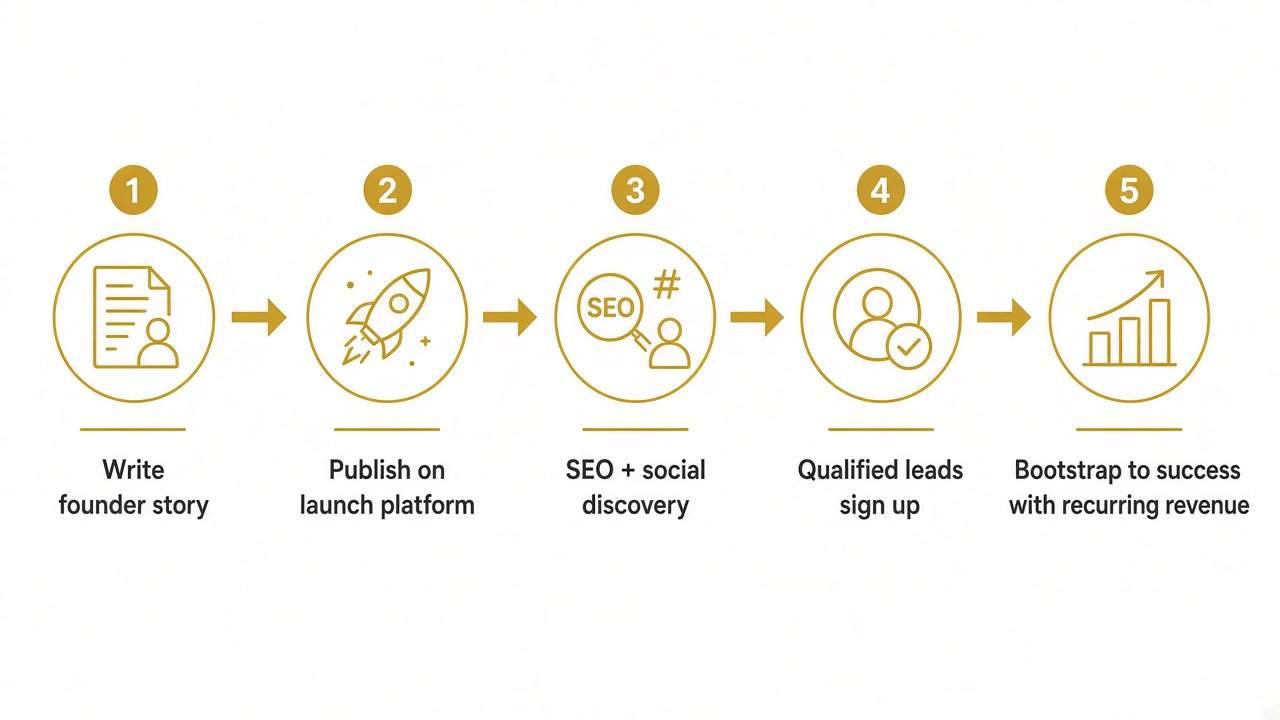 SaaS founder stories lead generation funnel - write, publish, discover, convert, grow
Stage 1 - Write the story. Pick one real moment: launch week, first paying customer, a pivot, a churn fix, a pricing change. Include specifics - dates, numbers, tools, mistakes.
Stage 2 - Publish on a discovery surface. Your blog builds domain authority. Founder stories on Founder.best put your narrative in front of buyers already evaluating SaaS tools, tied to your public founder profile and product listing.
Stage 3 - Earn discovery. SEO indexes the story for long-tails like "how I built [category] tool" or "bootstrap SaaS to $X MRR." Community shares amplify reach without ad spend.
Stage 4 - Convert leads. Every story ends with a clear next step: start a free trial, book a demo, join a waitlist. Link to your product page and Founder.best listing - not a generic homepage.
Stage 5 - Compound toward success. More stories mean more entry points, more backlinks, more trust. That is how bootstrapped founders bootstrap to success with content instead of capital.
Five founder story formats that generate leads
Not every story converts. These five formats consistently perform as a lead generation tool for SaaS founders:
1. Launch retro
Publish within 7–14 days of launch. Cover prep, launch-day traffic, what surprised you, and what you would do differently. Launch retros rank for "[product category] launch" queries and get shared in maker communities.
2. Revenue milestone
"How we hit $1K MRR in 90 days" or "First 100 paying customers without ads." Milestone posts attract founders and buyers evaluating whether your category is viable - both are qualified audiences.
3. Problem deep-dive
Explain the pain point your SaaS solves better than anyone else. No product pitch in the first half - just the problem, who feels it, and why incumbents fail. This ranks for buyer-intent keywords and positions you as the category expert.
4. Stack and workflow breakdown
"How we run [function] with [your tool] + 3 integrations." Practical posts attract users searching for workflows, not just tool names. Include screenshots and honest tradeoffs.
5. Failure and fix
"What broke at scale and how we fixed it." Vulnerability builds trust faster than success theater. These stories get cited, quoted, and linked - strong for SEO and AI answer visibility.
Pick one format per month. Rotate formats so your content library covers awareness, consideration, and conversion intents.
Where to publish SaaS founder stories for maximum lead gen
Distribution determines whether a founder story becomes a lead generation tool or a diary entry nobody reads.
Your own blog
Host the canonical version on your domain. Add internal links to pricing, docs, and case studies. This builds domain authority and gives you full control over CTAs and analytics.
Founder.best founder stories
Publish on Founder.best to reach startup buyers browsing founder stories, product listings, and weekly launch rankings. Stories are indexed, linked to your founder profile, and visible alongside your product page - a third-party corroboration layer that helps SEO and AI search visibility.
Communities (with context, not spam)
Share the Founder.best or blog URL in Indie Hackers, relevant subreddits, and Slack groups where your buyers gather. Lead with the lesson, not the product. One genuine comment thread often outperforms ten cross-posts.
Your email list and newsletter
Founder stories are your best newsletter content. Subscribers who read your journey convert at higher rates than subscribers who only see feature announcements.
SaaS founder stories vs other lead generation tools
Bootstrapped founders compare every channel on cost, speed, and durability. Here is how SaaS founder stories stack against common alternatives:
| Lead gen channel | Upfront cost | Speed to leads | Compounds over time? |
|---|---|---|---|
| Paid ads (Google/Meta) | High | Fast | No - stops when spend stops |
| Cold email / outbound | Medium | Medium | Partially - lists fatigue |
| Generic SEO blog posts | Low | Slow | Yes - if content is cite-worthy |
| SaaS founder stories | Free | Medium | Yes - indexed + shareable |
| Product Hunt launch | Low–medium | Fast spike | Partially - brief homepage window |
| Founder.best launch + stories | From $0 | Medium | Yes - permanent listing + stories |
The winning stack for bootstrapped SaaS: launch on Founder.best for a permanent dofollow product page, publish founder stories for long-tail SEO and trust, and add one spike channel (Product Hunt, Show HN, or a community launch) for week-one traffic.
That combination is how indie founders bootstrap to success without choosing between awareness and SEO.
SEO playbook: optimize founder stories for search
Treat every founder story like a landing page. These on-page basics help your saas founder stories lead generation tool bootstrap to success strategy rank:
- Title tag - include your primary keyword theme naturally: "How I built [product] - a SaaS founder story"
- Meta description - one sentence on the problem, one on the outcome, one CTA
- H2 structure - problem, approach, results, lessons, next step
- Internal links - link to product page, pricing, related stories, and your Founder.best listing
- External mentions - link to tools you used (builds credibility; some may link back)
- Freshness - add "Last updated" when metrics change; search engines favor current data
Founder stories also reinforce entity signals - your name, company name, and product category appearing consistently across your site, Founder.best, and directories. That helps AI answer engines recommend you when buyers ask "what is the best [category] tool for bootstrapped teams?"
For a deeper dive on AI and search visibility, see our guide on increasing SaaS brand visibility in AI answers.
30-day playbook: founder stories from bootstrap to first leads
Run this playbook the month you launch or relaunch your SaaS:
Week 1 - Foundation
- Launch on Founder.best - free slots available on open weekly dates; Standard from $9 for instant go-live
- Complete your public founder profile with photo, bio, and links
- Draft your launch retro outline with real numbers from launch week
Week 2 - Publish your first founder story
- Write and publish a launch retro (800–1,500 words) on Founder.best
- Cross-post to your blog with canonical tags pointing to your preferred URL
- Share in one community with a genuine summary - not a copy-paste promo
Week 3 - Stack distribution
- Send the story to your email list with a personal intro
- Add the story link to your product page and Founder.best listing
- Publish a short follow-up: "What we shipped since launch week"
Week 4 - Measure and iterate
- Track referral traffic from Founder.best, organic search, and communities
- Count signups where the source field or UTM shows story traffic
- Plan next month's story format based on what drove the most qualified clicks
Repeat monthly. Founders who publish consistently for six months often report that founder stories become their top-three lead source - ahead of paid channels they tried and abandoned.
Common mistakes that kill founder story lead gen
Even strong stories fail as a lead generation tool when founders make these errors:
- Vague inspiration posts - "Follow your dreams" ranks for nothing and converts nobody. Use numbers.
- No CTA - readers finish inspired but do not know what to do next. Always link to trial, demo, or listing.
- Keyword stuffing - write for humans first; search engines penalize unnatural repetition.
- Publish once, never update - stale MRR figures hurt credibility. Update milestone posts when numbers change.
- Orphan stories - no links from product page, profile, or blog. If Google cannot find it, buyers will not either.
- Skip the launch listing - stories without a product page have nowhere to send converted leads.
Fix these and your bootstrap to success path gets shorter, not easier - but more predictable.
How Founder.best turns founder stories into a growth engine
Founder.best was built for indie SaaS founders who need affordable distribution and durable SEO. Founder stories are a core part of that stack:
- Founder stories hub - browseable, indexed narratives from real builders
- Public founder profiles - every story ties to a profile at
founder.best/yourname - Product listing linkage - stories sit alongside your permanent product page and dofollow backlink
- Weekly discovery - active launches and stories get visibility in community feeds and newsletters
- Free launch tools - tagline generator, slug checker, and checklist at /tools to polish before you publish
You do not need a content team or a growth agency. You need one honest story, one product page, and a habit of publishing monthly.
Start your founder story lead gen stack today
SaaS founder stories are the most underused lead generation tool in bootstrapped SaaS. You already have the material. The founders who bootstrap to success in 2026 are the ones who publish it consistently, link it everywhere, and stack stories with launch listings that compound.
Ready to turn your journey into inbound leads?
- Launch your product on Founder.best - free and paid plans available
- Publish your first founder story within two weeks of going live
- Browse founder stories from other bootstrapped SaaS builders for inspiration
Your next customer is probably reading someone else's founder story right now. Make sure yours is the one they find next.
Key takeaways
- SaaS founder stories are a free lead generation tool - you already have the raw material from building your product.
- Build-in-public narratives rank for long-tail keywords buyers search before they pick a tool.
- Founder stories compound trust faster than feature lists because prospects buy from people they relate to.
- Bootstrapped founders bootstrap to success by stacking stories with launch listings, SEO backlinks, and community distribution.
- Publish one founder story within 14 days of every launch and link it from your product page, profile, and newsletter.
Frequently asked questions
Are SaaS founder stories really a lead generation tool?
Yes. SaaS founder stories function as a lead generation tool because they attract qualified search traffic, build trust before the sales conversation, and give you shareable assets for communities where buyers evaluate tools. Unlike ads, stories keep sending traffic after you publish them.
How do bootstrapped founders use founder stories to bootstrap to success?
Bootstrapped founders bootstrap to success by publishing honest founder stories about real problems, real revenue milestones, and real lessons. Each story becomes an indexed page that ranks for long-tail queries, links back to the product, and gets shared in Indie Hackers, Reddit, and launch communities - driving inbound leads without ad spend.
What should a SaaS founder story include for lead generation?
Include the problem you solved, why existing tools failed, your build timeline, one real metric (signups, MRR, churn fix), your stack, and a clear CTA to try the product. Specific numbers outperform vague inspiration posts for both SEO and conversion.
Where should I publish SaaS founder stories?
Publish on your own blog for domain authority, on Founder.best /stories for startup-audience discovery and SEO, and cross-link both. Founder.best founder stories are indexed, tied to your public founder profile, and visible to buyers browsing launch platforms.
How often should bootstrapped SaaS founders publish founder stories?
Publish one founder story within two weeks of every product launch, then one per month during active growth. Milestone posts - first paying customer, $1K MRR, major feature ship - perform especially well as lead generation content.
Do founder stories help with SEO and AI search visibility?
Yes. Founder stories cover long-tail keywords, add fresh indexed content, and reinforce entity signals (your name, product name, category) that search engines and AI answer engines use to recommend tools. Pair stories with a dofollow product listing for maximum corroboration.

About the author
Anuj Shashimal
Founder, Founder.best
SaaS founder, indie hacker, and software engineer. Anuj built Founder.best to help indie founders launch, get discovered through search and AI answers, and turn launches into customers. He writes from first-hand experience growing Founder.best from zero to 400+ founders and 300+ launched products.
Tagged in
Browse all tagsKeep reading
Free tools and guides for this topic
Hand-picked from the tags on this post.
- Founder storiesReal startup journeys, lessons, and wins from indie builders.
- How Founder.best worksSubmit in 10 minutes, rank on the weekly Launchpad, stay discoverable.
- Startup tagline generator12 tight one-liners for your landing page and launch post.
- Launch plans & pricingFree, Standard, Pro, and Pro+ launches compared side by side.
- Founder leaderboardTop indie founders ranked by community upvotes.
- Free startup launch checklist30+ tasks across pre-launch, launch day, and post-launch.
Ready to launch on Founder.best?
Weekly rankings, dofollow SEO backlinks, founder stories, and a community built for indie makers.
Submit your startup