SEO for founders
Founder-led SEO: the early-stage startup playbook for 2026
Early-stage startups do not lose at SEO because they lack budget. They lose because they outsource the one thing competitors cannot copy: the founder's own knowledge. Founder-led SEO turns sales calls, support tickets, and build decisions into pages Google ranks and AI answers cite.
Most early-stage startups approach SEO the same way: install a keyword tool, sort by volume, hire a freelancer to write ten "ultimate guides," and wait. Six months later the posts have a few hundred impressions and zero signups.
Founder-led SEO flips that. The founder, the person who has talked to every early customer, answered every support ticket, and made every product tradeoff, drives the SEO strategy directly. Not because founders are better writers, but because they hold the one input that makes pages rank in 2026: first-hand experience nobody else can copy.
This guide is the playbook for founder-led SEO for early-stage startups: why it works, what to write, how to fit it into 5 hours a week, and when to finally hand it off. It builds on our broader SEO for startups playbook and focuses on the part most guides skip: the founder's role.
What is founder-led SEO?
Founder-led SEO is an organic search strategy where the founder owns three things:
- Topic selection - keywords come from real customer language, not just tool exports
- Core content - the founder writes, dictates, or heavily edits the pages that matter most
- Distribution - pages are shared under the founder's personal name and profiles
It is the SEO counterpart of founder-led sales. In the early days, the founder closes the first customers because nobody else understands the problem well enough. The same logic applies to search: nobody else can explain the problem, the tradeoffs, and the solution with the same specificity.
Founder-led SEO is not "the founder does all the technical work forever." You still need an indexable site, a clean product page, and a few backlinks. The founder's job is to supply the insight layer that turns an ordinary page into one worth ranking and citing.
Why founder-led SEO works for early-stage startups
1. Experience is now a ranking signal
Google's quality guidelines evaluate content on E-E-A-T: Experience, Expertise, Authoritativeness, and Trustworthiness. The first "E" - experience - was added specifically to reward content written by people who have actually done the thing.
An early-stage founder writing "how we cut onboarding time from 14 days to 2 for accounting firms" has experience baked in. A freelancer writing "10 tips to improve onboarding" does not. Google cannot always tell who wrote a page, but it can tell which page contains specific details, original screenshots, and claims that do not appear anywhere else.
2. AI answers reward specificity
Buyers increasingly ask ChatGPT, Perplexity, and Google AI Overviews before they click a search result. These systems tend to cite pages that contain concrete, verifiable claims - numbers, named workflows, clear comparisons - over generic advice that could be summarized from any source.
Founder-written pages are naturally cite-worthy because they contain information that exists nowhere else. If you want the full AI layer, read how to increase SaaS brand visibility in AI answers.
3. Founders know the real keywords
Keyword tools show you what people type at scale. Customers show you what people type right before they buy. Those are often different phrases with tiny reported volume and outsized conversion.
A founder who hears "we tried Notion but it broke once we had more than 20 clients" on three calls in a month has found a keyword cluster ("notion alternative for agencies with many clients") that no tool will surface as a priority.
4. It costs time, not cash
At pre-seed and seed stage, cash is the constraint. Founder-led SEO trades a few focused hours a week for a channel that compounds. There is no retainer to cancel and no ramp-up period while an agency learns your market.
5. It builds the founder as an entity
Every page published under your name, every profile linking to your product, and every launch listing with your founder profile strengthens the connection between you, your company, and your topic. That author entity is what makes future pages rank faster and what AI models use to corroborate who you are.
Founder-led SEO vs agency SEO
Agencies are not bad. They are just a poor fit before you know what works.
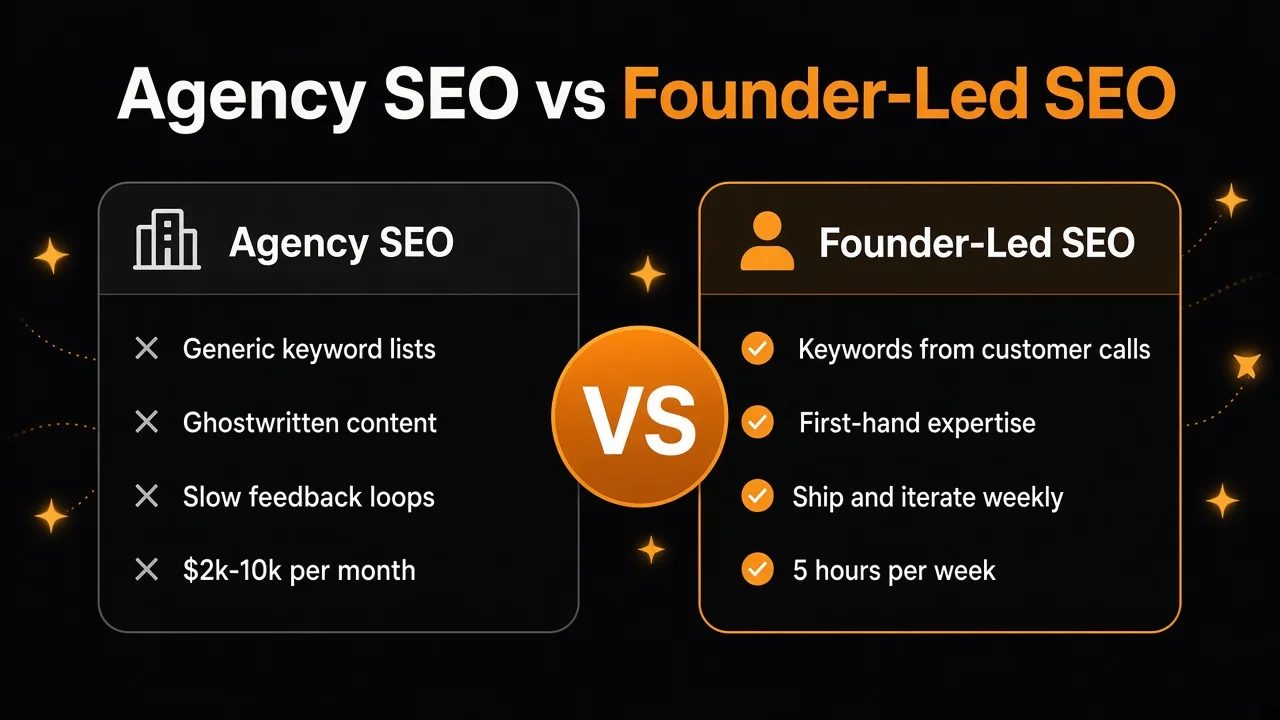
| Agency SEO | Founder-led SEO | |
|---|---|---|
| Keyword source | Tool exports, volume-first | Customer calls, tickets, objections |
| Content author | Generalist writers | Founder with first-hand experience |
| Feedback loop | Monthly reports | Weekly, tied to sales conversations |
| Proof on page | Stock images, generic stats | Screenshots, real numbers, decisions |
| Cost | $2k–10k per month | ~5 hours per week |
| Best stage | Post-PMF, scaling a proven format | Pre-seed to early revenue |
The right sequence for most early-stage startups: founder-led first, then systematize, then delegate. We cover the handoff at the end of this guide.
The founder-led SEO playbook
Step 1: Fix the foundation once
Founder-led content cannot rank on a site Google cannot crawl. Spend one weekend on the basics, then stop thinking about them:
- One canonical product page with a clear title tag and meta description
SoftwareApplicationorProductJSON-LD with name, URL, and pricing- Sitemap submitted to Google Search Console
- Mobile pages loading fast (check PageSpeed Insights)
- An
llms.txtfile listing your product, pricing, and best guides - An About or Founder page with your name, photo, background, and links to your profiles
That last item matters more for founder-led SEO than most founders realize. It is the page that ties your content to a real, verifiable person. For the product-page side, follow the product page SEO checklist.
Step 2: Mine keywords from customer conversations
Open a running doc called "Questions customers asked" and feed it from:
- Sales and demo calls - the exact phrasing of the problem, in their words
- Support tickets - "how do I..." questions that reveal missing documentation
- Churn and lost-deal reasons - honest comparison material
- Community threads - Reddit, Slack groups, and forums where your buyers complain
- Search Console queries - once you have impressions, the real phrases people used to find you
Then validate each question lightly. Search it on Google: if the top results are weak, outdated, or written by people who clearly never used the product category, that is a winnable page. Early-stage startups should chase low-competition, high-intent terms first, not the head term for your category.
Good early targets usually look like:
- "[competitor] alternative for [specific audience]"
- "how to [solve problem] without [expensive or painful approach]"
- "[category] for [niche], e.g. CRM for recruiting agencies"
- "[tool A] vs [tool B] for [use case]"
- "how much does [category] cost for a [team size]"
Step 3: Write insight pages, not generic blog posts
The core unit of founder-led SEO is the insight page: one buyer question, one clear answer, and proof only you can provide.
A good insight page includes:
- A direct answer in the first 2–3 sentences - this is what Google snippets and AI answers extract
- Your first-hand experience - "We tested this with 40 customers," "Here is what broke when we tried X"
- Original proof - screenshots, before/after numbers, workflow diagrams, pricing tables, code snippets
- A clear opinion - who this approach is right for, and who should pick something else
- Honest tradeoffs - including cases where a competitor is the better choice
- Internal links to your product page and 2 related articles
- A visible author byline linking to your founder page
The honest-tradeoffs point feels counterintuitive, but it is what separates cite-worthy pages from marketing copy. AI answer engines and skeptical buyers both trust a page more when it admits limits.
Step 4: Dictate, do not stare at a blank page
The most common reason founder-led SEO stalls is not strategy. It is that writing 2,000 words feels like a day the founder does not have.
The fix: talk first, write second.
- Pick one question from your customer doc
- Record a 15–20 minute voice memo answering it as if a customer asked you on a call
- Transcribe it (any transcription tool works)
- Use AI to structure the transcript into headings and tighten the language
- Add screenshots, numbers, and links yourself
- Do a final read in your own voice before publishing
This keeps the insight and voice yours while cutting drafting time by more than half. AI shapes the structure; you supply everything that makes the page worth ranking.
Step 5: Distribute under your own name
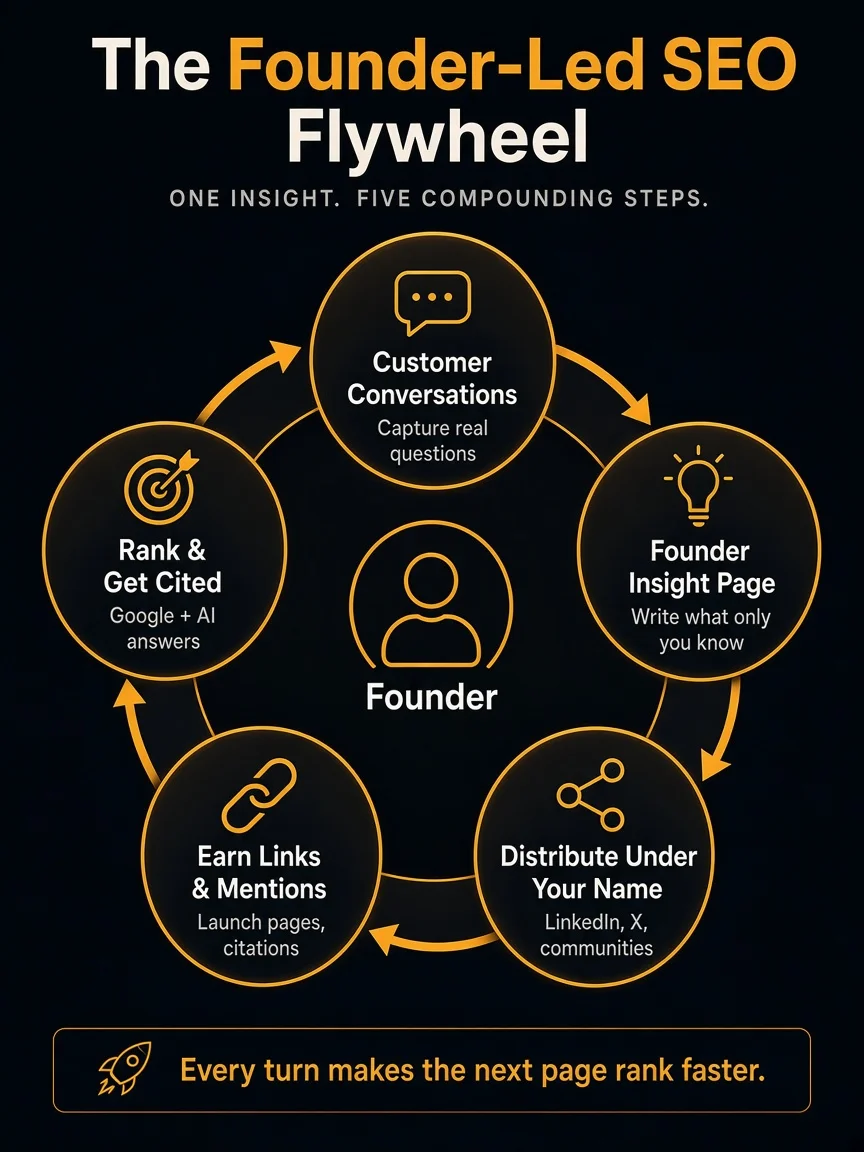
Publishing is half the work. Founder-led SEO pages need early signals: visits, shares, mentions, and links. The founder's personal network is the fastest way to get them.
For each page:
- Write a native post on LinkedIn or X sharing the core insight (not just a link)
- Answer one relevant community thread where the page genuinely helps
- Send it to customers who asked the original question
- Add it to your newsletter or product update email if you have one
Personal accounts almost always outperform company accounts early on. People follow people, and the engagement you get also reinforces the author entity behind the page. The content marketing for startups guide has a full distribution playbook.
Step 6: Earn links with founder credibility
Founders can get links agencies cannot, because people want to hear from the person who built the thing:
- Launch listings - a permanent product page with a dofollow backlink and founder profile on Founder.best
- Founder stories - publish your build journey on /stories with real milestones
- Podcast and newsletter guest spots - show notes usually link to your site
- Journalist and expert-quote requests - answer queries in your niche with specific data
- Integration and partner pages - "works with" listings from complementary tools
- Original data - share an anonymized benchmark from your product that others will cite
At the early stage, 5–15 relevant dofollow links is plenty to move long-tail pages. Quality beats volume - see high authority backlinks for founders for what to prioritize and what to avoid.
Step 7: Build a consistent founder entity
Google and AI models need to connect you, your company, and your topic. Make it easy:
- Use the same name, title, and one-line bio across your site, LinkedIn, X, GitHub, and launch profiles
- Link your founder profile to your product and your product page back to your profile
- Keep your product description and pricing identical everywhere it appears
- Add
Personschema to your founder page andauthorfields to article schema
A Founder.best founder profile connects your launches, stories, and product pages on one indexable URL, which is exactly the kind of third-party corroboration AI systems look for.
The 5-hour founder SEO week
You do not need to block out whole days. Here is a realistic weekly cadence for a busy founder:
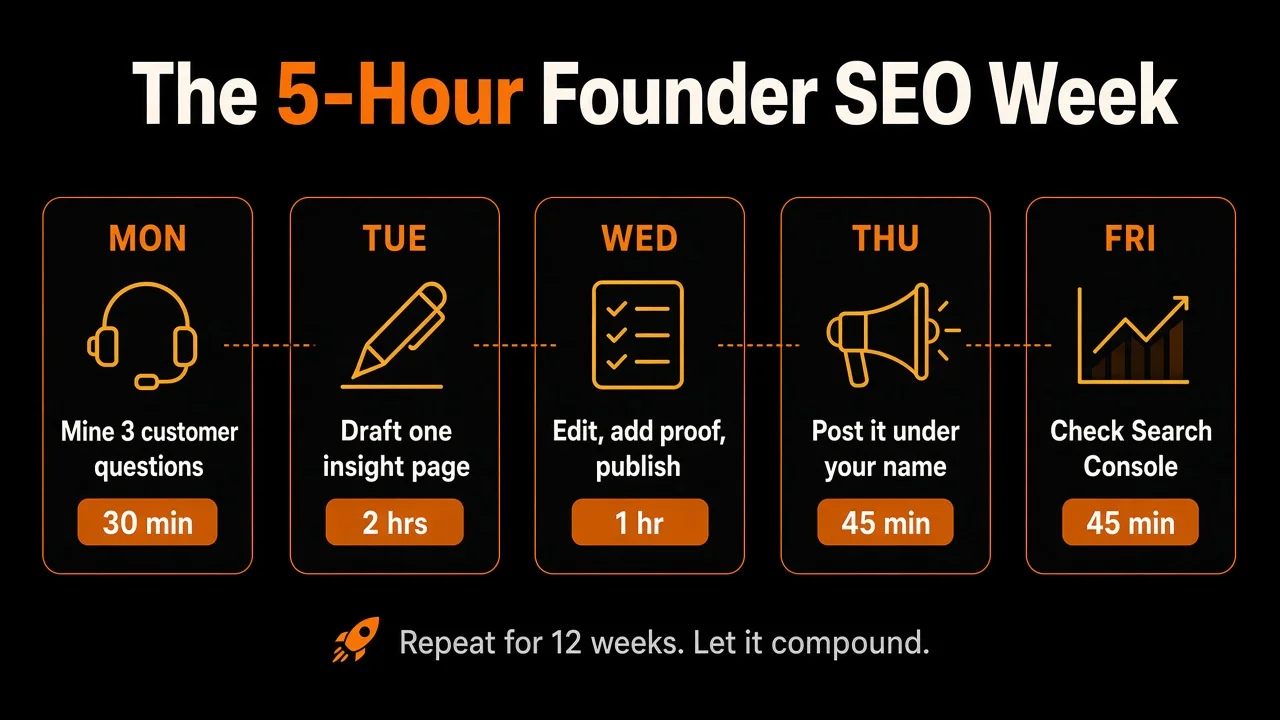
- Monday (30 min) - Pull 3 new questions from calls, tickets, and communities into your doc
- Tuesday (2 hrs) - Record a voice memo on the best question and turn it into a draft
- Wednesday (1 hr) - Add screenshots, numbers, internal links, and publish
- Thursday (45 min) - Share the insight on your personal profiles and one community
- Friday (45 min) - Check Search Console for new queries, and update one older page
Repeat for 12 weeks and you will have roughly a dozen genuinely useful pages, a clearer picture of which topics convert, and a personal distribution habit that keeps compounding.
What to publish first: a 90-day founder-led SEO plan
Weeks 1–2: Foundation and launch
- Fix technical basics and your founder page (Step 1)
- Launch on Founder.best for a permanent dofollow listing and founder profile
- Start your customer questions doc
- Publish one launch retrospective with real numbers
Weeks 3–6: Bottom-of-funnel pages
- 2 comparison or alternative pages ("[competitor] alternative for [audience]")
- 1 "how to solve [problem] for [niche]" page tied directly to your product
- 1 pricing or cost explainer for your category
Weeks 7–12: Expand the cluster
- 3–4 pages answering recurring support or objection questions
- 1 original data or benchmark page designed to earn links
- Refresh the first pages with Search Console queries they already rank for
- Run a first AI visibility check: ask 10 buyer questions in ChatGPT and Perplexity and log who gets cited
By the end of 90 days you should know which page types attract impressions, which convert to signups, and where to double down. If you are getting impressions but no signups, work through our no-signups-after-launch SEO checks.
Common founder-led SEO mistakes
- Writing for peers instead of buyers - founder essays about fundraising rarely bring customers. Write for the person who pays you.
- Chasing volume too early - a 50-search-a-month keyword that converts beats a 5,000-search keyword you cannot rank for.
- Publishing AI drafts unedited - if the page could have been written without you, it will not rank like you wrote it.
- Hiding the author - no byline, no founder page, no profile links means no experience signal.
- Skipping distribution - a great page with zero early visits and zero links can sit unindexed for weeks.
- Stopping at week 4 - most founder-led SEO results show up after month 3. The founders who quit early never see the compounding.
- Never updating - refreshing an existing page with new data is often faster than writing a new one.
When to hand off founder-led SEO
Founder-led does not mean founder-forever. Start delegating when:
- You have a repeatable page format that consistently gets impressions and signups
- You know your top 3 keyword clusters from real data, not guesses
- SEO is taking more than 8 hours a week and slowing down product or sales
- You have enough revenue to fund a writer or specialist without stress
When you hand off, keep the founder in the loop where it matters most:
- The founder still picks topics from customer conversations
- The founder records the raw insight (a 15-minute voice memo per page is enough)
- A writer or editor handles structure, polish, formatting, and publishing
- The founder does a final review and keeps the byline on flagship pages
This keeps the experience signal intact while freeing up your week.
Metrics to track
Keep it simple and review monthly:
- Impressions and clicks per page in Search Console
- Signups or demo requests attributed to organic traffic
- Number of queries each page ranks for (a sign of topical depth)
- Dofollow referring domains - track with the free Domain Rating checker
- AI citation rate - share of your 10 buyer prompts where your product is mentioned
Ignore daily ranking swings. Founder-led SEO is a quarterly game.
Start this week
You already have what most SEO agencies spend months trying to learn: your customers' exact words, your product's real tradeoffs, and a story only you can tell. Founder-led SEO is simply publishing that knowledge where buyers and AI answers can find it.
Your first week:
- Create your "Questions customers asked" doc and add 10 questions from recent calls
- Publish a founder page with your bio, photo, and profile links
- Launch on Founder.best to get a permanent dofollow listing and founder profile
- Record one 15-minute voice memo answering the best question, and turn it into your first insight page
- Share it under your own name
Launch once. Write what only you know. Let search and AI answers compound while you build.
Key takeaways
- Founder-led SEO wins because first-hand experience is the one ranking input agencies, competitors, and AI content generators cannot replicate.
- Your best keywords come from customer calls, support tickets, and sales objections - not from a keyword tool's top-volume list.
- Publish "insight pages": one buyer question, one clear answer, and proof only you have (screenshots, numbers, decisions, mistakes).
- Distribute every page under your own name. Founder profiles on LinkedIn, X, and Founder.best build the author entity that Google and AI models trust.
- Five focused hours a week for 12 weeks beats a $5k/month agency retainer at the early stage. Hand off only once a repeatable format is proven.
Frequently asked questions
What is founder-led SEO?
Founder-led SEO is an organic search strategy where the startup founder owns keyword selection, writes or dictates the core content, and distributes it under their personal name. Instead of outsourcing SEO to an agency, the founder turns direct customer knowledge and first-hand product experience into pages that rank and get cited by AI answers.
Why does founder-led SEO work for early-stage startups?
Early-stage startups cannot outspend incumbents on links or content volume, but founders have something incumbents lack: unfiltered customer conversations and first-hand experience. Google's E-E-A-T guidelines explicitly value experience, and AI answer engines prefer specific, verifiable claims. Founder-written pages naturally contain both.
How much time does founder-led SEO take?
About 5 hours a week is enough at the early stage: 30 minutes mining customer questions, 2 hours drafting one page, 1 hour editing and adding proof, 45 minutes distributing it, and 45 minutes reviewing Search Console. Consistency over 12 weeks matters more than total hours.
Should an early-stage startup hire an SEO agency instead?
Usually not before product-market fit. Agencies need months to learn your customer, often produce generic content, and cost $2k–10k per month. Founders should run SEO themselves until they have a repeatable content format and clear winning keywords, then hand off production while keeping topic selection and final review.
Can I use AI tools for founder-led SEO?
Yes, as an assistant rather than an author. Use AI to transcribe voice notes, cluster keywords, outline pages, and draft meta descriptions. The insight, examples, numbers, and opinions must come from you. Pages that are pure AI output rarely rank and are rarely cited by AI answers.
What should a founder write about first?
Start with bottom-of-funnel questions buyers ask right before choosing a tool: comparisons with competitors, "how to solve X for Y audience," pricing explainers, and objections from sales calls. These have lower search volume but convert far better than broad educational topics.
How long until founder-led SEO shows results?
Low-competition long-tail pages often start getting impressions within 4–8 weeks and clicks within 8–16 weeks, provided the site is indexable and has a few quality backlinks. Compounding results usually show between months 4 and 12.
How does founder-led SEO help with AI search visibility?
AI answer engines like ChatGPT, Perplexity, and Google AI Overviews cite pages with specific claims and corroborate brands through third-party mentions. A founder with consistent profiles, launch listings, and first-hand pages gives models a verifiable author and product entity to cite.
Tagged in
Browse all tagsKeep reading
Free tools and guides for this topic
Hand-picked from the tags on this post.
- Free Ahrefs Domain Rating checkerLive DR (0–100) for any domain before you chase a backlink.
- Browse blog posts by topicSEO, backlinks, launch platforms, AI search, startup tools, and more.
- Indie launch guideLaunch guide for indie founders and bootstrapped makers in 2026. Build in public, pick platforms, earn…
- Launch plans & pricingFree, Standard, Pro, and Pro+ launches compared side by side.
- Get your product discovered by AI assistantsWhich listing fields make your product rank for the right questions.
- Free startup directories listDofollow filters, Ahrefs DR scores, and a submission checklist.
Ready to launch on Founder.best?
Weekly rankings, dofollow SEO backlinks, founder stories, and a community built for indie makers.
Submit your startup