
Launch & growth
Content marketing for startups: 15 strategies to get discovered and grow
Most content marketing advice assumes you have a content team, a budget, and a year to wait. This guide assumes you have a product, a few hours a week, and a real need for signups. Here are 15 strategies that get a startup found on Google, in AI answers, and in the places your customers already hang out.
If you searched content marketing for startups, you have probably already read the generic version: "create valuable content," "know your audience," "be consistent." All true, and none of it tells you what to do on Monday morning with four free hours and a product that needs signups.
This guide is the practical version. It is built for founders with limited time and budget who need startup content marketing that produces results: organic traffic, backlinks, mentions in AI answers, and customers.
One shift shapes everything below. Buyers no longer discover products only through Google. They ask ChatGPT, Perplexity, and Google AI Overviews for recommendations, browse startup directories and launch platforms, and read founder posts on LinkedIn and Reddit. Good content marketing strategy for startups in 2026 gives every one of those channels a clear reason to find you, trust you, and mention you.
What is content marketing for startups?
Content marketing for startups is creating and distributing useful content that helps potential customers solve a problem, and in doing so, discover your product.
That content can be:
- Search content - guides, how-tos, and comparison pages that rank on Google
- Founder-led content - posts, threads, and stories published under a founder's name
- Community content - helpful answers on Reddit, Hacker News, Indie Hackers, and niche forums
- Proof content - launch retros, case studies, original data, and build-in-public updates
- Discovery listings - product pages on launch platforms and startup directories
The startup version differs from enterprise content marketing in three ways. You have fewer resources, so you publish fewer pages and make each one count. You have no brand yet, so distribution matters as much as writing. And you need revenue soon, so you start with content closest to a buying decision instead of broad awareness pieces.
Why content marketing matters for early-stage startups
Paid ads stop the moment your budget does. Launch-day traffic fades within a week. Content is one of the few startup marketing strategy channels that compounds: a page you publish this month can still send signups two years from now.
Here is what a focused content program gives an early-stage startup:
- Cheaper acquisition over time - each ranking page adds traffic without adding cost
- Trust before the first sales call - buyers read your thinking before they ever talk to you
- Backlinks and authority - useful pages earn links that lift your whole domain
- AI search visibility - models recommend products they can find and verify across multiple sources
- Sales and support leverage - one good article answers the same question a hundred times
The catch: content marketing only works if you treat it as a system - research, publish, distribute, measure, update - not as "write a blog post when we have time."
How to create a startup content strategy
A startup content strategy does not need a 40-page document. It needs answers to five questions, written on one page.
- Who exactly are you writing for? One primary customer, described by job, company size, and the problem they feel. "Solo founders running a SaaS under $10k MRR" beats "small businesses."
- What problems do they search for? The questions they type into Google and ask ChatGPT before they know your product exists.
- What can you say that others cannot? Your data, your customer conversations, your build experience, your opinion. This is your information gain.
- Where does each piece get distributed? Every article needs at least two distribution channels planned before you write it.
- What counts as success? Signups, demo requests, or trial starts from content - not pageviews.
Then pick one topic to own for the next 90 days. Not five. One theme where you can publish 5-10 connected pages and become the obvious source.
Content marketing for SaaS startups: what changes
Content marketing for SaaS startups has a few specific advantages worth using:
- Your product is demonstrable. Screenshots, GIFs, and short walkthroughs make a SaaS guide far more useful than a text-only post.
- Buyers compare before they buy. "X vs Y" and "X alternatives" searches are common in SaaS and convert well.
- Integrations create content. Every integration is a potential page: "How to connect [your tool] with Slack."
- Free tools earn links. A small calculator, checker, or template generator can attract backlinks for years.
Sequence SaaS content from the bottom of the funnel upward: comparison and alternative pages first, then use-case and how-to guides, then broader educational content.
1. Find keywords your customers are actually searching for
The biggest content mistake startups make is writing about what they want to say instead of what customers search for. Keyword research fixes that - and you can do a useful version for free.
Free sources of real search demand:
- Google autocomplete and "People also ask" - type your problem and note every suggestion
- Google Search Console - once your site is live, it shows queries you already get impressions for
- Reddit and community threads - the exact phrasing people use when they ask for help
- Sales calls and support tickets - questions customers ask right before (or right after) they buy
- AI assistants - ask ChatGPT or Perplexity "what questions do [your audience] ask about [problem]?" as a brainstorming aid, then validate in Google
How to pick keywords you can actually win:
- Prefer long-tail, specific phrases ("content calendar for B2B SaaS startup") over broad head terms ("content marketing")
- Look for buyer intent words: best, vs, alternative, pricing, template, tool, for [audience]
- Check the top 5 results - if they are all huge brands with thousands of backlinks, choose a narrower angle
- Aim for 10 keywords grouped around your one core topic
Write down each keyword with its intent (learn, compare, or buy) and the page type it needs (guide, comparison, list, template). That list becomes your content plan.
For the SEO side in more depth, see SEO for startups: the complete 2026 playbook.
2. Create content around problems, not your product
Nobody searches for your product name until they already know it. They search for their problem.
A project management startup should not publish "Why our Kanban view is great." It should publish "How to run sprint planning with a remote team of 5" - and show the product solving that problem inside the article.
The problem-first formula:
- Start with a specific problem your customer searches for
- Explain why it is hard and what most people get wrong
- Give a genuinely useful solution that works even without your product
- Show how your product makes that solution faster or easier, with screenshots
- End with one clear next step
This is how you earn trust and rankings at the same time. Google rewards pages that satisfy the searcher. Readers reward pages that help before they sell. AI systems cite pages that answer the question clearly.
Content marketing ideas for startups that follow this pattern:
- "How to [achieve outcome] without [common pain]"
- "[Task] checklist for [audience]"
- "Why [common approach] fails and what to do instead"
- "[Number] mistakes [audience] make with [problem]"
- "How we [solved problem] - with real numbers"
3. Build topic clusters
A topic cluster is one comprehensive pillar page surrounded by several focused supporting articles, all linking to each other and to your product page.
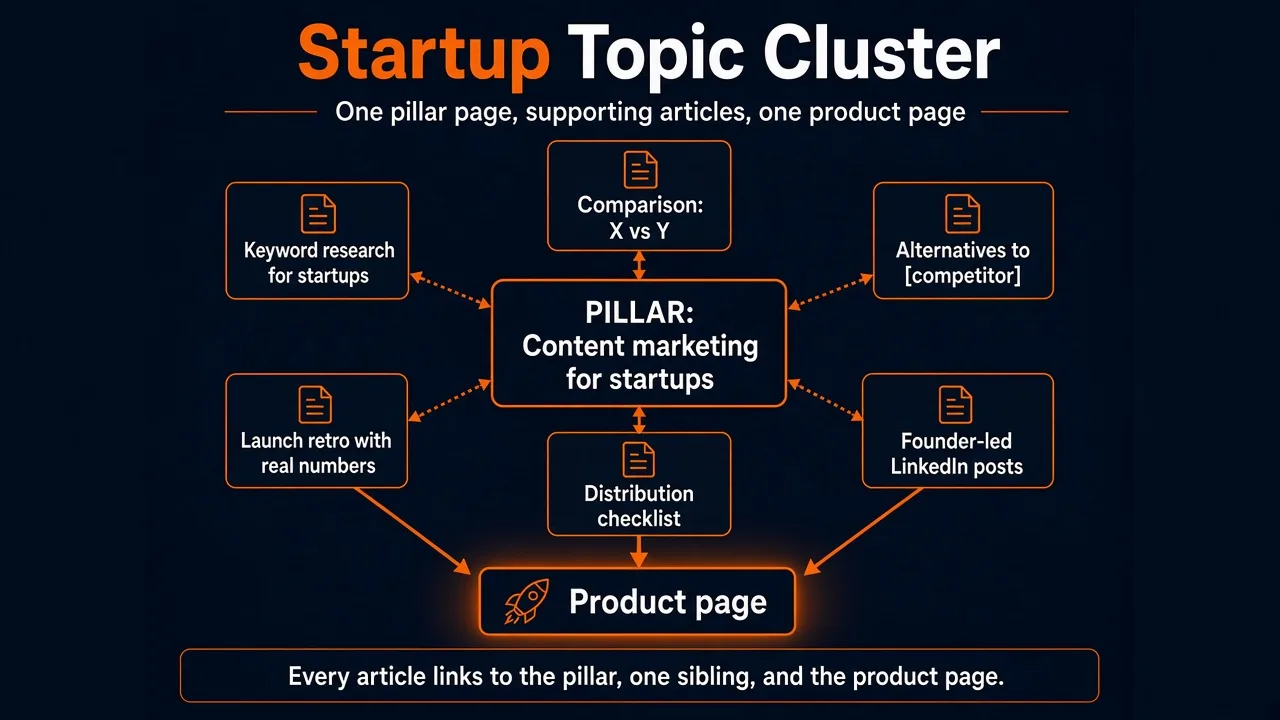
Clusters work because they signal depth. When Google or an AI system sees ten interlinked pages covering one theme in detail, your site looks like a reliable source on that topic - not a random blog with scattered posts.
How to build your first cluster:
- Pillar page (2,000-4,000 words): covers the full topic broadly, like this guide does for content marketing for startups
- 5-8 supporting articles: each targets one long-tail keyword from your research
- Internal links: every supporting article links to the pillar, to at least one sibling, and to your product page
- Consistent terminology: use the same names for concepts across every page
Internal linking rules that are easy to follow:
- Use descriptive anchor text ("startup content calendar template"), never "click here"
- Link from new articles to older ones, then go back and link older articles to the new one
- Keep your product page no more than one click away from every cluster article
One strong cluster beats thirty unrelated posts. Finish one before starting the next.
4. Create comparison and alternative pages
If you publish only one type of content this month, make it comparison pages. They target buyers who have already decided they need a solution and are choosing between options.
High-intent page types:
- "[Competitor] alternatives" - for people unhappy with an existing tool
- "[Your product] vs [competitor]" - for people already comparing
- "[Competitor A] vs [competitor B]" - where you can add your product as a third option
- "Best [category] for [specific audience]" - roundups where you are honest about tradeoffs
Make comparison pages trustworthy:
- Include a comparison table with pricing, key features, and who each option is best for
- Admit where competitors are better. Honest comparisons rank longer and convert better than one-sided pages
- Add screenshots from real usage, not stock images
- Show last updated dates and refresh pricing regularly
Comparison pages are also some of the most-cited formats in AI answers, because they package the facts a model needs to answer "what is the best X for Y?" in one place.
Founder.best publishes these itself - for example, BetaList vs Founder.best and PeerPush alternatives - because they answer the exact questions founders ask before choosing a launch platform.
5. Turn sales calls and support tickets into content
Your best content ideas are already sitting in your inbox. Every question a prospect asks on a sales call and every repeated support ticket is a search query someone else is typing into Google right now.
A simple weekly habit:
- Keep a running doc of every customer question (copy them word for word)
- Once a week, group similar questions together
- Turn the most common group into an article, FAQ section, or help doc
- Send the link the next time someone asks
This gives you content with guaranteed demand, written in your customers' own words. It also shortens your sales cycle because prospects arrive already educated.
6. Create founder-led content
People trust people more than logos. Founder-led content - posts, threads, videos, and stories published under the founder's own name - is one of the highest-leverage channels an early-stage startup has.
What works for founder-led content:
- Build-in-public updates: revenue milestones, launch results, failed experiments
- Opinionated takes: where you disagree with common advice in your industry, and why
- Behind-the-scenes decisions: why you priced the way you did, why you cut a feature
- Customer stories: what a real customer achieved (with permission)
- Lessons with numbers: "We tried X for 30 days. Here's what happened."
Where to publish:
- LinkedIn for B2B audiences and professional buyers
- X (Twitter) for developer, indie hacker, and tech audiences
- Your own blog for the long version that ranks and compounds
- Founder story platforms like Founder.best stories, where long-form build-in-public posts live on a trusted domain and link back to your product
Founder stories do double duty: they build audience on social platforms and create durable, indexable pages that search engines and AI systems can read. More on this in how founder stories drive lead generation.
7. Turn product launches into SEO content
Most startups treat a launch as a one-day event. Smart founders turn every launch into content that ranks for months.
Every launch can produce:
- A launch announcement page on your site explaining the problem, the solution, and who it is for
- A changelog or "what's new" entry with screenshots
- A launch retro with real numbers: traffic, signups, conversion rates, which channels worked
- Product listings on launch platforms, each with a permanent product page
- A product update on your listing so the page stays fresh after launch week
Launch retros are especially valuable. Founders search for them ("how did X launch go", "product launch results") and they are packed with original data - exactly the kind of information gain that ranks and gets cited.
If you are planning a launch, the SaaS launch checklist covers the full sequence.
8. Use communities like Reddit, LinkedIn and Hacker News
Content distribution for startups is where most content programs fail. You can write the best article on the internet, and it will still get zero traffic in its first month unless you put it in front of people.
Communities are the fastest way to get early readers, feedback, and sometimes backlinks. But every community punishes obvious self-promotion.
- Find subreddits where your customers ask questions (use search, not guesses)
- Answer questions fully in the comment itself; link your article only when it genuinely adds more depth
- Read each subreddit's self-promotion rules before posting anything
- Reddit threads increasingly show up in Google results and AI answers, so helpful answers keep working long after you post them
- Post the key insight from your article natively; do not just drop a link
- Put the link in the first comment if you want the post to get more reach
- Use a strong first line, short paragraphs, and one clear takeaway
Hacker News
- Best for technical deep-dives, original data, open-source projects, and honest post-mortems
- Use "Show HN" for things people can try right away
- Stay in the comments and answer questions directly; HN rewards substance and punishes marketing speak
Niche communities
- Indie Hackers, Slack groups, Discord servers, and industry forums often convert better than big platforms because the audience is more focused
A simple rule: give ten times before you ask once.
9. Get backlinks through startup directories
Backlinks are still one of the strongest ranking signals, and a new startup domain has almost none. Startup directories and launch platforms are one of the fastest ways to earn your first relevant links.
Not all directories are worth your time. Before you submit, check:
- Is the listing page indexed in Google? Search
site:directory.com yourproductafter you are listed - Is the link dofollow? Inspect a live listing in your category and look at the
relattribute - Is the directory active? Recent submissions and real traffic mean the site is still maintained
- Is it relevant? A niche SaaS or AI directory in your category beats a generic list of 500 sites
- Is it curated? Editorial review means fewer spam neighbors
Aim for 8-12 well-chosen listings around launch time instead of blasting hundreds of low-quality directories. Mass submissions can do more harm than good.
For a scoring framework, read Startup directories in 2026: traffic, dofollow links, and AI citations, or browse the free startup directories list with dofollow filters and DR scores.
10. Get your startup discovered beyond Google
SEO is not the only way people discover startups anymore. Founders can also submit their products to startup discovery platforms, directories, and communities where potential customers, other founders, and increasingly AI systems find new products.
Think of these platforms as distribution for your product itself, not just your articles. A good listing:
- Puts your product in front of people who browse for new tools - early adopters, founders, and investors
- Creates a permanent third-party page that describes what you do, in your category
- Earns a backlink that helps your own content rank
- Gives AI systems another trusted source that confirms your product name, category, and what it does
Founder.best is one of those channels. When you launch on Founder.best, you get:
- A permanent, indexable product page that stays live after launch week
- A dofollow backlink (paid plans immediately, free launches from launch week)
- A founder profile that connects you to everything you launch
- Homepage visibility, upvotes, and comments from other founders during your launch
- A place to post product updates so your listing stays fresh
Plans start at $0 with a free launch (limited weekly slots, reviewed by an admin) or $2.99 for an instant Standard launch with two weeks of homepage visibility. The idea behind the platform is simple: get found by people and AI.
Use Founder.best alongside your own content, not instead of it. Your blog explains your expertise. Discovery platforms confirm that your product exists, is active, and belongs in its category.
11. Get your startup discovered by AI search
A growing share of buyers now ask AI assistants for recommendations: "What's the best CRM for a two-person startup?" or "Alternatives to [tool] for indie founders?" If your startup is not part of those answers, you are invisible to those buyers.
AI systems tend to mention products they can find, understand, and verify. Your job is to give Google, ChatGPT, Perplexity, and other systems clear reasons to cite you.
Write content that is easy to cite:
- Answer first. Put a direct, one- or two-sentence answer right below each question-style heading
- Define things clearly. "X is a [category] that helps [audience] do [outcome]" is the kind of sentence AI systems quote
- Use tables and lists for comparisons, pricing, and features
- Include specific facts - numbers, dates, prices - and keep them up to date
- Add FAQ sections that match the questions people actually ask
Make your product easy to verify:
- Keep your facts consistent - the same product name, one-line description, category, and pricing on your site, social profiles, and every listing
- Add structured data (JSON-LD) for your product, articles, and FAQs
- Publish an
llms.txtfile at your domain root listing your most important pages - Earn third-party mentions on trusted sites: launch platforms, directories, reviews, podcasts, guest posts
Check where you stand once a month: ask 10-15 buyer questions in ChatGPT, Perplexity, and Google AI Overviews. Note whether you are mentioned, whether the details are correct, and which competitors show up instead. Then fix gaps in your content and listings.
The full playbook is in how to increase SaaS brand visibility in AI answers.
12. Publish original data and free tools
The fastest way to earn backlinks without asking for them is to create something people want to reference.
Original data ideas for startups:
- Aggregate, anonymized insights from your own product ("We analyzed 1,000 launches...")
- Survey your users or community and publish the results
- Benchmark competitors or tools on a clear, repeatable method
- Share your own metrics transparently: revenue, conversion rates, churn
Free tool ideas:
- Calculators (pricing, ROI, savings)
- Checkers and graders (a domain rating checker, a headline grader)
- Generators and templates (names, taglines, checklists)
Founder.best does this with free tools like the Domain Rating checker, startup name generator, and launch checklist. Tools like these attract links and repeat visits long after they are built, and they fit naturally into your topic cluster.
13. Repurpose one article into 10 pieces of content
Writing a great article takes hours. Distributing it properly takes a fraction of that time and multiplies its reach. Most founders stop after hitting publish.
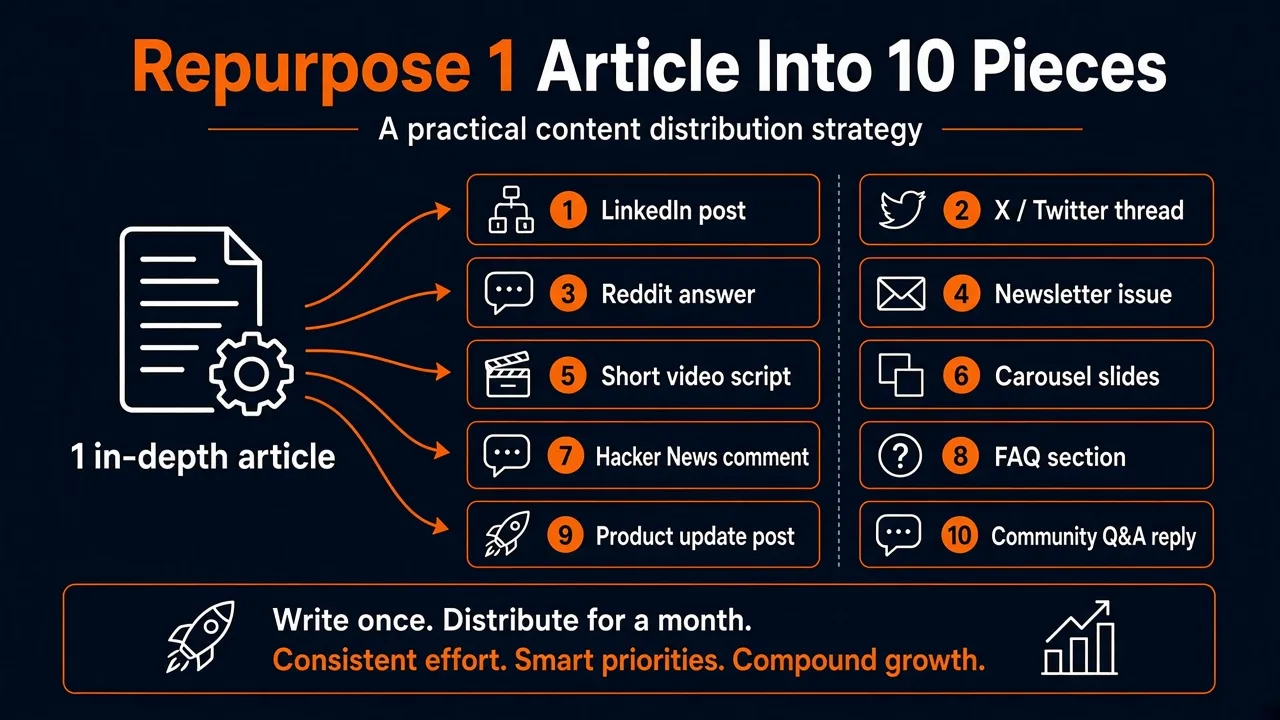
One in-depth article can become:
- A LinkedIn post sharing the single biggest insight
- An X thread walking through the key steps
- A Reddit answer to a question the article solves
- A newsletter issue with a personal intro
- A short video script for a 60-second explainer
- A carousel of 6-8 slides with the main framework
- A Hacker News comment that adds real depth to a related discussion
- An FAQ section on a relevant product or pricing page
- A product update post on your launch listing
- A community Q&A reply in a Slack, Discord, or forum
Spread these across three to four weeks. Each piece should stand on its own and deliver value even if nobody clicks through. The ones that do click are highly qualified.
14. Refresh and update what already ranks
Content decays. Pricing changes, screenshots go stale, competitors publish better pages, and dates make articles look abandoned. Updating existing content is often the fastest SEO win you have.
Every quarter:
- Open Google Search Console and find pages ranking in positions 5-20 - they are closest to breakthrough
- Update facts, prices, screenshots, and examples
- Add sections that answer new "People also ask" questions
- Add internal links to newer articles in the same cluster
- Update the "last updated" date only when you have made real changes
Fresh, accurate pages also matter for AI search: outdated pricing or features on your pages can lead to AI assistants repeating wrong information about your product.
15. Measure organic traffic, signups and backlinks
If you cannot connect content to signups, you will eventually stop doing it. Set up simple measurement from day one.
Track monthly (not daily):
| Metric | Where to find it | Why it matters |
|---|---|---|
| Organic clicks and impressions | Google Search Console | Shows whether pages are gaining visibility |
| Signups or trials from content | Your analytics with UTM or referrer tracking | The number that justifies the time |
| Referring domains | Ahrefs, Semrush, or manual checks | Authority that lifts every page |
| Keywords in top 10 | Search Console or a rank tracker | Progress on your cluster |
| AI mentions | Manual prompt checks in ChatGPT and Perplexity | Visibility in AI answers |
| Referral traffic from listings | Analytics referrers | Which discovery platforms send real users |
Tips:
- Add UTM parameters to links you share in communities and newsletters so you know what worked
- Look at which articles lead to signups, not just which get traffic, then write more like those
- Give each article 8-12 weeks before judging its SEO performance
To benchmark your domain authority, use the free Domain Rating checker, and read Ahrefs Domain Rating explained before worrying about small changes.
The 30-day content marketing plan for a startup
Here is how to turn everything above into one realistic month, assuming 5-8 hours per week.
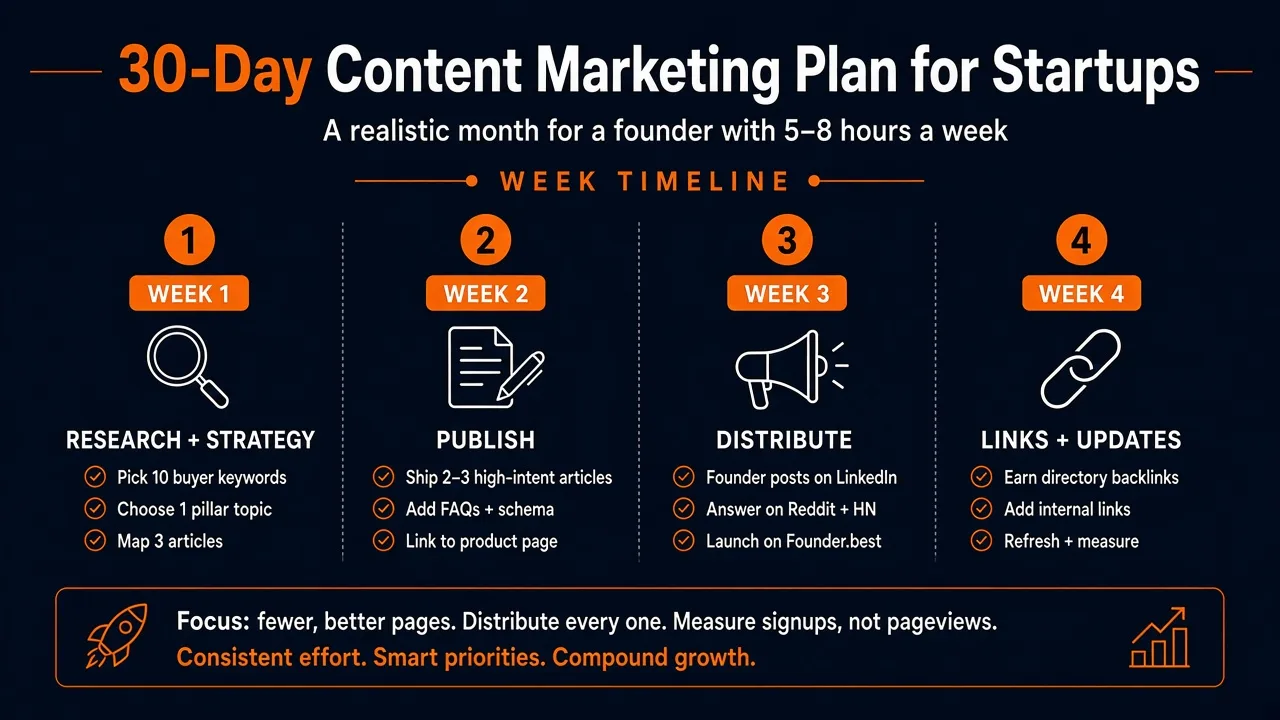
Week 1: Keyword research and content strategy
- Write your one-page content strategy (audience, problems, unique angle, channels, success metric)
- Collect 30-50 keyword ideas from Google autocomplete, Search Console, Reddit, and customer questions
- Pick 10 keywords around one core topic, labeled by intent
- Choose your pillar topic and plan 3 supporting articles, including at least one comparison or alternatives page
- Fix the basics on your product page: clear headline, meta title, and structured data
Week 2: Publish 2-3 high-intent articles
- Publish your comparison or alternatives page first - it has the highest buyer intent
- Publish 1-2 problem-focused guides with screenshots and a clear next step
- Add a FAQ section to each article with direct, citable answers
- Link each article to your product page and to each other
Week 3: Distribution and founder-led promotion
- Write one founder-led post per article on LinkedIn or X, sharing the core insight natively
- Answer 3-5 relevant questions on Reddit, Hacker News, or niche communities
- Launch on Founder.best and 2-3 relevant, curated directories in your category
- Send the best article to your email list or early users with a personal note
Week 4: Backlinks, internal linking and updates
- Check that your directory and launch listings are indexed and dofollow
- Add internal links from older pages on your site to the new articles
- Post a product update on your launch listings to keep them fresh
- Run your first AI visibility check with 10-15 buyer questions
- Review Search Console and analytics, then plan next month's 2-3 articles based on what worked
After 30 days you will have a small but real content engine: a cluster in progress, listings that send traffic and backlinks, a distribution routine, and data to decide what to write next. Repeat monthly and the results compound.
Common startup content marketing mistakes
- Writing about features instead of problems - nobody searches for your feature names
- Chasing broad keywords - "marketing tips" is unwinnable; "email onboarding sequence for B2B SaaS" is not
- Publishing without distributing - an article with no distribution plan is a draft nobody reads
- Mass-producing AI content with no proof - generic posts rarely rank or get cited; add screenshots, data, and real experience
- Skipping comparison pages out of fear of mentioning competitors - your buyers are comparing anyway
- Inconsistent product details across your site and listings - this confuses both buyers and AI systems
- Measuring pageviews instead of signups - traffic that does not convert is a vanity metric
Start this week
Content marketing for startups does not require a big team or a big budget. It requires focus: one audience, one topic, a few genuinely useful pages, and a habit of distributing every one of them.
Your minimum viable plan for this week:
- Write down 10 questions your customers ask before they buy
- Turn the most common one into a problem-focused article
- Draft one comparison or alternatives page
- Share the core insight as a founder-led post
- Launch your startup on Founder.best so people, search engines, and AI systems can find it beyond your own site
Publish, distribute, measure, and repeat. The founders who win with content are rarely the best writers. They are the ones who keep showing up.
Key takeaways
- Content marketing for startups is a distribution problem as much as a writing problem. Every article needs a plan for where it goes after you hit publish.
- Start with high-intent content: comparison pages, alternative pages, and problem-focused guides convert far better than top-of-funnel thought leadership.
- One topic cluster of 5-10 interlinked pages beats 30 unrelated posts, for both Google rankings and AI citations.
- AI search rewards clear, citable facts: direct answers, definitions, tables, consistent product details, and third-party mentions on trusted sites.
- Startup discovery platforms such as Founder.best are a distribution channel and a backlink source at the same time - use them alongside SEO, not instead of it.
- Measure organic signups, referring domains, and AI mentions monthly. Pageviews alone will mislead you.
Frequently asked questions
What is content marketing for startups?
Content marketing for startups is creating and distributing useful content - articles, comparison pages, founder posts, guides, and data - that helps potential customers solve a problem and discover your product. Unlike enterprise content marketing, it focuses on a small number of high-intent pages, founder-led distribution, and compounding channels like SEO and AI search rather than big brand campaigns.
Is content marketing worth it for early-stage startups?
Yes, if your product is live and you can commit a few hours a week. Content keeps sending traffic after launch week ends, costs far less than paid ads, and builds the third-party mentions that Google and AI assistants use to recommend products. It is not worth it if you publish generic posts with no distribution plan.
How long does content marketing take to work for a startup?
Community and founder-led distribution can send traffic the same week you publish. Organic search usually takes 2-4 months for low-competition, long-tail keywords and 4-8 months for more competitive terms. AI answer mentions tend to follow once your pages rank and your product is listed consistently on trusted third-party sites.
How many blog posts should a startup publish per month?
Two to four well-researched, well-distributed articles a month is enough for most early-stage startups. Quality and distribution matter more than volume. One comparison page that ranks and converts beats ten generic posts that nobody reads.
What type of content works best for SaaS startups?
For SaaS startups, the highest-converting content is usually bottom of the funnel: "[competitor] alternatives", "[tool A] vs [tool B]", "best [category] for [audience]", and how-to guides that show your product solving a specific problem. Add integration pages, pricing explainers, and use-case pages once those are in place.
How can startups get organic traffic without a big budget?
Target long-tail keywords with clear buyer intent, publish problem-focused articles with real screenshots or data, interlink them into a topic cluster, and earn a handful of relevant dofollow backlinks from startup directories, launch platforms, and guest posts. Distribute each article through founder-led posts and communities so it gets early traction.
How do I get my startup mentioned by ChatGPT and AI search?
Make your product easy to find, verify, and cite. Publish pages that answer questions directly, use clear definitions and comparison tables, keep your product name, category, and pricing consistent everywhere, add structured data and an llms.txt file, and get listed on trusted third-party sites such as launch platforms and startup directories.
Should founders write their own content?
Founders should at least own the ideas, opinions, and distribution. Founder-led posts on LinkedIn, X, and communities often outperform brand accounts because people trust people. You can use editors or AI for outlines and drafts, but the insights, stories, and proof should come from the founder.
Where does Founder.best fit in a startup content marketing strategy?
Founder.best is a distribution and discovery channel. Launching there gives your startup a permanent, indexable product page with a dofollow backlink, a founder profile, community upvotes, and a place to post product updates. Those listings help people, search engines, and AI systems discover and verify your product alongside your own content.
Tagged in
Browse all tagsKeep reading
Free tools and guides for this topic
Hand-picked from the tags on this post.
- Browse blog posts by topicSEO, backlinks, launch platforms, AI search, startup tools, and more.
- Free Ahrefs Domain Rating checkerLive DR (0–100) for any domain before you chase a backlink.
- Get your product discovered by AI assistantsWhich listing fields make your product rank for the right questions.
- Free startup directories listDofollow filters, Ahrefs DR scores, and a submission checklist.
- Startup tagline generator12 tight one-liners for your landing page and launch post.
- Launch plans & pricingFree, Standard, Pro, and Pro+ launches compared side by side.
Ready to launch on Founder.best?
Weekly rankings, dofollow SEO backlinks, founder stories, and a community built for indie makers.
Submit your startup