SEO for founders
Best AI search visibility tools for SaaS marketing (2026 comparison guide)
Your buyer might ask ChatGPT for the best CRM for startups before they ever hit your site. These ten tools help you see if you show up in those answers. We pulled pricing from vendor sites in October 2026. Double-check before you buy.

Post by Anuj Shashimal
Founder, Founder.best22 min read
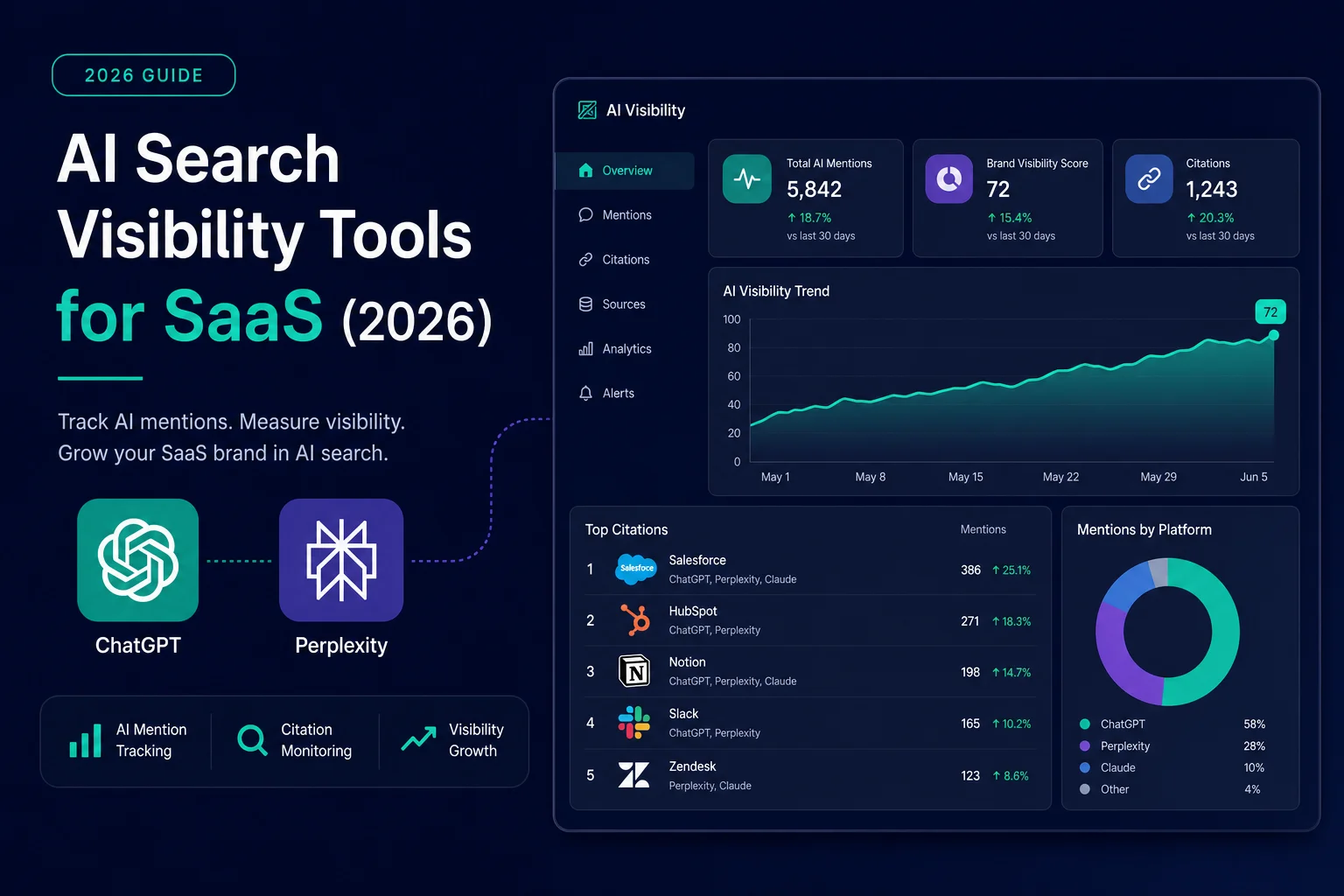
Your next signup might start in ChatGPT, not Google. Someone types "best CRM for startups" or "Notion alternatives for teams." Your product gets named, linked, or skipped. That is what ai search visibility tools saas teams care about in 2026: mentions, citations, and who else shows up on the same prompts.
This page is a shopping comparison. Ten products, one rubric, and what to fix on your site before software helps. It sits next to two other guides, not instead of them.
Read how to stack AI visibility tools when you want layers: monitors, SEO suites, launch listings. Read the newsletter's ten-platform comparison for a different shortlist, including execution tools like EzSeoAeo. Same topic, different vendors. Use both if you are narrowing a buy.
This is for founders, growth marketers, SEO leads, and early teams picking a monitor before launch week or renewal.
We built this from public pricing pages, help docs, and product pages in October 2026. We did not run a paid lab test on every login. Treat "best for" labels as editor picks for your shortlist. Confirm features, engines, and limits on each official site before you pay.
Comparison table: AI search visibility tools at a glance
Skim this first if you are in buying mode. Pricing moves fast. Verify everything on the vendor site.
| Tool | Best suited for | What to compare on the pricing page |
|---|---|---|
| Otterly.AI | Bootstrapped SaaS | Entry price, prompt limits, engine add-ons |
| Peec AI | Agencies and marketing teams | Prompts vs models, client workspaces |
| Profound | Enterprise SaaS | Custom quotes, agent credits, seats |
| Semrush | SEO teams | AI Visibility Toolkit vs base subscription |
| Ahrefs Brand Radar | SEO specialists | Index bundles vs Custom Prompt checks |
| HubSpot AEO | HubSpot marketing teams | CRM bundle, AI monitoring modules |
| AthenaHQ | Growth teams wanting analysis | Credits per response, API add-ons |
| Scrunch | Larger brands | Prompts, responses/month, LLM list |
| SE Ranking | Smaller SEO teams | AI visibility add-on vs rank tracker |
| Writesonic | Content-led marketers | GEO/content suite vs pure monitoring |
What is AI search visibility?
AI search visibility is how often your brand, product, or URL appears when people ask assistants for recommendations, comparisons, or how-tos.
You care about three signals. Your name in the answer text. A link to a specific page, yours or someone else's. Which competitors appear on the same prompt.
Traditional SEO chases rankings and clicks on blue links. AI visibility is about making the shortlist inside a generated answer. You might rank on page one in Google and still get left out of ChatGPT's answer for the same category.
You will hear AEO and GEO tossed around. AEO is structuring pages so answer engines can pull facts: pricing, integrations, use cases, FAQs. GEO is wider: showing up across sources models reuse, your site, docs, reviews, communities, directories, press. Monitors track outputs. Your GEO playbook and product page SEO checklist handle inputs.
A mention without a click still shapes the deal. A citation to your comparison post might send less traffic than your homepage but still tells the buyer you belong in the category. Track buyer-intent prompts, which URLs get cited, and whether signups move. Do not stop at mention counts.
Models do not share one brain. Your competitor might dominate in Perplexity and vanish in Copilot. Most SaaS teams start with ChatGPT, Perplexity, and Google AI Overviews, then add engines their buyers actually use.
How we evaluated the best AI search visibility tools
We scored every product on the same eight questions, using what vendors publish today.
| Criterion | What we looked for |
|---|---|
| AI platform coverage | Which assistants are included vs paid add-ons |
| Brand mention tracking | Prompt runs that log when your name appears |
| Citation analysis | Which URLs and domains answers reference |
| Competitor tracking | Share of voice on category prompts |
| Prompt tracking | Monitoring "best [category] for [audience]" queries |
| Reporting | Dashboards, exports, trends, client workspaces |
| Pricing | Published tiers vs sales-only enterprise quotes |
| Ease of use | How fast a marketer gets a useful chart |
We did not assign fake numeric scores or claim tests we did not run. If pricing is hidden, we say so.
The 10 best AI search visibility tools for SaaS marketing
Each section covers who it fits, what it does, trade-offs, pricing notes, and when to pick it over the rest.
1. Otterly.AI: best for budget-conscious SaaS founders
Official site: otterly.ai
Otterly.AI is built for AI search analytics. In October 2026, Lite started at $29 per month for fifteen tracked prompts. Standard and Premium add prompts and GEO URL audits. Base plans include ChatGPT, Google AI Overviews, Perplexity, and Microsoft Copilot. Claude, Gemini, and Google AI Mode usually show up as paid add-ons. Price the engine list you need, not just the cheapest tier.
Solo founders and tiny teams use it when they want daily prompt tracking and citation views without an enterprise sales call. You get a visibility index, domain views, citation analysis, GEO audits, exports, and unlimited teammates on published tiers.
The pricing page is clear. That matters when you are proving whether you have a gap at all. Add-on engines add up fast. Fifteen prompts run out quickly if you track a whole category.
Pick Otterly when you want a cheap monitor and your product page already states pricing correctly. Skip it if you have not fixed basics yet. A dashboard will just show zero.
Verdict: Strong entry monitor for bootstrapped SaaS if you confirm add-on pricing for every model you care about.
2. Peec AI: best for marketing teams and agencies
Official site: peec.ai
Peec AI sells prompt-based analytics, competitor benchmarks, citation and source views, and recommendations. Brand plans on peec.ai/pricing started around $95 per month on Starter when we checked. Agencies buy credits on peec.ai/pricing-agencies. One prompt on one model for one day equals one credit.
In-house SEO and content leads use it when they need charts for leadership or clients. Agencies use it when they juggle multiple brands. You get share of voice, sentiment, source gaps, and deeper shopping or crawl audits on upper tiers. Looker Studio hooks show up on advanced brand plans.
Unlimited users on brand plans is a nice touch for small teams. You usually pick a subset of models per plan. Perplexity and extras may cost more. Read the pricing page before you assume full coverage.
Choose Peec when spreadsheets hurt and you are not ready for a custom enterprise contract. You care more about client-ready citation stories than the lowest sticker price.
Verdict: Solid team and agency monitor when source-level citations matter.
3. Profound: best for enterprise SaaS companies
Official site: tryprofound.com
Profound targets enterprise AI search intelligence: brand performance in answers, citation analysis, competitive intel, and workflows that tie monitoring to action. Some Starter pricing is public on their site. Growth and Enterprise often mean a sales call. Treat any public number as a starting point.
Mid-market and enterprise SaaS with multiple brands, compliance pressure, and budget for custom terms fit here. Upper tiers advertise broad engine coverage, agent-style workflows, executive reporting, and integrations you should verify on current plans.
Depth is the point when AI visibility is a standing function, not a side quest. Cost and complexity are real. Lower tiers can cap seats compared with peers.
Choose Profound when procurement needs real reporting and you can staff onboarding. Confirm agent credits and seats before you sign.
Verdict: Enterprise analytics pick if you have budget for sales-led setup.
4. Semrush: best for teams combining SEO and AI visibility
Official site: semrush.com
Semrush is still a full SEO suite: keywords, audits, backlinks, content tools. AI visibility modules sit on top. If you already pay for Semrush, the win is one login. Rankings, competitor domains, and AI mention trends live near each other.
SaaS teams with a Semrush seat and a weekly SEO habit fit best. Packaging names change. Look for the current AI Visibility Toolkit or equivalent on Semrush's site before you budget.
You avoid a second tool if SEO and AI monitoring share the same competitor set. Dedicated AEO vendors may cover chat surfaces more completely. Your total bill is suite plus add-ons, not a standalone monitor price.
Choose Semrush when your SEO lead already lives there daily. Compare the incremental AI cost against a dedicated monitor before you pay for both.
Verdict: Best bundle play for Semrush-native teams.
5. Ahrefs Brand Radar: best for SEO-focused marketers
Official site: ahrefs.com/brand-radar
Brand Radar tracks AI visibility and brand mentions. Custom Prompt packages started around $50 per month for 2,500 checks when we read Ahrefs help docs. Higher tiers add checks. Paid Ahrefs plans include small daily Custom Prompt quotas on Lite and up. That helps if you want light monitoring without buying every AI index bundle.
SEO specialists who already live in Ahrefs for links, content gaps, and SERPs fit here. You get AI visibility indexes, custom prompts, discovery views, and ties to existing projects.
SEO and AI in one vendor is convenient. Custom prompt math can work if you budget carefully. Full Brand Radar AI indexes are separate purchases. All-platform bundles get expensive fast.
Choose Brand Radar when you want AI data next to link research, not a standalone GEO app. Model your monthly checks before you buy every index.
Verdict: Natural fit for Ahrefs-native SEO teams.
6. HubSpot AEO: best for HubSpot marketing teams
Official site: hubspot.com
HubSpot has been adding AI visibility and AEO-style measurement for teams on Marketing Hub and related CRM products. Names and packaging shift. Search HubSpot's catalog for AEO or AI visibility on your subscription tier.
SaaS companies that run inbound, email, and CRM in HubSpot use this when they want mention trends near campaign and pipeline reports. Features vary by tier. Confirm what your hub includes before you assume deep citation analysis.
AI signals sit next to data your team already trusts. That is the whole pitch. If HubSpot is not your system of record, value drops. Dedicated AEO tools may go deeper.
Choose HubSpot AEO when you are betting on HubSpot for the next year plus. Do not buy a second monitor until you know what is already included.
Verdict: CRM-integrated option when HubSpot is already paid for.
7. AthenaHQ: best for deeper AI visibility analysis
Official site: athenahq.ai
AthenaHQ mixes multi-model tracking with content and citation recommendations. Essential is free with limited credits. Starter was $295 per month with 3,600 credits in October 2026. One credit roughly equals one AI response on published plans. Enterprise is custom, with SSO, multi-region options, and heavier modules on sales-led tiers.
Growth teams pick it when they want analysis, not just a mention log. Starter lists many models and unlimited members on published plans. API access is often an add-on on Starter.
Published Starter pricing and a free tier help you test fast. Credits burn quickly on broad prompt sets. API and overages may need a sales conversation.
Choose AthenaHQ when you will act on content and citation suggestions, not just screenshot dashboards.
Verdict: Analysis-heavy monitor once you are past "do we appear at all?"
8. Scrunch AI: best for larger brands monitoring AI discovery
Official site: scrunch.com
Scrunch focuses on how your brand shows up in AI answers, plus site audits, sentiment, citations, and recommendations. Core was $250 per month in October 2026: 125 unique prompts, 5,000 responses per month, four LLMs on Core (ChatGPT, Perplexity, Google AI Overviews, Copilot). Enterprise adds models, SSO, API access, and custom limits.
Series A and brand teams treat AI discovery as a real channel, not an experiment. You get prompt management, competitor tracking, audits, and agency tiers for multiple clients. Core listed a seven-day trial when we checked.
Benchmarks for non-branded prompts are useful in exec meetings. Entry cost beats Otterly or Peec Starter. Extra users and overages need a fresh read of FAQ and pricing.
Choose Scrunch when you can spend $250 plus per month and you will fix what audits flag.
Verdict: Brand-scale monitor when reporting matters as much as monitoring.
9. SE Ranking: best for combining traditional SEO and AI search
Official site: seranking.com
SE Ranking is an SEO platform for rank tracking, audits, and competitor research, with AI visibility features added alongside classic SERP tracking. Confirm the current AI module name and engine list on SE Ranking's pricing page.
Small teams already paying for SE Ranking use it when they want keywords and AI answers in one bill. AI depth may trail dedicated AEO vendors. Match engine coverage to how your buyers search.
Total cost is often lower than enterprise AEO plus a separate SEO tool. Validate AI coverage before you cancel a dedicated monitor.
Choose SE Ranking when SEO fundamentals come first and AI monitoring is second.
Verdict: Dual SEO and AI value for compact teams.
10. Writesonic: best for teams combining AI content and visibility workflows
Official site: writesonic.com
Writesonic started as AI writing software. It now sells GEO and AI search optimization next to drafting tools. Content marketers who already publish at volume in Writesonic are the audience. Pure observability is not the main job.
You get AI-assisted content, optimization suggestions, and visibility features whose names change on Writesonic's site. The loop between drafting and checklists is tight. Monitoring depth may not match Peec or Otterly. Never swap a factual product page for generic AI fluff.
Choose Writesonic when throughput is the bottleneck, not enterprise citation intelligence.
Verdict: Content plus visibility workflow if you already pay for Writesonic. Add a dedicated monitor if you need strict prompt benchmarks.
How to choose the right tool for your SaaS
Match software to your stage and reporting job, not to logo walls.
Pre-launch? Run manual prompts in two AI tools. Fix your product page. Sketch one comparison post. Turn on Search Console once you are indexed. Pay for monitors when you have something worth citing.
Bootstrapped? Buy one affordable monitor like Otterly Lite. Tie prompts to real buyer questions. Skip duplicate SEO add-ons if nobody owns SEO weekly.
Growing? Prioritize competitor benchmarks, citation sources, and trends. Peec, Scrunch, AthenaHQ Starter, or Ahrefs Custom Prompts at scale are common picks. Point your content calendar at source gaps the tool shows you.
Enterprise? Look at Profound, Scrunch Enterprise, or AthenaHQ Enterprise for SSO, multi-region support, API access, and reporting procurement expects.
Agency? Optimize for multi-client workspaces, exports, credit math, and repeatable reporting. Peec agency plans, Scrunch agency tiers, or enterprise contracts are the usual path.
The priciest dashboard will not fix wrong pricing on your homepage. Software finds gaps. Founder-led SEO and content close them.
How to improve AI search visibility for your SaaS
Tools measure the gap. Your site and distribution close it.
Write honest comparison pages: Product A vs Product B, best tools for a specific job. See our content marketing guide.
Ship clear product and feature pages: who it is for, workflow, pricing, integrations. See product page SEO.
Publish original stuff models can cite: benchmarks, launch retros with real numbers, customer outcomes.
Fix technical SEO: indexability, titles, canonicals, SoftwareApplication schema. See SEO for startups.
Earn third-party mentions: press, communities, credible directories. See high authority backlinks.
Track buyer-intent prompts monthly: best [category] for startups, [competitor] alternatives, tools like [competitor].
Tie results to signups and pipeline, not vanity mention counts alone.
Can startup directories help SaaS companies appear in AI search?
Directories help people discover products. A good listing adds a crawlable third-party description that matches your site. That helps corroboration. It does not guarantee ChatGPT or Perplexity will recommend you.
You still need owned content, clean technical basics, and customer proof. Models weigh many sources. A directory row is one of them.
For early-stage SaaS, Founder.best is one channel: product pages and founder profiles that sit alongside your monitor. Read startup directories: traffic, links, and AI citations.
Submit your product to Founder.best when your positioning and pricing are stable enough to repeat everywhere.
Common mistakes when tracking AI search visibility
You open ChatGPT once, screenshot the answer, and call that your score. Run the same prompts on a schedule instead.
You only track branded queries while buyers search by category. Add unbranded prompts or you will miss the real fight.
You assume AI visibility equals Google rankings. Measure each channel on its own.
You ignore which URLs models cite. Fix those pages or earn links to them.
You buy two overlapping tools before you have a manual baseline.
You think allowing AI crawlers means you will get recommended. Crawling and recommending are different jobs.
You report mentions but never check signups, traffic, or pipeline.
Conclusion: Which AI search visibility tool should you choose?
There is no one best ai search visibility tools saas buy for every company. Otterly.AI fits tight budgets. Peec AI fits agencies and marketing teams. Profound and Scrunch fit larger orgs. Semrush, Ahrefs Brand Radar, and HubSpot fit stacks you already run. AthenaHQ fits teams that want analysis, not just logs. SE Ranking fits small SEO teams. Writesonic fits content-heavy workflows.
Log prompts by hand for a month. Fix wrong facts on your product site. Then buy one monitor that matches your prompt volume and engine list. Re-open official pricing pages before checkout.
For how to stack tools with launch listings, read AI search visibility tools: stack guide. For another vendor shortlist, read the newsletter comparison.
When your story is consistent, launch on Founder.best so buyers and the sources AI reads can find the same facts about your product.
Key takeaways
- AI visibility is about showing up in answers, not just ranking on Google. Track category prompts like best CRM for startups, not only your brand name.
- We compared features from public pricing pages and docs in October 2026. Confirm limits and add-ons on each vendor site before you checkout.
- Our newsletter runs a different ten-tool list, including execution-focused AEO tools. Link is below. Use both shortlists if you are shopping seriously.
- Software shows gaps. Clear product pages, technical SEO, and third-party listings actually close them.
- If you are bootstrapped, run fifteen prompts manually for thirty days before you pay for enterprise analytics.
Frequently asked questions
What is the best AI search visibility tool for SaaS?
There is no single winner. Bootstrapped founders often start with Otterly.AI because pricing is published and prompt tracking is straightforward. Agencies lean toward Peec AI or Scrunch for client reporting. If you already pay for Semrush, Ahrefs, or HubSpot, check their AI modules before you add another bill. Match the tool to how many prompts you need and which engines your buyers use.
How can I track whether ChatGPT recommends my SaaS?
Use a monitor like Otterly.AI, Peec AI, or Ahrefs Custom Prompts on a schedule. Or run the same questions yourself each month and log results in a sheet. Focus on unbranded queries such as best CRM for startups. No tool forces a recommendation. They only show whether you appear that day.
What is the difference between GEO, AEO, and SEO?
SEO chases rankings and clicks in traditional search. AEO is about getting cited inside AI answers. GEO is broader: your brand showing up across the sources models trust, including your site, docs, reviews, and directories. Monitors measure results. Your site and content change them.
Are there free AI search visibility tools?
Full monitors rarely stay free. AthenaHQ has a limited free Essential tier. Scrunch offers a short Core trial. Ahrefs gives small Custom Prompt quotas on paid SEO plans. The most reliable free baseline is manual testing: fifteen prompts in ChatGPT and Perplexity once a month, plus Search Console for Google.
Can AI search visibility tools track Perplexity and Google AI Overviews?
Most tools in this guide list Perplexity and Google AI Overviews on paid plans. Coverage varies. Claude, Gemini, and AI Mode are often add-ons. Open the pricing page for the tier you want and read the engine list line by line.
How much do AI search visibility tools cost?
Entry plans often land between twenty-nine and ninety-five dollars per month for solo founders. Team dashboards often run two hundred fifty to five hundred. Enterprise is custom. Ahrefs Brand Radar and Semrush add-ons can add hundreds on top of SEO you already buy. Price your real prompt count and engine list, not the cheapest headline.
How can a new SaaS company improve its AI visibility?
Fix your product page and pricing first. Publish honest comparison content. Add structured data. Earn real mentions on credible sites and directories that stay indexed. Then track category prompts monthly and correct wrong facts when a monitor flags them.
Do startup directories help with AI search visibility?
Directories do not guarantee AI citations. They can help people find you and give models a third-party description that matches your site. Treat listings as one layer alongside your content, technical SEO, and customer proof.
How long does it take to improve AI search visibility?
You can fix on-page facts and ship a comparison page in a few weeks. Share of voice on competitive category prompts usually shifts over one to three months if you keep publishing and earning mentions. Use the same prompt set each month so you can see a trend.

About the author
Anuj Shashimal
Founder, Founder.best
SaaS founder, indie hacker, and software engineer. Anuj built Founder.best to help indie founders launch, get discovered through search and AI answers, and turn launches into customers. He writes from first-hand experience growing Founder.best from zero to 400+ founders and 300+ launched products.
Tagged in
Browse all tagsKeep reading
Free tools and guides for this topic
Hand-picked from the tags on this post.
- Free Ahrefs Domain Rating checkerLive DR (0–100) for any domain before you chase a backlink.
- Get your product discovered by AI assistantsWhich listing fields make your product rank for the right questions.
- Free tools for foundersName generator, tagline writer, slug checker, DR checker, launch checklist.
- Startup tagline generator12 tight one-liners for your landing page and launch post.
- Browse blog posts by topicSEO, backlinks, launch platforms, AI search, startup tools, and more.
- Free SaaS directories for backlinksList of free SaaS and startup directories with dofollow filters, Ahrefs DR scores, and a submission checklist.
Ready to launch on Founder.best?
Weekly rankings, dofollow SEO backlinks, founder stories, and a community built for indie makers.
Submit your startup