SEO for founders
SEO strategy for startups: a practical guide to your first 1,000 organic visitors
You don't need hundreds of blog posts or an agency retainer to get organic traffic. You need the right keywords, genuinely useful pages, a clean technical foundation, and a repeatable way to build authority. This is the startup SEO strategy we'd follow from zero, including the 90-day plan and the checklist.

Post by Anuj Shashimal
Founder, Founder.best17 min read

SEO strategy for startups: what actually works
Most founders assume SEO means publishing hundreds of blog posts or paying an agency thousands of dollars a month. It doesn't. A working SEO strategy for startups needs four things: the right keywords, genuinely useful content, a clean technical foundation, and a way to build authority over time.
What makes startup SEO different from SEO at an established company is the starting position:
- You have almost no authority. A new domain has few backlinks, so broad keywords are out of reach for now.
- You have limited time. Every page has to earn its place, because you can't publish 50 posts a month.
- You need revenue soon. So you start with keywords close to a buying decision, not broad awareness topics.
- You can move fast. No approval chains, no legacy site, no 10,000 old pages to clean up.
This guide turns that into a step-by-step plan: research, keyword selection, technical setup, content, topic clusters, backlinks, AI discovery, measurement, a 90-day schedule, and a checklist you can copy.
Why a focused startup SEO strategy matters
- 96.55%
- of pages get no organic traffic from Google at all (Ahrefs study of about 14 billion pages)
- 94.74%
- of keywords get 10 or fewer searches a month, so most demand sits in the long tail (Ahrefs)
- 5.7%
- of newly published pages reached Google's top 10 within a year in Ahrefs' ranking-time study
- 27.6%
- of clicks go to the #1 organic result on average (Backlinko analysis of 4 million results)
Why SEO matters for startups
Paid ads stop working the moment you stop paying. Launch-day traffic fades within a week. SEO is one of the few acquisition channels that compounds:
- Organic traffic builds over time. A page you publish this month can bring signups for years.
- It reduces dependence on paid acquisition. You don't pay for every click.
- It meets buyers while they research. People search for their problem before they know your product exists.
- It builds long-term brand visibility. Ranking pages, and the AI answers that draw on them, keep your name in front of buyers.
- It works while you sleep. A ranking comparison page answers the same question for every buyer, around the clock.
The catch is that SEO is slow at first. Treat it as infrastructure you build every week, not a campaign you run once.
Start with SEO research before creating content
The biggest mistake in SEO for startups is writing first and researching later. An hour of research decides whether a page ever gets traffic.
Define your target audience
Write short answers to these four questions before you look at a single keyword tool:
- Who is the customer? Job title, company size, and stage. "Solo founders running a SaaS under $10k MRR" is useful. "Small businesses" isn't.
- What problem are they trying to solve? Describe it in their words, not yours.
- What tools are they using now? Every current tool is a future "[tool] alternatives" keyword.
- What do they search for before buying? Questions, comparisons, pricing, and "best [category] for [audience]" searches.
Good sources for these answers: sales calls, support tickets, Reddit threads, community Slack groups, and your own Google Search Console once the site is live.
Build a keyword list
Group keywords by what the searcher wants. Each type needs a different kind of page:
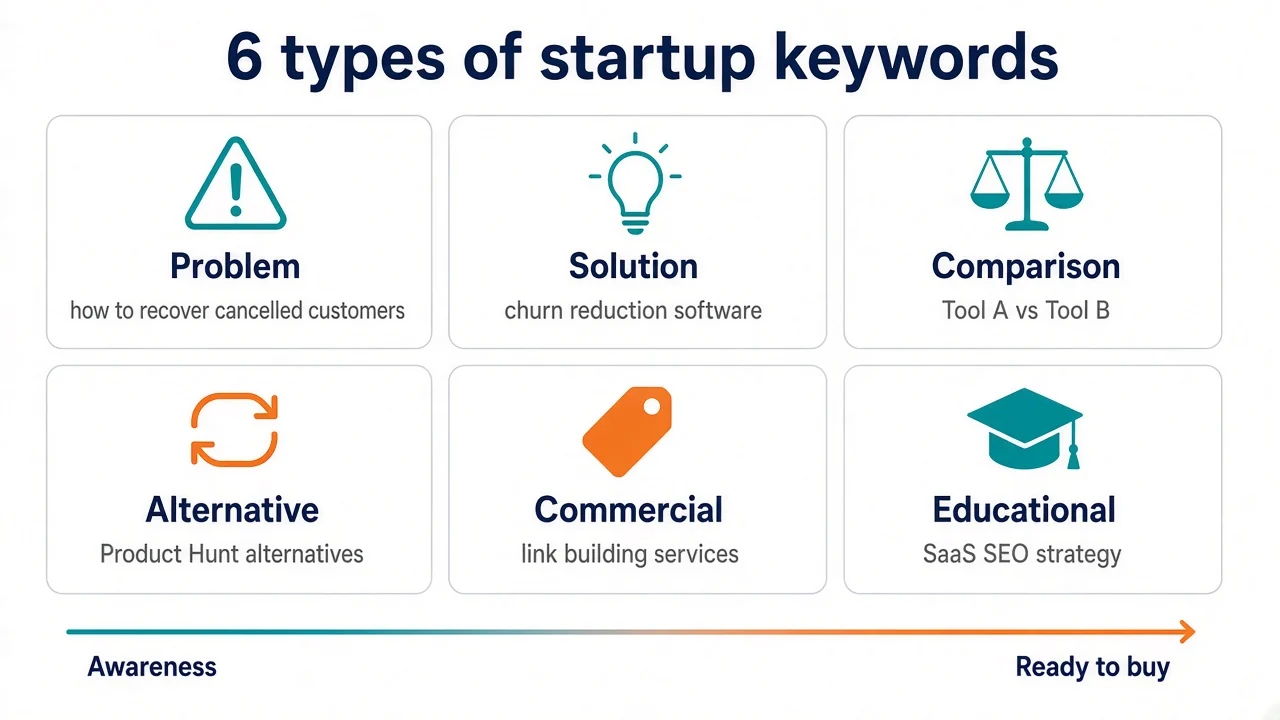 The six types of startup keywords, from problem and solution keywords to comparison, alternative, commercial, and educational keywords
| Keyword type | Example | Best page type |
|---|---|---|
| Problem | how to recover cancelled SaaS customers | How-to guide |
| Solution | SaaS churn reduction software | Category or product page |
| Comparison | Stripe vs Paddle | Comparison page |
| Alternative | Product Hunt alternatives | Alternatives roundup |
| Commercial | SaaS link building services | Service or "best of" page |
| Educational | SaaS SEO strategy | Pillar guide |
Aim for 30-50 keyword ideas at first, then narrow them down with the framework in the next section.
Don't only chase high-volume keywords. A keyword with 50 searches a month from people ready to buy can be worth more than one with 5,000 from people who are just curious. Low-volume keywords are also where a new site can actually rank, and one page often ranks for dozens of related long-tail variations, so its real traffic is usually higher than the tool estimate.
Choose keywords you can actually rank for
Two things decide whether a keyword is realistic: keyword difficulty (how strong the pages already ranking are) and search intent (what kind of page Google shows for it).
A startup shouldn't chase "SEO". Wikipedia, Google, and major SEO publishers own that search. Look for specific opportunities instead:
- "SEO strategy for SaaS startups"
- "how to get backlinks for a SaaS"
- "Product Hunt alternatives for startups"
These are long-tail keywords: longer, more specific phrases with less competition and clearer intent. Group related long-tail keywords around one theme and you build topical relevance, which makes each new page on that theme easier to rank.
To check a keyword, search it and look at the top five results. If they are all household-name brands with thousands of backlinks, pick a narrower angle. If you see forum threads, thin listicles, or small blogs, you have a real opening.
A simple keyword prioritization framework
Score each keyword from 1 to 5 on four factors and multiply them:
Relevance × Search Intent × Competition × Business Value
- Relevance: How closely does it match what your product does?
- Search intent: Is the searcher closer to learning or to buying?
- Competition: How winnable is it? Score 5 for easy and 1 for dominated by big brands.
- Business value: If this page ranks, how likely is it to bring a customer?
Multiplying rather than adding means a single weak factor drags the whole score down, which is exactly what you want. A perfectly relevant keyword you can never rank for is still a bad bet.
Example keyword scores (Relevance × Intent × Competition × Value, max 625)
- seo4
- startup seo checklist180
- how to get backlinks for a saas240
- product hunt alternatives for startups300
- seo strategy for saas startups320
Start with your top 10 scores. Map each keyword to exactly one page, so two of your own pages never compete for the same search.
Build an SEO-friendly startup website
Technical SEO is not where startups win, but it is where many quietly lose. Get these right once:
- Clear URL structure: short, lowercase, descriptive paths like
/blog/seo-strategy-for-startups - Fast loading pages: compress images, avoid heavy scripts, and aim for good Core Web Vitals
- Mobile-friendly design: Google indexes the mobile version of your site first
- HTTPS everywhere
- Unique title tags: primary keyword near the start, about 50-60 characters
- Meta descriptions: a clear promise that earns the click, about 150-160 characters
- One H1 per page, logical H2/H3 structure: headings should read like an outline
- Canonical URLs: one preferred version of each page
- XML sitemap: submitted in Google Search Console and Bing Webmaster Tools
- Robots.txt: make sure you're not blocking pages you want indexed
- Internal linking: every important page reachable within a few clicks
- Image optimization: modern formats, explicit sizes, and descriptive alt text
- Structured data where appropriate:
Organization,SoftwareApplication,Article, andFAQPageJSON-LD
Also make three kinds of pages easy to discover: your product page (what it is, who it's for, pricing), your founder page (who's behind it, which builds trust), and your content pages. The product page SEO guide covers the first one in depth.
Create content around problems, not just your product
Nobody searches for "Why [Your SaaS] Is Amazing." They search for their problem. The best SEO tips for startups all come back to this: write for the search, then connect it to your product.
Here's how a churn-reduction startup might level up its content plan:
| Content idea | Why it works (or doesn't) |
|---|---|
| Bad: "Our product features" | Nobody searches for it, and it only helps people who already know you |
| Better: "How to reduce SaaS churn" | Real search demand, but broad and competitive |
| Better: "How to recover cancelled SaaS customers" | Specific problem, less competition, clear pain |
| Even more commercial: "Best SaaS churn recovery tools" | The searcher is choosing a tool, and you can be one of the options |
Each of these articles should lead the reader toward the product naturally:
- Open with a direct answer to the search query.
- Explain the problem and what most people get wrong.
- Give a solution that works even without your product.
- Show how your product makes that solution faster or easier, with real screenshots.
- End with one clear next step, such as a free trial, template, or demo.
This order is what earns rankings, trust, and conversions together. Google rewards pages that satisfy the searcher, and readers trust pages that help before they sell. For the full content playbook, see content marketing for startups.
Build topic clusters
A topic cluster is one broad pillar page surrounded by focused supporting articles, all interlinked and linked to your product page.
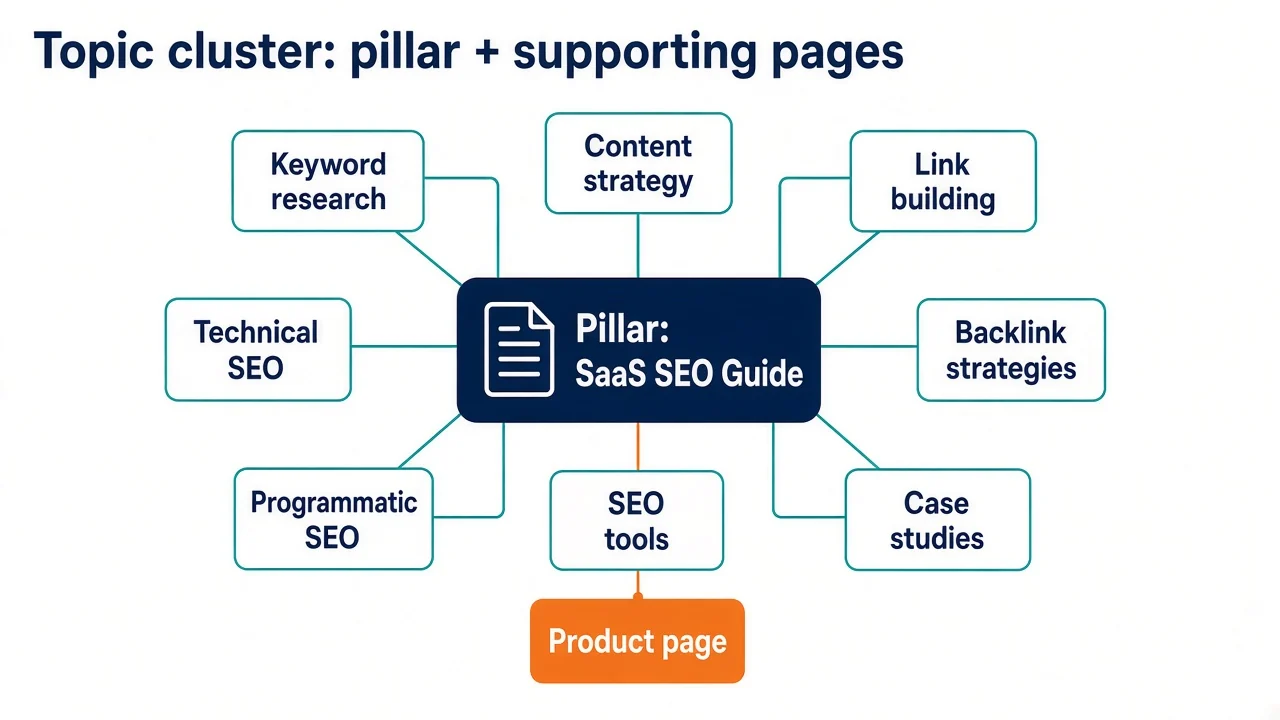 Topic cluster example: a SaaS SEO Guide pillar page connected to supporting articles and a product page
A SaaS SEO strategy cluster might look like this:
- Pillar: SaaS SEO Guide
- Supporting articles: SaaS keyword research, SaaS link building, SaaS content strategy, SaaS technical SEO, SaaS backlink strategies, SaaS programmatic SEO, SaaS SEO tools, and SaaS SEO case studies
Linking rules that keep a cluster working:
- Every supporting article links to the pillar, and the pillar links to every supporting article.
- Each supporting article links to at least one sibling article.
- Use descriptive anchor text ("SaaS link building services"), never "click here".
- Keep your product page one click away from every article in the cluster.
This is how a small site shows topical authority instead of publishing disconnected posts. At Founder.best, for example, this guide links to deeper pieces on SaaS link building services, authority backlinks, and founder-led SEO. Finish one cluster before you start the next.
Don't ignore programmatic SEO
Programmatic SEO means generating many pages from a structured dataset using one template. It suits startups because a small team can cover hundreds of long-tail searches.
Common startup patterns:
- "[Product] alternatives"
- "[Tool] alternatives for [audience]"
- "Best SaaS tools for [industry]"
- "Startups in [country]"
- "SaaS tools for [use case]"
Programmatic SEO only works when each generated page provides unique value. That means real data on every page: products, prices, features, reviews, screenshots, or filters that a searcher can't get anywhere else. Swapping one word in a template across thousands of URLs creates thin content that Google may ignore, and it can drag down the rest of your site.
A safe approach: launch 20-50 pages, confirm they get indexed and earn clicks in Search Console, improve the template, then expand.
Build backlinks and authority
Backlinks are still one of the strongest ranking signals, and a new startup domain has almost none. The goal isn't volume. Relevance matters more than simply collecting hundreds of links. Ten links from sites your buyers actually read beat 300 from spam directories.
Startup directories
Submit to a focused set of relevant directories:
- Startup directories and launch platforms
- SaaS directories
- Product and review directories
- Industry directories for your vertical
Check that each one is indexed, active, curated, and relevant to your category. The startup directories guide has a scoring framework, and the free startup directories list shows DR and dofollow status.
Founder communities
- Indie Hackers and niche founder communities
- Reddit: answer questions properly and follow each subreddit's self-promotion rules
- Hacker News: original data, technical deep dives, and "Show HN" posts
- LinkedIn and X: founder-led posts that share the core insight, not just a link
Community links are often nofollow, but they bring real visitors, brand searches, and the mentions that lead to editorial links later.
Digital PR and linkable assets
- Product launches and milestones
- Founder stories with real numbers
- Original research and data studies: "We analyzed 1,000 launches..."
- Free tools like calculators, checkers, and generators
Guest posting
Write for publications your customers read, on topics you know deeply. Avoid "guest post" marketplaces that sell placements, because buying links that pass ranking credit breaks Google's spam policies. If you want to hire help, read how to evaluate SaaS link building services first.
Get your startup listed in relevant directories
Directories deserve their own section because they're the fastest win on this list. A good listing helps with:
- Discovery: people browsing for new tools find you
- Referral traffic: visits that come straight from the listing
- Brand mentions: your name on another trusted site
- Backlinks: often dofollow on curated platforms
- Product discovery by category: buyers comparing options in your space
- Founder networking: feedback, upvotes, and connections with other builders
Founder.best is one option built for this. When you launch on Founder.best, you get a permanent, indexable product page with a dofollow backlink, a founder profile connected to everything you launch, homepage visibility during your launch week, and a place to post product updates so the listing stays fresh. You can launch for free (limited weekly slots, reviewed by an admin) or pay $2.99 for an instant Standard launch.
Use it as one listing among several. Pick 8-12 relevant directories around launch time instead of blasting hundreds.
Optimize for AI discovery too
Startup discovery increasingly happens inside AI assistants and AI search experiences. Buyers ask ChatGPT, Perplexity, and Google AI Overviews things like "What's the best churn tool for a small SaaS?" If AI systems can't understand and verify your product, you won't show up in those answers.
Make your product easy for machines to understand:
- Clear product descriptions: "X is a [category] that helps [audience] do [outcome]"
- Structured information: tables, lists, pricing, and FAQs with direct answers
- Public product pages that are crawlable and not hidden behind a login
- Strong third-party mentions on directories, reviews, podcasts, and guest posts
- Consistent brand information: the same name, one-liner, category, and pricing everywhere
- Crawlable pages: don't block AI crawlers you want to be found by
- An
llms.txtfile where useful, listing your most important pages - Mentions across relevant websites and directories, because AI systems tend to trust facts repeated by independent sources
This is the idea behind Founder.best's positioning: get found by people and AI. Every listing is another consistent, crawlable, third-party source that confirms what your product does. For the full playbook, read how to increase SaaS brand visibility in AI answers.
Use your product launch as an SEO opportunity
Most startups treat launch day as a one-day event. Treat it as the start of a content and authority campaign instead.
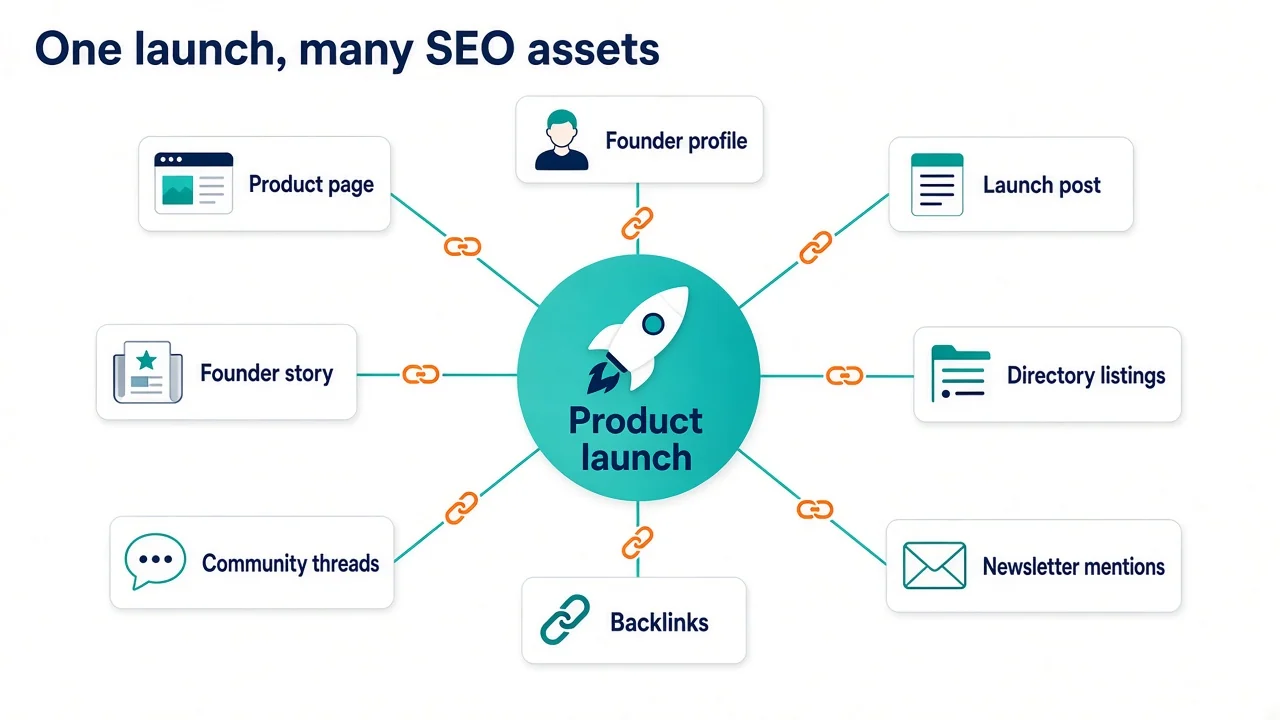 One product launch creates many SEO assets: product page, founder profile, launch post, founder story, directory listings, community threads, backlinks, and newsletter mentions
A single launch can create:
- A product page on each launch platform
- A founder profile
- A launch announcement on your own site
- A blog post on the problem you solve
- A founder story with real numbers (for example on Founder.best stories)
- Social posts on LinkedIn and X
- Community discussions on Reddit, Hacker News, and Indie Hackers
- Directory listings
- Backlinks from all of the above
- Newsletter mentions from curators who cover new products
Stagger these over two to four weeks. Afterwards, publish a launch retro with real traffic and signup numbers. Founders search for those, and original data earns links. The SaaS launch checklist covers the full sequence.
Measure SEO properly
Set up measurement before you publish, so you know which pages actually work.
Google Search Console
Track:
- Impressions: how often you appear in search
- Clicks: how often people visit
- CTR: clicks divided by impressions
- Average position
- Queries: the actual searches you show up for, which are a goldmine for new content ideas
- Indexed pages: which pages Google has and hasn't indexed
Google Analytics (or your analytics tool)
Track:
- Organic sessions
- Landing pages: which pages bring organic visitors
- Conversions: signups, trials, and demo requests
- Revenue from organic visitors, where you can attribute it
Other tools
- Ahrefs or Semrush: keyword research, competitor gaps, rank tracking, and backlinks
- Screaming Frog: crawling your site for broken links, missing tags, and redirect chains
- Google PageSpeed Insights: Core Web Vitals and performance fixes
If you use Vercel Analytics or a similar tool, filter by referrer to separate Google, Bing, AI assistants, and directory traffic. To benchmark authority, try the free Domain Rating checker.
Startup SEO metrics that matter
Don't obsess over traffic alone. Track the metrics that connect search visibility to the business:
| Metric | Why it matters |
|---|---|
| Organic clicks | Traffic from search |
| Impressions | Search visibility |
| Ranking keywords | Keyword footprint |
| Referring domains | Authority |
| Organic signups | Business impact |
| Organic conversions | Revenue potential |
| Indexed pages | Content discoverability |
| CTR | Search-result effectiveness |
From search visibility to revenue
- 1. Impressionsyou appear for the right searches
- 2. Clicksyour title and description earn the visit
- 3. Engaged visitorsthe page answers the question
- 4. Signupsa clear next step converts the reader
- 5. Customersorganic visitors become revenue
The key message: traffic is useful, but revenue-producing traffic is better. One comparison page bringing 200 visitors and 10 signups beats a viral post bringing 10,000 visitors and none.
How many pages does it take to get 1,000 organic visitors?
A useful way to set targets: most well-targeted long-tail pages on a young site bring somewhere between 20 and 100 visits a month once they rank. Assume about 50.
| Pages ranking | Avg. monthly visits per page | Monthly organic visitors |
|---|---|---|
| 5 | 50 | 250 |
| 10 | 50 | 500 |
| 20 | 50 | 1,000 |
| 30 | 60 | 1,800 |
So the first 1,000 organic visitors a month usually takes around 20 ranking pages, not 100 published posts. That's a realistic 3-6 month goal for a founder publishing 2-3 focused pages a week alongside the technical and backlink work above. The averages rise as your authority grows, which is why SEO speeds up after the slow start.
A 90-day SEO strategy for a startup
Here's the whole strategy as a quarter-long plan, assuming about 5-8 hours a week.
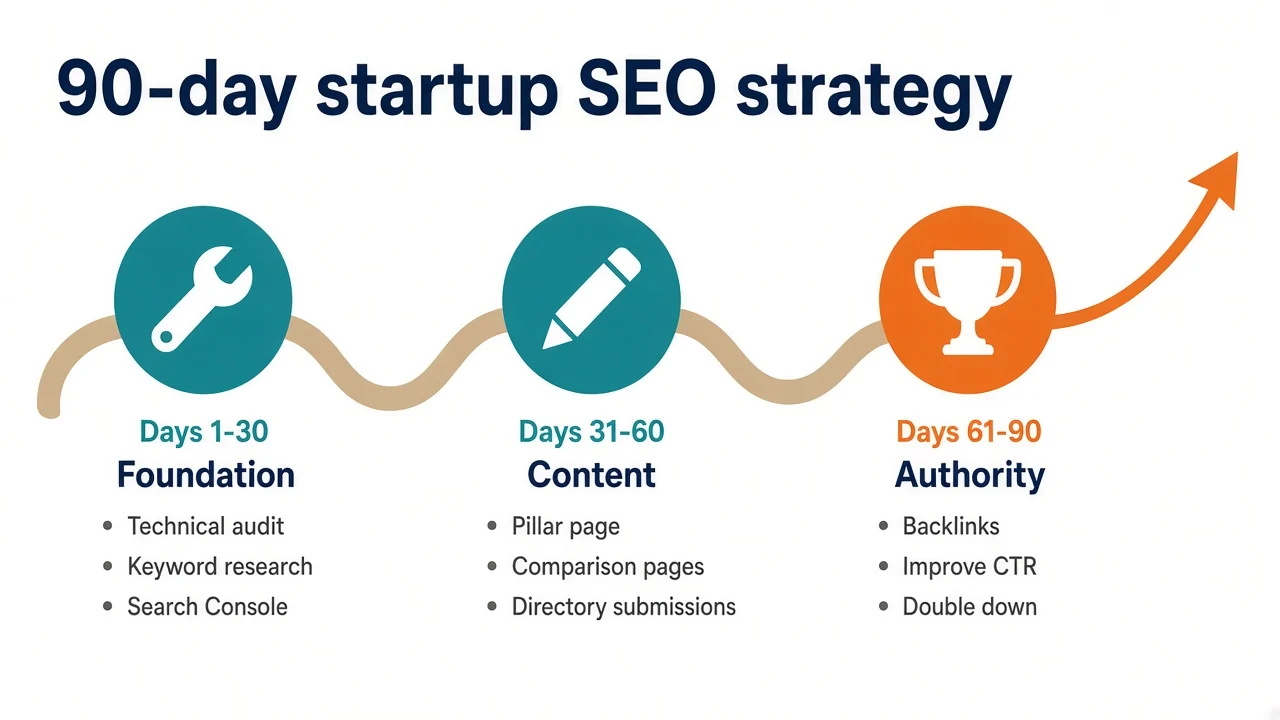 90-day startup SEO strategy: foundation in days 1-30, content in days 31-60, authority in days 61-90
Days 1-30: Foundation
- Run a technical SEO audit (crawl with Screaming Frog, check PageSpeed Insights)
- Do keyword research and score your list
- Set up Google Search Console and submit your sitemap
- Set up analytics with conversion tracking
- Optimize core pages: homepage, product, pricing, and about or founder page
- Create your initial content plan: one pillar and 5-10 supporting articles
- Fix indexing issues flagged in Search Console
- Build internal links between core pages
Days 31-60: Content
- Publish your pillar page
- Publish 3-5 supporting articles
- Create 1-2 comparison or alternative pages
- Improve existing pages with new sections, FAQs, and screenshots
- Start link building: guest post pitches, partner pages, and community participation
- Submit to relevant startup directories, including Founder.best
Days 61-90: Authority + optimization
- Build more relevant backlinks
- Update underperforming content (pages ranking in positions 8-20 are the closest wins)
- Improve CTR by rewriting titles and meta descriptions on high-impression, low-click pages
- Expand winning topics with more supporting articles
- Create a case study
- Publish original data
- Monitor conversions from organic
- Double down on pages generating qualified traffic
Suggested weekly split for a 6-hour startup SEO routine
- Writing and updating content3h
- Backlinks, directories and communities1.5h
- Technical fixes and internal links0.75h
- Measurement and planning0.75h
Startup SEO checklist
Copy this startup SEO checklist into your project tracker.
Technical SEO
- HTTPS on every page
- XML sitemap submitted to Search Console
- Robots.txt checked for accidental blocks
- Canonical tags on every page
- Mobile optimization
- Core Web Vitals passing
- Clean, descriptive URLs
Keyword research
- Define your ICP (ideal customer profile)
- Find problem keywords
- Find commercial keywords
- Analyze competitors' top pages
- Map one keyword to one page
Content
- Create pillar pages
- Create supporting articles
- Add internal links across the cluster
- Update old content every quarter
- Create comparison and alternative pages
Authority
- Submit to relevant directories
- Build relevant backlinks
- Publish original research
- Get founder and product mentions
- Participate in relevant communities
Measurement
- Google Search Console
- Google Analytics or equivalent
- Track rankings
- Track conversions
- Monitor backlinks
For a broader version that covers AI search, see the SEO for startups playbook.
SEO is a compounding growth channel
A good SEO growth strategy for a startup isn't about publishing 100 articles as fast as possible. It's about building an asset that gets stronger every month:
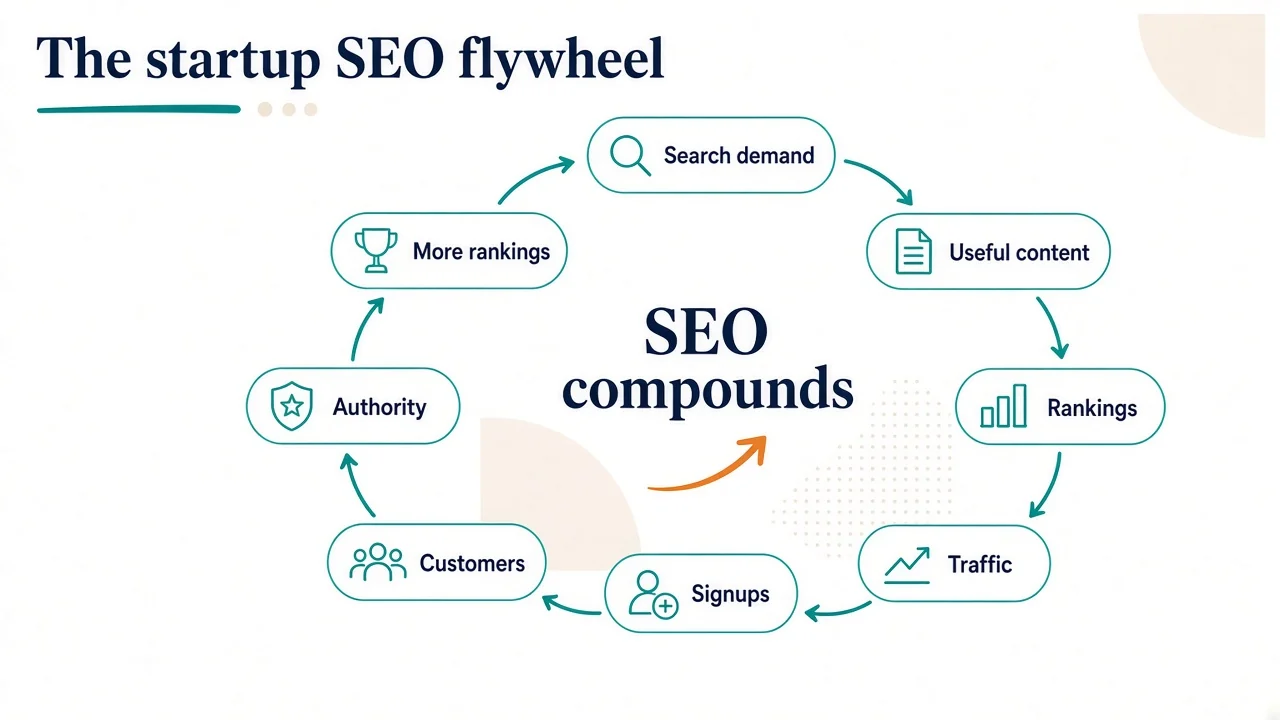 The startup SEO flywheel: search demand, useful content, rankings, traffic, signups, customers, authority, and more rankings
Search demand → Useful content → Rankings → Traffic → Signups → Customers → Authority → More rankings
Each loop makes the next one easier. Pages that rank earn links, links raise your authority, and higher authority helps your next page rank faster. The founders who win with SEO are rarely the ones who started with the biggest budget. They picked winnable keywords, published genuinely useful pages, and kept going.
Building a startup? Submit your product to Founder.best and get your startup in front of founders, builders, and people discovering new products, with a permanent product page that search engines and AI assistants can find.
Key takeaways
- Startup SEO is different from enterprise SEO: you have little authority, so you win with specific long-tail keywords, not head terms like "SEO".
- Score keywords by Relevance × Search Intent × Competition × Business Value. Search volume is only one input.
- Write about your customers' problems, not your features. Comparison and alternative pages usually convert best for early-stage startups.
- One topic cluster (a pillar page plus 5-10 supporting articles linked together) builds topical authority faster than scattered posts.
- Relevant backlinks from startup directories, launches, communities, and original data matter more than hundreds of random links.
- In 2026, optimize for AI discovery too: consistent product facts, public product pages, structured data, llms.txt, and third-party mentions.
- Track organic signups and revenue, not just traffic. Revenue-producing traffic is the goal.
Frequently asked questions
What is the best SEO strategy for startups?
The best SEO strategy for startups focuses on specific, low-competition keywords with clear buyer intent, a technically sound website, one topic cluster of genuinely useful content, and a steady stream of relevant backlinks from directories, launches, communities, and original research. Measure organic signups, not just traffic, and double down on pages that convert.
How long does SEO take for a startup?
Long-tail, low-competition pages on a technically healthy site often start getting impressions within a few weeks and meaningful clicks in 2-4 months. Competitive keywords usually take 6-12 months and more backlinks. Plan your startup SEO strategy in 90-day cycles and judge each page after 8-12 weeks.
How can a startup get its first 1,000 organic visitors?
Aim for roughly 20 pages that each bring 50 visits a month. Target problem, comparison, and alternative keywords you can realistically rank for, fix indexing and technical issues, interlink the pages as a topic cluster, and earn 10-20 relevant referring domains from startup directories, launch platforms, communities, and guest posts.
Is SEO worth it for early-stage startups?
Yes, once you have a live product and a clear customer. SEO compounds: pages keep bringing visitors without a cost per click, and the same pages help AI assistants understand and recommend your product. It is less useful before you know who your customer is, because you won't know which keywords matter.
What is the difference between SEO for SaaS and SEO for other startups?
A SaaS SEO strategy leans heavily on comparison, alternative, integration, and use-case pages, because software buyers compare tools before signing up. SaaS products can also demonstrate themselves inside content with screenshots and free tools, which makes problem-focused articles convert better.
Should startups use programmatic SEO?
Only when you have a structured dataset that makes every generated page genuinely useful, such as real product data, pricing, or reviews. Thousands of thin, near-duplicate pages can hurt your whole site. Start with a small batch, check that they get indexed and clicked, then expand.
Do startup directories help SEO?
Relevant, curated startup directories help with discovery, referral traffic, brand mentions, and early backlinks, and they give AI systems another trusted source that confirms what your product does. Mass submissions to hundreds of low-quality directories do not help and can look spammy.
What SEO tools does a startup need?
Google Search Console and an analytics tool are enough to start. Add Ahrefs or Semrush for keyword research, competitor analysis, and backlinks, Screaming Frog for technical crawls, and Google PageSpeed Insights for Core Web Vitals once you have content to optimize.

About the author
Anuj Shashimal
Founder, Founder.best
SaaS founder, indie hacker, and software engineer. Anuj built Founder.best to help indie founders launch, get discovered through search and AI answers, and turn launches into customers. He writes from first-hand experience growing Founder.best from zero to 400+ founders and 300+ launched products.
Tagged in
Browse all tagsKeep reading
Free tools and guides for this topic
Hand-picked from the tags on this post.
- Free Ahrefs Domain Rating checkerLive DR (0–100) for any domain before you chase a backlink.
- Browse blog posts by topicSEO, backlinks, launch platforms, AI search, startup tools, and more.
- Free SaaS directories for backlinksList of free SaaS and startup directories with dofollow filters, Ahrefs DR scores, and a submission checklist.
- Get your product discovered by AI assistantsWhich listing fields make your product rank for the right questions.
- Launch plans & pricingFree, Standard, Pro, and Pro+ launches compared side by side.
- Docs: public API, MCP server & AI discoveryHow AI assistants and agents search and cite Founder.best listings.
Ready to launch on Founder.best?
Weekly rankings, dofollow SEO backlinks, founder stories, and a community built for indie makers.
Submit your startup