
Frameworks
How to validate SaaS ideas before you build: a 10-step process
Most SaaS products fail because nobody wanted them, not because the code was bad. This guide shows you how to validate SaaS ideas step by step, from the problem statement to real preorders, so you only build what people will pay for.

Post by Anuj Shashimal
Founder, Founder.best17 min read
If you are searching for how to validate SaaS ideas, you are already ahead of most founders. The usual path is to get excited, spend three months building, launch to silence, and only then ask whether anyone wanted it.
This guide gives you the opposite path. It is a practical SaaS idea validation process in 10 steps, from writing a problem statement to collecting real preorders. Each step comes with a clear pass or fail signal, so you know when to keep going, when to pivot, and when to drop the idea.
It is written for bootstrapped founders, indie hackers, and small teams who would rather lose a weekend than lose six months. At the end you will find a copyable SaaS idea validation checklist, plus where to find ideas worth validating in the first place.
What does SaaS idea validation mean?
SaaS idea validation is the process of collecting evidence that a specific group of people has a painful, recurring problem, and that they will pay you to solve it, before you invest in building the full product.
The key word is evidence. Validation is not asking friends if they like your idea, and it is not a spike of upvotes on a tweet. It is proof that shows up in behavior:
- People describe the problem without being prompted
- They already spend money or time on workarounds
- They search for a solution on Google, in communities, or in AI assistants
- They give you something scarce, like an email, a call, a deposit, or a signed pilot
SaaS validation usually has two layers, and you need both:
- Idea validation (problem-solution fit). Does your solution solve a real problem for a specific customer?
- Market validation. Are there enough of those customers, can you reach them, and will they pay enough to support a business?
A validated idea in a market of 40 people is a consulting gig. A huge market with no painful problem is a nice-to-have. SaaS product validation only counts when both layers line up.
Why you should validate a SaaS idea before building
When CB Insights analyzed why startups failed, "no market need" was one of the top reasons, second only to running out of cash. Many of the other reasons, like a flawed business model or getting outcompeted, trace back to the same root cause: the idea was never properly tested.
Top reasons startups fail (% of failed startups citing each reason)
- Ran out of cash / failed to raise38%
- No market need35%
- Got outcompeted20%
- Flawed business model19%
- Regulatory / legal challenges18%
- Pricing / cost issues15%
Validating a SaaS idea first changes the economics of building:
- You spend days, not months, finding out an idea is weak. A landing page test costs a weekend. A failed product costs a quarter or more.
- You build the right first version. Interviews tell you which workflow matters most, so your MVP is narrow instead of bloated.
- You launch with users already waiting. A validated waitlist turns launch day into a conversion event instead of a cold start.
- You learn your positioning early. The words customers use in interviews become your headline, your SEO keywords, and your ad copy.
Validation does not guarantee success. It removes the most common and most avoidable way SaaS products fail.
The SaaS idea validation framework
Before the step-by-step process, here is the framework in one table. Every step later in this guide answers one of these questions. If you cannot answer a row with evidence, that is where your idea is weakest.
| Validation area | Question to answer | Evidence that counts |
|---|---|---|
| Problem | Does this solve a real problem? | Customers describe it unprompted in interviews |
| Customer | Who has this problem? | You can name 20 real people or companies |
| Competition | What alternatives already exist? | A map of tools, workarounds, and their gaps |
| Demand | Are people actively looking for a solution? | Search volume, community threads, "any tool for...?" posts |
| Pain | Is the problem painful enough to pay to solve? | Money, hours, or risk lost to the problem today |
| Distribution | Can you actually reach these customers? | A channel where you got replies or signups |
| Willingness to pay | Would someone pay for this today? | Preorders, deposits, paid pilots, or LOIs |
| MVP | Can you test the idea without building everything? | A no-code, concierge, or single-workflow version |
The 10 steps below work through this framework in the order that saves you the most time.
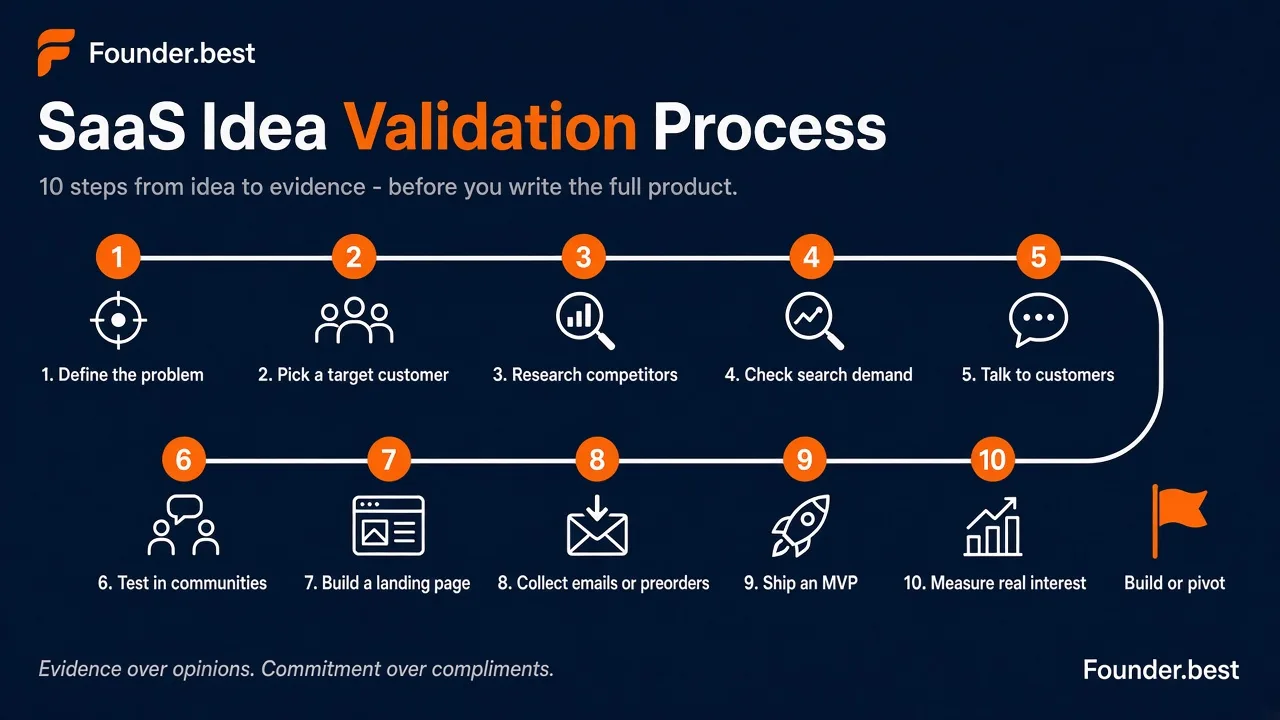 SaaS idea validation process - 10 steps from defining the problem to measuring real interest
Step 1: Define the problem you're solving
Every good SaaS idea starts with a problem, not a feature. "An AI dashboard for marketers" is a feature. "Marketing leads at 20-person agencies spend 6 hours every Monday building client reports by hand" is a problem.
Write a one-sentence problem statement using this format:
[Specific customer] struggles to [job they need done] because [root cause], which costs them [time, money, or risk]. Today they handle it by [current workaround].
If you cannot fill in every bracket, you are not ready to validate yet. You are still brainstorming.
Test your problem statement against three filters:
- Frequency. Does it happen weekly or daily? Problems that come up once a year make poor subscriptions.
- Intensity. Does it cost real money, hours, or career risk? Mild annoyances rarely convert.
- Existing spend. Is someone already paying for a workaround, like a spreadsheet, a freelancer, an agency, or a clunky tool? Existing spend is the best early sign of willingness to pay.
Pass signal: You can write the problem in one sentence, and it names a workaround people already use.
Step 2: Identify your target customer
"Small businesses" is not a target customer. "Solo bookkeepers who manage 15-40 clients in QuickBooks" is. The narrower your first customer, the easier every later validation step becomes, because you know exactly where to find them and what to ask.
Define your ideal customer profile (ICP) with these fields:
- Role and seniority. Who feels the pain, and who signs off on the purchase?
- Company size and type. Team size, industry, business model
- Tools they already use. Your integrations and your distribution channels often live here
- Trigger events. What makes the problem urgent right now? A new hire, a funding round, a compliance deadline?
- Where they hang out. Specific subreddits, Slack groups, newsletters, conferences, LinkedIn circles
A useful test is to list 20 real people or companies that fit your ICP, by name. If you cannot, your customer is either too vague or too hard to reach. Both are validation failures you want to find now, not after launch.
For B2B ideas, our guide to finding B2B clients for your SaaS walks through building an ICP and a first prospect list in detail.
Pass signal: You have a written ICP and a list of 20 named people or companies who match it.
Step 3: Research existing competitors
Founders often panic when they find competitors. Usually they should relax. Competitors prove the market exists and that people pay to solve the problem. Finding zero competitors is often the bigger red flag. It can mean nobody cares enough to pay.
Map three kinds of competition:
- Direct competitors. SaaS products solving the same problem for the same customer
- Indirect competitors. Tools that solve the problem as a side feature, like a CRM with basic reporting
- The status quo. Spreadsheets, email, a freelancer, or doing nothing. This is the competitor you will lose to most often.
For each direct competitor, note their pricing, target customer, positioning, and, most usefully, their negative reviews. One-star and three-star reviews on G2, Capterra, the app stores, and Reddit threads are a free list of unmet needs.
Good places to research competitors:
- Google. Search "[problem] software", "[competitor] alternatives", and "best [category] tools"
- Review sites. G2, Capterra, and Trustpilot for complaints and feature gaps
- Launch platforms and directories. Browse recent launches on Founder.best and product categories to see what founders shipped in your space recently. Many of these tools will never show up in a Google search yet.
- Alternatives pages. See which tools people are actively trying to replace on Founder.best alternatives
What you are looking for is a gap you can own: a segment the incumbents ignore, a workflow they handle badly, a price point they cannot serve, or an integration they do not support.
Pass signal: You can name at least 5 alternatives, including the status quo, and describe in one sentence how you will be different.
Step 4: Check whether people are already searching for a solution
Search demand is one of the cheapest and most honest validation signals. If people type the problem into Google, they are actively looking for a solution, and that is exactly the audience you want to reach later.
How to check search demand for a SaaS idea:
- List the phrases your customer would type. Include problem phrases ("how to automate client reports"), solution phrases ("client reporting tool"), and comparison phrases ("[competitor] alternative").
- Check volume and difficulty in a keyword tool like Google Keyword Planner, Ahrefs, Semrush, or Ubersuggest. For a niche B2B SaaS, even 50-500 monthly searches on a high-intent phrase can be a strong signal.
- Read Google autocomplete and "People also ask." These show you real phrasing and related pain points.
- Check Google Trends to see whether interest is growing, flat, or fading.
- Ask AI assistants. Prompt ChatGPT, Perplexity, or Claude with "What is the best tool for [problem]?" and note which products get recommended. Buyers now research this way too.
Low search volume does not automatically kill an idea. Brand-new categories often have little search demand at first. But it does mean you will need to lean on outbound, communities, or partnerships instead of SEO early on.
The keywords you find here also become the foundation of your future content strategy. Our SEO for startups playbook shows how to turn them into a content cluster once you launch.
Pass signal: You have found real search queries, community threads, or AI prompts where people ask for a solution to your problem.
Step 5: Talk to potential customers
Customer interviews are where most SaaS ideas are truly validated, or quietly killed. Nothing replaces hearing a customer describe the problem in their own words.
The golden rule is simple: ask about the past, not the future. "Would you use a tool that does X?" invites polite lies. "Tell me about the last time you had to do X" gets you the truth.
Aim for 15-20 interviews with people who match your ICP. After about 10, patterns usually start to repeat. If you are still hearing completely new problems after 20, your customer segment is too broad.
Where to find interviewees:
- Your list of 20 named ICP prospects from Step 2
- Cold emails and LinkedIn messages that ask for 15 minutes of advice, not a sale
- Community members who have posted about the problem (Step 6)
- Your own network, but only people who actually match the ICP
Use this script as a starting point:
 Interview template
SaaS idea validation interview script
Intro (1 min): Thanks for your time. I am researching how [customer role] handle [problem area]. I am not selling anything. I just want to learn how you work today.
1. Walk me through the last time you had to [job to be done]. What happened, step by step?
2. What was the hardest or most frustrating part?
3. How often does this come up? Weekly, monthly, less?
4. What do you use to handle it today? Tools, spreadsheets, people?
5. What have you tried that did not work? Why did you stop using it?
6. What does this problem cost you in time, money, or risk?
7. If you could wave a magic wand, what would change?
8. Who else on your team deals with this? Who would approve paying for a fix?
Close: This is really helpful. If I build something for this, can I show you an early version? Is there anyone else I should talk to?
After each call, write down three things: the exact words they used to describe the pain, what they currently pay (in money or hours), and whether they agreed to a next step. That last one matters most. A person who books a follow-up or introduces a colleague is giving you real evidence.
Pass signal: At least 60% of interviewees describe the problem as frequent and painful without prompting, and several agree to a follow-up or an early demo.
Step 6: Validate demand on communities
Online communities let you test your problem statement at scale and find people who are already complaining about the problem. The goal is not to promote. The goal is to listen, then ask.
Before posting anything, search each community for your problem keywords. Threads like "Is there a tool that...", "How do you handle...", and "I hate doing..." are validation gold. Save the links, note the number of replies, and message the people who wrote them.
| Community | Best for | How to validate there |
|---|---|---|
| Consumer, prosumer, and niche B2B pain points | Search niche subreddits, then post a problem-first discussion | |
| Hacker News | Developer tools, technical products, infrastructure | Read "Ask HN" threads, then share a Show HN once you have an MVP |
| Indie Hackers | Bootstrapped SaaS, founder tools, pricing feedback | Post your problem thesis and pricing for founder feedback |
| B2B, sales, HR, finance, and agency tools | Post a pain-point story and invite comments from your ICP | |
| X (Twitter) | Build-in-public audiences, dev tools, creators, AI tools | Share the problem, run polls, and DM people who engage |
Reddit is the best place to find unfiltered complaints. Search subreddits where your ICP spends time, like r/SaaS, r/Entrepreneur, r/smallbusiness, or niche ones like r/bookkeeping and r/sysadmin. Read the rules first, because most subreddits ban self-promotion. Post a question about the problem ("How are you handling X in 2026?"), not a pitch. Upvotes are weak evidence. Detailed replies and DMs asking "let me know if you build this" are much stronger.
Hacker News
Hacker News works best for developer tools and technical products. Search past "Ask HN" and "Show HN" threads for your category to see what the community liked and criticized. Save your own Show HN for when you have a working MVP, because HN readers reward things they can try, not ideas.
Indie Hackers
Indie Hackers is full of bootstrapped founders who will give you honest feedback on your problem, positioning, and pricing. It is especially useful if your customers are founders themselves. Share your validation process openly. Build-in-public posts tend to get more engagement than polished announcements.
For B2B SaaS, LinkedIn is often the most direct route to your real buyers. Write a short post describing the problem as a story ("Last month I spoke to 12 agency owners about client reporting. Here is what surprised me."), then invite people to comment with how they handle it. Comments from people who match your ICP are strong leads for interviews.
X
X works well for build-in-public founders and audiences in dev tools, AI, and the creator economy. Share the problem you are exploring, run a simple poll, and reply to people already talking about the pain. Treat likes as noise. Replies, DMs, and waitlist signups are the signals worth counting.
Pass signal: You found existing threads about the problem, and your own posts produced replies, DMs, or signups from people who match your ICP.
Step 7: Create a simple landing page
A landing page turns interest into something you can measure. It lets you test your positioning, headline, and pricing before a single line of product code exists.
A validation landing page needs only five things:
- A headline that names the problem and outcome in your customer's words, taken from your interviews
- Three benefit bullets covering the specific jobs your product will do
- A clear call to action like "Join the waitlist", "Get early access", or "Reserve your spot"
- Pricing or a price anchor, even if it is "Founding plan: $19/month, locked for life"
- An honest note that the product is in development
Build it in a day with Framer, Carrd, Webflow, or a simple Next.js page. Then send targeted traffic to it: your interviewees, the community threads from Step 6, and a small paid test of $50-100 on the channel where your ICP spends time.
Track two numbers: visitor-to-signup conversion and where signups came from. For targeted traffic, a waitlist page converting in the 10-20%+ range is a strong early sign. Low single digits usually means your message, your audience, or the idea itself needs work.
Pass signal: Targeted visitors convert to signups at a healthy rate, and you know which channel produced them.
Step 8: Collect emails or preorders
Emails are good. Money is better. This step moves your evidence from interest to commitment, the part of SaaS market validation most founders skip because it feels uncomfortable.
Not all validation signals are equal. Here is how they rank:
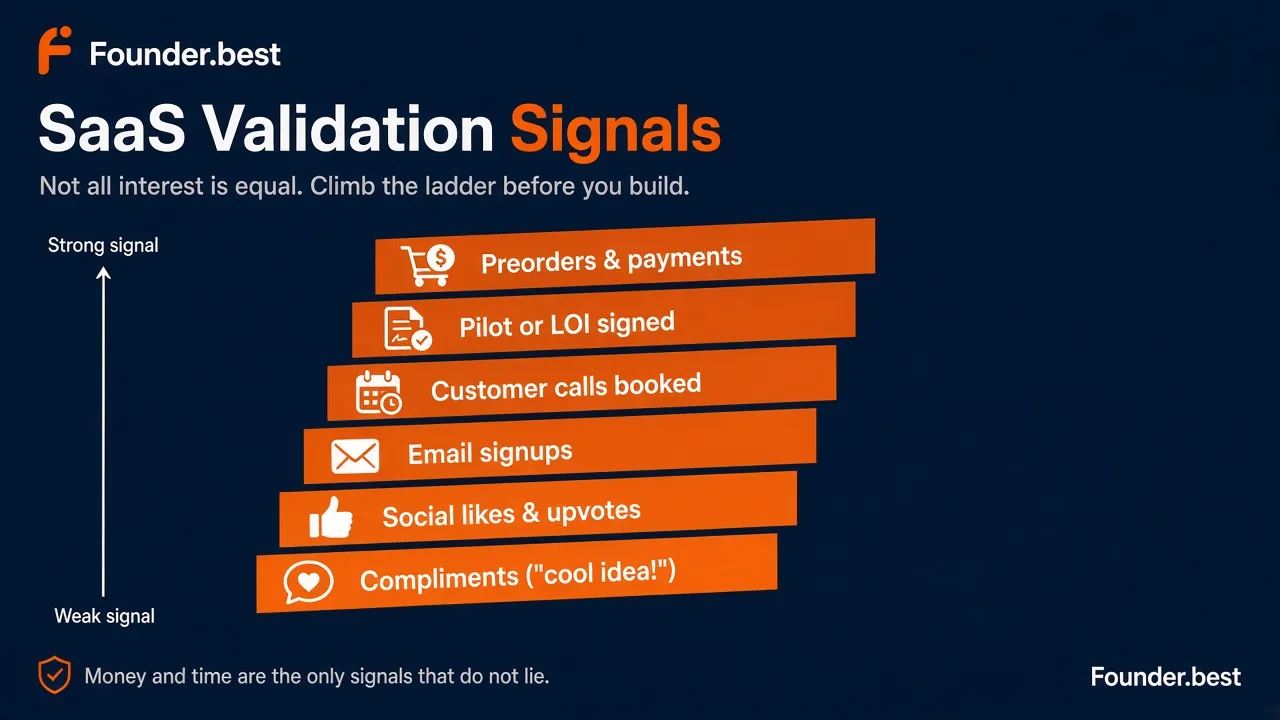 SaaS validation signals ladder - from compliments and likes up to preorders and payments
Validation signal strength (Founder.best scoring, 1-10)
- Preorders or payments10
- Paid pilot or signed LOI9
- Follow-up call booked7
- Email signup from targeted traffic5
- Social likes or upvotes2
- Compliments ('cool idea')1
Ways to test willingness to pay before the product exists:
- Preorders. Offer a discounted founding-member plan paid upfront, with a clear refund promise if you do not ship.
- Paid pilots. For B2B, offer a 60-90 day pilot at a reduced price, with setup done by you.
- Letters of intent (LOIs). A short signed note saying "we will pay $X/month when it launches." This is weaker than money, but real.
- Deposits. A small refundable deposit to reserve a spot in the first cohort.
- The pricing question. Put a "Choose plan" button on your landing page and measure clicks, even if it leads to a waitlist.
A practical benchmark for a first validation pass is 100+ targeted email signups, or 5-10 paying preorders or pilots. Five people paying for a product that does not exist yet is stronger evidence than 1,000 upvotes.
Pass signal: At least a handful of people have paid, put down a deposit, or signed an LOI.
Step 9: Build an MVP instead of the full product
Once people have committed, it is time to build, but only the minimum viable product. The MVP exists to test your riskiest assumption with real users, not to impress anyone.
Scope your MVP around one core workflow: the single job your interviewees described as most painful. Everything else waits, including settings, integrations, team features, and polish.
Consider cheaper MVP formats before writing full code:
- Concierge MVP. You deliver the outcome manually behind a simple interface. Good for testing whether the result is valuable.
- Wizard of Oz MVP. The product looks automated, but you do the work behind the scenes.
- No-code MVP. Built with Bubble, Softr, Airtable, or Zapier. Fast to build, easy to throw away.
- Single-feature MVP. Real code, but only one workflow, shipped in 2-6 weeks.
Your first users are your preorder customers and waitlist. Onboard the first 10 personally, watch where they get stuck, and fix the biggest problem each week.
For the full journey from validated idea to shipped product, see the SaaS creation framework, which covers the ideation, validation, MVP, launch, and growth stages end to end.
Pass signal: Real users complete the core workflow without you guiding them through it.
Step 10: Measure real user interest
Signups tell you the promise worked. Usage tells you the product works. This last step replaces opinions with behavior data.
Track these metrics from day one of your MVP:
- Activation rate. The percentage of signups who reach the core "aha" outcome, like sending a first report or completing a first workflow
- Week 1 and week 4 retention. How many activated users come back
- Free-to-paid conversion. How many trial or waitlist users pay once asked
- Qualitative pull. Feature requests, support messages, and users referring colleagues without being asked
- The Sean Ellis test. Ask users "How would you feel if you could no longer use this product?" If around 40% or more answer "very disappointed", that is a common sign of strong product-market fit.
Validation benchmarks to aim for (first pass)
- 15-20
- customer interviews with your ICP
- 60%+
- of interviewees describe the problem as painful, unprompted
- 100+
- targeted waitlist signups, or 5-10 paid preorders
- 40%
- of users 'very disappointed' without your product (Sean Ellis test)
If activation is low, fix onboarding and the core workflow. If activation is fine but retention drops off, the problem may not be frequent enough. If both are strong but nobody pays, revisit your pricing or your buyer.
Pass signal: Activated users come back week after week, and some convert to paid without heavy persuasion.
Common SaaS validation mistakes
Even founders who validate make these mistakes. Each one produces false confidence, which is worse than no data.
- Asking hypothetical questions. "Would you use this?" gets polite yeses. Ask about past behavior instead.
- Interviewing friends and family. They love you, and that is the problem. Only interview people who match your ICP.
- Pitching during interviews. The moment you pitch, people start being nice. Listen first, and show the product only at the end, if at all.
- Counting likes as validation. Upvotes, likes, and "great idea!" replies cost nothing. Count emails, calls, and money.
- Targeting everyone. "Any business with a website" is not a customer. Narrow segments validate faster and convert better.
- Fearing competitors. An empty market is usually a warning sign, not an opportunity.
- Never asking for money. If you never test willingness to pay, you have not validated a business, only a problem.
- Building the full product as the test. An MVP should take weeks, not months. If your "test" takes a quarter, it is not a test.
- Ignoring distribution. A great product your customers cannot find is still a failed SaaS. Validate the channel, not just the product.
A simple SaaS idea validation checklist
Use this checklist before you commit to building. Each item maps to one of the 10 steps above. If you cannot tick a box, go back to that step.
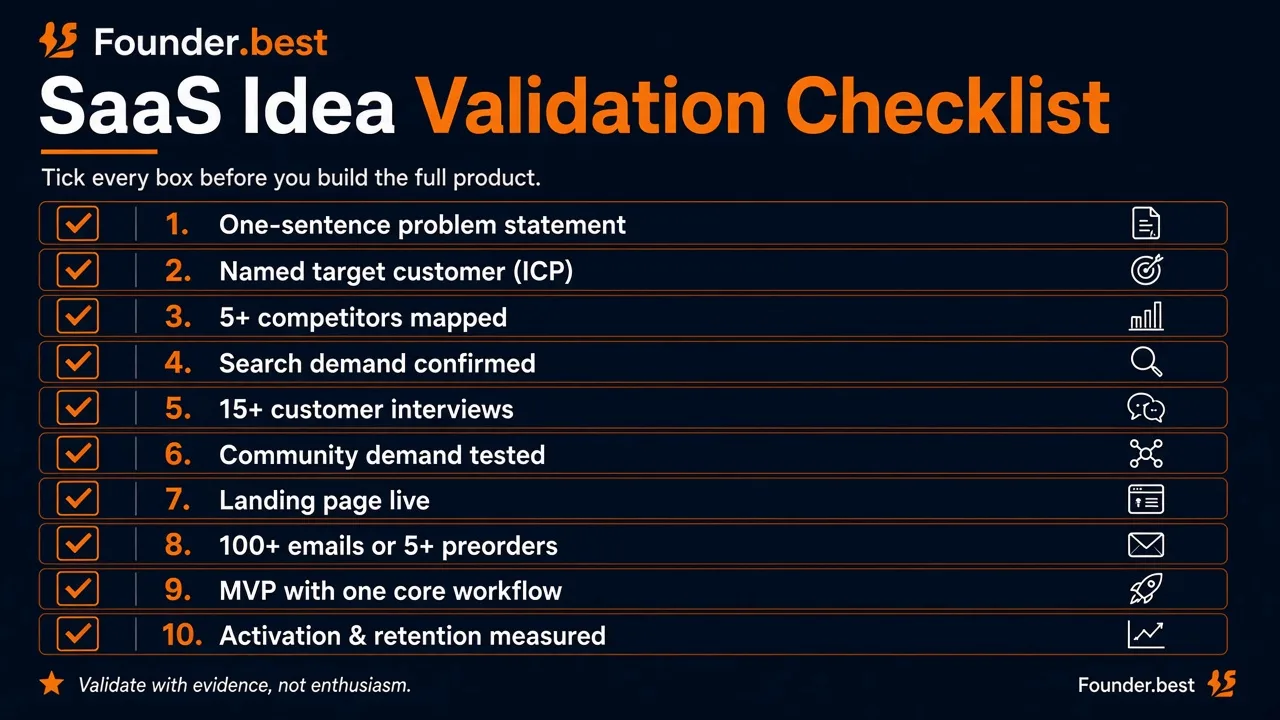 SaaS idea validation checklist - 10 items to confirm before building the full product
Copy the checklist below into Notion, a Google Doc, or your launch notes:
Copyable checklistSaaS idea validation checklist
Problem
☐ One-sentence problem statement: customer, job, root cause, cost, current workaround
☐ The problem happens at least weekly for the target customer
Customer
☐ Written ICP covering role, company size, tools, trigger events, and where they hang out
☐ 20 named people or companies who match the ICP
Competition
☐ 5+ alternatives mapped, including the status quo, with pricing and weak spots
☐ One-sentence differentiation: how you are different, and for whom
Demand
☐ Search queries, community threads, or AI prompts that ask for a solution
☐ 15-20 customer interviews completed, with pain quotes recorded
☐ Demand tested in at least two communities (Reddit, Hacker News, Indie Hackers, LinkedIn, or X)
Commitment
☐ Landing page live with a clear headline, CTA, and price anchor
☐ 100+ targeted email signups, or 5-10 preorders, paid pilots, or LOIs
MVP and usage
☐ MVP scoped to one core workflow and shipped in weeks, not months
☐ Activation, week 4 retention, and free-to-paid conversion tracked
☐ Decision made: build, pivot, or drop, based on evidence
Where to find SaaS ideas worth validating
The best SaaS ideas rarely come from brainstorming sessions. They come from watching where people struggle, pay for workarounds, or complain in public. Here are the most reliable sources:
- Your own work. Problems you have faced in a job or an industry you know well. You already understand the customer.
- Community complaints. Threads on Reddit, Hacker News, Indie Hackers, and niche Slack groups where people ask "Is there a tool for...?"
- Negative reviews. One-star and three-star reviews of established SaaS tools on G2, Capterra, and the app stores
- Spreadsheet workflows. Any team running a critical process in Google Sheets is a SaaS idea waiting to be validated.
- Freelance marketplaces. Recurring gigs on Upwork and Fiverr show tasks businesses pay humans to do over and over.
- Platform shifts. New APIs, AI models, regulations, and integrations open up gaps that incumbents are slow to fill.
- Newly launched products. What other founders are building right now shows you where the market is heading.
Discover SaaS ideas from products already being built
One of the most underrated ways to validate a SaaS startup idea is to study what other founders are already launching. New products reveal emerging categories, the customer problems founders believe are worth solving, and how crowded a space is becoming, often months before any of it shows up in search volume or analyst reports.
This is exactly what Founder.best is built for. Founder.best helps founders discover newly launched SaaS products, startups, and tools. Instead of validating an idea in isolation, you can see what other founders are building, identify existing solutions, and spot opportunities for differentiation.
A practical way to use it during validation:
- Browse product categories related to your idea to see how many tools exist and how they position themselves.
- Scan recent launches and weekly winners to spot emerging categories and problems that are getting traction.
- Read product pages for pricing, target customers, and feature scope. Note what each one leaves out.
- Check alternatives pages to see which tools people are trying to replace, and why.
- Read founder stories to learn how other founders validated, priced, and launched in your space.
- Talk to the makers. Founder profiles make it easy to reach people building next to your idea, who are often your best source of honest market insight.
If you find five products tackling your exact problem, that is market validation. Your job becomes finding the segment or workflow they serve badly. If you find none, dig deeper before you celebrate.
What to do after validating your SaaS idea
Validation is a gate, not the finish line. Once your SaaS idea passes, the work shifts from proving demand to capturing it.
- Build and ship the MVP around the single workflow your interviews confirmed, then onboard your preorder customers personally.
- Turn interview language into positioning. Use your customers' exact words for your homepage headline, product page, and ads. Our guide to B2B SaaS product marketing shows how.
- Prepare your launch. Work through the SaaS launch checklist and plan launch-day channels, including your waitlist, the communities from Step 6, and launch platforms.
- Launch on Founder.best. Submit your product to get in front of early adopters, collect upvotes and feedback during your launch week, and earn a permanent, indexable product page with a dofollow backlink that keeps sending discovery traffic after launch day.
- Start SEO early. The keywords from Step 4 become your first content cluster. See SEO for startups and content marketing for startups.
- Keep validating. Every new feature, pricing change, and market segment deserves the same process: problem, evidence, commitment, then build.
Before you launch, use the free Founder.best tools to generate a startup name, write a sharper tagline, and run the launch checklist.
Start validating this week
You do not need a product to start validating your SaaS idea. You need a problem statement, a list of 20 people, and the discipline to ask about the past instead of the future.
A realistic first week looks like this:
- Write your one-sentence problem statement and ICP
- Map 5 competitors, including recent launches on Founder.best
- Check search demand for 10 problem and solution phrases
- Book your first 5 customer interviews
- Post one problem-first discussion in a community where your ICP spends time
Collect the evidence first, and build once the market has told you what it wants.
Key takeaways
- SaaS idea validation means collecting evidence that a specific customer has a painful problem and will pay to solve it, before you build the full product.
- Validate in order: problem, customer, competition, search demand, interviews, communities, landing page, preorders, MVP, then real usage metrics.
- Competitors are usually a good sign. They prove the market exists. Your job is to find the gap they leave open.
- Rank your evidence on the signal ladder. Preorders, paid pilots, and booked calls outweigh any number of compliments or upvotes.
- Study products other founders are already launching on Founder.best to spot crowded categories, existing solutions, and room to differentiate.
Frequently asked questions
How do you validate a SaaS idea?
Validate a SaaS idea by collecting evidence before you build. Define the problem in one sentence, name the target customer, map competitors, check search demand, interview 15-20 potential customers about how they handle the problem today, test interest in online communities, launch a landing page, and collect emails or preorders. Only then build a narrow MVP and measure activation and retention.
How long does it take to validate a SaaS idea?
A focused founder can run a first validation pass in 2-4 weeks. That covers desk research and search demand checks (a few days), customer interviews (1-2 weeks), and a landing page test with emails or preorders (1-2 weeks). Validating with an MVP and retention data takes another 4-8 weeks.
How do I know if a SaaS idea is worth building?
A SaaS idea is worth building when you can name a specific customer with a frequent, painful problem, when people already spend money or time on workarounds, when you can reach those customers through a channel you control, and when at least some of them commit before the product exists. That commitment can be preorders, paid pilots, letters of intent, or repeated calls.
How many customer interviews do I need to validate a SaaS idea?
Aim for 15-20 interviews with people who match your target customer. After about 10 interviews, patterns usually start to repeat. If you are still hearing brand-new problems after 20, your target customer is probably too broad and you should narrow it.
Is having competitors bad for a new SaaS idea?
No. Competitors usually prove that a market exists and that people pay to solve the problem. Having no competitors at all is often the bigger red flag. Validate the gap instead: a segment the incumbents ignore, a workflow they handle badly, or a price point they cannot serve.
What is the difference between SaaS idea validation and market validation?
SaaS idea validation tests whether your specific solution solves a real problem for a specific customer. SaaS market validation tests whether enough of those customers exist, can be reached, and will pay enough to support a business. You need both. A validated idea in a tiny market is a hobby, not a SaaS.
Can I validate a SaaS idea without building anything?
Yes. Most of the validation process needs no code: problem interviews, competitor research, search demand checks, community posts, a landing page with a waitlist, and a preorder or paid pilot offer. Build an MVP only after people have committed time or money.
How does Founder.best help with SaaS idea validation?
Founder.best is a launch platform and directory of newly launched SaaS products, startups, and tools. Before you build, you can browse categories and recent launches to see what other founders are building, find existing solutions to your problem, and spot gaps worth filling. Once your MVP is ready, you can launch it on Founder.best for early users and a permanent, indexable product page.

About the author
Anuj Shashimal
Founder, Founder.best
SaaS founder, indie hacker, and software engineer. Anuj built Founder.best to help indie founders launch, get discovered through search and AI answers, and turn launches into customers. He writes from first-hand experience growing Founder.best from zero to 400+ founders and 300+ launched products.
Tagged in
Browse all tagsKeep reading
Free tools and guides for this topic
Hand-picked from the tags on this post.
- Launch SaaS guideHow to launch a SaaS product in 2026: validation, launch platforms, SaaS launch checklist, SEO backlinks,…
- Free startup launch checklist30+ tasks across pre-launch, launch day, and post-launch.
- Free tools for foundersName generator, tagline writer, slug checker, DR checker, launch checklist.
- Free SaaS directories for backlinksList of free SaaS and startup directories with dofollow filters, Ahrefs DR scores, and a submission checklist.
- How Founder.best worksSubmit in 10 minutes, rank on the weekly Launchpad, stay discoverable.
- Launch platform alternatives & guidesProduct Hunt alternatives, where to launch, and SEO launch guides.
Ready to launch on Founder.best?
Weekly rankings, dofollow SEO backlinks, founder stories, and a community built for indie makers.
Submit your startup