Launch & growth
12 Branding Tips for Startups: Build a Memorable Brand in 2026
You do not need a rebrand every quarter or a $50k agency deck to look credible. You need a clear story, consistent visuals, and a few channels where the right people keep seeing you. These twelve branding tips for startups cover the whole loop—from who you serve to how you measure whether anyone remembers you.

Post by Anuj Shashimal
Founder, Founder.best11 min read

If you searched branding tips for startups, you probably do not need another lecture about "brand is more than a logo." You need a sequence: who you are for, what you promise, how you look and sound, and where people first encounter you when Google, a friend, or an AI assistant sends them your way.
This guide walks through twelve practical steps in that order. None of them require a huge budget. All of them work better if you pick a lane and stay in it long enough for someone to remember your name.
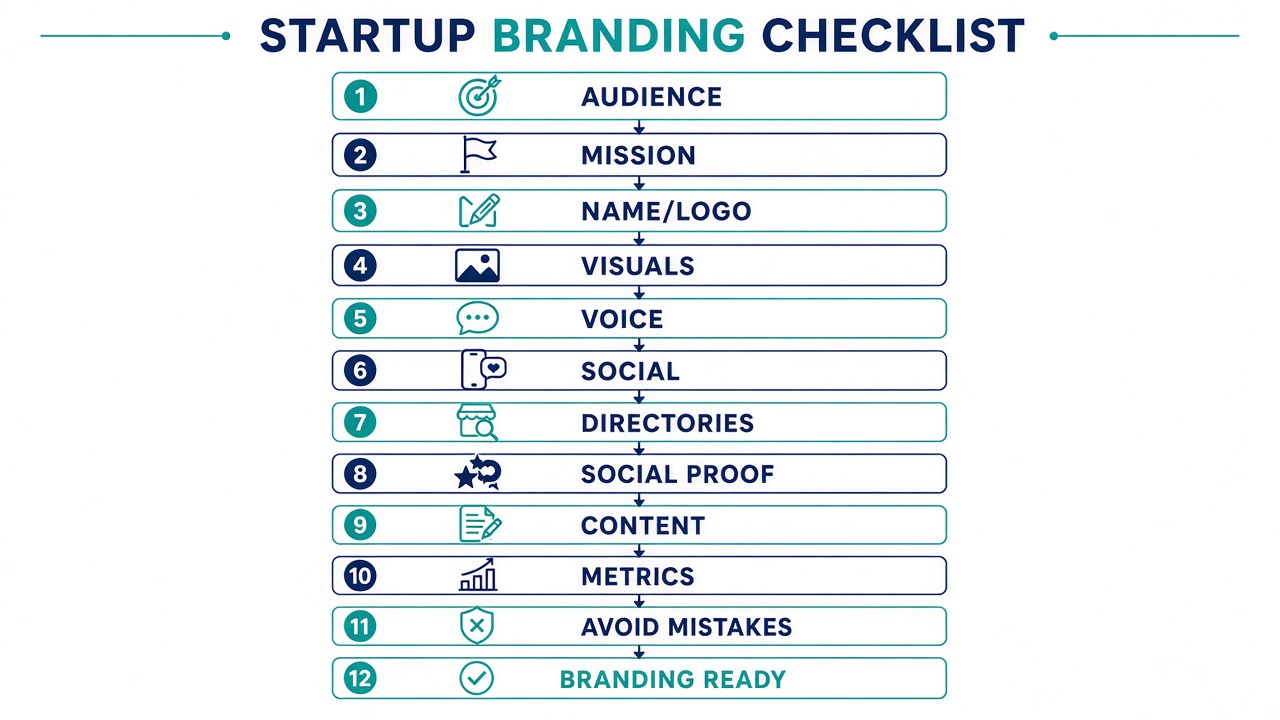 Twelve-step startup branding flow from audience research through mission, visuals, voice, distribution, social proof, content, metrics, and common mistakes to avoid
1. What is startup branding and why does it matter?
Startup branding is the set of signals that tell people who you are, what you solve, and whether you feel credible—before they read your pricing page or book a demo.
That includes your name, visuals, tone, customer stories, and even where your product shows up on third-party sites. It is not decoration. It is shorthand for trust.
In crowded markets, buyers default to names they recognize. Strong branding helps you:
- Stand out when ten tools claim the same feature list
- Shorten sales cycles because prospects already know your angle
- Support higher prices when you look intentional, not improvised
- Make marketing efficient—every channel repeats the same story
Weak branding does the opposite. If your site, Twitter bio, and Product Hunt tagline all describe different products, nobody stores a clear memory of you. Fix the story first; polish the pixels second.
2. Define your target audience before building your brand
Your brand should feel magnetic to one group and invisible to everyone else. That starts with research, not mood boards.
Talk to real people. Run 10–15 short interviews with people who have the problem you solve. Ask what they tried, what failed, and what words they use—not what you wish they said.
Write one ideal customer profile (ICP). Include role, company size, industry if relevant, and the trigger moment that makes them search for a solution.
List pains and desired outcomes. Pain is emotional ("I waste hours reconciling invoices"). Outcomes are measurable ("close books in two days, not two weeks").
Note what they already trust. Communities, newsletters, influencers, and tools they mention tell you where your brand needs to appear.
Your homepage headline, ad copy, and social posts should sound like those interviews—not like your internal roadmap. When audience clarity is sharp, color palette debates get a lot shorter.
3. Establish your brand mission, vision, and values
Mission, vision, and values are not wall art. They are decision filters.
Mission is why you exist today: the change you make for customers.
Vision is where you are headed in 5–10 years if things go well.
Values are the non-negotiables in how you build and sell.
Skip generic lines like "we put customers first." Use specifics you would defend in a hard tradeoff:
- Mission example: "We help solo founders publish SEO-ready launch pages without hiring an agency."
- Vision example: "Every bootstrapped SaaS has the same discoverability tools incumbents use."
- Values example: "Ship proof over hype," "Publish pricing," "No dark patterns in onboarding."
Keep each statement to one or two sentences. Revisit them when you pivot—not every sprint. Consistent purpose makes your startup brand identity easier to recognize across channels.
4. Create a memorable startup name and logo
Your name is the handle people type into search bars and Slack threads. Treat it like infrastructure.
Choose something distinctive and easy to say. Avoid names that only make sense after a three-minute pitch.
Check domain and social handles early. A .com or clean alternative plus matching handles saves pain later.
Design a simple logo. One mark, readable at favicon size, works on light and dark backgrounds. Complex illustrations age fast.
Plan to keep it. Frequent renames erase SEO equity and confuse returning visitors. Rebrand when the business model truly changes—not because you are bored.
If you are stuck between two names, say both aloud in a customer interview and watch which one they repeat back correctly. That reaction is branding data.
5. Choose consistent brand colors, fonts, and visuals
Consistency is free trust. A lightweight brand style guide beats a 40-page PDF nobody opens.
Pick:
- 2–3 brand colors (primary, accent, neutral)
- 2 fonts max (one for headings, one for body)
- Spacing and button styles on your site
- Screenshot and illustration rules (light UI shots, rounded corners, etc.)
Document it on a single page: hex codes, font names, logo clear space, and "do / don't" examples.
Apply the same rules to your website, social banners, pitch deck, support docs, and listing pages on startup directories. When every touchpoint matches, you look established even if the team is three people.
6. Develop a clear brand voice and value proposition
Brand voice is how you sound: direct or playful, technical or plain, bold or calm. Pick three adjectives and test them against sample copy.
Your value proposition answers three questions on the homepage:
- What does the product do?
- Who is it for?
- Why should they care now?
Headline formulas that work for startups:
- "[Outcome] for [audience] without [common pain]"
- "The [category] that [specific difference]"
- "Stop [bad habit]. Start [better outcome] in [timeframe]."
Examples (illustrative, not vendor claims):
- "Launch-ready product pages for bootstrapped SaaS—without an agency retainer."
- "The CRM that syncs Gmail threads for solo consultants—not enterprise sales teams."
Subheads should add proof: a metric from beta users, a integration list, or a clear free tier. If a stranger cannot paraphrase your offer after five seconds, tighten the copy before you boost traffic.
7. Build your brand presence on social media
You do not need every platform. You need one or two where your ICP already spends time.
Choose channels deliberately. B2B SaaS often fits LinkedIn and X; developer tools lean on GitHub and Hacker News; visual products may fit Instagram or TikTok.
Share build-in-public updates with substance: what you shipped, what broke, what customers asked for. Stories beat announcement graphics.
Keep messaging aligned with your site. Same product name, same category words, same promise.
Engage, do not broadcast. Reply to comments, quote customers with permission, and join relevant threads without spamming links.
Social is a reinforcement layer for brand awareness for startups, not a replacement for a clear site and product experience. Batch content weekly so you stay visible without living in notifications.
8. Use startup directories and product launch platforms
Most buyers discover tools outside your domain—directories, launch sites, newsletters, and comparison lists. Your brand needs a verified footprint there.
Startup directories give you a permanent product page, category context, and often a backlink search engines can follow.
Launch communities add social proof during release week.
Newsletters and niche lists put your name in front of qualified readers who already trust the curator.
Product discovery platforms such as Founder.best combine launch visibility with an indexable listing—useful for both referral traffic and third-party mentions buyers (and AI systems) use to confirm you exist.
Treat each listing as a brand asset: same logo, same description, same URL, updated when you ship major features. Inconsistent listings look like a scam; aligned listings compound startup branding over time.
9. Build trust with testimonials, reviews, and social proof
Early-stage startups can show trust without inventing numbers.
Collect honest testimonials. Ask right after a win: "What changed after you started using us?" Keep quotes specific, even if short.
Share customer outcomes with permission—time saved, errors reduced, revenue influenced—without exaggerating.
Display credible proof on your homepage: logos (only if real), review snippets, G2 or Capterra widgets when you have them, case study links when you do not.
Use video or screenshots when possible; they are harder to fake and easier to believe.
If you only have three beta users, three strong quotes beat a fake "trusted by 10,000 companies" banner. Trust compounds when proof matches reality.
10. Use content marketing to increase brand awareness
Content puts your brand next to problems people already search for. Done well, it is branding that scales.
Useful formats for startups:
- Problem guides that teach the workflow you improve
- Founder stories that show why you built the product
- Case studies with before/after details
- Newsletters with one insight per issue
- Educational posts that stand alone even without a pitch
Pair content with distribution—see content marketing for startups for a full playbook. One strong article listed on your site, shared by the founder, and linked from a directory page does more for awareness than ten posts nobody reads.
Write in your brand voice, link to your product naturally, and update top performers when your product changes. Search and AI answers reward clarity and consistency over keyword stuffing.
11. Measure brand awareness and improve over time
Branding feels fuzzy until you attach numbers. Track a small dashboard monthly:
| Signal | What to watch | Why it matters |
|---|---|---|
| Branded search | Impressions and clicks for your company name in Search Console | People seek you by name |
| Direct traffic | Sessions with no referrer in analytics | Word of mouth and recall |
| Mentions | Alerts for brand name on social, forums, and news | Share of conversation |
| Referral traffic | Visits from directories, newsletters, partners | Distribution working |
| Customer feedback | "How did you hear about us?" in onboarding | Qualitative truth |
| Conversion rate | Signups or demos from branded vs non-branded visits | Awareness that pays |
Improvement usually means doubling down on what already moves branded search and direct traffic—not renaming for the third time. If a channel sends traffic but never converts, fix positioning or onboarding before you post more there.
12. Common startup branding mistakes to avoid
Even good founders slip here:
- Copying competitors — same blue gradient, same "AI-powered" headline, same vague promise
- Redesigning too often — kills recognition and burns founder time
- Trying to appeal to everyone — dilutes message and ads
- Inconsistent messaging — site says one thing, sales deck another, Twitter a third
- Spending big before validation — expensive identity systems before anyone pays
- Ignoring third-party presence — stale directory pages and broken links erode trust
- Chasing vanity metrics — follower counts without signups or branded search
When in doubt, simplify. One audience, one promise, one visual system, repeated everywhere for a year. That is how memorable startup brands actually get built.
Put your brand where people can find it
Strong branding tips for startups only matter if real buyers encounter your story. Polish your homepage, align your social profiles, collect proof from early customers, and publish one piece of content that answers a question your ICP actually asks.
Then extend that presence beyond your site. Launch on Founder.best so your product sits alongside other vetted startups—with a consistent listing search engines and communities can reference long after launch week ends.
Brand is what people remember when you are not in the room. Make that memory accurate, repeated, and easy to find.
Key takeaways
- Branding for startups is recognition plus trust: people should know what you do and feel safe trying you before sales gets involved.
- Audience research comes first. A sharp ideal customer profile beats a prettier logo every time.
- Keep visual identity simple and stable—one logo, a small palette, two fonts, and a short style guide you actually use.
- Directories and launch platforms extend your brand beyond your site and give third-party proof search engines and buyers can verify.
- Measure branded search, direct traffic, referral sources, and conversion—not post count or follower totals alone.
Frequently asked questions
What are the best branding tips for startups?
Start with one clear audience and a value proposition you can say in one sentence. Lock a simple name, logo, colors, and voice, then use them everywhere—site, social, listings, and sales decks. Collect honest testimonials, publish useful content, and list on trusted startup directories so people discover you outside your own domain. Consistency beats constant redesigns.
How can a startup build a brand on a small budget?
Use free or low-cost tools: Canva or Figma for visuals, a one-page style guide, and your own founder voice on LinkedIn or X. Skip paid brand workshops until you have paying customers. Invest time in customer interviews, a clean landing page, and listings on curated launch platforms that send traffic and backlinks. Reuse one core message across every channel.
How much does startup branding cost?
DIY branding can cost little beyond a domain and a logo tool—often under $500 if you keep it minimal. Freelance logo and identity packages often run $1,500–$5,000. Full agency rebrands for startups frequently land at $10,000–$50,000+. Early teams usually get better ROI from a simple identity plus distribution than from an expensive visual system nobody sees.
What are the most important elements of a startup brand?
The essentials are audience clarity, a clear value proposition, consistent visuals (name, logo, colors, typography), and a recognizable voice. Add social proof—testimonials, logos, or outcomes—and proof of presence on third-party sites. Together these tell strangers what you do, who it is for, and why they should trust you.
How can startups increase brand awareness?
Show up where buyers already look: search content, founder-led social posts, communities, newsletters, and startup directories. Launch on product discovery platforms, run a simple content rhythm, and encourage customers to share results. Repeat the same positioning everywhere so people and algorithms associate your name with one problem you solve.
How long does it take to build a recognizable brand?
Familiarity in a niche can start within a few months if you publish and distribute consistently. Broader recognition often takes 12–24 months of steady messaging, customer proof, and repeated touchpoints. Rebrands reset that clock—so stabilize your identity early, then improve execution rather than renaming every quarter.

About the author
Anuj Shashimal
Founder, Founder.best
SaaS founder, indie hacker, and software engineer. Anuj built Founder.best to help indie founders launch, get discovered through search and AI answers, and turn launches into customers. He writes from first-hand experience growing Founder.best from zero to 400+ founders and 300+ launched products.
Tagged in
Browse all tagsKeep reading
Free tools and guides for this topic
Hand-picked from the tags on this post.
- Free SaaS directories for backlinksList of free SaaS and startup directories with dofollow filters, Ahrefs DR scores, and a submission checklist.
- Launch platform alternatives & guidesProduct Hunt alternatives, where to launch, and SEO launch guides.
- How Founder.best worksSubmit in 10 minutes, rank on the weekly Launchpad, stay discoverable.
- Free tools for foundersName generator, tagline writer, slug checker, DR checker, launch checklist.
- Free startup launch checklist30+ tasks across pre-launch, launch day, and post-launch.
Ready to launch on Founder.best?
Weekly rankings, dofollow SEO backlinks, founder stories, and a community built for indie makers.
Submit your startup