SEO for founders
How to identify your SEO target audience: a guide for SaaS founders
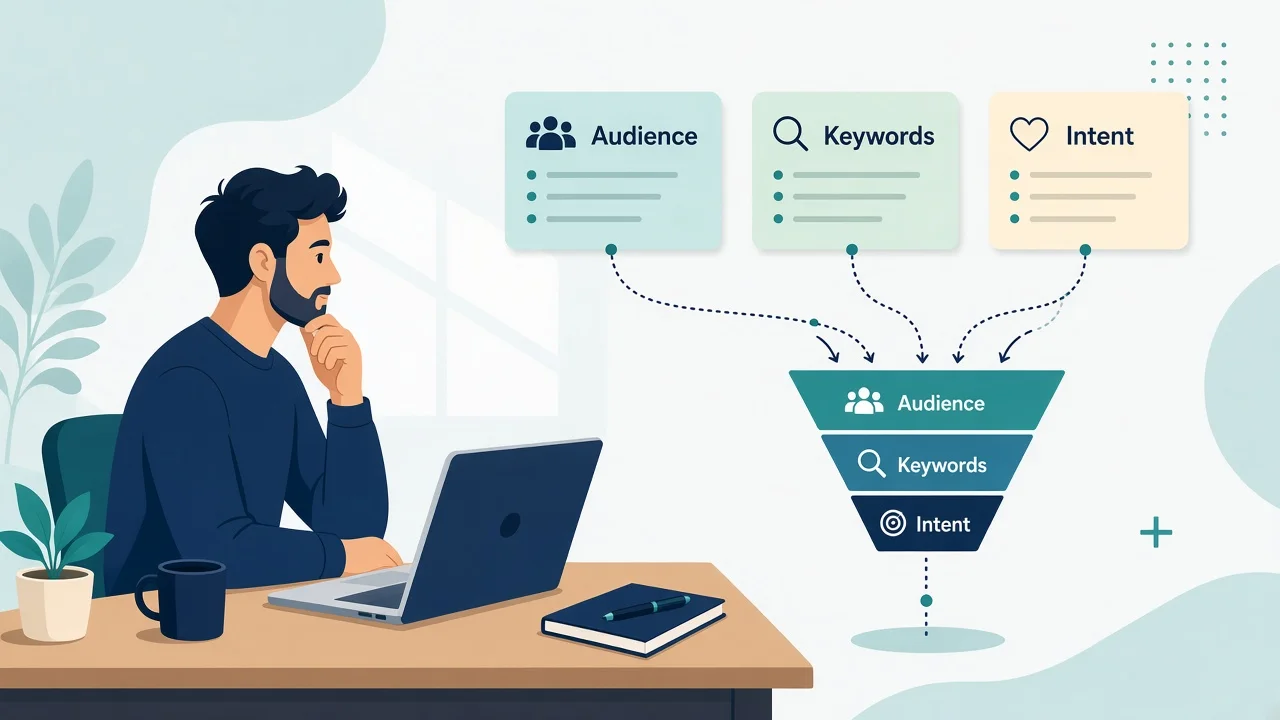
Ranking for the wrong searches feels like progress until you look at signups. Your SEO target audience is the group of people whose problems, language, and buying path should decide every keyword you chase and every page you publish.

Post by Anuj Shashimal
Founder, Founder.best16 min read
On this page
- TL;DR
- Why your SEO target audience matters
- What is an SEO target audience?
- Why defining your SEO audience matters for startups
- How to identify your ideal customers
- How to find the keywords your audience searches for
- How to analyze search intent and customer pain points
- How to build SEO buyer personas for SaaS
- How to create content for each stage of the customer journey
- SEO audience research tools for startups
- How to measure whether you're reaching the right audience
- Common SEO audience research mistakes
- Build an SEO strategy around your audience
- Key takeaways
- FAQ
- About the author
- Keep reading
- Tools & guides
You can publish every week, climb impressions in Google Search Console, and still hear crickets on demo requests. The traffic is real. The fit is not.
That gap usually means your SEO target audience was never defined clearly enough to steer keywords, page types, and messaging. Search rewards pages that match what a specific searcher wanted at a specific moment. Generic "startup" content rarely does that.
This guide walks through how to identify your target audience for SEO, turn that into SEO audience research you can repeat, and plug it into a SaaS SEO strategy that early teams can actually run. It complements our SEO strategy for startups and founder-led SEO playbook, with the audience layer those guides assume you already have.
Why your SEO target audience matters
Organic search is one of the few channels where the visitor raises their hand first. They type a problem, a comparison, or a "best tool for X" query before they know your brand. If you guess wrong about who that person is, you optimize for queries that never convert.
Three patterns show up constantly on early-stage SaaS sites:
- Volume vanity. A post ranks for a broad term like "social media marketing tips" while your product sells scheduling APIs to developers.
- Wrong intent. You rank for informational queries when buyers needed a comparison or pricing page.
- Split focus. One page tries to speak to agencies, in-house marketers, and indie creators at once, so Google picks a clearer competitor instead.
Defining a target audience for SEO fixes the input to everything downstream: keyword lists, content formats, internal links, and what you measure. Get the audience right and keyword research stops feeling like gambling on big numbers.
What is an SEO target audience?
Your SEO target audience is the subset of potential customers you deliberately attract through organic search. It is defined by:
- Who they are (role, company type, team size, technical level)
- What they are trying to accomplish when they search
- How they describe the problem in plain language
- Where they are in the buying journey (learning, comparing, ready to buy)
This is related to, but not identical to, your overall ICP (ideal customer profile). Marketing might target "SMB marketers" across ads, email, and partnerships. SEO needs a sharper slice: which of those marketers search for what, and which queries can your domain win in the next 6–12 months?
Google's guidance on helpful, people-first content boils down to serving a real need with clear expertise. Audience definition is how you prove which need you are serving on each URL.
SEO audience vs total addressable market
Your TAM might be "every team that publishes social content." Your SEO audience for year one might be "technical founders at seed-stage SaaS companies evaluating posting APIs." That narrower group searches differently, compares different alternatives, and needs different proof on the page.
You are not ignoring other customers forever. You are sequencing SEO so each topic cluster has a clear reader.
Why defining your SEO audience matters for startups
Startups face asymmetric constraints: low domain authority, limited content bandwidth, and founders who must split time between product and distribution. Audience clarity is a force multiplier in that environment.
You cannot out-volume incumbents
Established brands publish at scale and collect links passively. You win by being the most specific, credible answer for a defined reader on a defined query. Specificity requires audience definition first.
Keywords without audience context mislead
Tools report search volume and difficulty scores. They do not report whether the clicker matches your pricing, integration requirements, or sales motion. A keyword research for startups workflow that starts with audience segments avoids chasing impressive metrics that your sales team will never close.
Content compounds around topics
When you know the audience, you can build a topic cluster: one pillar page plus supporting articles that interlink. Clusters work when every page serves the same reader progression, not random SEO ideas.
AI answers reuse the same signals
AI search surfaces often pull from pages with clear definitions, structured comparisons, and consistent product facts. Those pages are easier to write when you know exactly who should trust the answer.
How to identify your ideal customers
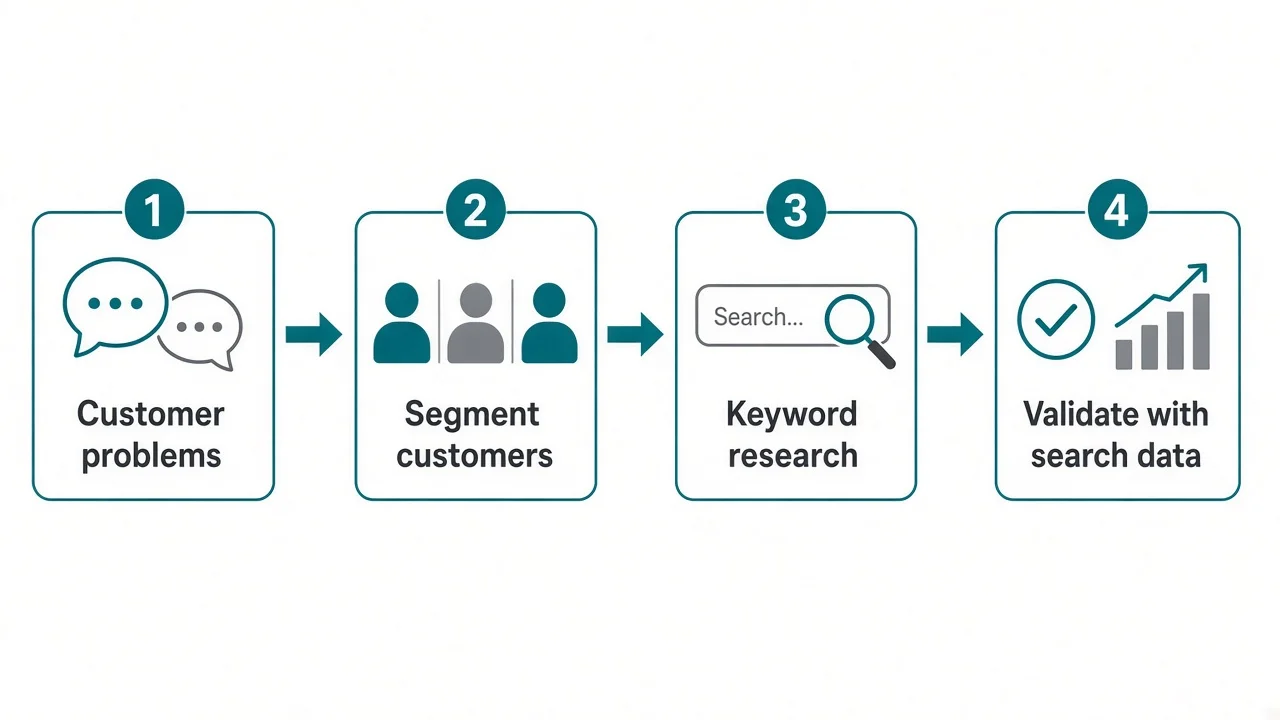
Customer identification for SEO is part anthropology, part sales archaeology. You are extracting language and priorities from real people, then checking whether that language exists in search.
Start with problems, not personas
Before you name "Marketing Megan," list problems your product solves well today:
- What did your last ten happy customers say they were struggling with?
- What almost made them churn?
- What did they use before you, and why did they switch?
Write problems in the customer's words. "I spend Sunday night copying posts into five client accounts" beats " inefficient workflow management."
Segment buyers you can actually reach
Split the list into segments that differ in search behavior, not just demographics:
| Segment dimension | Why it matters for SEO |
|---|---|
| Role (developer vs marketer vs founder) | Different queries, different proof |
| Company size | Budget and tool stack keywords change |
| Workflow (agency vs in-house vs solo) | "For agencies" modifiers appear in search |
| Technical depth | API docs vs beginner guides |
| Geography or compliance | Regulated niches add long-tail demand |
Pick one primary segment per content initiative. Secondary segments get their own pages later.
Example A: Social media scheduling SaaS
Imagine a startup selling social scheduling software with both a UI and a publishing API. Three segments emerge:
- Indie creators searching "best free social scheduler" and tool roundups
- Marketing agencies searching "client approval workflow for social posts" and white-label tools
- SaaS companies searching "social media API for product" and developer docs
Same product, three SEO audiences. If you blend them on one homepage and one blog, you compete against specialists in each lane. SEO audience research here means choosing which lane matches your roadmap and sales motion, then owning vocabulary for that lane.
Validate segments with evidence
Use a simple checklist before you assign keywords to a segment:
- At least five customer or prospect conversations support this segment
- You can name tools they compare you to
- You can describe a "day in the life" problem your feature fixes
- Someone on the team can write credibly for this reader
- Search results for sample queries are not owned entirely by megabrands
If a segment fails the checklist, keep it in CRM targeting but not in SEO priority yet.
How to find the keywords your audience searches for
Once segments exist, keyword discovery is systematic. Seed terms come from customers; tools expand and prioritize phrasing.
Build seed lists from customer language
Sources worth mining weekly:
- Sales and demo call notes
- Support tickets and live chat logs
- Churn and lost-deal interviews
- Reddit, Slack, and forum threads (search within communities)
- Reviews of you and competitors on G2, Capterra, or Product Hunt comments
- Google Search Console queries once you have impressions
For each segment, aim for 20–40 raw phrases before you open a paid keyword tool.
Expand and group keywords
Drop seeds into Google Keyword Planner, Ahrefs, Semrush, or similar tools to find variations. Group by topic, not alphabetically. A group might be "agency client approval," "API rate limits," or "LinkedIn scheduling for B2B SaaS."
For startups, prefer:
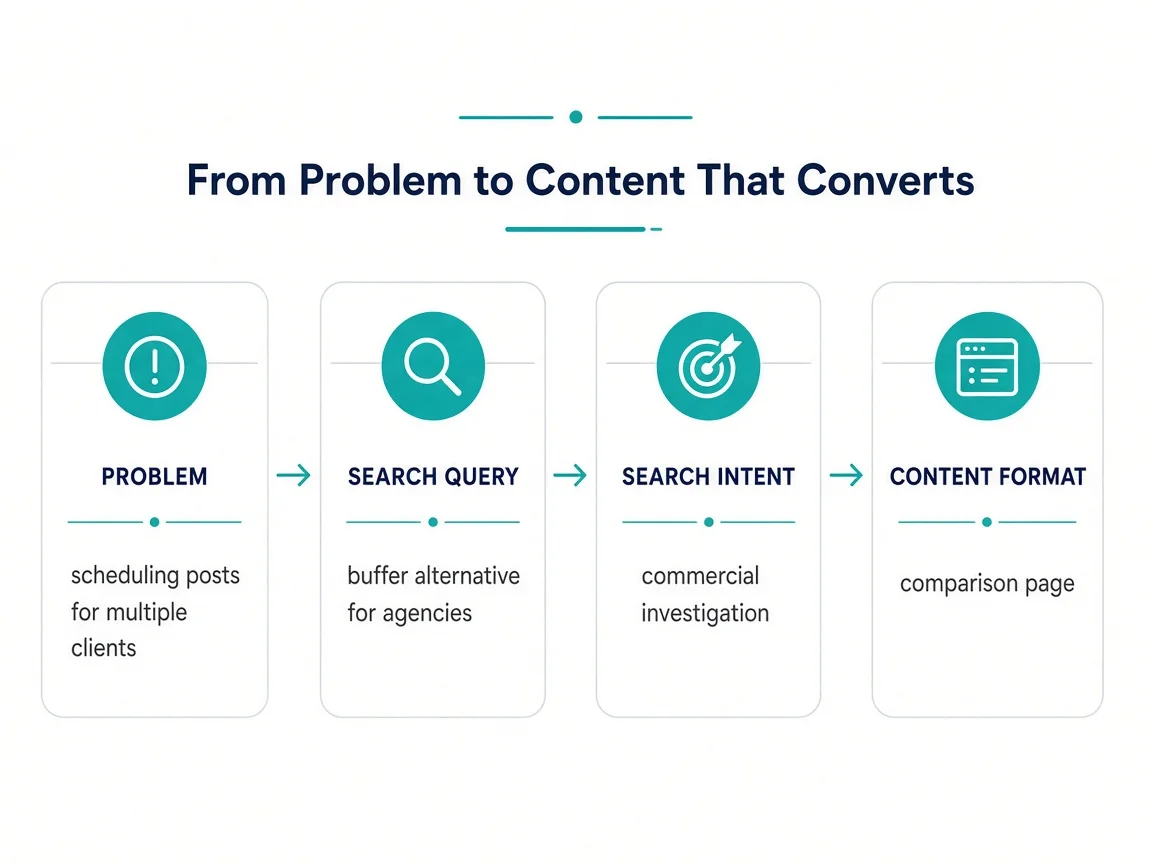
- Problem queries ("how to schedule posts for multiple clients")
- Comparison queries ("[competitor] alternative for agencies")
- Category plus audience ("social media API for developers")
- Pricing and evaluation ("[category] pricing for small team")
Avoid starting with head terms your site cannot rank for yet. Our SEO for startups playbook covers prioritization scoring in more detail.
Example B: SEO keyword mapping (illustrative)
The table below uses illustrative queries, not verified volume data. It shows how audience problems map to intent and page types.
| Audience problem | Example search query | Search intent | Suitable content format | Appropriate next step |
|---|---|---|---|---|
| Agency juggles many client accounts | buffer alternative for social media agencies | Commercial investigation | Comparison page | Link to pricing and trial |
| Developer embeds posting in app | REST API to schedule social posts | Transactional / technical | API docs + integration guide | Link to SDK and signup |
| Founder picks first scheduler | best social media tool for solo SaaS founder | Commercial | Best-of listicle (niche angle) | Link to product page |
| Marketer fixes broken approval process | client social media approval workflow | Informational | How-to guide with template | CTA to product feature |
| Ops lead worries about compliance | social media archiving for regulated industry | Informational / commercial | Niche guide + checklist | Contact sales or docs |
One keyword, one primary page. If two segments need different answers, split URLs rather than stuffing sections.
How to analyze search intent and customer pain points
Search intent analysis is the step where you open Google, search the phrase, and study the top results. Tools estimate intent categories; the SERP shows what Google actually rewards.
The four intent buckets (with SaaS nuance)
| Intent type | What the searcher wants | Typical SaaS page |
|---|---|---|
| Informational | Learn a concept or solve a step | How-to, glossary, template |
| Commercial investigation | Compare options before buying | Comparison, "best X for Y," alternatives |
| Transactional | Sign up, buy, or implement | Product, pricing, signup, docs |
| Navigational | Reach a specific brand | Homepage, login (usually not SEO targets) |
Many B2B queries blend informational and commercial intent. A SERP full of listicles and "vs" pages tells you to write comparison content, not a 4,000-word essay with no product angle.
Tie pain points to SERP features
Note what appears alongside organic results: People Also Ask boxes, video carousels, discussion threads, or AI overviews. Pain points that show up as questions ("how do I get client approval on posts?") become H2 headings and FAQ blocks on your page.
Match product page SEO intent on money pages and educational intent on supporting posts. Mixing them on one URL confuses both users and crawlers.
When intent and audience conflict
Sometimes a keyword has volume but the SERP audience is wrong. Example: "social media calendar template" might attract students and hobbyists while you sell to agencies. Low conversion despite traffic is an audience mismatch signal. Deprioritize or narrow the angle ("client social media calendar template for agencies").
How to build SEO buyer personas for SaaS
SEO buyer personas add search behavior to traditional personas. Keep them lean. One page per persona in your internal wiki beats a deck nobody opens.
What to include
For each primary segment, document:
- Role and business stage
- Goals and success metrics
- Pain points and triggers that start a search
- Queries they type (informational and commercial)
- Content formats they trust (docs, benchmarks, founder essays)
- Objections and what proof overcomes them
- Topics you will own in the next two quarters
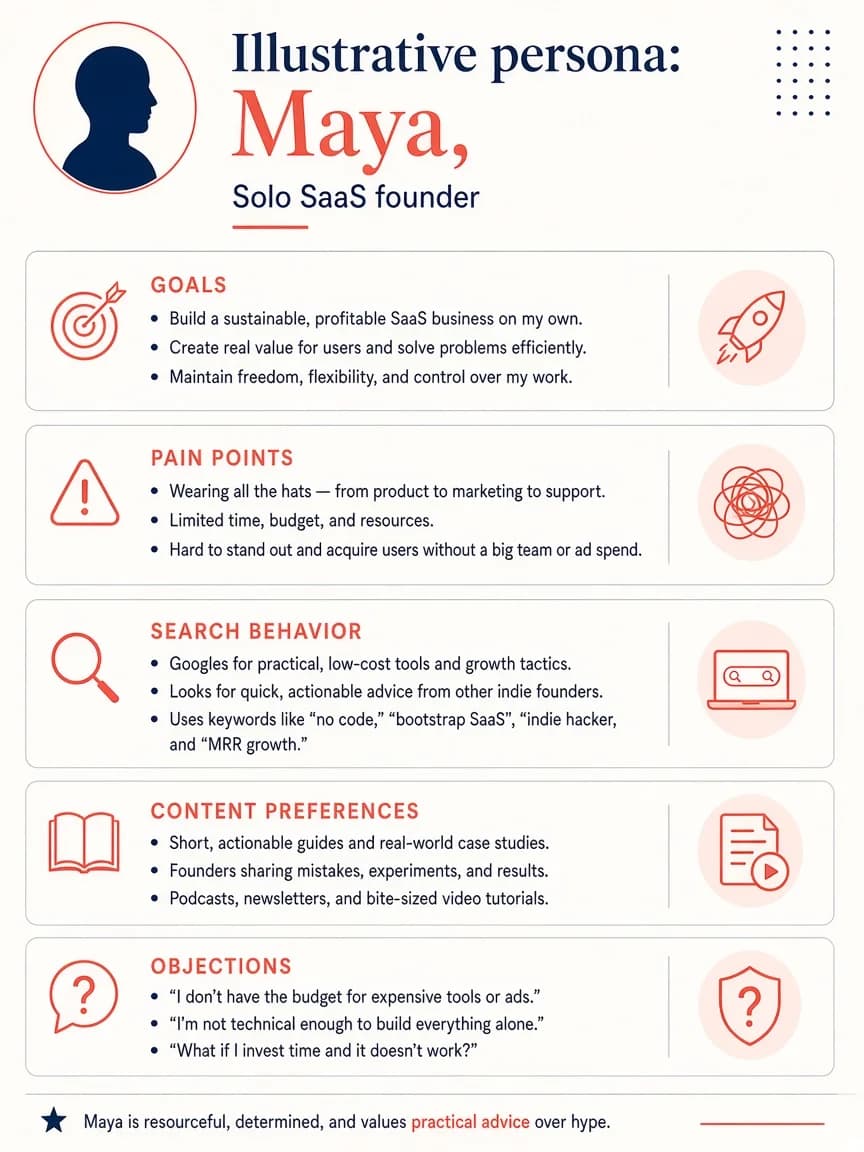
Example C: Illustrative SEO buyer persona
Persona label: Illustrative only, not a real customer.
Name: Maya Chen
Role: Solo SaaS founder, pre-seed, building a dev tool
Stage: First 500 users, no marketing hire
Goals: Ship faster, acquire users without a big ad budget, look credible next to funded competitors.
Pain points: No time to write; unsure which keywords matter; afraid of picking the wrong positioning angle.
Search behavior: Googles "[competitor] alternative for indie hackers," "how to get first 100 users SaaS," "founder-led SEO," and pricing comparisons before trying tools.
Content preferences: Short, tactical posts with screenshots; honest comparison tables; checklists over thought leadership.
Likely objections: "SEO takes too long," "my category is too crowded," "I tried blogging and got zero signups."
Relevant content topics: Narrow positioning guides, comparison pages against incumbents, measurement posts tied to signups, launch and directory strategy for early traction.
Maya should not be the audience for every page on your site. She is the reader for your founder acquisition cluster. Agency buyers need a separate persona and keyword set.
Connect personas to Founder.best discovery
Startup founders like Maya often discover tools through founder communities and startup discovery platforms, not only Google. SEO still matters because they search before and after those discoveries. Your persona should include both search paths and where they expect to see social proof.
How to create content for each stage of the customer journey
Audience research fails if every post targets the same funnel stage. Map formats to journey stages so readers graduate from education to evaluation to action.
Awareness
Reader knows they have pain but not your category. Content answers "why is this hard?" and "what approaches exist?"
Formats: problem guides, templates, glossary entries, myth-busting posts tied to real workflows.
SEO tip: internal link forward to consideration pages, not only your homepage.
Consideration
Reader compares approaches and vendors. This is where many SaaS startups should spend more SEO effort.
Formats: comparisons, alternative pages, "best X for Y" posts with a defensible niche, feature deep dives against a named competitor.
SEO tip: align title tags with commercial queries; include pricing context where honest.
Decision
Reader is ready to act. Organic search still plays a role for branded queries, pricing, integrations, and security reviews.
Formats: product and pricing pages, docs landing pages, implementation timelines, security or SOC2 explainers.
SEO tip: follow the product page SEO checklist so transactional pages can rank.
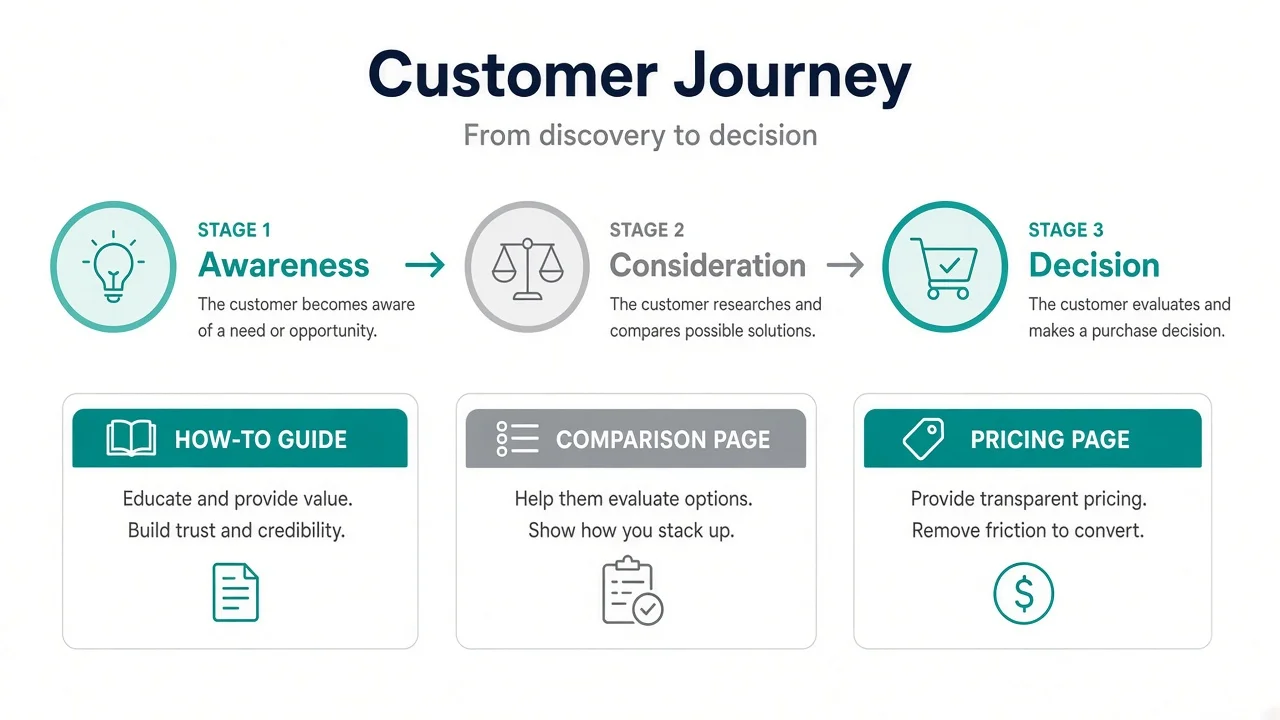
One audience, one journey map
Draw a simple table for your primary persona:
| Stage | Example query | Page on your site | Primary CTA |
|---|---|---|---|
| Awareness | how to manage social posts for 10 clients | Workflow guide | Subscribe or read comparison |
| Consideration | [tool] vs [tool] for agencies | Comparison | Start trial |
| Decision | [your brand] pricing | Pricing | Sign up |
Gaps in the table are content ideas with built-in audience fit.
SEO audience research tools for startups
You do not need a massive stack. You need tools that answer specific questions.
| Tool / source | Best for | Startup-friendly note |
|---|---|---|
| Google Search Console | Queries and pages that already earn impressions | Free, essential |
| Google Analytics (or privacy-friendly alternative) | Landing pages and conversion paths | Tie organic landing pages to signup events |
| Google Keyword Planner | Seed expansion and rough volume ranges | Free with Google Ads account |
| Ahrefs / Semrush / similar | Difficulty, SERP analysis, clustering | Use after you have customer seeds |
| AlsoAsked / answer-focused tools | Question variants for FAQs | Good for H2 outlines |
| Reddit / communities | Raw language and pain threads | Search within subreddits |
| SparkToro (or similar) | Where an audience spends attention | Useful for distribution, not just SEO |
| Customer interviews | Truth | Still the highest-signal source |
Automations help with clustering and drafts; they do not replace audience judgment. See what SEO automation really does for realistic boundaries.
How to measure whether you're reaching the right audience
Traffic without fit is a reporting mirage. Measurement connects queries to segments and segments to revenue signals.
Example D: Search Console plus analytics workflow
Use this monthly process (adjust tools if you use a different analytics stack):
- Search Console → Performance → Search results. Filter to the last 28 days. Export queries with clicks and impressions.
- Highlight queries that match your defined segments. Tag each as on-audience or off-audience based on your persona doc. If more than 30% of clicks are off-audience, revisit content priorities.
- Open the Pages report. Sort by clicks. For each top URL, write which persona and journey stage it serves. Misaligned high-traffic pages are refresh candidates.
- In analytics, create a segment for organic users. Compare landing pages to signup, trial, or "book demo" events. Use UTM-free organic paths; landing page is enough for many startups.
- Qualitative loop. Ask sales and support: "Where did you hear about us?" and "What did you read?" Match answers to URLs. Mismatch teaches more than pageviews.
- Decide one action. Double down on a winning comparison page, narrow an overly broad post, or add internal links from awareness posts to consideration pages.
For content-level metrics frameworks, read how to measure SaaS content marketing.
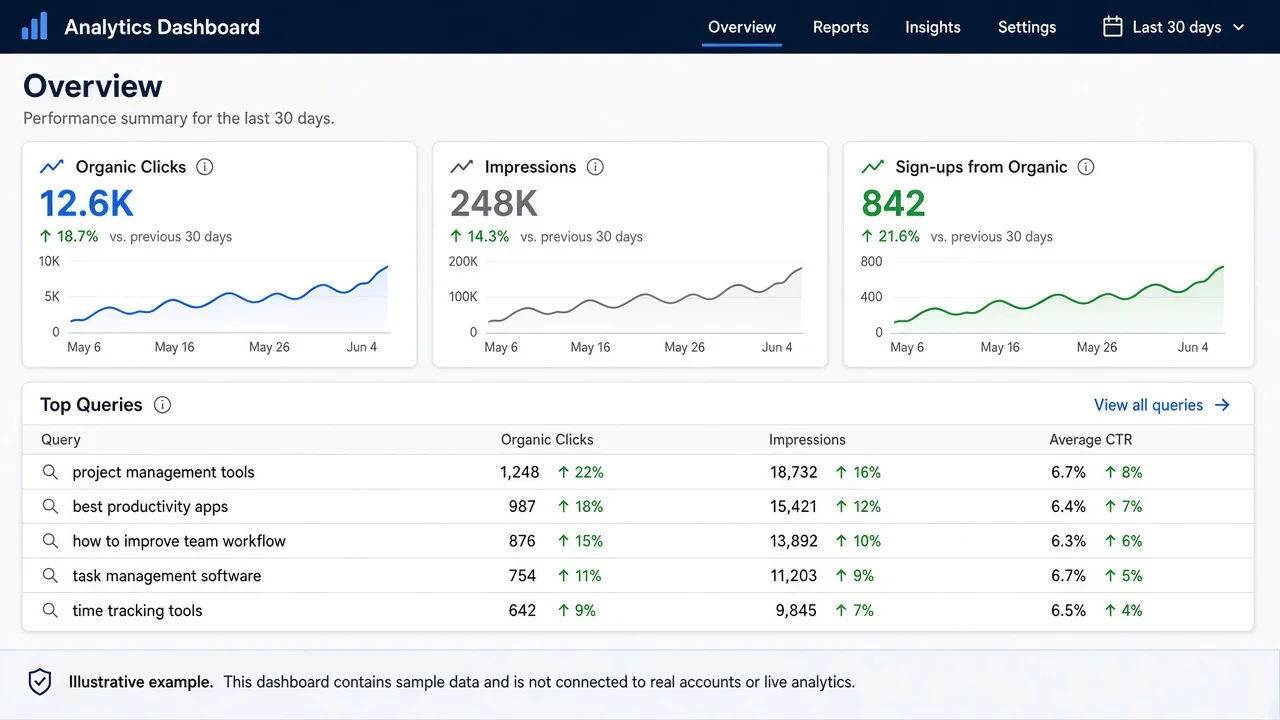
Signals you are on track
- Queries in Search Console mirror customer language from calls
- Comparison and product pages earn a growing share of organic conversions
- Bounce rates on money pages are stable while support questions decrease
- Sales mentions specific articles that map to your persona doc
Signals you are off track
- Top queries are celebrity names, unrelated trends, or pure definitions you did not intend
- Organic traffic rises while organic-sourced signups stay flat
- One generic post eats crawl budget and internal links without leading to evaluation pages
Common SEO audience research mistakes
Chasing volume before fit
A keyword with 10,000 searches means little if the SERP audience will never buy. Score business fit before volume.
One persona for everyone
"Marketers" is not an SEO buyer persona. Role, workflow, and company size change queries.
Skipping SERP review
Difficulty scores guess competition. Opening the top five results shows whether you can realistically beat them with your proof.
Publishing without distribution context
Audience research includes where readers discover answers. Founders read content marketing for startups for the distribution half; SEO gets you in the room, not always the conversation.
Ignoring existing Search Console data
Pre-launch sites have no data. Live sites do. Refresh audience assumptions when queries surprise you.
Personas with no search fields
If your persona doc lacks example queries and intent, it will not guide titles or H1s. Add search behavior or admit the doc is sales-only.
Build an SEO strategy around your audience
Your SEO target audience is the filter on every strategic choice: which segment you serve first, which keywords get pages, which formats match intent, and which metrics prove fit.
A practical sequence for the next 30 days:
- Document one primary segment and one SEO buyer persona.
- Collect 30 seed phrases from customers and Search Console.
- Map the top ten to intent and a single URL each.
- Publish or refresh one consideration page and one awareness page that links to it.
- Review Search Console and signup paths at day 30 and adjust.
This sits inside the broader 90-day SEO plan many teams use, but audience definition is the piece to finish first.
Building something for the startup community? Browse tools from fellow founders on Founder.best, or submit your product so the people you defined in your persona doc can find what you are building when they search and when they explore new launches.
Key takeaways
- Your SEO target audience is the buyer segment whose problems, search behavior, and conversion path should drive keyword and content decisions.
- Customer language from calls, tickets, and communities beats tool exports for finding queries that convert.
- Map each keyword to search intent and one content format so pages match what Google already ranks.
- One detailed SEO buyer persona per core segment keeps content focused and stops you from writing for "marketers" in the abstract.
- Use Search Console queries plus organic signup paths to see whether traffic matches the audience you intended.
Frequently asked questions
What is an SEO target audience?
An SEO target audience is the specific group of people you want to reach through organic search: their job role, company context, problems, and the queries they use while researching solutions. It connects business positioning to keyword research and content planning so you rank for searches that lead to qualified visitors, not just high-volume topics.
How is an SEO target audience different from a marketing persona?
A marketing persona describes who you sell to across all channels. An SEO target audience adds search behavior: how they phrase problems, what they compare, which content formats they click, and where they are in the journey when they search. SEO personas should be narrow enough to pick keywords and page types, not just ad creative.
How do SaaS founders identify their target audience for SEO?
Talk to customers and lost deals, read support tickets, and watch community threads where buyers complain. Segment by role, company size, and workflow. For each segment, list problems in their words, then search those phrases on Google to see intent and competition. Prioritize segments that combine strong fit, clear search demand, and pages you can win.
What tools help with SEO audience research for startups?
Google Search Console and analytics show who already finds you and what they searched. Keyword tools such as Google Keyword Planner, Ahrefs, or Semrush help expand phrasing once you have seed terms from customers. AlsoAsked and Reddit surface question-style queries. SparkToro-style audience tools can show where a topic cluster congregates online. No tool replaces customer interviews.
How do you know if SEO is reaching the right audience?
In Search Console, review queries and landing pages for relevance to your segments. In analytics, compare organic landing pages to signup or trial events. If traffic clusters on educational posts but signups come from comparison pages, your audience is clicking, but your content mix may be off. Qualitative checks matter too: sales calls that start with "I read your article on X" should match pages you meant for buyers.
Should startups target multiple audiences in SEO?
Most early-stage SaaS products serve more than one buyer type eventually, but SEO works better when you prioritize one primary segment per topic cluster. You can add secondary audiences with separate pages rather than one vague page for everyone. Split developer and marketer audiences, for example, instead of blending API docs and thought leadership on the same URL.
Ready to launch on Founder.best?
Weekly rankings, dofollow SEO backlinks, founder stories, and a community built for indie makers.
Submit your startup
About the author
Anuj Shashimal
Founder, Founder.best
SaaS founder, indie hacker, and software engineer. Anuj built Founder.best to help indie founders launch, get discovered through search and AI answers, and turn launches into customers. He writes from first-hand experience growing Founder.best from zero to 400+ founders and 300+ launched products.
Keep reading
Free tools and guides for this topic
Hand-picked from the tags on this post.
- Free Ahrefs Domain Rating checkerLive DR (0–100) for any domain before you chase a backlink.
- Browse blog posts by topicSEO, backlinks, launch platforms, AI search, startup tools, and more.
- Indie launch guideLaunch guide for indie founders and bootstrapped makers in 2026. Build in public, pick platforms, earn…
- Launch plans & pricingFree, Standard, Pro, and Pro+ launches compared side by side.
- Free SaaS directories for backlinksList of free SaaS and startup directories with dofollow filters, Ahrefs DR scores, and a submission checklist.
- Get your product discovered by AI assistantsWhich listing fields make your product rank for the right questions.