
Launch & growth
How to Measure SaaS Content Marketing: 9 Metrics That Matter in 2026
Pageviews feel good on a Tuesday. They do not tell you whether a blog post brought in a trial, influenced a deal, or paid back the hours you spent writing. Here is how to measure SaaS content marketing in a way a three-person team can actually run every month—formulas, a sample spreadsheet, and nine metrics tied to signups and revenue.

Post by Anuj Shashimal
Founder, Founder.best17 min read

You published twelve posts last quarter. Search Console says impressions are up. Your co-founder asks a fair question: did any of this turn into customers?
That is the gap how to measure SaaS content marketing closes. Rankings and pageviews are visibility signals. They matter. They are not the scoreboard if your job is ARR. You need a line from article to signup to pipeline—and enough discipline to review it without hiring a analytics team.
This guide gives you nine metrics, a five-step setup, ROI math with a worked example, tool picks, and a measurement loop built for founders who still write half the posts themselves.
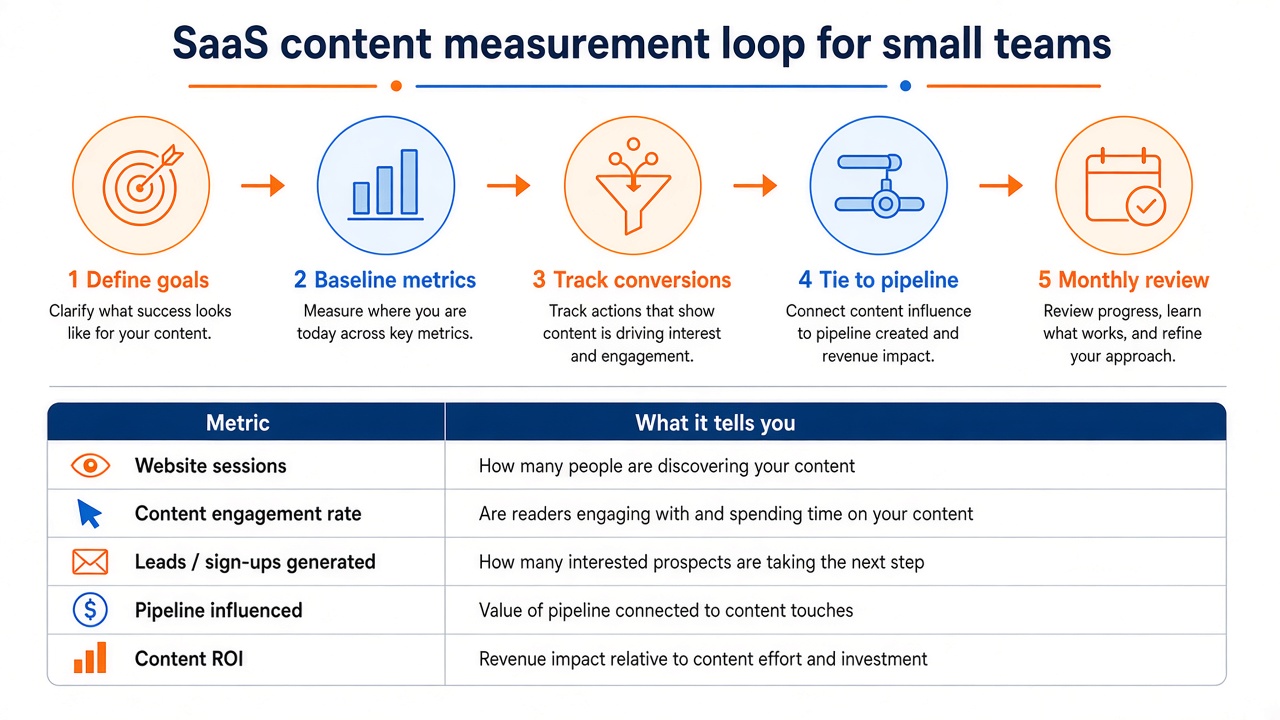 Five-step SaaS content measurement framework for small teams—goals, baselines, tracking, revenue tie-in, monthly review
What is SaaS content marketing measurement?
SaaS content marketing measurement is the practice of tracking how your articles, guides, comparison pages, and founder essays influence discovery, product action, and revenue.
It is not a single dashboard. It is a set of agreed rules: which URLs count as content, which conversions matter (trial, demo, paid), and how you credit a blog post when someone reads three articles, joins a newsletter, and signs up two weeks later from a branded search.
Good measurement answers four questions.
Who is arriving, and from which queries? Do they stay long enough to trust you? Do they take the next step you care about this quarter? And does any of this show up in pipeline or cash?
Connect those answers and content stops being a hobby with a CMS. It becomes a growth channel you can fund—or cut—with evidence.
Why measuring SaaS content marketing matters
SaaS buyers research for weeks before they talk to sales. They read comparison posts, skim pricing pages, and check whether you sound like you understand their workflow. If you only measure top-of-funnel traffic, you will chase topics that win clicks from students and competitors—not from accounts that could pay $200 a month.
When you measure properly, you can see which clusters attract qualified visitors instead of curious browsers. You spot posts that correlate with trial starts even if they never rank number one. You compare the cost of an article to the LTV of customers who first touched your blog, which keeps marketing ROI honest. And you prioritize refreshes on pages that already sit on page one with weak conversion—often the fastest win in the whole program.
None of that requires perfect attribution. It requires consistent tracking and a monthly hour on the numbers.
The metrics map (what each number is for)
Before the deep dive, here is the cheat sheet. Pin it above your spreadsheet.
| Metric | What it tells you |
|---|---|
| Organic traffic | Whether content attracts visitors |
| Trial conversion rate | Whether visitors take action |
| Content-assisted pipeline | Whether content supports sales opportunities |
| Customer acquisition cost | How efficiently you acquire customers |
| Content marketing ROI | Whether the investment generates a return |
The nine metrics below expand each layer—discovery, engagement, leads, revenue, efficiency—so you are not guessing which cell a new number belongs in.
9 SaaS content marketing metrics you should track
You do not need all nine on day one. You do need all nine defined so you add them in order instead of chasing whatever your tool defaults to.
Where small SaaS teams usually feel pain first (self-reported priority)
- Trial and demo conversion from organic pages92
- Content-assisted pipeline in CRM78
- Keyword rankings on buyer-intent terms71
- Newsletter and lead capture58
- Raw organic traffic volume45
- Blended content ROI39
Organic traffic and search visibility
Organic traffic is sessions from unpaid search. Search visibility adds impressions and average position from Google Search Console—how often you show up, not just who clicked.
Segment organic landing pages into buckets: product-led (features, pricing), problem-led (how-to guides), and comparison-led (alternatives, vs pages). A spike in problem-led traffic with flat trials tells you to tighten CTAs or internal links. A flat traffic line with rising impressions often means you are climbing but not yet earning clicks—fix titles and meta descriptions before you rewrite the whole post.
For a small team, one useful ratio is organic sessions to trial starts from organic per month. It is coarse. It keeps you honest.
Keyword rankings and click-through rate
Rankings without CTR are incomplete. A post sitting in position four with a 0.8% CTR is a packaging problem. A post in position eleven with strong engagement might only need internal links and a content refresh.
Track a short list of money keywords—terms where the searcher could plausibly start a trial this week. "What is customer success software" is research. "Best customer success software for Shopify" is closer to intent. Record position and CTR monthly; tools like Ahrefs, Semrush, or Search Console's query report are enough.
CTR formula for a single query in Search Console:
CTR = Clicks ÷ Impressions × 100
Compare the same URL month over month, not against industry averages you saw on Twitter.
Visitor engagement and content quality
Engagement proxies tell you whether the right reader found the page. In GA4, look at average engagement time and scroll depth (if you enable it) on long guides. On the site, watch internal link clicks toward pricing, signup, or related BOFU pages.
A practical quality check: divide engaged sessions on a URL by organic sessions to that URL. If traffic doubled but engaged sessions flatlined, the new keyword might be mismatched—or the intro might be burying the answer.
Comments, shares, and time-on-page are nice. For SaaS, the engagement metric that should wake you up is percentage of organic readers who view a second high-intent page in the same session.
Newsletter subscriptions and lead generation
If email is part of your nurture path, treat newsletter signups per post as a first-class metric. Tag signups with the article slug in your form hidden field or automation tool.
Lead gen from content is not only email. Checklist downloads, templates, and webinar registrations count— as long as you store source URL in the CRM. Without that field, you will attribute every lead to "website" and learn nothing.
Lead capture rate for a post:
Lead capture rate = New leads attributed to the URL ÷ Organic sessions to that URL × 100
Even a rough attribution beats none.
Free trial and demo conversion rate
This is the metric your CEO will ask about. Define conversion once: free trial start, freemium signup with verified email, or booked demo—pick one primary action per quarter.
Trial conversion rate (organic):
Trial conversion rate = Trial starts where landing page or referrer is organic content ÷ Organic sessions to content URLs × 100
In GA4, use an exploration with landing page plus event count for sign_up or your trial event. Cross-check with product analytics; GA4 will lie if your signup flow spans subdomains and you never configured cross-domain measurement.
Comparison and alternative pages usually convert higher than broad guides. If your averages hide that, segment by template.
Content-assisted conversions
Not every customer clicks "Start trial" on the blog. Many read, leave, and come back through branded search or direct. Content-assisted conversion credits pages that appeared anywhere before conversion within your lookback window—often 30, 60, or 90 days.
Simple assisted model for small teams:
- Log
first_content_urlon signup (first blog path in the session). - Log
content_urls_seenas a comma-separated list before conversion (from your product analytics or reverse proxy logs if you are fancy; a post-signup "How did you hear about us?" field works too). - Count a conversion as content-assisted if any URL matches
/blog/or your docs path.
Assisted numbers are almost always higher than last-click blog numbers. That is the point. You are measuring influence, not just the final tap.
Marketing-qualified leads and pipeline
For sales-assisted SaaS, content's job is often MQL creation and deal acceleration, not same-day self-serve signup. Track:
Content-sourced MQLs: leads where first touch or latest content touch matches your blog.
Pipeline influenced: open opportunities where a sales note, CRM activity, or multi-touch model includes a content URL.
HubSpot's "original source" and custom properties work. Pipedrive custom fields work. A Notion table linked from Slack works if you enforce it.
Pipeline dollar value matters more than MQL count. One enterprise demo sourced by a technical deep-dive beats forty newsletter emails that never reply.
Customer acquisition cost (CAC)
CAC tells you whether organic is actually cheap—or just slow-paid work in disguise.
For customers attributed to content ( however you define attribution):
CAC (content) = Total content program cost in period ÷ New paying customers attributed to content in period
Total content program cost should include founder writing time at a realistic hourly rate, freelancers, design, SEO tools, and listing fees if content promotion includes startup directories. Undercounting labor makes every channel look like a bargain.
Compare CAC (content) to CAC (paid) and to LTV. Content often wins on CAC but loses on speed; that trade is fine if you plan runway accordingly.
Content marketing ROI
ROI rolls up revenue against cost. The formula is simple. The hard part is choosing attributed return.
ROI = (Attributed return − Content cost) ÷ Content cost × 100
Attributed return might be:
- First-year contract value of customers whose first touch was organic content
- Multi-touch weighted revenue (advanced; skip until you have volume)
- Content-influenced closed-won in the CRM (pragmatic for small sales teams)
State your rule in writing. Change it only on quarter boundaries so you can compare periods.
How to measure SaaS content marketing step by step
Here is the operating system. Five steps, repeatable monthly.
Monthly content measurement loop (small team)
- 1. Define quarterly content goalOne primary conversion
- 2. Establish baselinesExport last 90 days from GSC and GA4
- 3. Wire trackingEvents, UTMs, CRM fields
- 4. Connect revenueAssisted and last-touch views
- 5. Review and refreshTop movers and page-5–20 URLs
Step 1 — Define your content goals. One primary goal per quarter: trials, demos, or pipeline. Secondary metrics can watch email or backlinks. If everything is primary, nothing is.
Step 2 — Establish baseline metrics. Export organic sessions, top queries, trial events, and lead counts for the last ninety days. Your future self needs a before picture.
Step 3 — Set up analytics and conversion tracking. In GA4, mark key events as conversions. Add UTM parameters to every link you place off-site (utm_source=newsletter&utm_medium=email&utm_campaign=slug). Pass first_content_url into your product database on signup.
Step 4 — Connect content to signups and revenue. Join product, CRM, and billing monthly. Build one tab for last-touch content conversions and one for assisted. They will disagree. That is healthy.
Step 5 — Review results monthly and improve underperforming pages. Rank URLs by trials assisted, not traffic. Refresh posts ranking positions five through twenty. Add internal links from high-traffic posts to high-converting posts. Archive or merge thin content that attracts junk queries.
If you want publishing and distribution context first, read content marketing for startups and founder-led SEO for early-stage startups—measurement sits on top of that rhythm.
Worked example: a fictional SaaS team runs the numbers
Meet RelayQueue, a fictional shared inbox for small agencies. Three people. They publish two articles per month. They sell $79/month plans with a fourteen-day trial.
Quarter content cost (fully loaded):
| Cost item | Amount |
|---|---|
| Founder writing (40 hrs × $85/hr internal) | $3,400 |
| Freelance editor | $600 |
| Ahrefs | $129/mo × 3 |
| Stock imagery | $120 |
| Total content cost | $4,507 |
Attributed return (content-influenced, 90-day lookback): They count customers who visited /blog/ before trial and closed within the quarter. That cohort closed $18,960 in first-year contract value (20 customers × $79 × 12).
ROI:
ROI = ($18,960 − $4,507) ÷ $4,507 × 100 ≈ 321%
If they used last-click blog only, only eight customers stayed on-site from blog to trial, and ROI drops to about 67%. Neither number is "truth." They answer different questions. The team reports both until volume grows.
RelayQueue Q3 snapshot (illustrative)
- $18,960
- First-year value (content-influenced cohort)
- 20
- Paying customers in that cohort
- 4.2%
- Trial rate on comparison pages
- 1.1%
- Trial rate on broad guides
- 321%
- ROI at influenced attribution
Action they took from the review: They rewrote two broad guides to point to a single comparison page, updated titles on posts with high impressions and low CTR, and stopped writing net-new top-of-funnel pieces until trial rate on existing URLs improved.
That is measurement doing its job—not producing a trophy metric, but changing the calendar.
How to calculate SaaS content marketing ROI (detailed)
Return to the formula:
ROI = (Attributed return − Content cost) ÷ Content cost × 100
Content cost should include:
- Cash spent on tools, freelancers, and design
- Founder and marketer time (use a consistent internal rate)
- Amortized annual costs (SEO tools, email platform) for the months you measure
Exclude unrelated paid ads unless a post is the ad landing experience.
Attributed return options, from simplest to heaviest:
Last-touch content: Revenue from customers whose last non-direct click before signup was a blog URL. Easy in GA4. Undervalues nurture.
First-touch content: Revenue where the first known session included /blog/. Rewards discovery. Undervalues sales follow-up.
Content-influenced (CRM): Sales or onboarding records mention reading a specific article. Honest for B2B with demos. Depends on discipline.
Multi-touch weighted: Assign fractional credit across touches. Useful above ~100 deals per quarter. Overkill for most seed-stage teams.
Pick influenced or first-touch for B2B with sales calls; last-touch is fine for PLG if signup happens on-site in one session.
Sensitivity check: run ROI under two models. If content looks good under both, invest. If only one model saves it, you know where the story is thin.
Best tools to measure SaaS content marketing
You can run this stack for under $200/month until ARR supports more.
Google Search Console shows queries, pages, impressions, CTR, and indexing issues. It is the source of truth for search visibility. Check the Performance report filtered to /blog/.
Google Analytics 4 tracks sessions, engagement, conversions, and explorations. Configure enhanced measurement carefully on SPAs. Mark trial signup as a conversion event early.
Ahrefs or Semrush track keyword positions, competitors, and backlinks. Use them weekly for priority keywords, not for obsessing over ±1 rank moves. Our Ahrefs Domain Rating explained guide helps if your team argues about authority scores.
CRM (HubSpot, Pipedrive, Attio, etc.) stores lead source, influenced URLs, and pipeline stages. Custom properties beat native "source" alone.
Product analytics (PostHog, Mixpanel, Amplitude) shows activation after trial—content that brings signups who never activate is a product problem wearing a marketing costume.
A shared spreadsheet with monthly exports still works. Many teams at $1M ARR never outgrow a good sheet tied to a thirty-minute review meeting.
For AI answer visibility—a growing slice of discovery—add periodic prompt checks or a dedicated tool from our AI search visibility tools for SaaS roundup. It complements Search Console; it does not replace conversion tracking.
How long does it take to see content marketing results?
There is no honest universal timeline. There are signal types that show up at different speeds.
Early visibility signals—impressions climbing, new keywords entering positions twenty through fifty, backlinks from distribution—can appear in weeks if you publish on an established domain with internal links and submit URLs for indexing.
Engagement and list growth often lag one to two months behind visibility, especially if your topics are mid-funnel.
Trial, pipeline, and ROI signals usually need multiple publish cycles and refreshes before you trust trends—often three to six months on a young domain, faster on a site that already has trust.
Judge each URL by stage. A two-week-old post should be measured on indexing and impressions. A six-month-old money page should be measured on trials and assisted pipeline. Killing a guide at day fourteen because it has zero customers is like firing a salesperson before their pipeline closes.
Common SaaS content marketing measurement mistakes
Focusing only on traffic trains you to write clickbait for your category. Traffic matters as a leading indicator, not a finish line.
Ignoring conversion tracking means every debate ends in vibes. Fix events before you fix editorial calendar.
Attributing all revenue to the last click makes email, community, and content look worthless the moment someone types your brand in Chrome.
Tracking too many metrics without clear goals produces dashboards nobody opens. Nine defined metrics with one primary beats forty graphs.
Failing to update older content lets rankings decay and CTR rot. Measurement without refresh is just watching a slow leak.
Changing attribution rules every month makes ROI meaningless. Pick a model, document it, revisit quarterly.
Frequently Asked Questions
How do you measure SaaS content marketing success?
Success is repeated connection between specific URLs and trials, qualified leads, or closed deals—not a single viral month. Build a short list of money pages, track their organic sessions, trial assists, and CRM mentions, and compare month over month. When a post keeps appearing in customer interviews, promote it in nav and sales decks even if traffic is modest.
What are the most important SaaS content marketing KPIs?
If you must cut the list to three: organic trial or demo conversion rate, content-assisted pipeline value, and CAC for content-sourced customers. Add ROI once costs and attribution are stable. Everything else supports diagnosis—rankings explain why traffic moved; engagement explains why conversion did not.
How do you calculate content marketing ROI?
Use ROI = (Attributed return − Content cost) ÷ Content cost × 100. Be explicit about attributed return (first-year ACV, gross margin, or multi-year—pick one). Undercounting labor inflates ROI; ignoring assisted touches deflates it. Run two attribution views until the gap narrows with better data capture.
How often should SaaS companies measure content performance?
Weekly spot-checks on Search Console are fine for indexing fires. Monthly reviews should drive decisions: budget, topics, refreshes. Quarterly, revisit attribution and goals. Daily ranking alerts are optional; daily strategy changes are usually noise.
Which tools are best for measuring content marketing?
Start with Search Console + GA4 + CRM + product analytics. Add Ahrefs or Semrush when you manage a keyword list bigger than a sticky note. Add AI visibility tooling when organic Google is no longer your only discovery surface. Tools do not replace the signup question on your form or the first_content_url field in your database.
Start measuring this week
You do not need a data team. You need nine defined metrics, one attribution rule written down, and a monthly hour to ask which URLs earned their keep.
Export baselines from Search Console and GA4 today. Mark your trial event. Add UTMs to the next link you share. Log content URLs in CRM when a lead replies "your post on X."
Then keep publishing where measurement says pull works—and refresh where traffic already exists but trials do not. Strong measurement turns content from something you hope works into something you can scale—or stop—without guessing.
Related reading: B2B SaaS product marketing · SEO for startups in 2026 · Marketing tools for startups · List your product on Founder.best so discovery and backlinks show up in the same reports you already review.
Key takeaways
- If you only watch pageviews, you will optimize for topics that attract tourists—not buyers who start trials or book demos.
- Nine metrics cover the full loop: discovery, engagement, leads, product action, pipeline, efficiency, and return on spend.
- Small teams win with one monthly review ritual, UTMs on every distributed link, and CRM fields that record which URLs appeared before a signup.
- Content ROI depends on attribution. Pick a simple rule (first touch, last touch, or content-influenced) and keep it for at least two quarters.
- Early signals (impressions, rankings) show up in weeks; pipeline and ROI need months of compounding—judge pages on stage, not age alone.

About the author
Anuj Shashimal
Founder, Founder.best
SaaS founder, indie hacker, and software engineer. Anuj built Founder.best to help indie founders launch, get discovered through search and AI answers, and turn launches into customers. He writes from first-hand experience growing Founder.best from zero to 400+ founders and 300+ launched products.
Tagged in
Browse all tagsKeep reading
Free tools and guides for this topic
Hand-picked from the tags on this post.
- Free Ahrefs Domain Rating checkerLive DR (0–100) for any domain before you chase a backlink.
- Startup tagline generator12 tight one-liners for your landing page and launch post.
- Free startup launch checklist30+ tasks across pre-launch, launch day, and post-launch.
- Free SaaS directories for backlinksList of free SaaS and startup directories with dofollow filters, Ahrefs DR scores, and a submission checklist.
- Launch SaaS guideHow to launch a SaaS product in 2026: validation, launch platforms, SaaS launch checklist, SEO backlinks,…
- Directories & SEOWhich startup directories give dofollow backlinks in 2026? Launch platforms, SaaSHub, AI directories, and…
Ready to launch on Founder.best?
Weekly rankings, dofollow SEO backlinks, founder stories, and a community built for indie makers.
Submit your startup