
SEO for founders
What SEO Automation Really Does (and What It Can't)
SEO automation promises rankings on autopilot. The reality is narrower - and more useful. The best founders automate monitoring, alerts, and repetitive checks while keeping strategy, original content, and link building human. Here is an honest map of what SEO automation actually does in 2026.
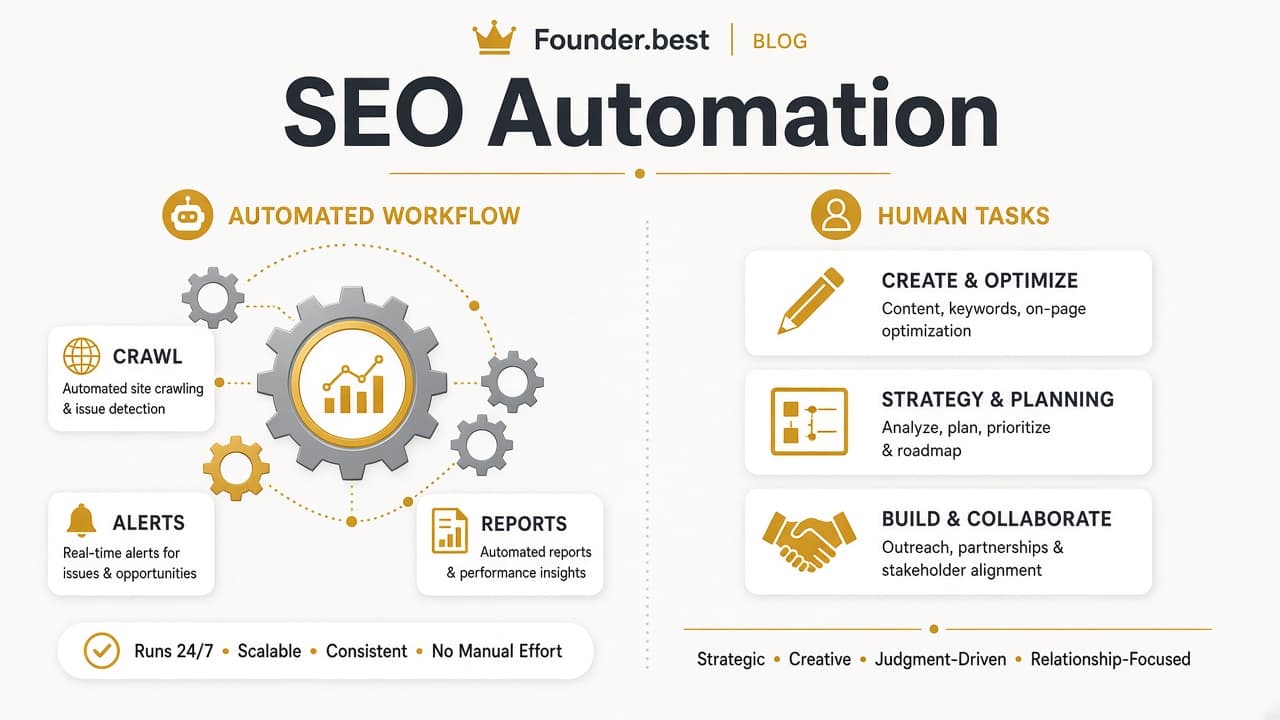
If you searched SEO automation, you have probably seen ads promising "rank on autopilot" or tools that will "run your entire SEO department." Most of that is marketing. SEO automation is genuinely useful - but only when you know exactly which jobs a script can do and which jobs still need a founder's judgment.
This guide explains what SEO automation really does, what it cannot replace, and how bootstrapped teams at Founder.best build a lean SEO automation stack without spammy shortcuts. No fantasy dashboards. Just the repeatable work worth automating in 2026.
The short version: SEO automation is instrumentation for organic growth. It watches your site, surfaces regressions, and saves hours on reporting. It does not write your positioning, earn editorial links, or turn a vague landing page into a cite-worthy product.
What SEO automation actually means
SEO automation is any workflow that runs search-related tasks on a schedule (or trigger) without someone clicking the same buttons every week.
That includes:
- Technical SEO automation - crawls, 404 alerts, redirect chains, robots.txt checks
- On-page SEO automation - title/meta drift detection, H1 duplication flags, schema validation
- Reporting SEO automation - rank snapshots, Search Console exports, Slack or email digests
- Content ops SEO automation - brief templates, internal link suggestions, publish reminders - not auto-publishing junk
It does not mean Google ranks you because a tool exists. Rankings still follow intent match, authority, and trust. SEO automation just helps you notice problems faster and document progress without living inside five tabs.
What SEO automation does well
The highest-ROI SEO automation tasks share one trait: clear pass/fail rules.
1. Technical monitoring
Your site breaks quietly. A deploy removes a canonical tag. A blog migration creates redirect loops. SEO automation catches that before traffic dips.
Automate:
- 404 and 5xx alerts on money pages (product, pricing, docs)
- Index coverage checks - are key URLs still indexed?
- Core Web Vitals regression alerts after frontend releases
- Sitemap ping after publishing new comparison or guide pages
- SSL / mixed-content warnings
These are pure SEO automation wins. No creativity required - only thresholds and notifications.
2. Rank and visibility tracking
You cannot automate rankings, but you can automate measurement. Track a small keyword set weekly:
- Primary category term (e.g. "project management for agencies")
- 3–5 long-tail phrases you target with content
- Branded queries ("yourproduct pricing", "yourproduct vs competitor")
- SEO automation keyword: if you publish about automation, track "seo automation tools" and variants
Tools or scripts snapshot positions and send a digest. The value is trend detection - did a product page update correlate with a drop on a money keyword?
3. Schema and structured-data validation
For SaaS founders, SEO automation should validate JSON-LD after every deploy:
SoftwareApplicationorProductschema still parses- Price and offer fields match live billing
- FAQ schema matches visible on-page FAQs
- Organization / sameAs links are present
Broken schema is invisible in the UI but obvious to crawlers. Automating validation takes five minutes to set up and prevents weeks of bad rich-result eligibility.
4. Internal link hygiene
As your blog cluster grows, orphan pages multiply. SEO automation can flag:
- Pages with zero internal inlinks
- Anchor text over-optimization patterns
- Links pointing to redirected or deprecated URLs
Fix the list manually once a month. The automation finds the needles; you prioritize which pages matter.
5. Reporting for stakeholders
Investors and co-founders want numbers, not Ahrefs login access. SEO automation can compile:
- Organic sessions (GA4)
- Impressions and CTR (Search Console)
- Dofollow referring domain count (monthly snapshot)
- Top 10 landing pages by conversion
Automate the export. Interpret the story yourself.
What SEO automation cannot do (and should not pretend to)
Honest SEO automation guides spend as much time on limits as features. These jobs stay human:
Strategy and positioning
Software cannot decide whether you are "CRM for dentists" or "CRM for solo consultants." SEO automation does not pick your wedge, pricing narrative, or category entry point. Bad positioning automated at scale is still bad positioning - just faster.
Original, cite-worthy content
You can automate outlines, meta drafts, and content briefs. You cannot automate information gain - screenshots, launch metrics, pricing tables, founder lessons. Mass SEO automation content pipelines create index bloat. Google and AI systems reward pages with proof, not paragraph factories.
Use AI inside your SEO automation workflow, not as the publisher. Our SEO for startups guide covers where AI helps vs hurts.
Link building and relationships
Outreach templates can be semi-automated. Relationships cannot. Editorial backlinks, integration pages, and podcast mentions come from humans trusting your product.
SEO automation can remind you to follow up. It cannot replace a genuine launch story on Founder.best or a thoughtful guest post. Avoid tools that promise "automated link building" via comment spam or PBNs.
Brand entity consistency
AI answers cite brands they can verify across sources. SEO automation can alert when your tagline changes on your site but not on your directory listings. It cannot decide what the canonical facts should be.
Launch on Founder.best so you have a third-party product page with matching name, category, and links - then add that URL to your SEO automation monitoring checklist alongside your own /product page.
Judgment calls on indexation
Should you noindex thin tag pages? Merge two competing landing pages? SEO automation flags duplicates; founders decide tradeoffs. Index management is strategy, not cron.
SEO automation vs "full autopilot SEO" products
Be skeptical of platforms selling SEO automation as a black box that "handles everything."
| Legitimate SEO automation | Risky "autopilot SEO" |
|---|---|
| Scheduled crawls + alerts | Auto-generated thousands of city pages |
| Rank tracking dashboards | Mass directory submission blasts |
| Schema validation in CI | Automated blog spam to third-party sites |
| Search Console API reports | Fake traffic or engagement bots |
| Brief templates + human edit | Publish AI articles with no review |
The second column creates cleanup SEO - disavows, pruning, reputation repair. Founders on Founder.best see this often: a startup runs an aggressive SEO automation tool for 90 days, then spends six months undoing toxic links.
SEO automation should reduce toil, not multiply risk.
A lean SEO automation stack for startups (2026)
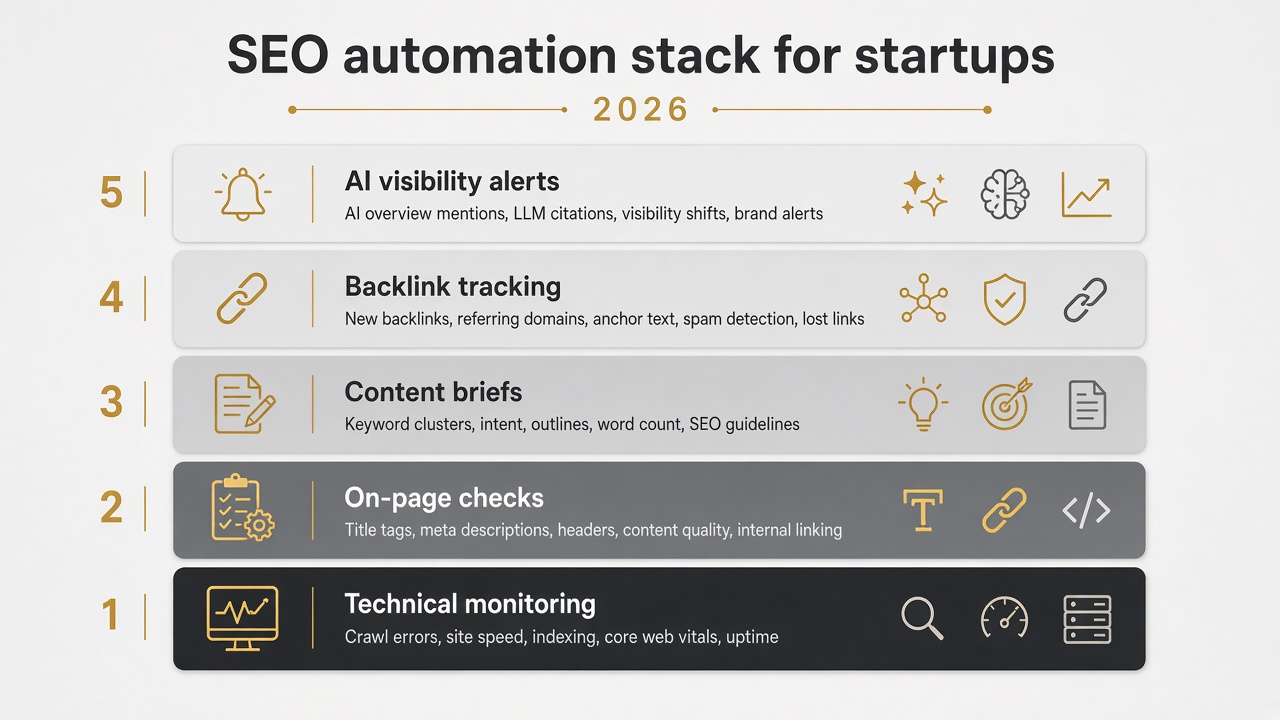
You do not need enterprise orchestration. This SEO automation stack fits a two-person team:
Free layer (start here)
- Google Search Console - index coverage, query data, email alerts
- Google Analytics 4 - organic landing page reports
- PageSpeed Insights / Lighthouse CI - performance regression on deploy
- Manual monthly checklist - product page title, meta, schema, Founder.best listing parity
Low-cost automation layer
- Scheduled site crawl (Screaming Frog scheduled export, Sitebulb cloud, or similar) - monthly full crawl, weekly key URL subset
- Rank tracker - 10–20 keywords, weekly snapshot
- Uptime monitor on
/,/pricing,/product, and your Founder.best product URL - Slack/email digest - script or Zapier connecting Search Console + rank CSV
Optional when MRR supports it
- Ahrefs or Semrush - backlink alerts, content gap exports (feeds human decisions)
- AI mention monitoring - track brand in ChatGPT/Perplexity answers monthly (AI visibility guide)
Total setup time: one focused day. Maintenance: 30–45 minutes weekly reviewing SEO automation alerts - not ignoring them.
Use Founder.best free tools at /tools as manual checkpoints that complement automation:
- Domain Rating checker - monthly authority snapshot
- Slug checker - validate product URL before listing
- Launch checklist - ensure SEO basics before go-live
Where AI fits in SEO automation
AI is not separate from SEO automation - it is a layer on top.
Good AI + SEO automation pairings:
- Summarize crawl exports into prioritized fix lists
- Draft three title tag variants for A/B human review
- Cluster keywords from Search Console queries
- Generate schema JSON from a product spec (human validates before deploy)
- Compare your site copy vs Founder.best listing for entity mismatches
Bad AI + SEO automation pairings:
- Auto-publish 50 "seo automation" articles with no original data
- Rewrite competitor pages verbatim on a schedule
- Generate fake reviews or testimonials for rich snippets
The rule: SEO automation moves data; AI interprets; humans publish.
Read our AI search visibility tools guide for monitoring how models cite your brand after you fix technical basics.
SEO automation checklist for founders
Copy this SEO automation checklist into Notion and tick monthly:
- Money pages return 200 and load under 3s on mobile
- Product schema price matches Stripe/billing page
- Search Console shows no new "Excluded" errors on
/product - Rank tracker: no >5 position drop on top 3 keywords without known cause
- Internal link report: no new orphan pages in money cluster
- Founder.best listing matches site tagline, URL, and category
- llms.txt and sitemap reachable (200)
- At least one new cite-worthy asset this quarter (data, guide, comparison)
SEO automation handles the checks. You handle the fixes and the next strategic bet.
Common SEO automation mistakes to avoid
- Automating content volume instead of content quality - 200 thin pages hurt more than 5 strong ones
- Ignoring Search Console because a dashboard looks prettier - GSC is ground truth for Google
- Tracking 500 keywords - noise drowns signal; track fewer, act faster
- Set-and-forget after setup - alerts only help if someone reads them
- Automating directory spam - see our directory submission guide for quality bars
- Skipping third-party corroboration - automate checks on your Founder.best listing, not just your domain
How SEO automation connects to product page SEO
Your product page is the hub. SEO automation should treat it like production infrastructure.
Every deploy, verify:
- Title tag still includes category keyword
- Meta description unchanged accidentally
- Single H1, logical H2 structure
- SoftwareApplication schema valid
- OG image resolves
Pair with product page SEO best practices. SEO automation guards what you already built; it does not build it for you.
The bottom line on SEO automation
SEO automation really does save time - when you automate detection and reporting, not strategy and trust.
For founders:
- Automate crawls, alerts, rank snapshots, and schema checks
- Keep positioning, content, outreach, and launch storytelling human
- Use Founder.best as a corroboration URL in your monitoring stack
- Treat AI as a drafting assistant inside SEO automation, not the publisher
Rankings compound when your product is clear, your facts are consistent across the web, and your team fixes small issues before they become crises. SEO automation is how you notice those issues early - not how you skip the work that actually moves needles.
Ready to add a permanent listing to your SEO automation monitoring list? Launch on Founder.best - free and paid plans include indexable product pages, founder profiles, and dofollow backlinks on paid tiers from $2.99.
Key takeaways
- SEO automation is best for monitoring and repetition - not for strategy, original content, or link relationships.
- Automate technical checks (404s, schema drift, index coverage, Core Web Vitals alerts) so problems surface before rankings drop.
- Avoid "full SEO automation" products that promise auto-rankings via mass content or directory blasts - they create cleanup work, not compounding traffic.
- Pair your site with a permanent Founder.best product listing so automated audits can verify the same facts on a third-party dofollow page.
- Use AI inside your SEO automation workflow for briefs and drafts - publish only pages with screenshots, pricing, or data a human verified.
Frequently asked questions
What is SEO automation?
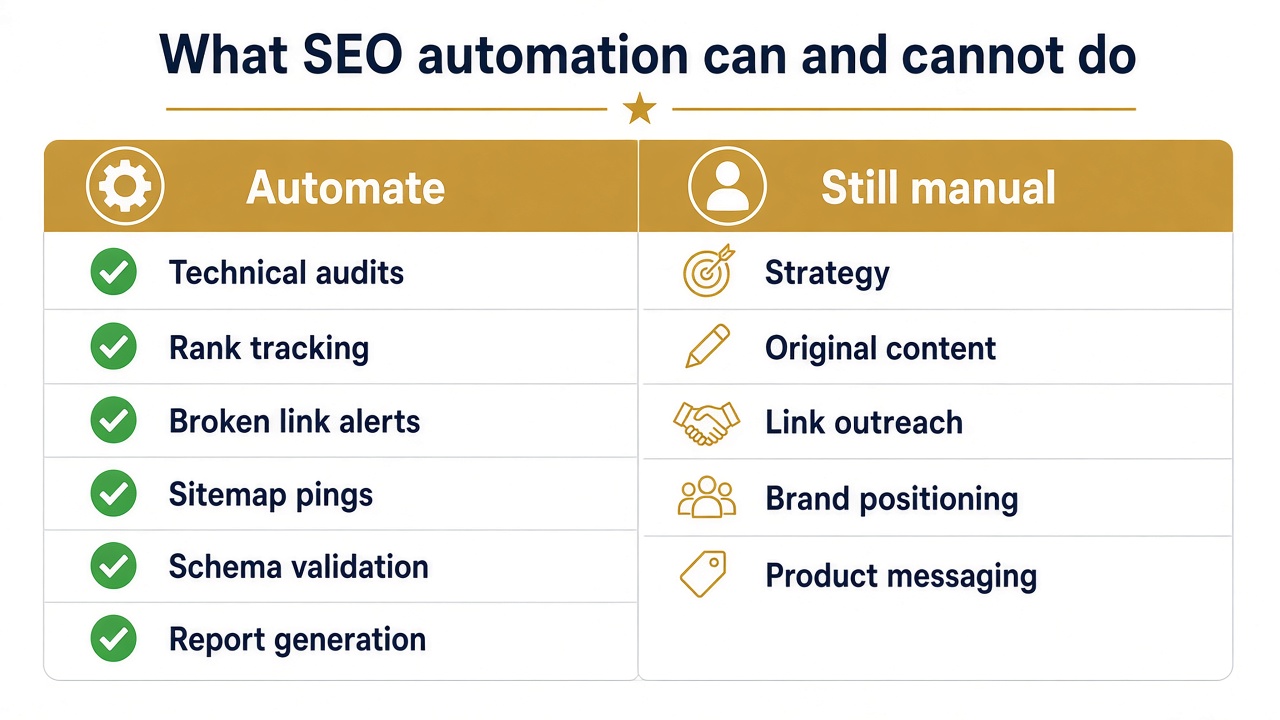
SEO automation is the use of software, scripts, or scheduled workflows to handle repetitive search optimization tasks without manual repetition. Common examples include rank tracking, site crawls, broken-link alerts, sitemap submissions, schema validation, and report generation. SEO automation does not mean rankings happen automatically - it means your team spends less time checking dashboards and more time on decisions that require judgment.
What tasks should you automate in SEO?
Automate tasks with clear rules and low creative risk: uptime and 404 monitoring, index coverage checks in Google Search Console, weekly rank snapshots for priority keywords, internal link orphan detection, schema validation after deploys, and alerts when title tags or meta descriptions change unexpectedly. These are the highest-ROI SEO automation wins for startups.
What can SEO automation not do?
SEO automation cannot pick your positioning, write cite-worthy thought leadership, negotiate editorial backlinks, or understand buyer intent the way a founder can. It also cannot fix a weak product page, replace third-party corroboration, or turn thin AI content into a durable ranking asset. Treat SEO automation as instrumentation - not a substitute for strategy.
Is SEO automation worth it for startups?
Yes - in a lean form. A bootstrapped team should automate monitoring and reporting first, not content production at scale. Search Console alerts, a monthly crawl, and rank tracking for 10–20 keywords cost little and prevent silent SEO regressions. Expensive enterprise SEO automation suites are usually overkill until you have multiple domains or content editors.
Can AI replace SEO automation tools?
AI complements SEO automation but does not replace dedicated tools. AI is strong at summarizing crawl exports, drafting meta variants, and clustering keywords. Dedicated SEO automation tools are stronger at scheduled crawls, historical rank data, and alert thresholds. The best stack combines both: tools for detection, AI for interpretation, humans for publish decisions.
What are common SEO automation mistakes?
The biggest mistakes are auto-publishing hundreds of AI pages, blasting directory submissions, scheduling fake engagement, and trusting "set and forget" link builders. These tactics create index bloat, toxic backlinks, and brand risk. Good SEO automation reduces toil; bad SEO automation scales spam.
How does SEO automation relate to AI search visibility?
SEO automation can monitor brand mentions in AI answers, track llms.txt availability, and alert when structured data breaks - all signals that affect GEO (Generative Engine Optimization). It cannot force ChatGPT or Perplexity to cite you. Citations follow consistent entity facts across your site and trusted third-party pages like Founder.best product listings.
Does Founder.best help with SEO automation workflows?
Founder.best gives you a permanent, indexable product page with stable facts (name, tagline, category, links) that your automated checks can compare against your own site. Paid launches include a dofollow backlink and schema-marked listing - a corroboration layer AI systems and Google use to verify your brand. Launch at /submit, then add the listing URL to your SEO automation monitoring list.
Tagged in
Browse all tagsKeep reading
Ready to launch on Founder.best?
Weekly rankings, dofollow SEO backlinks, founder stories, and a community built for indie makers.
Submit your startup