Startup ideas
YC Startup Ideas 2026: 15 Startup Ideas Inspired by Y Combinator
YC publishes the problems it wants founders to work on. Here are 15 ideas built on those requests, with a real customer and a first MVP for each, so you can pick one and start testing it this month.

Post by Anuj Shashimal
Founder, Founder.best17 min read
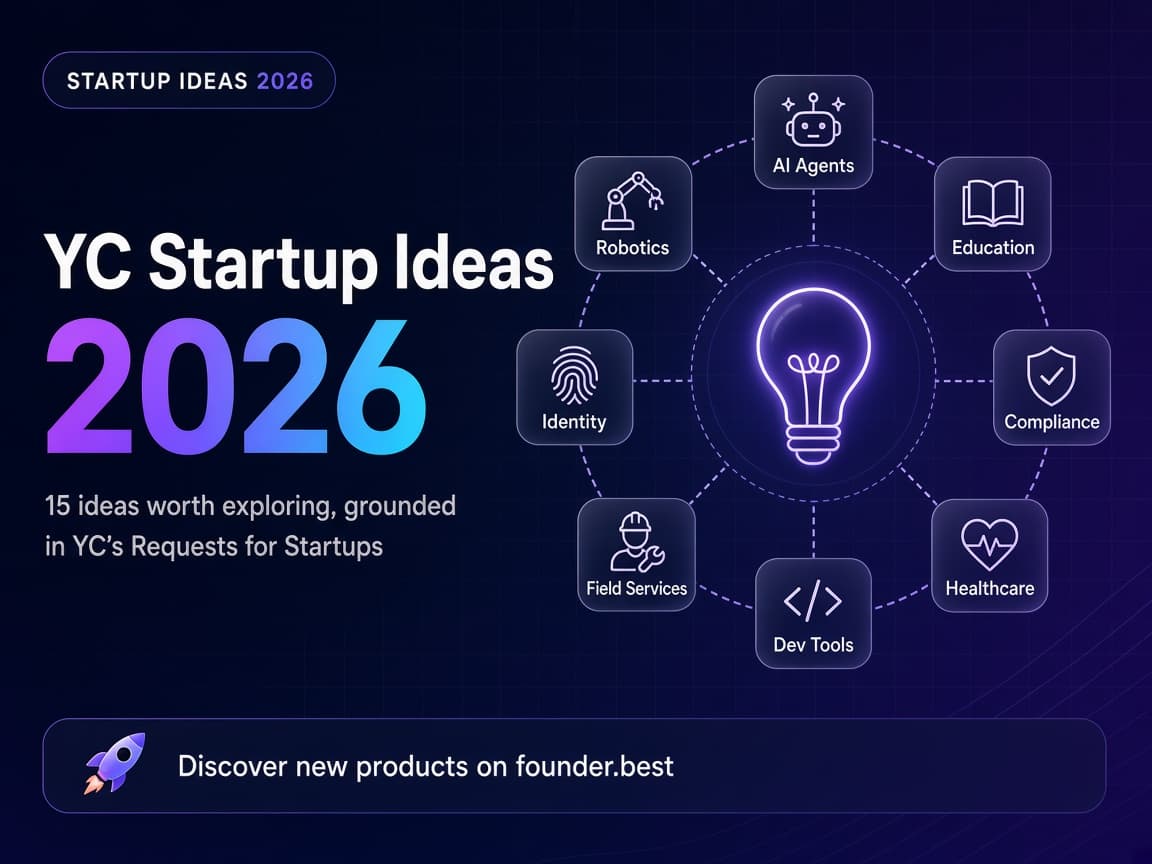
You've got a free weekend and a vague itch to build something. You open YC's Requests for Startups, read about compute flotillas at sea and Army interceptors, and close the tab. Cool, but what do you actually build on Monday?
This guide closes that gap. It takes Y Combinator's latest published requests and turns them into 15 ideas, each with a real customer and an MVP you could ship in weeks, not years.
Quick note on sources: everything here was checked against YC's Requests for Startups page on October 20, 2026, which currently shows the Fall 2026 list. We'll update this post when YC publishes new requests.
1. What Are YC Startup Ideas in 2026?
What is Y Combinator?
Y Combinator is a startup accelerator in San Francisco. It's backed Airbnb, Stripe, Coinbase, DoorDash and thousands of others.
Its standard deal is $500,000. $125,000 buys a fixed 7% of your company, and the other $375,000 goes in on an uncapped MFN SAFE. YC doesn't charge fees to join.
What are YC's Requests for Startups?
Each batch, YC partners publish a short list of problems they'd like founders to tackle. That list is called the Requests for Startups, or RFS.
The Fall 2026 list has 13 requests. Its theme is AI moving into the physical world: education, healthcare, defense, finance, infrastructure and work itself.
YC by the numbers (October 2026)
- 13
- Requests in the Fall 2026 RFS
- $500K
- YC standard investment
- 7%
- Fixed equity for the first $125K
- $0
- Fees to join the program
How YC startup ideas help you find opportunities
YC partners see thousands of applications a batch. When they write a request, they're telling you where they think a big market is opening up, often because something just got cheaper or possible.
Take the Fall 2026 consumer request. YC notes that some AI products cost around $1,000 a month in tokens per user today, and that cost is falling about 10x a year. That's a timing signal you can plan around.
These are inspiration, not funding guarantees
This part matters. YC says plainly that the RFS represents "just a fraction of what we fund," and you don't need to work on these ideas to apply.
Building on an RFS topic won't get you in. A strong team with early users on a totally different idea beats a weak team copying the list. The 15 ideas below are our own takes, built on YC's published themes. YC hasn't endorsed them.
2. Best YC Startup Ideas for 2026
Each idea below includes the problem, who pays, a first MVP, and the YC request it connects to. Where an idea isn't on YC's current list, we say so.
1. AI agents that do the back-office work, not just help with it
Small companies outsource bookkeeping, payroll cleanup, insurance paperwork and collections. They pay people to do it, and it's still slow.
YC's Summer 2026 list asked for "AI-native service companies" that sell the finished work instead of a tool. The idea is simple: spending on services is many times larger than spending on software.
- Who pays: agencies, clinics and e-commerce brands with 5 to 50 employees
- First MVP: a monthly bookkeeping catch-up service for one niche, such as Shopify stores, where AI does the categorizing and you review the output by hand
- YC signal: AI-native service companies (Summer 2026, as summarized by VC Cafe)
Charge a flat monthly fee for the outcome. Customers don't care how much of it is AI. They care that the books close on time.
2. An AI tutor that teaches young kids to read and do math
YC's first Fall 2026 request, "The Primer," is named after the interactive book in Neal Stephenson's The Diamond Age. YC wants a product that teaches young children reading, writing and arithmetic as well as a devoted private tutor would.
Notice how specific that is. It's not "AI for education." It's early literacy and arithmetic, sold to parents, as a supplement to teachers.
- Who pays: parents of kids aged 4 to 8, then schools and tutoring centers
- First MVP: a voice-first phonics app that listens to a child read aloud and adapts the next story to the sounds they're missing
- YC signal: The Primer (Fall 2026)
3. AI tools for small local businesses
This one isn't on YC's current list. It's our pick, because the demand is obvious and the competition is still thin in most verticals.
Picture a three-chair dental office missing 30% of its calls during lunch. Every missed call is a lost booking. An AI receptionist that answers, books and texts confirmations pays for itself in a week.
- Who pays: salons, dental offices, auto shops, plumbers, physiotherapists
- First MVP: an AI phone answering service for one vertical, connected to the booking software they already use
- YC signal: none directly. It sits close to the AI-native services theme in idea 1.
4. Self-maintaining APIs
A YC request from a founder who's worked with over 50 API vendors points out that, during their time at AWS, over 30% of service downtime came from external API or package changes nobody noticed.
The fix YC suggests: when an API provider ships a breaking change, an agent scans customer codebases, finds affected code, and opens a pull request. Think Dependabot, but for APIs.
- Who pays: API companies (to cut churn and support tickets) or engineering teams (to stop surprise breakages)
- First MVP: a GitHub app that tracks changelogs for 10 popular APIs and opens PRs when a deprecation hits your repo
- YC signal: Self-Maintaining APIs (Fall 2026)
5. A cloud for "small software"
Everyone's building tiny internal tools with AI coding agents now. Sprint trackers, pricing calculators, one-off dashboards. Building them is easy. Sharing them safely with your team isn't.
YC wants a cloud built for software that only a handful of people will ever use. Sharing it should be as easy as sharing a Google Doc, with auth and permissions already handled.
- Who pays: ops, finance and product teams at companies with 20 to 500 people
- First MVP: one-click hosting for AI-generated apps, with Google Workspace login and per-person access controls built in
- YC signal: A Cloud for Small Software (Fall 2026)
6. AI for healthcare administration
US healthcare spends enormous amounts on paperwork: prior authorizations, insurance eligibility checks, claim denials and appeals. Clinics hire whole teams just to chase payers on the phone.
YC listed healthcare administration as a target for AI-native service companies in Summer 2026. Fall 2026 adds a related request for AI for the aging population.
- Who pays: independent clinics, physical therapy groups, specialty practices and billing companies
- First MVP: a denial-appeal service for one specialty that drafts appeal letters from the claim and chart notes, with a human biller approving each one
- YC signal: AI-native service companies, healthcare administration (Summer 2026)
Go in knowing you'll need HIPAA compliance and a business associate agreement before a clinic shares any patient data.
7. Compliance automation for growing businesses
YC's Fall 2026 compliance request describes the pain well. Companies rely on spreadsheets, scattered tools and expensive headcount. And costs grow faster than revenue once you expand into new states or countries.
The sharpest pain is state-by-state licensing: renewal deadlines, audits and rules that differ across jurisdictions.
- Who pays: fintechs, lenders, insurance agencies, staffing firms and healthcare groups licensed in multiple states
- First MVP: a license and renewal tracker that monitors regulator websites, flags upcoming deadlines and drafts the renewal paperwork
- YC signal: AI-Native Compliance Infrastructure (Fall 2026)
8. Deepfake detection and proving you're human
YC opens this request with a real case: a finance worker joined a video call with his CFO and colleagues, then wired out $25 million. Everyone else on the call was a deepfake.
Voice clones are cheap now. Any trust signal that assumed faking a human was expensive is broken.
- Who pays: finance teams, banks, HR teams hiring remotely, dating apps and marketplaces
- First MVP: a verification step for payment requests, where any wire over a set amount triggers a check on a separate, trusted channel before it goes out
- YC signal: Proving You're Human (Fall 2026)
YC also says it would prefer an answer that doesn't force everyone to give up their privacy. That's a good design constraint to start with.
9. AI tools for construction and field services
80% of the world's workers don't sit at a desk, according to YC's request. Yet the software they use (dispatching, tracking, asset management, billing) hasn't changed much in 20 years.
YC's bigger vision is an operating system that manages AI agents, robots and people together. You don't need robots to start, though. Start with the agent part.
- Who pays: HVAC, electrical, roofing and plumbing contractors with 5 to 100 technicians
- First MVP: AI quoting that turns a technician's photos and voice notes from a site visit into an itemized quote in minutes
- YC signal: New Operating Systems for the Physical World (Fall 2026)
Contractors who send quotes the same day win more jobs. That's an easy pitch to make.
10. Personalized consumer AI applications
YC's take is blunt. Three years into AI, the only new icon on most home screens is ChatGPT. They think consumer is about to come back in a big way as token costs fall.
The categories YC lists are wide open: getting things done, getting around, learning, staying healthy, managing money, playing, connecting with friends.
- Who pays: consumers, usually through a subscription after a free trial
- First MVP: a single-job app that's great at one thing, like an AI that plans your week of meals around what's already in your fridge and your grocery budget
- YC signal: AI-Powered Consumer Products for 1 Billion People (Fall 2026)
Consumer is hard. You need a habit, not a demo. Track day-30 retention from your first week.
11. AI for aging adults and family caregivers
By 2030, one in five Americans will be over 65. YC's request notes that 53 million family members already do caregiving work for free.
Most of those caregivers are juggling jobs, kids, pharmacy refills and doctor's appointments from a group text.
- Who pays: adult children caring for a parent, home care agencies, senior living operators
- First MVP: a shared care hub where family members track medications, appointments and notes, with an AI voice line the parent can call to ask what's next
- YC signal: AI for the Aging Population (Fall 2026)
12. Multiplayer AI for teams
Google Docs beat Word. Figma beat Photoshop. Both won by being multiplayer. YC's point is that AI agents are still mostly single-player: one person, one chat, one private thread.
As agents take on tasks that run for hours or days, teams will need to watch, redirect and hand off the same live session.
- Who pays: support, sales, legal and engineering teams that already work on one problem together
- First MVP: a shared agent workspace for support teams, where anyone can join a live ticket, see what the agent has tried and take over
- YC signal: Multiplayer AI (Fall 2026)
13. Developer tools that make software usable by AI agents
YC's Summer 2026 list included "Software for Agents," built on the line that the next trillion internet users will be AI agents, not people.
Agents struggle with software built for humans clicking buttons. They need clean APIs, MCP servers, CLIs and documentation they can read and act on.
- Who pays: SaaS companies that want agents to choose and use their product
- First MVP: a tool that turns a company's existing API docs into an MCP server and agent-readable docs, then tests whether common agents can complete key tasks
- YC signal: Software for Agents (Summer 2026, as summarized by VC Cafe)
14. Robotics and physical-world data
YC argues that AI is great at code, language and images because there's so much data. The physical world doesn't have that yet. Sensors are cheaper now, so collecting dense real-world data is finally practical.
YC points to companies like Gecko Robotics, which uses robots to inspect hard-to-reach industrial assets.
- Who pays: energy companies, farms, logistics operators, construction firms and insurers
- First MVP: drone inspections for one asset type, such as commercial roofs, sold as a report per site, then build the dataset across hundreds of sites
- YC signal: Data for the Real World (Fall 2026)
15. Stablecoin payments for cross-border work
YC's crypto request is surprisingly upbeat for a down market. Its argument: bear markets filter out the hype and leave room for real builders. Stablecoins are being adopted by major financial institutions, and regulation is getting clearer.
YC even names portfolio companies doing this, like BlindPay and Infinia for Latin America and Aspora for transfers to India.
- Who pays: companies paying contractors abroad, and freelancers who lose 3% to 6% to wire and conversion fees
- First MVP: stablecoin payouts for one corridor, such as US companies paying contractors in the Philippines, with a local cash-out partner
- YC signal: The Best Time to Build in Crypto (Fall 2026)
The rest of the Fall 2026 list, defense hardware and compute at sea, is real and important. It's also capital-heavy and better suited to teams with deep hardware or government experience.
3. Which YC Startup Ideas Can You Build With a Small Team?
Here's the honest version. Some of these ideas need millions in capital and regulatory approval. Others can start with one founder, a laptop and a Stripe account.
How well each idea fits a 1 to 3 person team (editorial score out of 100)
- Self-maintaining APIs90
- Compliance tracker85
- AI back-office service85
- Field-service quoting80
- Small-business AI receptionist80
- Agent-ready docs80
- Small software cloud65
- Caregiver hub65
- AI tutor60
- Healthcare admin55
- Consumer AI50
- Deepfake verification45
- Stablecoin payouts40
- Robotics data30
Low-cost SaaS ideas
The compliance tracker (idea 7) and field-service quoting (idea 9) are classic B2B SaaS. Customers already pay for software in these markets, so you're replacing a spreadsheet or a clunky incumbent, not teaching anyone a new habit.
You can charge $99 to $500 a month per company from day one.
AI microSaaS opportunities
MicroSaaS works best when the job is narrow and painful. An AI receptionist for one vertical (idea 3) is a great example. So is a single-specialty denial appeal tool (idea 6), if you can handle the compliance work.
A good rule: if you can explain the product in one sentence to a business owner, and they say "how much?", you're on the right track.
Developer-focused products
If you write code, ideas 4, 5 and 13 are your best bets. You are the customer, so you can test the product on your own projects before anyone else sees it.
Developer tools also spread well through GitHub, Hacker News and open-source repos, which keeps your early marketing budget near zero.
No-code and low-code MVPs
Not technical? You can still start ideas 1, 3, 9 and 11.
- Run the service manually with a form (Tally), a database (Airtable) and AI tools you already use.
- Automate the repetitive steps with Zapier or Make.
- Build real software once you've delivered the service 20 or 30 times and know exactly which steps matter.
Ideas that can start with one founder
The AI back-office service (idea 1) is probably the easiest solo start. Your first customer can be a friend's agency. You do the work with AI help, charge a flat fee, and learn the workflow before you build anything.
Self-maintaining APIs (idea 4) is the best solo pick for a developer. One GitHub app, one API to start, and a clear before-and-after demo.
4. How to Choose the Right YC Startup Idea
YC's advice on ideas has stayed fairly consistent over the years: the best ones usually come from founders who know a problem from the inside. Here's how to apply that to the list above.
Find a problem people already pay to solve
If a clinic already pays a billing company 5% to 8% of collections, it has a budget for your product. If nobody spends money on the problem today, you'll spend years convincing them it's worth paying for.
Pick a specific target customer
"Small businesses" isn't a customer. "Independent HVAC contractors in Texas with 10 to 30 technicians" is. Narrow customers are easier to find, easier to interview and easier to sell to.
Research existing competitors
Search G2, Capterra, Product Hunt and the Founder.best product directory for your category. Competitors aren't a bad sign. They prove a market exists.
What you want to find is a gap. Maybe they're too expensive for small teams, too complex for non-technical users, or built before AI was useful.
Look for underserved niches
Big players go after big segments. That leaves room in the corners: one specialty, one region, one type of business. Plenty of the strongest SaaS companies started in a niche that looked too small to bother with.
Choose a problem you understand
If you spent five years in insurance, the AI-native brokerage idea is yours to lose. If you've never been inside a construction site, field services will be a slow climb.
Your experience is a real advantage. It means you know the jargon, the buyers, and the hidden reasons the obvious solution hasn't worked.
5. How to Validate a Startup Idea Before Building
This is where most founders skip ahead. Don't. A month of validation can save you a year of building something nobody pays for.
Interview potential customers
Book 15 to 20 calls with people who fit your target customer. Ask about the past, not the future.
- "Walk me through the last time this happened."
- "What did it cost you, in time or money?"
- "What have you tried to fix it?"
Skip "would you use this?" Everyone says yes to be polite. Our guide to validating SaaS ideas has a full interview script.
Analyze competitors and alternatives
Your real competitor is often a spreadsheet, a virtual assistant or simply ignoring the problem. List every alternative your interviewees mention and what each one costs them.
If the current fix is "a part-time admin for $2,000 a month," you've just found your price anchor.
Create a landing page
Write the page in your customers' own words, taken straight from your interview notes. Include a clear price and one call to action.
You don't need a product yet. See how to build a SaaS landing page before you have customers.
Test willingness to pay
Emails are cheap. Money is the real signal. Ask for a refundable deposit, a pre-order or a paid pilot.
A rough benchmark: if 3 to 5 of your 20 interviewees agree to pay for a pilot, keep going. If none do, change the customer, the problem or the price before you write code.
A realistic validation funnel for a B2B idea
- 1. Outreach150 messages sent
- 2. Interviews20 calls booked
- 3. Problem fit8 people with a costly, frequent problem
- 4. Paid pilots3 customers put money down
Launch a small MVP and collect feedback
Give your first pilot customers the smallest version that solves their problem, even if part of it runs by hand behind the scenes. Talk to them every week.
Watch what they actually use, not what they say they want. Once a few of them would be upset if you shut it down, you're ready to build properly.
6. Where to Find More Startup Ideas and Discover New Products
YC's list is a great start, but it's one source. The best ideas usually come from watching what's already working.
YC's company directory and startup resources
The YC company directory lets you filter by batch, industry and region. Sorting by the most recent batches shows you where YC is actually writing checks, which is often a better signal than the RFS itself.
YC's Startup School is free and has solid material on finding and testing ideas.
Product Hunt and indie hacker communities
Product Hunt shows what's launching daily. Indie Hackers and r/SaaS are where solo founders share real revenue numbers, failed experiments and what customers complained about.
Read the comment threads, not just the headlines. Complaints about existing tools are a goldmine of startup ideas.
Discover emerging tools on Founder.best
Founder.best is a launch platform where founders list new products, and a good place to see which categories are getting crowded and which are still empty.
- Browse categories to see how many tools already exist in your space.
- Check weekly winners and launch archives to spot what's getting traction.
- Read founder stories to see how other builders found their first customers.
Study how other founders position their products
When you find a competitor, look closely at their homepage headline, pricing page and onboarding. Who are they talking to? What do they promise in the first sentence?
You'll often find three products solving the same problem for three different buyers. That tells you which positioning is still open.
7. How to Turn a YC Startup Idea Into a Profitable Business
An idea is a guess. A business is a guess that people pay for every month. Here's how to get from one to the other.
Choose a business model
Match the model to the idea:
- Subscription SaaS for tools used every week (compliance tracking, field-service quoting)
- Flat-fee service for AI-native services (bookkeeping, denial appeals)
- Usage-based pricing for developer tools and APIs
- Freemium plus subscription for consumer apps
Don't overthink it. You can change pricing later. You can't easily change a customer who expects everything free.
Find your first paying customers
Your first 10 customers usually come from direct outreach, not marketing. Message people from your interviews, ask for intros, and show up in the communities where your buyers spend time.
Our guide on how to get your first 100 users breaks this down by channel.
Set pricing and validate demand
Charge more than feels comfortable. B2B founders almost always start too low.
A simple test: if nobody pushes back on price, it's too cheap. If everyone does, it's too expensive or you're talking to the wrong buyer.
Build distribution channels
Pick one or two channels and get good at them before adding more. For B2B, that's often outbound plus SEO. For developer tools, it's GitHub, docs and community posts. For consumer, it's short-form video and referrals.
Launch platforms help too. A product page on Founder.best gives you a permanent listing and a backlink that keeps sending traffic after launch week. The launch checklist tool helps you prep.
Track retention, revenue and customer feedback
Three numbers matter most early on:
- Monthly recurring revenue, and how it changes
- Month-two retention: do people stay after the first month?
- Why customers leave, in their own words
If retention is weak, stop spending on growth. Fix the product first. Pouring users into a leaky bucket only makes the leak more expensive.
8. Frequently Asked Questions About YC Startup Ideas
What are the best YC startup ideas for 2026?
Based on YC's Fall 2026 Requests for Startups, the strongest themes are AI tutors for young kids, AI-native compliance, proving you're human, operating systems for field work, multiplayer AI, self-maintaining APIs, AI for aging adults and consumer AI. The best idea for you is the one where you already know the customer.
Where can I find Y Combinator startup ideas?
Start with YC's Requests for Startups, which is updated each batch. Then filter the YC company directory by recent batches. Product Hunt, Indie Hackers and Founder.best show what founders are shipping now.
Can I apply to YC with my own startup idea?
Yes. YC says its requests are only a fraction of what it funds, and you don't need to work on them to apply. Most YC companies work on ideas their founders came up with.
Do I need funding to start a YC-style startup?
No. Most of the small-team ideas here can start as a paid service or a simple SaaS product for almost nothing. YC invests $500,000 on its standard deal, but plenty of founders apply after they already have paying customers.
What are the best AI startup ideas for 2026?
AI that finishes the job instead of assisting with it. AI-native bookkeeping, insurance or healthcare admin services, agents that update code when APIs change, compliance monitoring, AI quoting for contractors and AI tutoring are all strong picks. Start narrow and sell the outcome.
How do I validate a startup idea before building it?
Interview 15 to 20 potential customers about how they handle the problem today. Study what they already pay for. Put up a landing page with a real price, ask for a deposit or paid pilot, and deliver the first version by hand or with a small MVP before you build the full product.

About the author
Anuj Shashimal
Founder, Founder.best
SaaS founder, indie hacker, and software engineer. Anuj built Founder.best to help indie founders launch, get discovered through search and AI answers, and turn launches into customers. He writes from first-hand experience growing Founder.best from zero to 400+ founders and 300+ launched products.
Tagged in
Browse all tagsKeep reading
Free tools and guides for this topic
Hand-picked from the tags on this post.
- Indie launch guideLaunch guide for indie founders and bootstrapped makers in 2026. Build in public, pick platforms, earn…
- Launch plans & pricingFree, Standard, Pro, and Pro+ launches compared side by side.
- Free tools for foundersName generator, tagline writer, slug checker, DR checker, launch checklist.
- Free startup launch checklist30+ tasks across pre-launch, launch day, and post-launch.
- Free SaaS directories for backlinksList of free SaaS and startup directories with dofollow filters, Ahrefs DR scores, and a submission checklist.
- How Founder.best worksSubmit in 10 minutes, rank on the weekly Launchpad, stay discoverable.
Ready to launch on Founder.best?
Weekly rankings, dofollow SEO backlinks, founder stories, and a community built for indie makers.
Submit your startup