Frameworks
AI SaaS product classification criteria: how to categorize your AI startup in 2026
Every SaaS calls itself "AI-powered" now. This guide gives founders 8 practical criteria, a maturity ladder, and a scoring table to work out what kind of AI SaaS you actually have, and how to position it so the right people find it.

Post by Anuj Shashimal
Founder, Founder.best19 min read
Open any launch platform this week and count how many products describe themselves as "AI-powered".
It's most of them. A grammar checker, a CRM, an autonomous coding agent, and a to-do list with a "summarize" button all use the same two words. That's a problem for you as a founder, because when everything is "AI-powered", the label stops telling anyone anything.
Buyers can't tell what your product actually does. Directories file you next to tools you don't compete with. AI search engines like ChatGPT and Perplexity describe you vaguely, or not at all. And you end up competing on the loudest headline instead of the clearest one.
This guide fixes that. It isn't written for an enterprise procurement team building a vendor spreadsheet. It's written for founders who need to answer one practical question: what kind of AI SaaS am I building, and how do I explain it so the right people find it?
You'll get 8 classification criteria, a maturity ladder, a matrix, a scoring table you can fill in today, and real examples of each category.
AI is everywhere. That's exactly why classification matters.
- 88%
- of organizations say they regularly use AI in at least one business function
- 62%
- are at least experimenting with AI agents
- 23%
- say they are already scaling an agentic AI system somewhere in the business
- ~1 in 3
- say they have started scaling AI across the organization, so most buyers are still figuring out what to buy
What is an AI SaaS product?
An AI SaaS product is cloud software, sold by subscription or usage, where artificial intelligence does meaningful work inside the core workflow.
The key word is meaningful. The AI might write a first draft, predict which leads will close, read an invoice, answer a customer, or take an action in another tool. What matters is that the AI is part of how the product delivers value, not a chat bubble sitting in the corner.
A simple way to think about it:
- Traditional SaaS gives you better tools to do the work.
- AI SaaS does some, most, or all of the work for you.
Most real products sit somewhere in between, which is why we need classification criteria in the first place.
Is your product actually an AI SaaS?
Before the criteria, try one question. It cuts through most of the confusion in about ten seconds.
If you removed the AI tomorrow, would your product still deliver its core value?
- If yes, AI is an enhancement. You have an AI-assisted or AI-augmented product. That's fine. Plenty of great businesses live here. But your positioning should lead with the workflow, not the AI.
- If no, AI is the product. You're building something AI-native, and probably AI-driven or autonomous. Your positioning should lead with the outcome the AI delivers.
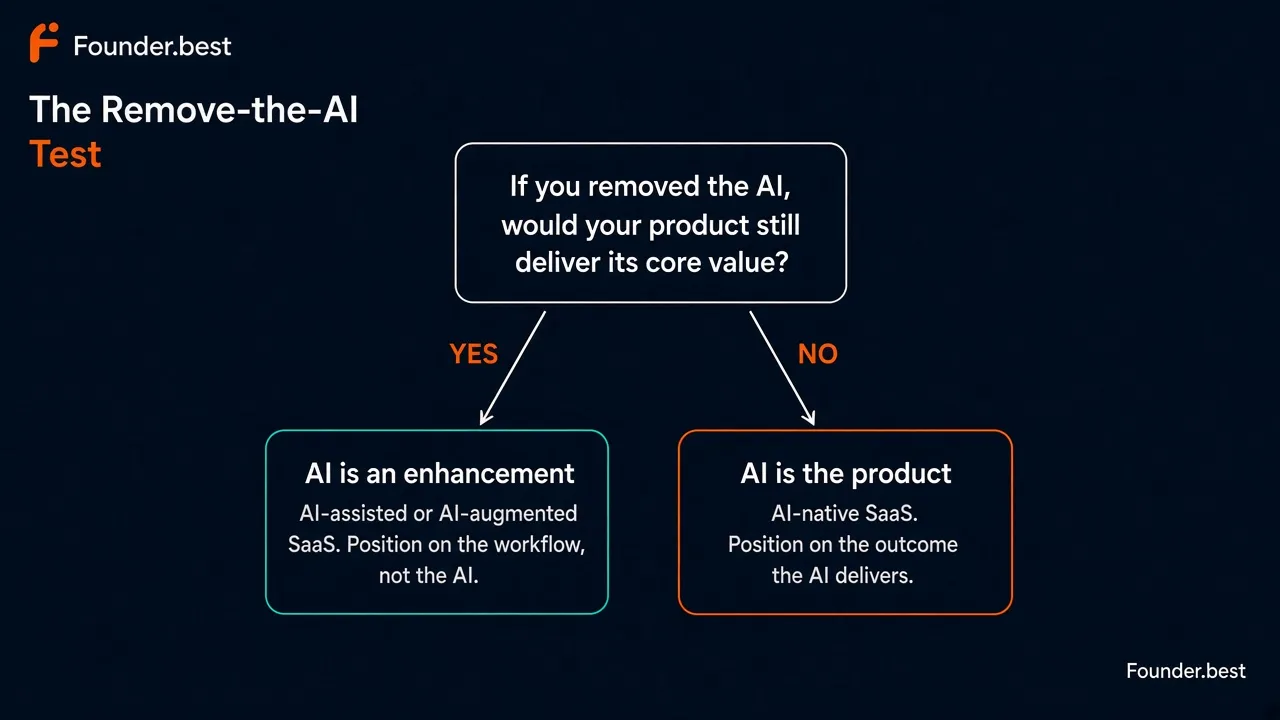 The remove-the-AI test - if the product still delivers its core value without AI, AI is an enhancement; if not, AI is the product
Here's how that plays out. Take away the AI from a project management tool with an "AI summary" button, and people still plan projects in it. Take the AI away from an app that turns sales calls into CRM updates with no typing, and there's nothing left. The first is AI-enhanced. The second is AI-native.
There's a grey zone, of course. Some products would technically still work without AI, but nobody would pay for them. If removing the AI would cause most customers to cancel, treat AI as central.
Why AI SaaS classification matters for founders
You might be thinking: "Isn't classification something analysts do?" Mostly, yes. But for a founder, getting it right has very practical payoffs.
1. Buyers decide in seconds. A visitor lands on your page and is trying to work out three things: what is this, is it for me, and how much will it do for me? A clear classification ("an AI agent that books meetings from inbound leads for B2B sales teams") answers all three. "AI-powered growth platform" answers none of them.
2. Directories and marketplaces put you on a shelf. When you submit to a launch platform or directory, you pick categories, use cases, and audiences. Pick vaguely and you get filed next to tools you don't compete with, in front of people who don't need you.
3. AI search engines repeat what's clear. When someone asks ChatGPT "what's the best AI tool for summarizing legal contracts?", the model leans on consistent, specific descriptions across the web. If your landing page, directory listings, and launch posts all describe you the same specific way, you're far easier to recommend. We cover this in depth in our guide on increasing your SaaS brand's visibility in AI answers.
4. It shapes your pricing and roadmap. Your classification isn't just a marketing label. An autonomous product priced per seat has a margin problem. A vertical product built on generic public data has a moat problem. Classifying honestly exposes those issues early.
5. Investors pattern-match. If you raise, investors will mentally sort you into "wrapper", "copilot", "vertical AI", or "agent" within minutes. Better that you choose the frame yourself, with evidence, than have it chosen for you.
AI SaaS vs traditional SaaS
AI changes more than the feature list. It changes how a SaaS business works underneath.
| Traditional SaaS | AI SaaS | |
|---|---|---|
| Core promise | Tools that help people do work | Software that does part or all of the work |
| Outputs | Deterministic: same input, same result | Probabilistic: outputs vary and need evaluation |
| Cost to serve | Close to zero per extra action | Real compute cost on every AI call |
| Typical pricing | Per seat, per month | Seats plus credits, usage, or outcomes |
| How it improves | Shipping new features | New features plus better models, data, and feedback loops |
| Main product risk | Nobody needs it | Nobody trusts it, or it's easy to copy |
| What buyers ask | "What features does it have?" | "How accurate is it, and what happens when it's wrong?" |
| Moat | Workflow lock-in, integrations | Proprietary data, domain depth, distribution, trust |
The row founders underestimate most is cost to serve. In traditional SaaS, a power user costs you almost nothing extra. In AI SaaS, your heaviest users can cost more than they pay. That single fact is why pricing shows up as one of the 8 criteria below.
8 AI SaaS product classification criteria
These are the 8 dimensions we recommend using. You don't need a perfect answer for each one. You need an honest one.
The 8 AI SaaS classification criteria
- 1. AI integration levelhow central is AI to the product?
- 2. AI and model typewhat kind of AI does the work?
- 3. Level of autonomyhow much does it do without a human?
- 4. Business functionwhich team or job does it serve?
- 5. Target industryhorizontal for everyone, or vertical for one market?
- 6. Data dependencywhat data does it need, and whose?
- 7. Deployment modelwhere and how does it run?
- 8. Pricing and business modelwhat does the customer pay for?
1. AI integration level
The question: How central is AI to the value your product delivers?
This is the remove-the-AI test, turned into a scale.
| Level | What it looks like | Example pattern |
|---|---|---|
| AI-enabled | Existing product with AI features added | "Summarize this doc" button in a docs tool |
| AI-enhanced | AI meaningfully speeds up the main workflow | Smart drafting and autocomplete in an email tool |
| AI-first | Built around AI, but works without it in a limited way | AI meeting notes that also allow manual notes |
| AI-native | Core value is impossible without AI | Voice agent that answers and books calls for clinics |
Founder tip: Be honest here. An AI-enabled product that claims to be AI-native disappoints people in the first five minutes, and disappointed early adopters write reviews.
2. AI and model type
The question: What kind of AI actually does the work?
Different AI types solve different problems, and buyers increasingly know the difference.
- Generative AI creates new content: text, images, code, audio, video. Think writing tools, design tools, and code assistants.
- Predictive AI forecasts outcomes from historical data: churn risk, lead scoring, demand forecasting, fraud detection.
- Analytical or classification AI sorts, tags, extracts, and detects: reading invoices, categorizing support tickets, flagging risky contracts.
- Conversational AI talks with users or customers through chat or voice.
- Computer vision understands images and video: quality inspection, medical imaging, document scanning.
- Agentic AI plans multi-step tasks and uses tools, such as browsing, calling APIs, or editing files, to reach a goal.
Many products combine several. A support platform might classify incoming tickets (analytical), draft replies (generative), and close simple ones end to end (agentic). In that case, classify by the type that delivers the core outcome, and mention the others as supporting capabilities.
It's also worth being clear about your model strategy, because technical buyers will ask:
- Third-party foundation models (OpenAI, Anthropic, Google, and others) via API
- Open-weight models you host or fine-tune yourself
- Proprietary models trained on your own data
- A mix, routing tasks to different models by cost and quality
None of these is "better" by default. Building on third-party models gets you to market faster. Your moat then has to come from somewhere else, like workflow, data, or distribution.
3. Level of autonomy
The question: How much does your product do without a human stepping in?
This is the criterion that matters most in 2026, because "agent" has become the most overused word in SaaS. Here's the ladder we use:
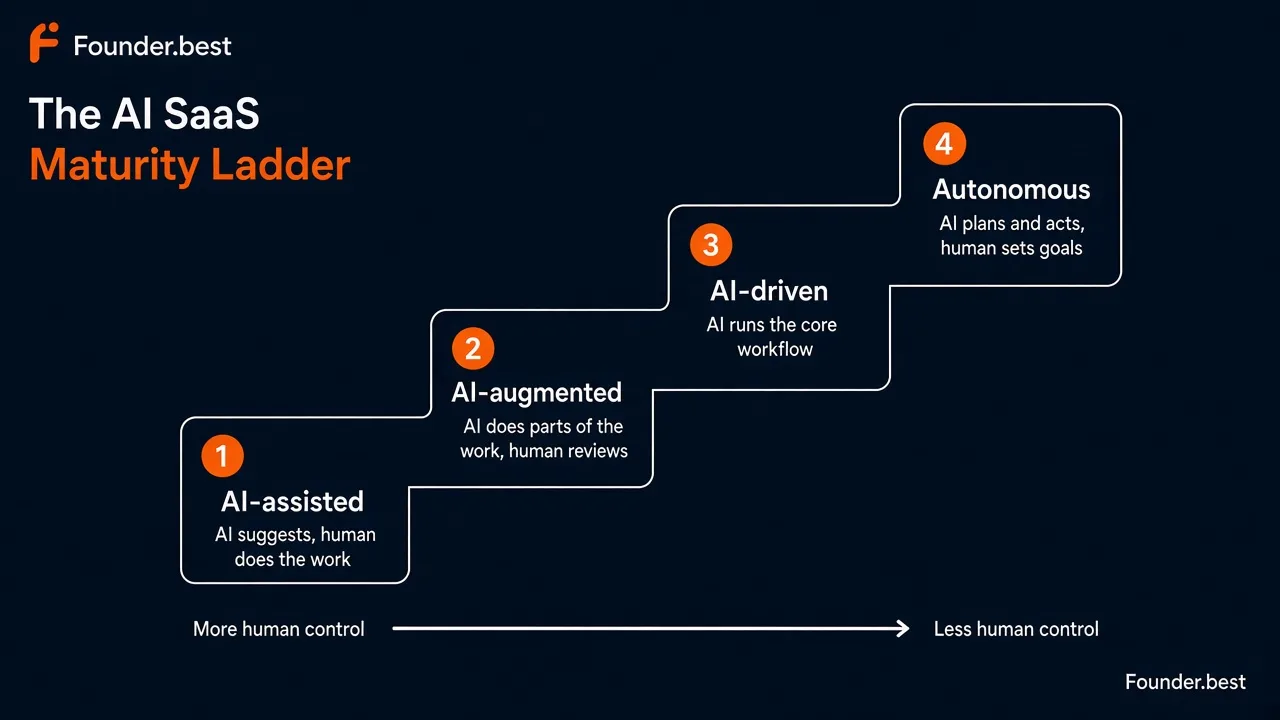 The AI SaaS maturity ladder - AI-assisted, AI-augmented, AI-driven, and autonomous, from more human control to less
- AI-assisted: The AI suggests. The human does the work. Autocomplete, recommendations, "did you mean...?"
- AI-augmented: The AI does parts of the work. The human reviews and approves. First drafts, suggested replies, pre-filled forms.
- AI-driven: The AI runs the core workflow. Humans handle exceptions and spot-check. Tickets resolved automatically unless confidence is low.
- Autonomous: The AI plans and acts across multiple steps and tools toward a goal. Humans set the goal and the guardrails. An agent that researches leads, writes outreach, sends it, and books meetings.
We'll compare these in more detail in the maturity section below.
4. Business function
The question: Which team or job does your product serve?
This is the criterion buyers use first when they search. Nobody types "generative agentic AI SaaS" into Google. They type "AI tool for customer support" or "AI bookkeeping software".
Common business functions for AI SaaS:
- Sales: prospecting, outreach, call intelligence, CRM automation
- Marketing: content, SEO, ads, social, creative
- Customer support: ticket triage, chat and voice agents, help center content
- Engineering: code generation, code review, testing, DevOps
- Finance and accounting: bookkeeping, invoice processing, forecasting, spend control
- HR and recruiting: screening, scheduling, onboarding, internal Q&A
- Operations: document processing, workflow automation, scheduling
- Product and design: research synthesis, prototyping, analytics
- Legal and compliance: contract review, policy checks, audits
Pick one primary function. If you're tempted to list four, that's a sign your positioning isn't sharp yet. Our B2B SaaS product marketing guide has a good exercise for narrowing it down.
5. Target industry
The question: Is your product for everyone who has a certain job, or for one industry?
This is the horizontal vs vertical split, and it shapes almost everything about your go-to-market. We give it its own section below, but the short version is:
- Horizontal: one job, many industries. An AI meeting assistant for any team.
- Vertical: many jobs, one industry. An AI platform for dental clinics that handles calls, notes, and billing codes.
A useful middle ground for early-stage founders is a horizontal product with a vertical go-to-market: the product could serve anyone, but you launch, write content, and sell to one industry first.
6. Data dependency
The question: What data does your AI need to work well, and who owns it?
This one is easy to skip and expensive to ignore. It determines your onboarding friction, your privacy obligations, and your moat.
| Data level | What it means | What it implies |
|---|---|---|
| No customer data | Works out of the box on general knowledge | Fast onboarding, but easy for competitors to copy |
| Customer context | Uses the customer's documents, CRM, or codebase at runtime | Needs integrations and clear privacy terms |
| Customer-trained | Fine-tunes or adapts to each customer's data over time | Higher switching costs, more security scrutiny |
| Proprietary data network | Improves from aggregated data across customers or exclusive sources | Strongest moat, but needs consent, governance, and scale |
Founder tip: If you're at the "no customer data" level, your product can be replicated by a competitor with the same model API in a weekend. That doesn't mean you can't win. It means you need to win on distribution, UX, or niche focus, and you should know that going in.
Also ask early: does your data touch regulated information such as health records, financial data, or children's data? If so, compliance is part of your classification, not an afterthought. We wrote about this in our guide to product launch risk management for healthcare and legal SaaS.
7. Deployment model
The question: Where does your product run, and how do users access it?
In 2026, this is no longer just "web app or not". AI products show up in a lot of places:
- Web app: the classic SaaS dashboard
- API: developers call your AI from their own products
- Embedded or plugin: lives inside Slack, Gmail, Figma, VS Code, Salesforce, or a browser extension
- MCP server: exposes your product's tools to AI assistants and agents directly
- CLI or desktop: for developers and power users
- Mobile: for field work, voice, or camera-based use cases
- Private cloud or on-premise: for enterprises that can't send data to a shared cloud
Deployment also covers where the model runs: through a third-party API, in your own cloud, in the customer's cloud, or on the device. Security-conscious buyers ask about this before anything else.
8. Pricing and business model
The question: What exactly does the customer pay for?
Because every AI action has a real cost, pricing is part of your product's identity in a way it never was for traditional SaaS.
| Pricing model | How it works | Best fit |
|---|---|---|
| Per seat, AI included | Normal subscription, AI bundled in | AI-assisted products with light, predictable AI usage |
| Seat plus AI add-on | Base plan plus a paid AI upgrade | Existing SaaS adding AI features |
| Credits or usage | Pay per generation, minute, page, or token | Generative tools with uneven usage |
| Outcome-based | Pay per resolved ticket, booked meeting, or processed document | AI-driven and autonomous products with clear, measurable results |
| Hybrid | Platform fee plus usage or outcomes | Products with both a workspace and an AI workforce |
A pattern worth noticing: the more autonomous your product, the less sense per-seat pricing makes. If your AI agent does the work of three support reps, charging per human seat means you earn less as your product gets better. That's why support products like Intercom's Fin moved to per-resolution pricing.
How well each pricing model fits each autonomy level
- AI-assisted with per-seat pricing90/100
- AI-augmented with seat plus AI add-on80/100
- AI-augmented with credits or usage70/100
- AI-driven with usage or hybrid pricing85/100
- Autonomous with outcome-based pricing95/100
- Autonomous with per-seat pricing25/100
AI SaaS classification matrix
Here's the full picture on one page. Read across a row to see how one criterion varies. Read down a column to see what a typical product at that stage looks like.
| Criterion | AI-assisted | AI-augmented | AI-driven | Autonomous |
|---|---|---|---|---|
| Integration level | AI-enabled feature | AI-enhanced workflow | AI-first or AI-native | AI-native |
| Typical AI type | Predictive, generative suggestions | Generative drafts, classification | Generative plus analytical | Agentic, multi-model |
| Human role | Does the work | Reviews and edits | Handles exceptions | Sets goals and guardrails |
| Typical function | Productivity, docs, design | Marketing, sales, support drafts | Support, finance ops, document processing | Sales outreach, coding, IT, research |
| Data dependency | Little or none | Customer context | Customer context and feedback | Deep integrations and tool access |
| Deployment | Inside an existing app | Web app or plugin | Web app plus API | API, integrations, MCP, background jobs |
| Common pricing | Included in seat | Seat plus AI add-on, credits | Usage or hybrid | Outcome-based or hybrid |
| Main buyer question | "Does it save me time?" | "Is the output good enough?" | "How accurate is it?" | "Can I trust it to act alone?" |
You don't need to sit neatly in one column. Most products do one or two things autonomously and the rest with human review. Classify by what your core workflow does, not your most advanced feature.
AI-assisted vs AI-native vs AI-driven vs autonomous
These four terms get used interchangeably, and they shouldn't be. Here's the distinction that clears it up:
AI-assisted, AI-augmented, AI-driven, and autonomous describe how much of the work the AI does. AI-native describes whether the product was built around AI from day one.
They're two different questions. Which means you can have combinations that look odd at first:
- An AI-native product that is only AI-augmented. For example, an AI writing tool that was built around a language model from day one, but where the user still reviews and edits every draft.
- An AI-driven product that isn't AI-native. For example, a mature helpdesk that added an AI layer which now resolves most simple tickets automatically.
Here's how the four autonomy levels compare in practice:
| AI-assisted | AI-augmented | AI-driven | Autonomous | |
|---|---|---|---|---|
| Who does the work | The human | Both, AI goes first | The AI | The AI, across many steps |
| Who approves | No approval needed | Human approves every output | Human approves exceptions | Human sets guardrails, reviews logs |
| Cost of an AI mistake | Low, the human catches it | Medium, a bad draft wastes time | Higher, errors can reach customers | Highest, the AI takes real actions |
| What to show on your landing page | Time saved | Output quality | Accuracy and coverage rates | Guardrails, audit logs, and results |
| Honest one-liner | "Write faster with AI suggestions" | "AI drafts it, you approve it" | "Resolves most tickets automatically" | "Books qualified meetings while you sleep" |
The last two rows are the practical part. Each level needs different proof. An AI-assisted tool can win on a quick demo. An autonomous tool needs evidence that it won't embarrass the customer: guardrails, approval settings, logs, and real results.
Horizontal vs vertical AI SaaS
This is probably the biggest strategic choice in your classification, so it's worth slowing down.
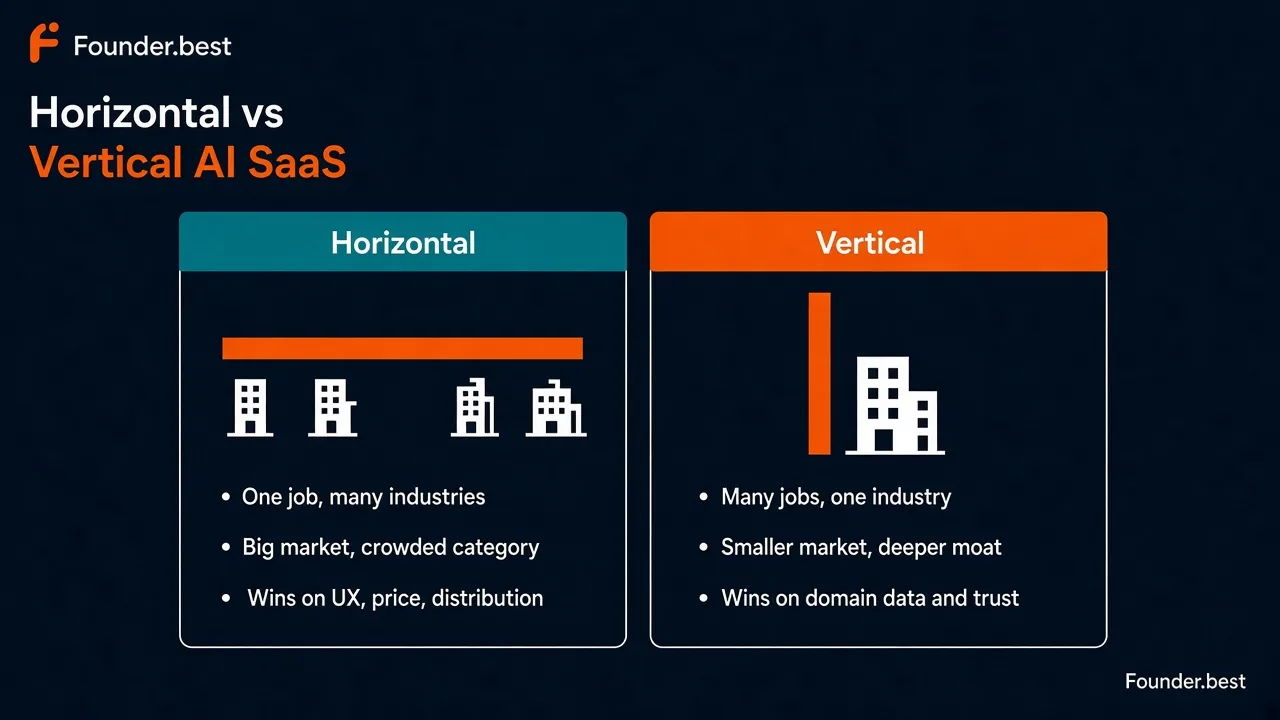 Horizontal vs vertical AI SaaS - horizontal does one job across many industries, vertical does many jobs for one industry
Horizontal AI SaaS does one job for many industries. AI writing, meeting notes, code assistants, and support chat are classic examples. The upside is a huge market. The downside is that you're competing with well-funded startups, and with the AI features that big platforms keep adding for free.
Vertical AI SaaS does many jobs for one industry. Legal, healthcare, construction, insurance, real estate, accounting, and logistics are all seeing a wave of these. The market is smaller, but the moat is deeper: you learn the industry's language, workflows, regulations, and data, and a general-purpose tool can't easily match that.
| Horizontal AI SaaS | Vertical AI SaaS | |
|---|---|---|
| Scope | One job, many industries | Many jobs, one industry |
| Market size | Large | Smaller but focused |
| Competition | Intense, including big platforms | Lighter, often legacy software |
| Moat | UX, brand, distribution, price | Domain data, compliance, trust, integrations |
| Hardest part | Standing out | Earning trust in a conservative industry |
| Where to launch | Broad founder and tech audiences, SEO | Industry communities, events, niche newsletters |
| Typical pricing | Self-serve, freemium, low entry price | Higher price, sales-assisted, annual contracts |
Neither is better. But you need to pick one story. "We're for everyone, but especially lawyers, and also marketers" is the kind of positioning that confuses people.
If you go vertical, our guide on how to launch a SaaS to a niche professional audience walks through the channels that actually reach specialists.
How to classify your own SaaS
Theory is nice. Here's the 20-minute version you can do right now.
Step 1: Run the remove-the-AI test
Write down your product's core value in one sentence. Then cross out every part the AI does. What's left? If the sentence still makes sense, AI is an enhancement. If it doesn't, AI is the product.
Step 2: Score your AI centrality
Score each question 0, 1, or 2. Be honest. Score what your product does today, not your roadmap.
| Question | 0 points | 1 point | 2 points |
|---|---|---|---|
| Remove the AI: what happens? | Product works fine | Product works but is much worse | Product stops delivering value |
| How much of the core workflow does AI do? | Suggestions only | Some steps | Most or all steps |
| What does the human do? | The work itself | Reviews every output | Sets goals and handles exceptions |
| What does the AI produce? | Suggestions or insights | Drafts or artifacts inside your product | Actions in other tools (sends, books, updates, deploys) |
| Does it learn from data? | Generic model, no feedback | Uses customer data as context | Improves from customer feedback or proprietary data |
| How do customers pay for the AI? | Bundled in the seat price | Add-on or credits | Per task, outcome, or result |
Now add it up:
What your AI centrality score means (0 to 12)
- 0 to 3 points - AI-assisted3/12
- 4 to 6 points - AI-augmented6/12
- 7 to 9 points - AI-driven9/12
- 10 to 12 points - Autonomous12/12
A quick example. Imagine a tool that listens to sales calls and updates the CRM.
- Remove the AI: nothing left. 2 points.
- AI does most of the workflow: transcribes, extracts deal details, writes the summary. 2 points.
- The rep reviews the summary before it syncs. 1 point.
- It writes to the CRM directly. 2 points.
- It uses the customer's CRM fields and past deals as context. 1 point.
- Priced per seat with a usage cap. 0 points.
Total: 8 points, AI-driven. And the scorecard flags something useful: pricing scores 0 while everything else is high. That's a hint the founder should look at usage or hybrid pricing before heavy users start eating the margin.
Step 3: Fill in the other criteria
The score tells you your autonomy level. The remaining criteria fill in the rest of the profile. Copy this template and fill it in:
 Copyable template
Your AI SaaS classification profile
Product name:
Remove-the-AI test: Still works without AI / Breaks without AI
1. AI integration level: AI-enabled / AI-enhanced / AI-first / AI-native
2. AI and model type: Generative / Predictive / Analytical / Conversational / Vision / Agentic
3. Level of autonomy (score out of 12): AI-assisted / AI-augmented / AI-driven / Autonomous
4. Primary business function:
5. Target industry: Horizontal / Vertical (which industry?)
6. Data dependency: No customer data / Customer context / Customer-trained / Proprietary data network
7. Deployment model: Web / API / Plugin / MCP / CLI / Mobile / Private cloud
8. Pricing model: Per seat / Seat plus AI add-on / Credits or usage / Outcome-based / Hybrid
My one-line classification: A [horizontal/vertical] [autonomy level] [AI type] SaaS that helps [audience] [do outcome], priced [pricing model].
Step 4: Write your one-line classification statement
This is the sentence you'll reuse everywhere. Some examples:
- "A vertical, AI-driven platform that handles patient intake calls for dental clinics, priced per booked appointment."
- "A horizontal, AI-augmented writing assistant that drafts LinkedIn posts for B2B founders, priced per seat."
- "An autonomous AI agent that finds, qualifies, and emails leads for B2B SaaS sales teams, priced per qualified meeting."
Notice what's missing: words like "revolutionary", "all-in-one", and "next-generation". The classification statement does the selling because it's specific.
Step 5: Use it everywhere, consistently
Put the same description on your landing page hero, your meta description, your directory listings, your launch posts, and your social bios. Consistency across the web is a big part of how both search engines and AI assistants learn what your product is.
Examples of different AI SaaS categories
Real products make this easier to picture. These classifications are our own reading of how each product is publicly positioned, and products change fast, so treat them as illustrations rather than official labels.
| Product | Classification | Why |
|---|---|---|
| Notion AI | Horizontal, AI-assisted, generative, AI add-on | Notion works without AI. The AI speeds up writing, summarizing, and search inside an existing workspace. |
| Grammarly | Horizontal, AI-augmented, generative and analytical | Suggests and rewrites text across the apps people already use. The human accepts or rejects each change. |
| GitHub Copilot | Horizontal (engineering), AI-augmented moving toward AI-driven | Started as code suggestions. Now also offers agent features that take on whole tasks for review. |
| Cursor | Horizontal (engineering), AI-native, generative and agentic | An editor built around AI from day one. Its core value depends on the AI. |
| Gong | Horizontal (sales), AI-driven, analytical and predictive | Records and analyzes sales calls to surface deal risks and coaching insights automatically. |
| Intercom Fin | Horizontal (support), AI-driven, conversational | Answers and resolves support conversations, handing off to humans when needed. Priced per resolution. |
| Harvey | Vertical (legal), AI-native, generative | Built for law firms and legal teams, with workflows for research, drafting, and document review. |
| Abridge | Vertical (healthcare), AI-driven, generative | Turns clinician and patient conversations into clinical notes, with the clinician reviewing the output. |
| Devin (Cognition) | Horizontal (engineering), autonomous, agentic | Positioned as an AI software engineer that plans and carries out multi-step coding tasks. |
A few patterns stand out:
- Most big, established products started at the AI-assisted or AI-augmented level and moved up the ladder as models improved and trust grew.
- Vertical products tend to be AI-native from the start, because they were founded specifically to apply AI to one industry's workflow.
- Products that reach AI-driven or autonomous levels often change their pricing, moving toward per-resolution, per-task, or usage-based models.
Common AI SaaS classification mistakes
We see a lot of AI products launch on Founder.best. These are the mistakes that come up again and again.
Mistake #1: Calling everything "AI-powered"
It's the default headline, and that's exactly why it doesn't work. "AI-powered" tells the reader nothing about what you do. Fix: lead with the outcome and audience. Mention AI as the how, not the what.
Mistake #2: Over-claiming autonomy
If your product needs a human to approve every output, it isn't autonomous, and calling it an "agent" sets up a disappointing first demo. Fix: classify by what your core workflow does most of the time, and describe advanced features as features.
Mistake #3: Classifying by your roadmap
"We'll be fully autonomous by Q3" is a pitch, not a classification. Early adopters judge what they can use today. Fix: classify today's product. Talk about the roadmap separately.
Mistake #4: Picking too many functions or industries
"For sales, marketing, support, and ops" reads like "for nobody in particular". Fix: pick one primary function and, if you can, one industry to start. You can widen later.
Mistake #5: Confusing AI-native with good
AI-native isn't a quality badge. Plenty of AI-native products are thin wrappers, and plenty of AI-assisted products are excellent. Fix: use AI-native only if your product genuinely can't work without AI, and back it with what the AI does that a general chatbot can't.
Mistake #6: Ignoring data dependency
Founders often skip this until a buyer's security team asks. Fix: decide upfront what data you need, where it's processed, whether it's used for training, and how customers can delete it. Put a short, clear answer on your site.
Mistake #7: Mismatched pricing
An autonomous product on per-seat pricing gets cheaper for the customer, and less profitable for you, the better it works. Fix: check that your pricing model fits your autonomy level using the matrix above.
Mistake #8: Inconsistent descriptions across the web
Your landing page says "AI copilot", your directory listing says "automation platform", and your launch post says "AI agent". Search engines and AI assistants can't tell what you are. Fix: write one classification statement and reuse it everywhere.
How AI SaaS founders can position their product
Classification tells you what you are. Positioning is how you say it so the right person cares. Here's how to turn one into the other.
Lead with the job, not the model. Buyers search for problems: "AI tool to reply to Google reviews", not "LLM-powered sentiment engine". Your headline should match how they search. Model details belong lower down the page, for the technical evaluator.
Match your proof to your autonomy level. This is the part most AI landing pages get wrong.
- AI-assisted: show a quick before-and-after and the time saved.
- AI-augmented: show real output quality. Real examples beat adjectives.
- AI-driven: show accuracy, coverage, and what happens when the AI isn't sure.
- Autonomous: show guardrails, approval settings, audit logs, and results from real customers.
Name your category clearly, then own a niche inside it. "AI receptionist" is a category people already understand. "AI receptionist for veterinary clinics" is a niche you can own. Creating a brand-new category sounds exciting, but it's expensive. Most early-stage founders do better attaching to a category people already search for.
Say what the AI doesn't do. Counterintuitively, being clear about limits builds trust. "Drafts replies for your approval, never sends without you" is more reassuring than vague promises, especially in regulated industries.
Turn your classification into pages. Each part of your profile can become a landing page or a piece of content: a page per use case, per industry, per integration, and an honest comparison with the tools you're often confused with. Our SEO strategy for startups shows how to build that cluster without a big team.
Be consistent where AI assistants look. Your product page, directory listings, docs, and launch posts are all sources that ChatGPT, Perplexity, and Google's AI answers draw from. One clear, repeated description beats ten creative ones. If you want to track how AI assistants describe you, see our roundup of AI search visibility tools for SaaS.
If you haven't built your landing page yet, our guide on what to put on a SaaS landing page before you have customers pairs well with this one.
Submit your AI SaaS product to Founder.best
Once you've classified your product, put that classification to work.
Founder.best is a launch platform and directory for founders and early adopters. When you submit, the classification step asks for exactly the kind of information this guide helps you work out:
- Categories: where your product lives in the directory
- Use cases (up to 3): the jobs it does, such as AI Agents, AI Automation, AI Writing, or AI Code Assistant. This maps to your business function and AI type.
- Target audience (up to 3): such as Founders, Developers, Marketers, Sales Teams, or Support Teams
- Pricing: free, freemium, subscription, one-time, or paid. This maps to your pricing model.
- Platforms: Web, Mobile, API, MCP, CLI, or Desktop. This maps to your deployment model.
- Alternatives (up to 5): the products you're most often compared with, which helps people discover you on the pages of tools they already know
Fill those in using your classification profile, and your product lands on the right shelf, in front of the right people.
You'll also get a permanent, indexable product page that keeps working for search and AI discovery long after launch week, a backlink to your site, a linked founder profile, and a shot at the weekly winners list. There's a free launch option, and paid plans add instant go-live and extra visibility.
Final thoughts
"AI SaaS" was a meaningful label a few years ago. In 2026 it's the starting line. Nearly every product uses AI somewhere, so the founders who stand out are the ones who can say precisely what their AI does, how much of the work it takes on, who it's for, and what it costs.
Start with the remove-the-AI test. Score yourself honestly. Write one clear sentence. Then use it everywhere.
When you're ready, launch your AI SaaS on Founder.best and let the right people find it.
Related guides: The SaaS creation framework · How to validate SaaS ideas · SaaS landing page before customers · B2B SaaS product marketing · Brand visibility in AI answers · Best websites to launch a SaaS
Key takeaways
- "AI SaaS" is not a category. It is a starting point. Buyers, directories, and AI search engines need to know what kind of AI product you are, for whom, and how much of the work the AI actually does.
- Use the remove-the-AI test: if your product still delivers its core value without AI, AI is an enhancement. If it breaks, AI is the product.
- Classify with 8 criteria: integration level, model type, autonomy, business function, industry, data dependency, deployment, and pricing.
- The maturity ladder runs AI-assisted, AI-augmented, AI-driven, autonomous. AI-native is a different question: whether the product was built around AI from day one.
- Vertical AI SaaS usually wins on domain data and trust. Horizontal AI SaaS usually wins on UX, price, and distribution. Pick one story, not both.
- The most common mistake is over-claiming. Calling an AI-assisted tool "autonomous" wins clicks and loses trust in the first demo.
Frequently asked questions
What is an AI SaaS product?
An AI SaaS product is cloud-based software, sold on a subscription or usage basis, where artificial intelligence does meaningful work inside the core workflow. That might mean generating content, making predictions, classifying data, answering customers, or taking actions on a user's behalf. A traditional SaaS with a small AI feature added on is better described as AI-enabled than as an AI SaaS.
How do you classify an AI SaaS product?
Use 8 criteria: AI integration level (how central AI is), AI or model type (generative, predictive, agentic, and so on), level of autonomy, business function, target industry, data dependency, deployment model, and pricing model. Together they produce a profile like "a vertical, AI-driven, generative SaaS for dental clinics, priced per completed task". A quick first check is to ask whether the product still works if you remove the AI.
What is the difference between AI-native and AI-enabled SaaS?
AI-native SaaS is built around AI from day one, so the product cannot deliver its core value without it. AI-enabled (or AI-assisted) SaaS is a product that worked before AI and has added AI features to make users faster. Notion with Notion AI is AI-enabled. A tool that turns sales calls into CRM updates with no manual input is AI-native.
What is the difference between AI-assisted, AI-driven, and autonomous SaaS?
They describe how much of the work the AI does. In AI-assisted SaaS the AI suggests and the human does the work. In AI-augmented SaaS the AI does parts of the work and a human reviews it. In AI-driven SaaS the AI runs the core workflow and humans handle exceptions. In autonomous SaaS the AI plans and acts across steps and tools toward a goal the human sets, with oversight rather than step-by-step approval.
What is the difference between horizontal and vertical AI SaaS?
Horizontal AI SaaS does one job for many industries, like AI writing, meeting notes, or customer support. Vertical AI SaaS does many jobs for one industry, like legal, healthcare, construction, or real estate. Horizontal products have bigger markets and more competition. Vertical products have smaller markets but deeper moats from domain data, compliance, and trust.
How is AI SaaS different from traditional SaaS?
Traditional SaaS gives users tools to do work. AI SaaS increasingly does the work. That changes the economics (each AI action has a real compute cost), pricing (more usage-based and outcome-based models), product design (outputs are probabilistic, so you need review, guardrails, and evaluation), and how the product improves (through data and feedback, not only new features).
How should AI SaaS products be priced?
Common models in 2026 are per-seat subscriptions with AI included, per-seat plus an AI add-on, credit or token-based usage, and outcome-based pricing such as per resolved ticket or per completed task. As a rule, the more of the work your AI does on its own, the more sense it makes to price on usage or outcomes instead of seats.
Does my product need to be AI-native to call itself AI SaaS?
No, but it should be honest about where it sits. An AI-assisted product can be a great business. Just position it on the workflow it improves, and describe the AI as a feature. Calling an AI-assisted product "autonomous" or "AI-native" sets expectations the product cannot meet.
Where can I list my AI SaaS product?
You can launch it on Founder.best. The submit flow asks for categories, use cases, target audience, pricing, platforms such as Web, API, or MCP, and similar products, which maps closely to the classification criteria in this guide. You get a permanent, indexable product page, a backlink, and a linked founder profile.

About the author
Anuj Shashimal
Founder, Founder.best
SaaS founder, indie hacker, and software engineer. Anuj built Founder.best to help indie founders launch, get discovered through search and AI answers, and turn launches into customers. He writes from first-hand experience growing Founder.best from zero to 400+ founders and 300+ launched products.
Tagged in
Browse all tagsKeep reading
Free tools and guides for this topic
Hand-picked from the tags on this post.
- Launch SaaS guideHow to launch a SaaS product in 2026: validation, launch platforms, SaaS launch checklist, SEO backlinks,…
- Browse products by categorySaaS, AI, developer tools, marketing, and more.
- Indie launch guideLaunch guide for indie founders and bootstrapped makers in 2026. Build in public, pick platforms, earn…
- Free startup launch checklist30+ tasks across pre-launch, launch day, and post-launch.
- Docs: public API, MCP server & AI discoveryHow AI assistants and agents search and cite Founder.best listings.
- Free tools for foundersName generator, tagline writer, slug checker, DR checker, launch checklist.
Ready to launch on Founder.best?
Weekly rankings, dofollow SEO backlinks, founder stories, and a community built for indie makers.
Submit your startup