Launch & growth
Finding B2B clients for your SaaS in 2026
There is no single magic channel for B2B SaaS in 2026. Founders who win match acquisition tactics to their stage, talk to the right buyers, and measure conversations and revenue - not launch-day spikes alone.

Post by Anuj Shashimal
Founder, Founder.best17 min read
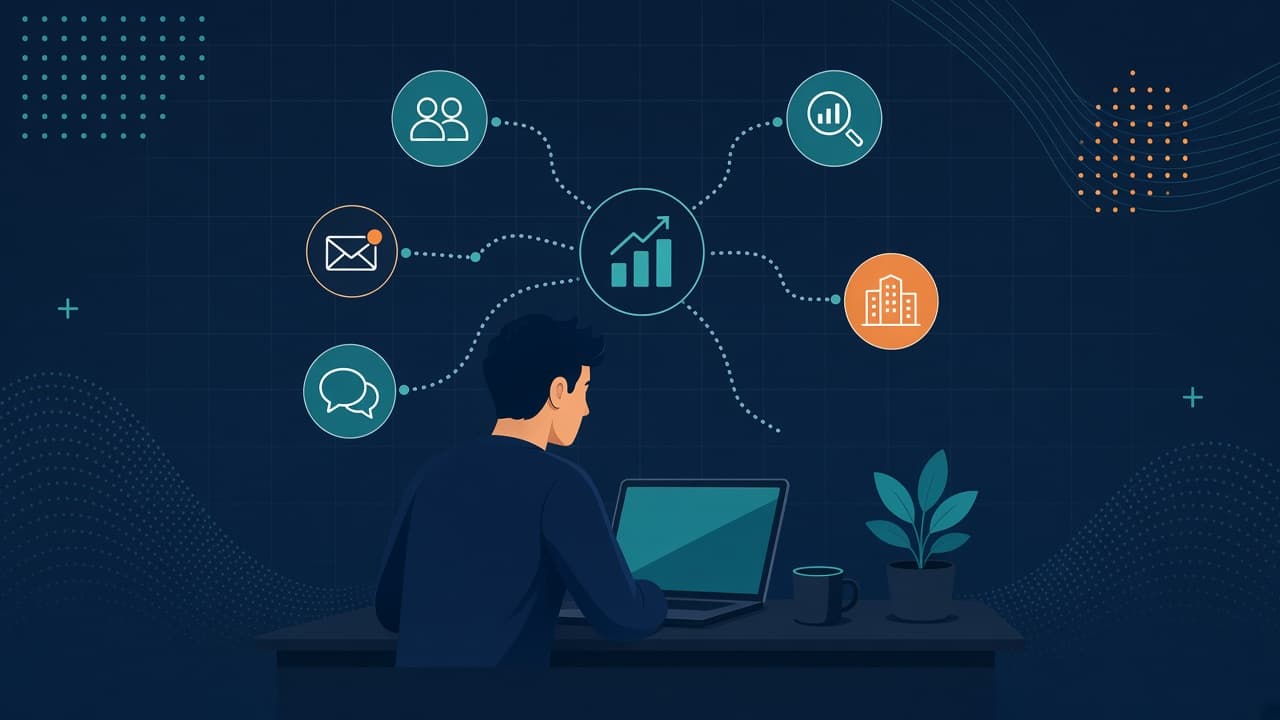
If you are finding B2B clients for your SaaS in 2026, you have probably already tried a launch, a few LinkedIn posts, and maybe a cold email template from a thread that promised "10x pipeline." Some of it sent traffic. Less of it sent paying customers.
That gap is normal. B2B buying is slow, committee-driven, and skeptical of generic software pitches. The founders who land early clients treat acquisition as a portfolio of channels matched to stage - not a hunt for one universal hack.
This guide walks through what actually works when finding B2B clients for your SaaS: ICP first, then network, LinkedIn, communities, outbound, SEO, directories, partnerships, referrals, and case studies - plus how to measure what converts and a simple 30-day B2B customer acquisition plan you can run on founder time.
Define your ideal customer first
You cannot find B2B clients if "B2B" is your only filter. Before you open LinkedIn or write a launch post, write a one-page ideal customer profile (ICP):
- Role and seniority - who feels the pain daily (ops manager) vs who signs (VP or head of function)?
- Company shape - employee count, revenue band, industry, geography, tech stack
- Workflow - the exact job step your SaaS improves, in their words
- Trigger event - what makes them search now (new compliance rule, team hire, tool churn, failed spreadsheet)
- Alternatives - what they use today, including "do nothing" or internal builds
- Budget and cycle - self-serve card, team plan, or procurement with security review?
Your ICP also drives positioning, messaging, and launch planning - the full playbook is in our guide to B2B SaaS product marketing. If you serve a vertical niche, read how to launch a SaaS to a niche professional audience - the same precision applies to ongoing client acquisition, not just launch week.
Quick ICP test: name ten real companies that fit. If you cannot, your ICP is still too broad. Narrow until you can describe a Tuesday morning in your buyer's calendar.
Store ICP notes in whatever you use for pipeline (best CRM for startups compares lightweight options). Every channel below should map back to this document.
Don't confuse traffic with customers
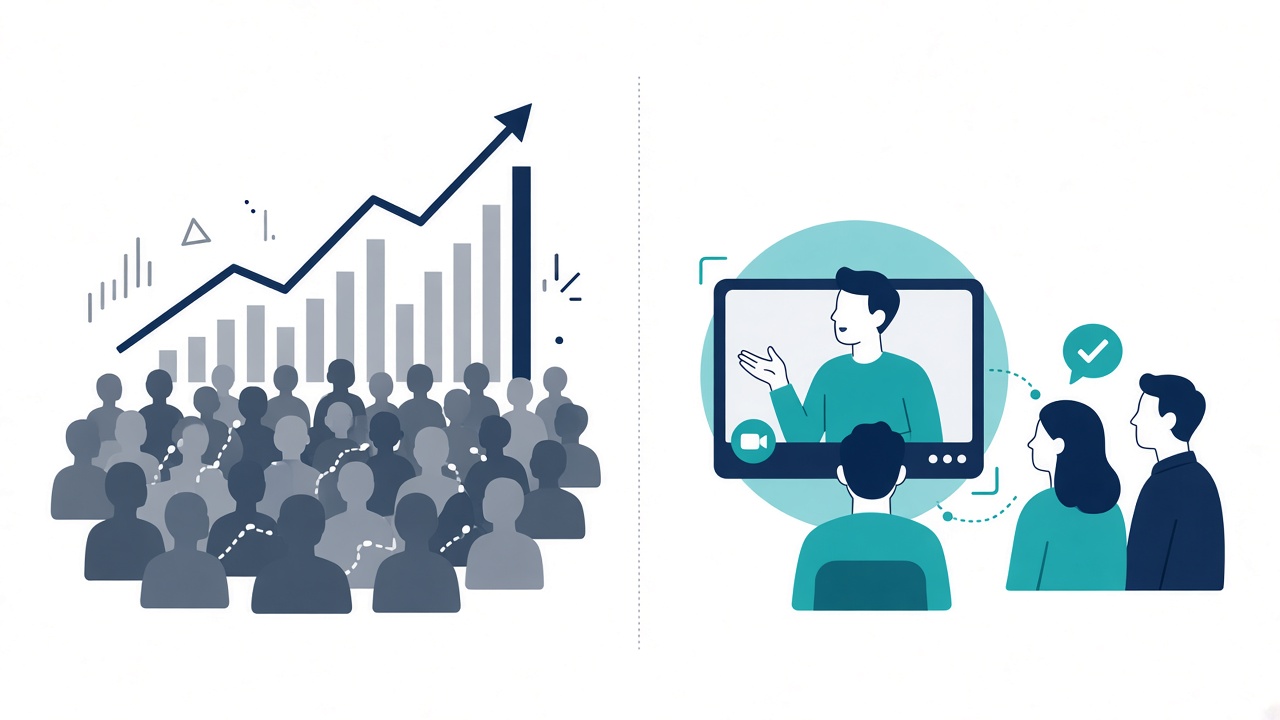 Traffic spikes versus qualified B2B buyer conversations - finding B2B clients for your SaaS
Launch platforms, SEO, social posts, Reddit threads, and directory listings all help with discovery. They can spike visits, add backlinks, and put your name in front of founders and buyers who browse for tools.
They do not replace conversations with the right economic buyer.
In B2B SaaS, a "customer" usually means:
- A qualified demo or trial started by someone in your ICP
- A procurement conversation with a defined problem and timeline
- A paid invoice, not just a signup from a curious visitor
Traffic without ICP fit shows up everywhere in 2026: viral launch days, broad SEO keywords, engagement bait on LinkedIn, and directory homepages that rotate weekly. Those metrics are useful for awareness and SEO. They are dangerous if you treat them as sales pipeline.
Separate metrics by intent:
| Signal | Often means | Good for |
|---|---|---|
| Homepage spike from a launch | Awareness | Social proof, backlinks, retargeting lists |
| Blog traffic on "what is X" | Research stage | Brand, email capture, nurture |
| Traffic on "[competitor] alternative" | Active evaluation | Demos and trials |
| Warm intro from your network | Trust transfer | First revenue, case studies |
| Outbound reply from ICP match | Problem acknowledged | Pipeline |
Founder-focused research in 2026 keeps repeating the same lesson: match acquisition channels to company stage instead of copying whatever worked for a different product at a different price point. Pre-revenue teams should optimize for conversations. Post-PMF teams can invest more in scalable inbound and partnerships.
When a channel sends traffic but zero ICP conversations after 4-6 weeks, fix the message, the landing page, or the channel - do not just pour more volume in. Our post-launch SEO checks guide applies the same logic when rankings grow but signups flatline.
Use your existing network
Your fastest B2B clients often come from people who already trust you - not strangers on the internet.
Where to look:
- Former coworkers and managers in your target industry
- Investors, advisors, and accelerator cohort peers (with a specific ask, not a mass blast)
- Customers from consulting, freelancing, or agency work before the SaaS
- Alumni groups, Slack communities you already belong to, and conference contacts
How to ask without being annoying:
- Send a two-sentence product description tied to one workflow pain
- Ask for introductions to two people who match your ICP - not "anyone who might be interested"
- Offer a white-glove onboarding window for the first five design partners
- Follow up once; respect a no
Warm intros convert because they skip the "who are you?" line. They also produce your first case studies and quotes - assets every later channel needs.
Log every intro source in your CRM or a simple spreadsheet so you know whether network-led deals stay your strongest channel after month three.
Find prospects on LinkedIn
LinkedIn remains the default finding B2B clients for your SaaS channel when your buyer has a professional profile and you sell workflow software above hobby pricing.
Make the profile a landing page:
- Headline states who you help and which outcome - not "CEO at Stealth Startup"
- Featured section links to a demo, BOFU article, or product page
- About section uses ICP language from customer calls
Prospecting routine (30-45 minutes, 3x per week):
- Search titles and companies from your ICP list
- Connect with a note referencing their role or a public post - no pitch in the connection request
- After acceptance, share one useful resource (your comparison page, a checklist, a short Loom) before asking for a call
Content that supports outbound:
- Short posts about one lesson from a customer conversation (anonymized)
- Screenshots of workflow improvements, not feature dumps
- Comments on posts your ICP already reads
LinkedIn works best as outbound plus credibility, not as a replacement for email or demos. Pair it with founder-led posts described in content marketing for startups - especially if you publish BOFU pages on your domain and link them from your profile.
Use Reddit and niche communities
B2B buyers still ask "what do you use for X?" in Reddit, Slack groups, Discord servers, industry forums, and association listservs. The rule is the same everywhere: earn trust before you pitch.
Playbook:
- List 5-10 communities where your ICP already discusses the workflow you solve
- Lurk until you understand norms (self-promo rules, flair, weekly threads)
- Answer questions without linking your product for 2-3 weeks
- When relevant, share a genuine experience and mention your tool only if it directly answers the question
- Keep a founder account - anonymous astroturfing destroys reputation fast
Reddit rewards specificity. A post that helps "FP&A leads at 50-200 person SaaS companies close the month-end books" beats a generic "we built a tool for finance teams."
For broader community strategy and distribution rhythm, see marketing tools for startups (outreach and demand-discovery sections) and how to get more reach for your startup.
Niche beats general: one active subreddit or Slack for your vertical often outperforms r/entrepreneur for B2B pipeline.
Do targeted cold outreach
Cold email and LinkedIn DMs still work for B2B SaaS customer acquisition when volume is low and relevance is high. Early-stage founders can outperform SDR teams by writing manually for 20-40 accounts per week.
Structure that respects busy buyers:
- Subject line: their workflow or metric, not your product name
- First line: why this account specifically (public hiring, tool stack, regulatory change)
- Body: one sentence on the problem, one proof point, one ask (15 minutes)
- No attachments on first touch; link to a short page or BOFU article
Hygiene:
- Verify emails; never scrape blindly into a blast tool on day one
- Cap follow-ups at two touches unless they engage
- Track replies and meetings by segment (industry, title, trigger) so you refine ICP
Outbound pairs well with Pain Base-style demand discovery - knowing which phrases buyers use in public threads before you write copy. If outbound gets opens but no meetings, the problem is usually positioning, not send volume.
Create bottom-of-funnel SEO content
Top-of-funnel posts build awareness. Bottom-of-funnel (BOFU) SEO brings buyers who are already comparing vendors - the highest-intent traffic for finding B2B clients for your SaaS.
Publish early:
- "[Competitor] alternatives" and "[Competitor] vs [Your product]"
- "Best [category] for [role/industry]" with honest tradeoffs
- Integration guides ("How to connect [your SaaS] with [tool they already use]")
- Pricing and ROI pages that answer procurement questions
BOFU pages should link to your product page, include FAQs AI systems can cite, and use real screenshots. Founder-led SEO - where the founder writes from customer calls - outperforms generic AI drafts here because buyers and Google both reward first-hand detail. See founder-led SEO for early-stage startups and product page SEO in 2026.
Internal linking: connect each BOFU page to 2-3 related guides on your site so crawlers and readers see topical depth. One small cluster beats dozens of unrelated posts - the same cluster logic in SEO for startups.
Expect BOFU movement in 8-16 weeks for long-tail terms; pair publishing with a few dofollow backlinks from launch listings and directories so pages actually rank.
Launch on startup and product directories
Directories and launch platforms belong in your stack because B2B buyers Google alternatives, browse category pages, and read weekly launch roundups - especially when they evaluate smaller vendors.
Think of directories as permanent discovery pages, not just launch-day fireworks:
- Curated SaaS launch platforms with indexable product URLs and dofollow links
- Review and comparison sites (G2, Capterra network, SaaSHub, AlternativeTo) where buyers compare incumbents
- Integration marketplaces when your product plugs into ecosystems buyers already pay for
On Founder.best, you get a permanent product page, category placement (for example Marketing or your core use case), weekly Launchpad visibility, and a dofollow backlink on paid tiers - useful both for referral traffic and for SEO that supports your BOFU cluster. It fits naturally alongside other listings; see best websites to launch a SaaS and best SaaS directories in 2026 for how to prioritize by buyer type.
Do not spray 200 low-quality submission sites. Use a quality bar like our directory submission guide and high authority backlinks framework: permanent URL, indexable, relevant category, sane moderation.
After launch week, post product updates on listings that support feeds - stale pages look abandoned to buyers and search engines alike.
Build partnerships and integrations
Partnerships scale finding B2B clients for your SaaS when your product sits adjacent to something larger - CRM, data warehouse, HRIS, vertical ERP, or agency workflows.
High-leverage partnership types:
- Integration partners - co-marketing with tools your ICP already pays for
- Agencies and consultants who implement software for your ICP weekly
- Non-competing SaaS selling to the same buyer with a different workflow slice
- Marketplace listings with verified badges and co-sell motions
Start narrow: one integration, one agency pilot, one co-webinar. Measure partner-sourced demos separately from organic and outbound.
Partnerships take longer than outbound but produce higher-trust deals - especially when the partner's brand already cleared security and procurement once.
Use customer referrals
Referrals are the cheapest B2B channel once you have even three happy customers - but they rarely happen unless you operationalize the ask.
Tactics that work for B2B SaaS:
- Ask after a measurable win (time saved, error reduced, revenue lifted) - not at random renewal
- Offer a double-sided incentive (credit, extended seats, donation) that fits your ACV
- Give customers a forwardable one-pager or BOFU link so they do not have to write copy
- Identify internal champions who already slack your praise to colleagues
Track referral source in CRM fields (referral_partner, customer_id) so you know whether to invest in a formal program or informal asks.
Turn early customers into case studies
B2B buyers trust peers in the same role more than your homepage hero. Case studies convert skeptical evaluators and fuel every other channel - LinkedIn, outbound attachments, BOFU pages, directory listings, and sales decks.
Minimum viable case study:
- Customer context - industry, size, stack (with permission)
- Problem in their words - one paragraph
- Why they chose you over status quo or a named competitor
- Implementation - how long, who was involved
- Results - metrics, quotes, screenshot if possible
Publish on your site, link from the product page, and snippet quotes into BOFU articles. Founder stories that include real numbers also rank for long-tail searches; see SaaS founder stories as lead generation.
One strong case study beats five generic testimonials.
Track which channel actually converts
Finding B2B clients for your SaaS without attribution is guesswork. You do not need enterprise marketing analytics on day one - you need consistent fields and a weekly review.
Minimum tracking stack:
- CRM or pipeline sheet with
sourceandsource_detail(linkedin_outbound, warm_intro, reddit, directory_founder_best, seo_alternatives_page, partner_agency_x) - UTM parameters on links in posts, emails, and directory bios
- Product analytics (PostHog, Plausible, or similar) tied to signup and activation events
- Calendar audit - tag how each demo was booked
Review weekly:
| Channel | ICP conversations | Demos | Trials or POs | Notes |
|---|---|---|---|---|
| Network | ||||
| Communities | ||||
| Outbound | ||||
| SEO / BOFU | ||||
| Directories | ||||
| Partners | ||||
| Referrals |
Kill or pause channels that accumulate traffic but zero ICP conversations after a fair test. Double down where revenue appears, not just where posting feels productive.
Attribution tools like LaunchDock Track (covered in our marketing tools guide) help when you run multiple campaigns - but a spreadsheet beats a complex stack you never update.
Match channels to your stage
Use this lens before copying another founder's playbook:
Pre-revenue / design partners
- Network, LinkedIn outbound, communities (help-first), manual cold outreach
- Skip heavy SEO investment until you have messaging that closes calls
First 10 paying customers
- BOFU page for your top competitor alternative
- One curated directory launch + product page SEO basics
- First case study from design partner
Scaling past ~$20k MRR (illustrative, not a rule)
- Expand SEO cluster, formal referrals, integration partnerships
- Layer paid only on channels with proven CAC from organic tests
The SaaS creation framework aligns product and GTM stage gates if you want a fuller lifecycle view.
A simple 30-day B2B customer acquisition plan
Assume 6-10 hours per week and one founder owning sales. This sprint builds pipeline and habits without pretending SEO will close deals in week one.
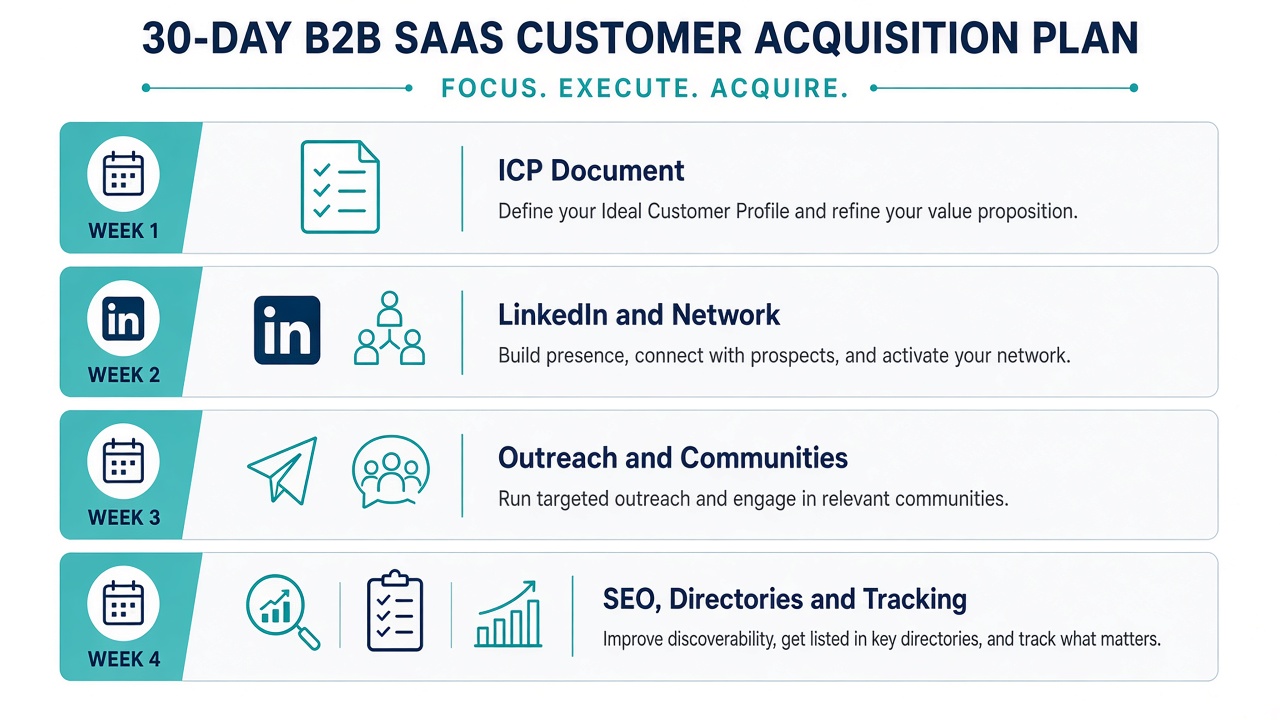 30-day B2B SaaS customer acquisition plan - ICP, network, outreach, SEO, directories, tracking
Week 1: ICP, network, and tracking
- Finalize your one-page ICP and list 30 target accounts
- Message 10 warm contacts with a specific intro ask
- Set up CRM or pipeline sheet with source fields
- Fix product page basics (headline, CTA, social proof placeholder)
- Pick one primary outbound channel (LinkedIn or email) for the month
Week 2: Conversations and BOFU
- Send 20-40 targeted outbound touches to ICP accounts
- Book 5 customer discovery or demo calls (warm + cold)
- Publish one BOFU page (alternative or comparison)
- Answer 3 community questions helpfully - no pitch
- Start 3 LinkedIn posts from call insights
Week 3: Discovery layers
- Launch or refresh your listing on Founder.best and one comparison directory relevant to your category (directory playbook)
- Share BOFU page in founder-led LinkedIn post and relevant community thread
- Send follow-ups to week-2 outbound; pause non-responders
- Draft case study outline from best customer or design partner call
- Run launch checklist items still open (indexing, analytics, UTMs)
Week 4: Measure, proof, and double down
- Score each channel in your weekly table (conversations, demos, revenue)
- Publish case study or testimonial block on site + product page
- Add internal links from BOFU page to product and related guides
- Ask two happy users for referrals with forwardable blurb
- Plan next 30 days: 2x what worked, drop what sent only traffic
After 30 days you should have real conversations, one BOFU asset, indexed discovery pages, and data - not twelve tactics started and none finished.
Common mistakes when finding B2B SaaS clients
- Skipping ICP and wondering why LinkedIn outreach gets ignored
- Treating launch traffic as pipeline without follow-up to qualified visitors
- Generic cold email at scale before messaging works manually
- Only top-of-funnel SEO while buyers search "[competitor] alternative"
- Directory spam instead of 5-10 quality listings with maintained pages
- No CRM discipline - you forget who introduced whom and repeat awkward asks
- Quitting communities after one promotional post gets removed
Start this week
Finding B2B clients for your SaaS in 2026 is not about being everywhere. It is about being specific, helpful, and measurable where your buyers already work and search.
Your minimum plan for the next seven days:
- Write your one-page ICP and 30 target accounts
- Request five warm intros from your network
- Publish or update one BOFU comparison page
- Send 15 targeted outbound messages
- Launch or update your product on Founder.best so discovery channels have a permanent home to send buyers to
Stack conversations with compounding discovery. Measure revenue by source. Adjust monthly. That is how early B2B SaaS teams win without a giant ads budget.
Related guides: Content marketing for startups · Best CRM for startups · How to get more reach · SaaS launch checklist · Free launch checklist tool
Key takeaways
- Finding B2B clients for your SaaS requires a written ICP before you pick channels - vague "SMBs" waste every hour you spend on outreach.
- Match acquisition channels to stage: network and LinkedIn for first customers, SEO and directories for compounding discovery, partnerships when you have a clear integration story.
- Launch spikes, community posts, and directory traffic are discovery - B2B revenue still comes from demos and procurement conversations with the right buyer.
- Bottom-of-funnel SEO (alternatives, comparisons, integration guides) attracts buyers who are already evaluating vendors.
- Track demos, trials, and revenue by source weekly; kill channels that send traffic but never produce conversations.
- A 30-day sprint with one primary outbound motion and one compounding channel beats twelve half-finished tactics.
Frequently asked questions
How do you find B2B clients for a SaaS product?
Define your ideal customer profile first - role, company size, workflow, and buying trigger. Then use your existing network for warm intros, LinkedIn for targeted outreach, niche communities for trust, and bottom-of-funnel SEO plus curated startup directories for inbound discovery. Measure which sources produce demos and revenue, not just clicks.
What is the fastest way to get B2B SaaS customers in 2026?
For most early-stage B2B SaaS, the fastest path is warm outreach: former colleagues, investors' portfolios, and LinkedIn connections who match your ICP. Pair that with one high-intent SEO page (alternatives or comparison) and a permanent listing on a curated launch directory so buyers who discover you later can still convert.
Does Product Hunt work for B2B SaaS client acquisition?
Product Hunt can create awareness, but many B2B buyers are not browsing there when they have budget approved. Treat launch platforms as one discovery layer - useful for social proof and backlinks - not your entire B2B sales motion. Stack them with LinkedIn, outbound, and BOFU content aimed at your ICP.
Is cold outreach still effective for B2B SaaS?
Yes, when it is targeted: short emails to people who match your ICP, tied to a specific workflow problem, with a clear ask (15-minute call, not "checking in"). Generic blasts burn domains and reputation. Quality and relevance beat volume for early-stage teams without SDR headcount.
What SEO content works best for B2B SaaS leads?
Bottom-of-funnel pages convert best: "[competitor] alternatives", "[tool A] vs [tool B]", pricing comparisons, integration guides, and role-specific "how to" guides tied to your product category. Top-of-funnel thought leadership helps brand, but comparison and alternative pages match buyers who are already shopping.
How long does a 30-day B2B customer acquisition plan take to show results?
Warm network and LinkedIn outreach can book demos within the first two weeks. Community trust takes longer - often 3-6 weeks of helpful posts before a launch-style mention lands well. BOFU SEO and directory listings usually need 8-12 weeks to show steady inbound. The 30-day plan builds habits and pipeline; compounding channels pay off in month two and three.

About the author
Anuj Shashimal
Founder, Founder.best
SaaS founder, indie hacker, and software engineer. Anuj built Founder.best to help indie founders launch, get discovered through search and AI answers, and turn launches into customers. He writes from first-hand experience growing Founder.best from zero to 400+ founders and 300+ launched products.
Tagged in
Browse all tagsKeep reading
Free tools and guides for this topic
Hand-picked from the tags on this post.
- How Founder.best worksSubmit in 10 minutes, rank on the weekly Launchpad, stay discoverable.
- Startup tagline generator12 tight one-liners for your landing page and launch post.
- Launch SaaS guideHow to launch a SaaS product in 2026: validation, launch platforms, SaaS launch checklist, SEO backlinks,…
- Free startup directories listDofollow filters, Ahrefs DR scores, and a submission checklist.
- Browse blog posts by topicSEO, backlinks, launch platforms, AI search, startup tools, and more.
- Launch plans & pricingFree, Standard, Pro, and Pro+ launches compared side by side.
Ready to launch on Founder.best?
Weekly rankings, dofollow SEO backlinks, founder stories, and a community built for indie makers.
Submit your startup